
Maxwell Engineering IPO: Facts, Filings, and Guide
Learn how to verify the Maxwell Engineering IPO filings, assess company financials, and navigate Indian public issue guidelines safely.

- NV Trends
- 12 min read

Search interest for the Maxwell Engineering IPO has surged across Indian financial platforms, driven by retail market participants actively tracking upcoming primary market offerings in the manufacturing and engineering sectors. When search volume spikes rapidly around an industrial entity, it typically indicates growing retail attention, pre-IPO market chatter, or early-stage regulatory filings. However, retail investors must separate speculative buzz from verified statutory disclosures before making any financial commitments.
In the Indian capital markets, an Initial Public Offering (IPO) is governed strictly by the statutory framework administered by the Securities and Exchange Board of India (SEBI). Every company seeking to raise capital from the public must submit detailed regulatory documents, including a Draft Red Herring Prospectus (DRHP) and a final Red Herring Prospectus (RHP). Because preliminary listing details, issue dates, and price bands are subject to regulatory clearance and company timelines as of 2026, prospective participants should approach trending search queries with structured due diligence rather than speculative assumptions.
This guide provides an objective, step-by-step breakdown of how to evaluate an engineering issue like the Maxwell Engineering IPO. It explains how to verify official filing records on stock exchanges, assess the operational fundamentals unique to engineering and capital-goods firms, navigate the UPI ASBA application architecture, and avoid the common traps associated with unverified market rumors.
Key takeaways
- Statutory filing verification: Official information regarding issue dates, price bands, and allotment schedules exists only in approved DRHP or RHP documents filed with SEBI or exchange platforms.
- Engineering sector analysis: Evaluating an industrial business requires checking the order-book-to-bill ratio, capacity utilization, raw material cost sensitivity, and working capital cycles.
- Platform distinctions matter: Mainboard IPOs feature standard retail lot values around Rs. 14,000 to Rs. 15,000, whereas Small and Medium Enterprise (SME) listings require a minimum ticket size typically between Rs. 1,00,000 and Rs. 1,40,000.
- Disciplined bidding process: Retail bids are executed through the Application Supported by Blocked Amount (ASBA) facility using UPI mandates; unverified Grey Market Premiums (GMP) should never substitute for balance sheet analysis.
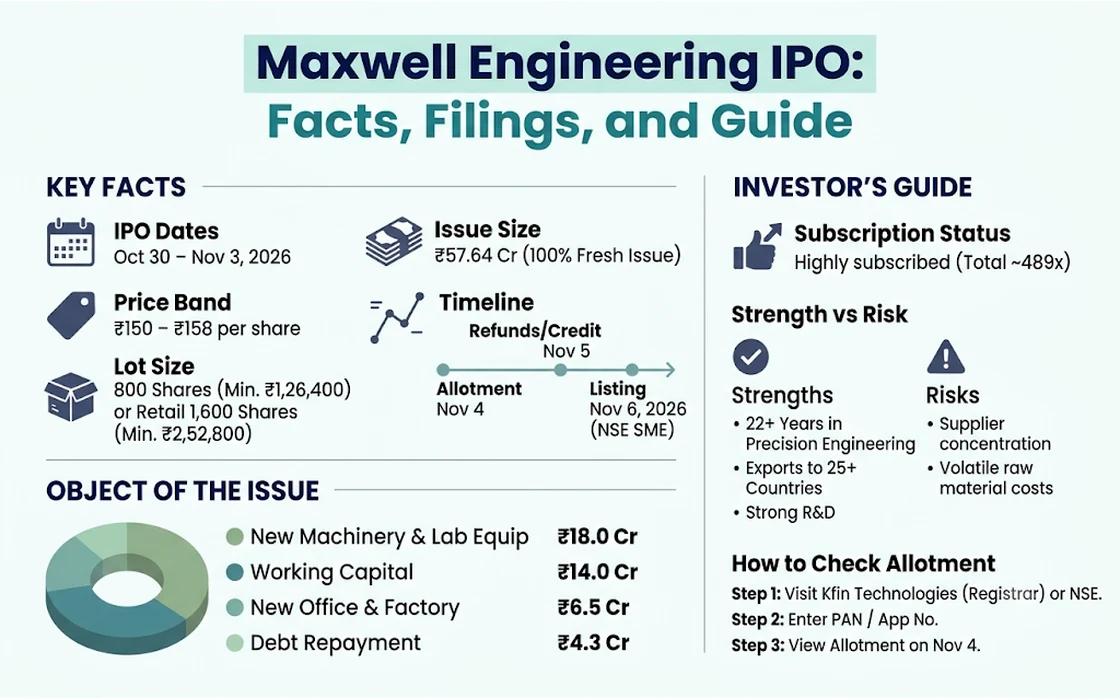
Understanding Search Spikes in Industrial and Engineering IPOs
When an industrial or engineering enterprise becomes the subject of a sudden search surge, several market dynamics are typically at play. India’s broader macroeconomic focus on manufacturing, infrastructure upgrades, and indigenization under production-linked incentive schemes has created strong retail appetite for capital-goods issues.
Engineering firms generally fall into two broad listing avenues in India:
- The Mainboard Exchange: For larger, established firms listing on the National Stock Exchange (NSE India) and the Bombay Stock Exchange (BSE India), meeting strict historical profitability and net-worth thresholds.
- The SME Platforms: For emerging small-to-midsize enterprises listing on BSE SME or NSE Emerge, designed to facilitate growth capital for specialized niche manufacturers.
Sudden online search velocity often precedes the formal announcement of price bands or follows the submission of a DRHP to merchant bankers. For investors who want to understand the procedural safeguards required for primary market investing, our detailed guide on How to Invest in IPOs Safely: Step-by-Step Guide outlines how regulatory timelines unfold.
Investors must recognize that market rumors, unofficial WhatsApp groups, and unverified blog posts often circulate speculative price targets before lead managers have issued official press releases. A disciplined investor always verifies the company’s corporate identity, registered office, and active filings through designated exchange channels before committing funds.
How to Verify Official IPO Filings
Before analyzing any financial metrics, an investor must confirm whether the entity has an active filing with Indian market regulators. Public issues cannot solicit retail capital without explicit regulatory approval and published documentation.
1. Searching the SEBI Repository
The SEBI portal houses all public draft documents under its regulatory filings section:
- Visit the official SEBI website and navigate to Filings > Public Issues.
- Search for the entity name under draft offer documents filed with SEBI.
- If the document is approved, the status will indicate “Observations Issued” or display an updated final prospectus.
2. Checking Stock Exchange SME and Mainboard Portals
If the issue is slated for an SME platform rather than the mainboard, the initial filings are reviewed primarily by the respective exchange:
- On BSE India, review the Public Issues or SME Platform sections.
- On NSE India, check the NSE Emerge portal under active or prospective draft prospectuses.
3. Reviewing Merchant Banker Disclosures
Every public offering is managed by one or more SEBI-registered Book Running Lead Managers (BRLMs). Lead managers are legally obligated to host the complete DRHP, RHP, and statutory public notices on their corporate websites. If an IPO announcement does not identify registered lead managers, the details should be treated with extreme caution.
Analyzing statutory filings is equally crucial across diverse sectors. For example, our review of the MK Sons Fine Jewels IPO: Facts, Filings, and Analysis illustrates how sector-specific disclosures—such as inventory holding and working capital requirements—directly influence a company’s listing trajectory.
Core Fundamentals: How to Evaluate an Engineering Company
Engineering and heavy-equipment enterprises operate under economic dynamics that differ markedly from technology, service, or consumer retail firms. If a prospectus for an engineering company becomes available, an investor should evaluate the following sector-specific parameters.
       ┌────────────────────────────────────────────────────────┐
       │     Core Evaluation Pillars for Engineering IPOs       │
       └───────────────────────────┬────────────────────────────┘
                                   │
         ┌─────────────────────────┼─────────────────────────┐
         ▼                         ▼                         ▼
┌───────────────────┐    ┌───────────────────┐    ┌───────────────────┐
│    Order Book     │    │  Working Capital  │    │ Capacity & Capex  │
│ - Quality/Tenure  │    │ - Debtor Days/DSO │    │ - Utilization %   │
│ - Client Spread   │    │ - Inventory Cycle │    │ - Fresh vs. OFS   │
│ - Book-to-Bill    │    │ - Operating Cash  │    │ - Plant Expansion │
└───────────────────┘    └───────────────────┘    └───────────────────┘
1. Order Book-to-Bill Ratio
The order book is the most critical forward-looking indicator for an engineering company. It represents the total value of contracted projects or supply agreements awaiting execution.
- The Formula: Divide the total confirmed order book by the company’s trailing twelve months (TTM) revenue.
- Interpretation: A ratio between 1.5x and 3.0x generally indicates stable revenue visibility for the next 18 to 36 months. A ratio below 1.0x may signal depleting demand or sluggish customer acquisition.
- Order Quality: Check whether the orders are backed by formal letters of intent (LoIs) with price-escalation clauses. Without escalation clauses, rising steel, copper, or energy costs can compress operating margins during project delivery.
2. Working Capital Intensity and Debtor Days
Industrial manufacturing requires significant upfront capital for raw material procurement, component tooling, and fabrication before milestone payments are released by clients.
- Days Sales Outstanding (DSO): Assess how many days it takes for the company to collect receivables from clients. In the Indian engineering sector, a DSO exceeding 120 to 150 days can lead to severe liquidity constraints.
- Operating Cash Flow vs. Net Profit: Compare the company’s Profit After Tax (PAT) with its Cash Flow from Operations (CFO). If reported net profit is positive but operating cash flow is consistently negative across three financial years, the business is locking its earnings into unpaid receivables or unsold inventory.
3. Customer Concentration Risk
Many mid-sized Indian engineering enterprises act as tier-1 or tier-2 suppliers to public sector undertakings (PSUs), automotive original equipment manufacturers (OEMs), or large infrastructure conglomerates.
- Examine the “Risk Factors” section of the prospectus.
- If the top 3 or top 5 clients account for more than 60% to 70% of total revenue, any delay, contract termination, or payment dispute with a primary client poses a substantial risk to earnings continuity.
4. Fresh Issue vs. Offer for Sale (OFS)
An IPO can comprise two capital components:
- Fresh Issue: New equity shares issued by the company. The capital raised flows directly to the company’s balance sheet to fund capital expenditures (e.g., purchasing CNC machinery, expanding fabrication units), repay existing bank borrowings, or satisfy working capital requirements.
- Offer for Sale (OFS): Existing promoters or private equity investors sell their existing shareholding to public investors. The capital raised goes to the selling shareholders, not to the corporate treasury.
For manufacturing and engineering businesses, a higher proportion of fresh issue capital allocated to debt reduction or capacity expansion is generally more constructive than an issue dominated entirely by an OFS exit.
Mainboard vs. SME Platform: Key Differences for Retail Bidders
Depending on its scale and capital requirements, an engineering company may choose to list on the Mainboard or an SME Exchange platform. The operational and investment parameters differ significantly between these venues, as outlined below:
| Feature / Metric | Mainboard IPO (BSE / NSE) | SME IPO (BSE SME / NSE Emerge) |
|---|---|---|
| Minimum Application Size | Approx. Rs. 14,000 – Rs. 15,000 | Approx. Rs. 1,00,000 – Rs. 1,40,000 |
| Minimum Post-Issue Capital | Rs. 10 Crores (typically much higher) | Up to Rs. 25 Crores |
| Minimum Allottees | At least 1,000 retail investors | At least 50 distinct investors |
| Market Making Requirement | Not mandatory | Mandatory for at least 3 years |
| Trading Lot Size After Listing | Single share (Lot size of 1) | Fixed trading lot (e.g., 500–2,000 shares) |
| Reporting Cadence | Quarterly financial disclosures | Half-yearly financial disclosures |
| Underwriting Structure | Standard syndicate underwriting | 100% underwritten (lead manager takes 15%+) |
The Liquidity Trade-Off
A critical practical distinction for retail investors is post-listing liquidity. On the mainboard, once shares are credited to a demat account, an investor can sell any quantity, even a single share, at prevailing market prices.
On an SME platform, shares must be bought and sold in fixed lot sizes throughout their listing tenure (unless the company subsequently migrates to the mainboard). If an investor receives an allotment in an SME issue where the lot size is 1,200 shares, any subsequent sale must be executed in multiples of 1,200 shares. This structural constraint can impact exit timing if daily trading volumes on the exchange are low.
The Application Process: Bidding via UPI ASBA
Retail participants bidding for Indian public issues must apply through the Application Supported by Blocked Amount (ASBA) framework. This process ensures that funds remain in the investor’s personal bank account, earning normal savings interest, until the basis of allotment is finalized.
┌────────────────────────────────────────────────────────┐
│             The Retail ASBA Bidding Workflow           │
└───────────────────────────┬────────────────────────────┘
                            │
                            ▼
      1. Submit Bid via Broker/Bank (Select Cut-off)
                            │
                            ▼
      2. Authorize UPI Mandate on Mobile Payment App
                            │
                            ▼
      3. Bank Blocks Funds (No Deduction at This Stage)
                            │
                            ▼
     ┌──────────────────────┴──────────────────────┐
     ▼                                             ▼
[Shares Allotted]                           [No Allotment]
Funds Debited to Issuer                     Mandate Revoked /
Shares Credited to Demat                    Funds Unblocked
Step 1: Submitting the Bid
Investors submit their bid through their registered stockbroker platform or net-banking interface. When bidding, retail investors can apply at the “Cut-Off Price,” ensuring their application remains eligible across the final discovered price within the announced price band.
Step 2: UPI Mandate Authorization
- For retail applications up to Rs. 5,00,000, SEBI mandates the use of UPI-based ASBA for applications submitted through syndicate brokers.
- Enter your correct UPI ID in the broker application.
- Open the corresponding UPI app (e.g., BHIM, Google Pay, or bank-specific UPI interfaces) and approve the incoming autopay/mandate request before the mandate deadline.
Step 3: Allotment and Fund Transfer
- If the issue is oversubscribed in the retail category, allotment is determined through a computerized lottery system governed by SEBI rules.
- If allotted: The required application amount is debited from your bank account, and the allotted shares are credited to your depository account (NSDL or CDSL) before the listing date.
- If not allotted: The bank removes the lien, unblocking the funds in your account within the timeline specified in the issue calendar.
Critical Risks and Red Flags to Screen
When evaluating an engineering IPO, retail investors should maintain a cautious checklist to identify potential balance sheet and operational risks.
1. The Trap of Unregulated Grey Market Premiums (GMP)
Grey Market Premium represents unofficial, off-exchange cash transactions where speculative traders wager on listing prices.
- GMP figures published on social messaging channels or unverified websites are entirely unregulated by SEBI or stock exchanges.
- These numbers can be artificially inflated through low-volume trades to create artificial retail demand.
- Basing investment choices on GMP rather than published financial statements exposes retail participants to sharp listing losses if broader market sentiment shifts.
2. Rising Contingent Liabilities
Examine Note disclosures in the financial statements regarding contingent liabilities:
- Tax disputes under appeal with authorities.
- Performance bank guarantees invoked by dissatisfied project clients.
- Outstanding litigation that could result in substantial financial penalties relative to the company’s net worth.
3. Substantial Related-Party Transactions
In mid-sized industrial firms, scrutinize transactions involving promoter-owned private entities. If the listed issuer purchases raw materials from or leases manufacturing facilities from private companies controlled by the promoters’ family members at non-arm’s-length terms, it can lead to margin dilution and corporate governance friction.
4. Excessive Debt Burdens
Engineering businesses frequently borrow to fund machinery purchases and working capital. Examine the company’s Debt-to-Equity (D/E) ratio and Interest Coverage Ratio:
- A D/E ratio consistently above 1.5x in a cyclical industry can amplify earnings volatility if revenues contract.
- An interest coverage ratio below 2.5x indicates that a substantial portion of operating earnings is consumed merely by servicing interest obligations.
FAQ
What is the official status of the Maxwell Engineering IPO?
As of 2026, details regarding the Maxwell Engineering IPO remain subject to official regulatory filings. Prospective investors must verify whether a formal Draft Red Herring Prospectus (DRHP) has been registered on the SEBI portal or exchange platforms before relying on dates or price bands circulating online.
Where can investors read the official DRHP or RHP for an engineering issue?
Statutory draft and final prospectuses are accessible on the official SEBI website under the “Public Issues” section, as well as on the BSE and NSE exchange websites. Additionally, the registered Book Running Lead Managers managing the issue are legally required to host downloadable copies of the complete filings on their websites.
What is the minimum investment required for an IPO in India?
For Mainboard IPOs, the minimum investment for a retail lot is typically structured between Rs. 14,000 and Rs. 15,000. For SME platform offerings (on BSE SME or NSE Emerge), the minimum retail application value is substantially higher, generally ranging between Rs. 1,00,000 and Rs. 1,40,000 per lot.
Is Grey Market Premium (GMP) a reliable indicator of listing performance?
No, Grey Market Premium is an unregulated, unofficial estimate that carries no statutory oversight from SEBI or recognized exchanges. GMP figures can be volatile, highly illiquid, and manipulated; sound investment decisions should be based strictly on audited financial disclosures and business fundamentals.
Conclusion
Sudden search momentum around terms like the Maxwell Engineering IPO underscores the persistent appetite among Indian investors for capital-goods and manufacturing opportunities. However, navigating the primary market successfully requires disciplined analysis rather than reaction to search trends or speculative commentary.
Before submitting any bid, verify the existence of an approved DRHP or RHP on the SEBI or stock exchange websites. Scrutinize the core operational metrics—such as order book execution timelines, working capital health, client concentration, and the utilization of fresh issue proceeds. By grounding investment choices in verifiable balance sheet data and utilizing official UPI ASBA channels, retail participants can navigate public market listings with clarity and financial prudence.
- Tags:
- Maxwell Engineering Ipo
- Indian Stock Market
- Ipo Guide
- Drhp Filings
- Sebi Guidelines
- Sme Ipo