
MK Sons Fine Jewels IPO: Facts, Filings, and Analysis
Understand the MK Sons Fine Jewels IPO search trend, how to verify DRHP filings on SEBI, and key metrics to evaluate Indian jewellery public issues.

- NV Trends
- 14 min read
Searches for the MK Sons Fine Jewels IPO have climbed sharply across Indian financial search channels as retail investors and market observers seek clarity on the firm’s listing intentions, issue dates, and regulatory filings. In the Indian primary market, sudden surges in search interest around small- and mid-sized enterprises often occur when a company initiates preliminary underwriting discussions, files a draft document with market intermediaries, or circulates private pre-IPO placement memoranda.
When a brand name begins trending before an official listing schedule is widely publicized, investors frequently encounter fragmented speculation, unverified grey market claims, and incomplete data. Navigating such moments requires separating verifiable regulatory disclosures from speculative market chatter. Understanding whether a prospective issuer is targeting the mainboard or an SME exchange, how the underlying jewellery business operates, and what regulatory checkpoints must occur before shares become available to the public is critical.
This guide provides an objective breakdown of how to track the status of the MK Sons Fine Jewels IPO, what economic variables dictate performance within the Indian jewellery sector, and the exact due diligence framework every market participant should follow when evaluating emerging public issues.
Key takeaways
- Verify official documentation first: Always confirm an IPO’s status via formal filings with the Securities and Exchange Board of India (SEBI), rather than relying on unofficial listings or online search spikes.
- Identify the platform tier: Clarify whether the prospective issue is structured for the Mainboard or an SME platform, as this dictates minimum application capital, lot sizes, and secondary market liquidity.
- Scrutinize sector-specific fundamentals: In jewellery businesses, evaluate working capital intensity, inventory turnover rates, gold hedging practices, and the balance between plain gold and higher-margin studded products.
- Maintain capital discipline: Avoid making investment decisions based on unvetted grey market premium (GMP) figures or speculative social media momentum.
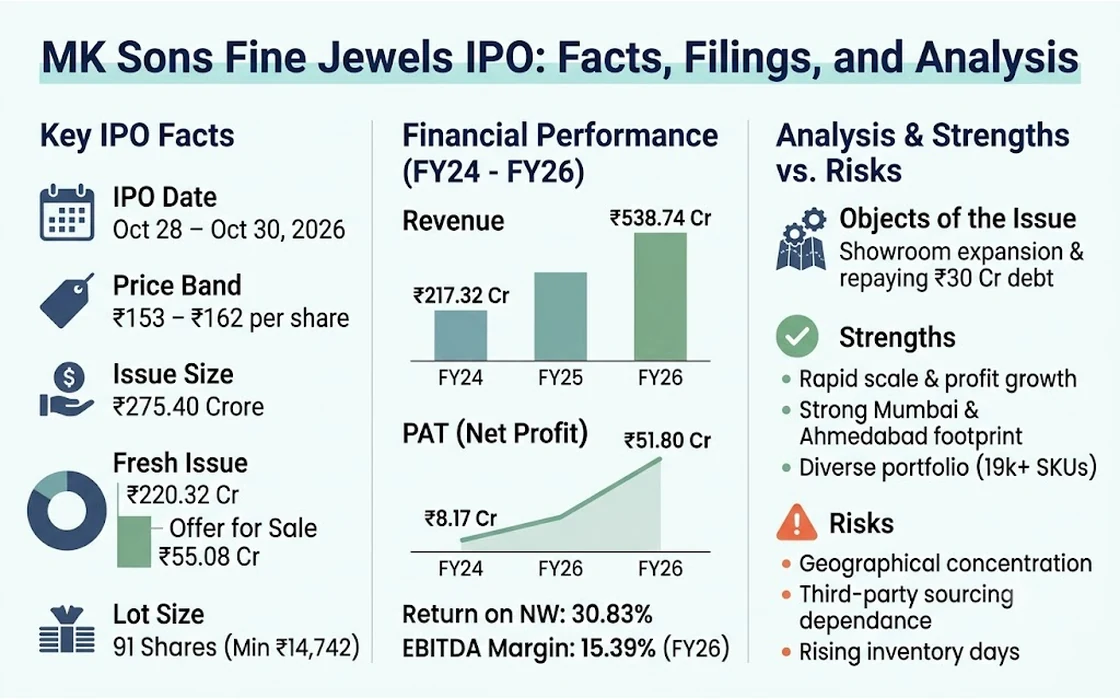
What Is the MK Sons Fine Jewels IPO?
The search phrase “MK Sons Fine Jewels IPO” points to market interest in a potential public offering by MK Sons Fine Jewels, an entity operating within India’s gems, jewellery, and luxury ornament sector. In India, public equity offerings allow private enterprises to raise expansion capital, pay down high-cost working capital borrowings, or provide exit liquidity to early promoters and venture partners through an Offer for Sale (OFS).
When search volume for a specific private enterprise spikes by thousands of percent over a brief window, it generally stems from one of four events:
- Filing of a Draft Document: The company has submitted a Draft Red Herring Prospectus (DRHP) to market regulators or the stock exchanges.
- Appointment of Lead Managers: Market buzz has emerged regarding the appointment of book-running lead managers (BRLMs) or merchant bankers to manage an impending issue.
- Pre-IPO Funding Activity: The business has executed a preferential allotment or private placement round to institutional or high-net-worth investors ahead of a formal public filing.
- Name Confusion with Existing Issuers: Retail searchers occasionally confuse newly incorporated entities or private regional jewellers with similarly named listed peers or active SME IPOs.
Because public issue timelines are subject to regulatory clearance, merchant banker scheduling, and prevailing market sentiment, prospective investors must treat early market buzz as exploratory until an official Red Herring Prospectus (RHP) receives approval. As of 2026, regulatory scrutiny over SME and retail-focused listings has tightened significantly, making formal document verification the only reliable starting point.
How to Verify Official IPO Filings in India
Before analyzing financial metrics or setting aside investment capital, you must establish whether an issue is formally registered. Speculative dates and indicative price bands circulated on internet forums often misquote figures or conflate older filings with active issues.
To confirm the factual status of the MK Sons Fine Jewels IPO or any other emerging corporate issue, use these verified statutory checkpoints:
1. SEBI Public Issues Database
All public offers in India—excluding certain standalone micro-SME filings that go directly through exchange SME boards—must register their draft prospectuses with the regulator. You can visit the Securities and Exchange Board of India (SEBI) official portal under the “Filings” section to check:
- Draft Offer Documents: Initial submissions outlining the business history, capital structure, and risk factors.
- Observations Issued: Regulatory remarks, queries, or approvals granted to the merchant bankers.
2. Stock Exchange Emerging Platforms
If MK Sons Fine Jewels is planning an SME offering rather than a mainboard listing, the primary filing locus will reside on the dedicated exchange platforms:
- BSE SME: Check the public issues section on BSE India for draft SME prospectuses and listing notices.
- NSE Emerge: The specialized SME division of NSE India maintains an up-to-date registry of companies undergoing review, in-bidding, and listing.
3. Lead Manager and Registrar Announcements
Every legitimate public issue is managed by registered Merchant Bankers (such as corporate finance houses or boutique investment banks) and serviced by an official Registrar to the Issue (such as Link Intime, KFin Technologies, or Bigshare Services). If an IPO is genuine and active:
- The registrar’s official portal will list the company under its “Active Issues” or “Allotment Status” tabs.
- The lead manager’s statutory notices will be published in national financial newspapers and on their corporate website.
If you are new to tracking public offerings and want a step-by-step breakdown of how allotments and ASBA applications function, review our detailed guide on How to Invest in IPOs Safely: Step-by-Step Guide.
Mainboard vs. SME IPO: Understanding the Structural Differences
Prospective investors tracking emerging jewellery issues must understand the fundamental divide between an Indian Mainboard listing and an SME Exchange listing. Mid-sized regional jewellers often choose the SME route because it features lower capital-raising thresholds and streamlined compliance requirements. However, this structure carries distinct operating implications for retail participants.
+--------------------------------------------------------------------------+
|                       INDIAN IPO STRUCTURAL ROUTE                        |
+--------------------------------------------------------------------------+
                                    |
        +---------------------------+---------------------------+
        |                                                       |
        v                                                       v
+-------------------------------+       +-------------------------------+
|         MAINBOARD IPO         |       |            SME IPO            |
|  - Managed via BSE / NSE      |       |  - Managed via BSE SME/NSE    |
|  - Min Application: ~Rs.15,000|       |  - Min Application: >=Rs.100k |
|  - Broad institutional float  |       |  - Mandatory Market Maker     |
|  - Flexible lot liquidity     |       |  - Traded strictly in lots    |
+-------------------------------+       +-------------------------------+
The table below highlights the operational differences established by SEBI regulations that every investor must weigh:
| Parameter | Mainboard IPO | SME Platform (BSE SME / NSE Emerge) |
|---|---|---|
| Minimum Post-Issue Capital | Typically Rs. 10 crore to Rs. 25 crore minimum | Minimum Rs. 3 crore, capped at Rs. 25 crore |
| Minimum Retail Application | 1 Lot (~Rs. 14,000 to Rs. 15,000) | Fixed Lot Size (Typically Rs. 1,00,000 to Rs. 1,40,000) |
| Secondary Market Trading | Single shares traded freely post-listing | Traded only in pre-defined lot bundles (e.g., 1,000 shares) |
| Market Maker Provision | Not mandatory for trading support | Mandatory market making for at least 3 years |
| Financial Reporting Cadence | Quarterly audited/unaudited financial results | Half-yearly financial disclosures permitted |
| Underwriting Requirement | 100% underwritten (lead manager + syndicate) | 100% underwritten (merchant banker min. 15% on own book) |
For retail investors accustomed to putting Rs. 15,000 into mainstream listings, an SME issue requires substantially higher capital concentration. Furthermore, because SME secondary trades must take place in fixed lots, selling partial holdings to rebalance your portfolio is not possible. You must buy or sell entire lots, which can lead to extended liquidity freezes during market downturns.
Analyzing the Indian Jewellery Business Model
Before evaluating any financial prospectus from MK Sons Fine Jewels, it is essential to understand the underlying economics of the Indian gems and jewellery landscape. Unlike software companies or asset-light digital platforms, jewellery enterprises operate in a capital-intensive, margin-sensitive, and highly regulated environment.
1. Working Capital Intensity
Jewellery manufacturers and retailers require substantial upfront capital to maintain store inventory. Gold, diamonds, and precious gemstones must be purchased, insured, and displayed long before revenue is realized.
- Inventory Holding Period: Typical retail jewellers carry inventory for 90 to 180 days. A protracted holding period inflates financing costs.
- Financing Structure: Watch whether the issuer relies heavily on short-term bank borrowings, cash credit facilities, or Gold Metal Loans (GML). A business spending an outsized portion of its operating profit on debt servicing faces severe margin compression when interest rates rise.
2. Product Mix: Plain Gold vs. Studded Jewellery
The profitability of an ornament business depends directly on its product assortment:
- Plain 22-Karat Gold: Commands high sales volumes but low gross margins (often between 6% and 10%). The primary source of gross profit is the “making charge” (wastage charge), which is vulnerable to local price competition.
- Studded & Diamond Jewellery: Offers substantially higher gross margins (typically 20% to 35%), but turns over at a much slower pace. When reviewing an upcoming prospectus, check whether the company is growing its high-margin studded segment or relying almost entirely on commoditized plain bullion and ornaments.
       Plain Gold Ornaments                Studded & Diamond Pieces
+-------------------------------+       +-------------------------------+
| Gross Margin: 6% - 10%        |       | Gross Margin: 20% - 35%       |
| Turnover: High (Rapid)        |       | Turnover: Slower (90-180 days)|
| Capital Risk: Low price drift |       | Capital Risk: Inventory drag  |
+-------------------------------+       +-------------------------------+
3. Sourcing and Hedging Mechanisms
The spot price of gold experiences volatility driven by currency fluctuations, import duty revisions by the Ministry of Finance, and global macroeconomic trends. A well-managed jewellery company utilizes formal hedging mechanisms on commodity exchanges or procures raw material through Gold Metal Loans to insulate its balance sheet from price shocks. If a company operates without systematic hedging, an unexpected dip in gold prices can directly wipe out quarterly operating profits.
4. Regulatory Compliance and Hallmarking
The Bureau of Indian Standards (BIS) mandates hallmarking for gold jewellery across designated districts in India. Compliance with hallmarking, prevention of money laundering regulations (PMLA reporting for high-value cash purchases), and clear documentation of raw material procurement are essential. A prospective issuer facing pending tax inquiries or hallmarking irregularities carries substantial governance risk.
Core Financial Metrics to Inspect in the DRHP
When the Draft Red Herring Prospectus for MK Sons Fine Jewels becomes publicly available on exchange repositories, investors should review several critical indicators rather than relying on marketing summaries.
Balance Sheet Quality and Borrowings
Examine the company’s total outstanding borrowings relative to its net worth (Debt-to-Equity ratio). A ratio consistently above 1.5x in a retail jewellery company indicates high financial leverage. Check the “Objects of the Issue” section:
- Healthy Capital Allocation: Using fresh issue proceeds to expand retail store networks, upgrade design manufacturing facilities, or systematically repay expensive short-term bank debt.
- Questionable Capital Allocation: Using issue proceeds primarily for undefined “General Corporate Purposes” or funding an outsized Offer for Sale (OFS) where promoters offload substantial equity while injecting zero new growth capital into the firm.
Cash Flow from Operations (CFO) vs. EBITDA
In working-capital-heavy sectors, net profit figures can be misleading. Rapidly growing revenue often conceals trapped capital:
- If a company reports Rs. 20 crore in EBITDA but records negative Cash Flow from Operations over consecutive years, it indicates that cash is entirely absorbed by unsold inventory or delayed trade receivables.
- For a broader perspective on establishing disciplined portfolio allocations and avoiding common valuation traps, explore our Beginner’s Guide to Stock Market Investment.
Return on Capital Employed (ROCE)
Because jewellery operations require massive amounts of capital (equity plus long-term debt) to purchase raw metals, ROCE is the truest test of managerial competence. A firm generating an ROCE below its cost of borrowing (e.g., an ROCE of 9% while borrowing at 11%) is destroying economic value, regardless of how fast its topline sales are expanding.
What to Do and What to Avoid When Researching Unconfirmed IPOs
The period between initial search momentum and an actual listing requires rigorous personal discipline. Investors frequently make unforced errors during this phase.
+--------------------------------------------------------------------------+
|                  TACTICAL DUE DILIGENCE CHECKLIST                        |
+--------------------------------------------------------------------------+
| [DO]   Verify filings directly on SEBI, BSE, or NSE databases.           |
| [DO]   Inspect the audited Cash Flow Statement, not just Net Profit.    |
| [DO]   Check promoter shareholding post-issue and lock-in covenants.     |
| [AVOID] Trusting unregulated Grey Market Premium (GMP) platforms.        |
| [AVOID] Committing minimum SME capital (Rs.1L+) without liquidity plans. |
| [AVOID] Applying based purely on social media recommendation channels.   |
+--------------------------------------------------------------------------+
Practices to Adopt
- Track the BRLM Track Record: Check the historical performance of previous IPOs managed by the assigned Book Running Lead Manager. Certain boutique merchant bankers consistently price issues at aggressive valuations that struggle on listing day.
- Read the “Risk Factors” Section: Internal risk disclosures in the DRHP outline supplier concentration, geographic cluster dependence, and pending litigations against promoters.
- Compare Peer Valuations: Benchmark the company’s Price-to-Earnings (P/E) and Enterprise Value-to-Sales (EV/Sales) multiples against established listed jewellery peers (such as Titan Company, Kalyan Jewellers, Senco Gold, or Thangamayil Jewellery) after adjusting for differences in scale and retail footprint.
Pitfalls to Avoid
- Never Rely on Grey Market Premiums (GMP): Grey market trades are completely unregulated, informal, and prone to artificial manipulation. High indicative GMPs are often floated on thin trading volumes to manufacture artificial retail demand ahead of issue opening.
- Do Not Ignore Illiquidity Risks: If the issue lists on an SME platform, remember that selling your allocation requires finding a buyer willing to transact in full lot sizes (often Rs. 1,00,000 or more). In volatile markets, bid-ask spreads on SME boards can widen dramatically.
- Avoid Speculative IPO Pre-Orders: Do not transfer funds to unauthorized intermediaries promising guaranteed pre-IPO shares or special retail allotments outside the standard Application Supported by Blocked Amount (ASBA) framework.
For a deeper dive into common behavioral missteps and risk-mitigation strategies, consult our practical guide on How to Avoid Common Investment Mistakes: Complete Guide.
Step-by-Step Guide: Preparing for the Application Process
If MK Sons Fine Jewels confirms its public offering and files an approved RHP with designated bidding dates, follow this standard operational path to participate securely:
- Activate an ASBA-Enabled Demat Account: Ensure your bank account supports Application Supported by Blocked Amount (ASBA) or is linked to an approved UPI handle configured for stock market mandates.
- Review the Approved Price Band: Note whether the issue uses a book-building process (with a defined floor and cap price) or a fixed-price mechanism. Retail applicants typically bid at the “Cut-off Price” to maintain eligibility in case of oversubscription.
- Submit the Bid During Regular Market Hours: IPO bidding windows operate between 10:00 AM and 5:00 PM IST on official trading days. Bids submitted outside this window or through non-certified intermediaries will be rejected.
- Approve the UPI Mandate: If bidding via a retail broker, authorize the auto-debit hold in your mobile banking or UPI application before the mandate cut-off deadline (usually 5:00 PM on the issue closing day). The funds remain blocked in your own account, earning savings interest, until allotment is finalized.
- Monitor Allotment and Unblocking: Once the basis of allotment is finalized by the registrar, successful applicants receive credit of shares to their Demat accounts, while unsuccessful applicants see their funds released immediately.
FAQ
Where can I check the official MK Sons Fine Jewels IPO status?
You can confirm the status of the filing directly through the public issues section of the Securities and Exchange Board of India (SEBI) portal or on the dedicated platforms of BSE India and NSE India. If no draft prospectus or listing application is indexed under that corporate entity, any circulating listing dates remain unofficial and unconfirmed.
Is the MK Sons Fine Jewels IPO a mainboard or an SME issue?
The exact platform category depends entirely on the company’s post-issue paid-up capital and the route specified in its draft prospectus. If the post-issue capital remains below Rs. 25 crore, the company qualifies for listing on SME platforms like BSE SME or NSE Emerge, which require minimum investment lots of Rs. 1,00,000 or more. A mainboard listing requires higher net worth parameters and offers smaller retail lot sizes around Rs. 15,000.
What is the minimum amount required to apply for an Indian jewellery IPO?
For mainboard public issues, the minimum retail application amount is determined by one lot, typically structured between Rs. 14,000 and Rs. 15,000 as per SEBI retail allocation guidelines. If the offering is hosted on an SME exchange, SEBI rules require minimum bid values ranging from Rs. 1,00,000 to Rs. 1,40,000, depending on the issue price band and designated lot size.
Are grey market premiums (GMP) a reliable indicator of listing day gains?
No, grey market premiums are unregulated, speculative estimates generated through off-market dealer networks without regulatory oversight. They carry no legal guarantee of listing returns and are frequently manipulated through low-volume unofficial quotes to generate artificial bidding momentum. Investors should focus strictly on balance sheet fundamentals, valuation metrics, and formal RHP risk disclosures.
Conclusion
The sudden surge in searches for the MK Sons Fine Jewels IPO highlights the strong appetite among Indian retail participants for upcoming opportunities in the consumer and luxury goods space. However, navigating unconfirmed or emerging public issues requires strict adherence to regulatory facts over speculative trends. Before allocating capital, locate the verified Draft Red Herring Prospectus on official exchange portals, identify whether the issue is structured for the Mainboard or SME board, and rigorously evaluate balance sheet leverage, inventory turnover, and cash flow stability. Maintaining a systematic due diligence process ensures your investment decisions remain anchored in fundamental value rather than temporary online momentum.
- Tags:
- Ipo
- Mk Sons Fine Jewels Ipo
- Sme Ipo
- Stock Market India
- Investing
- Sebi Filings