
Muse Wonder and Muse Wonder Full: Frontier Agent Models
Explore Meta's Muse Wonder and Muse Wonder Full models, built for autonomous AI agents with optimized tool calling, planning, and deployment trade-offs.

- NV Trends
- 12 min read
Meta has officially revealed Muse Wonder and Muse Wonder Full, introducing two frontier-grade foundation models specifically engineered to power autonomous agents and complex multi-step reasoning workflows. Early announcements reported by Facebook across social platforms like Threads highlight a dedicated shift away from traditional conversational chatbots toward models that plan, execute code, call external tools, and verify intermediate steps autonomously.
The release arrives at a turning point for artificial intelligence infrastructure. While general-purpose large language models (LLMs) excel at textual synthesis and single-turn querying, autonomous agents place fundamentally different demands on model architecture. Agentic systems require high-precision function calling, rigid adherence to structured output schemas, resilient self-correction when tools fail, and minimal token overhead during repetitive reasoning loops.
For software engineers, enterprise architects, and AI founders in India, this dual-model release offers a timely framework for evaluating agent design. Rather than relying on a single monolithic model for every stage of an automated pipeline, the bifurcation into Muse Wonder and Muse Wonder Full signals a future where compact, execution-optimized models work hand-in-hand with heavy, long-horizon planners.
Key takeaways
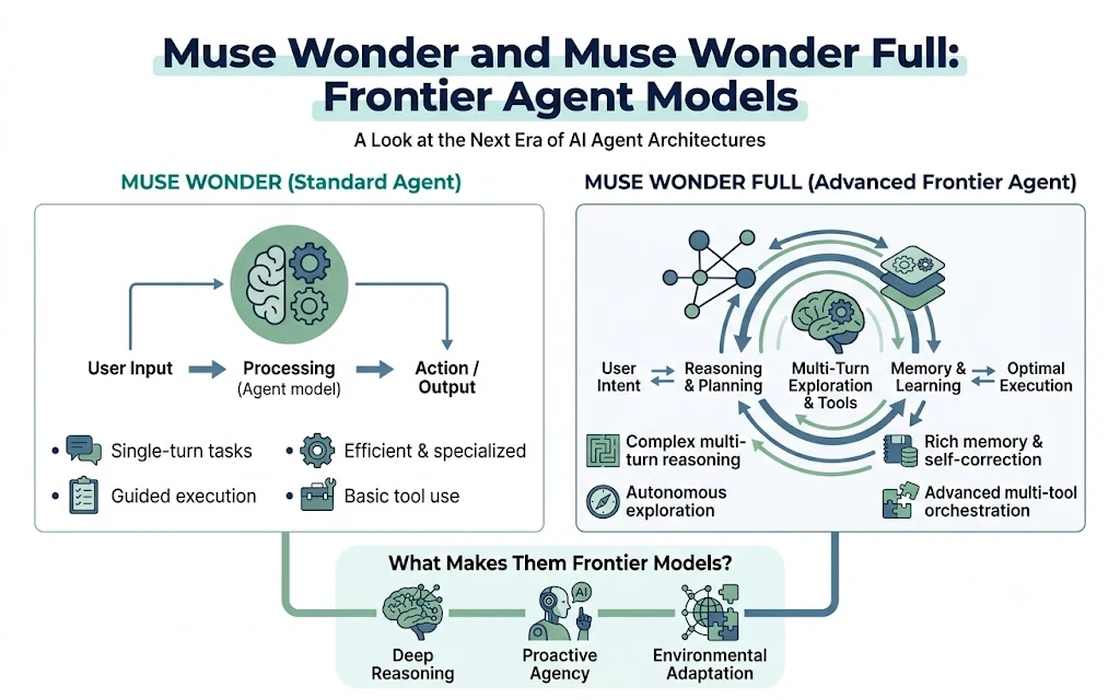
- Dual-Tier Agent Architecture: Muse Wonder is built for rapid, low-latency tool execution and deterministic API calling, whereas Muse Wonder Full is optimized for long-horizon planning and deep multi-step reasoning.
- Agent-First Design Focus: Both models prioritize structured JSON output stability, environment feedback handling, and automated error recovery over passive chat generation.
- Cost and Latency Optimization: Splitting orchestration between a heavy planner and a lean executor prevents runaway inference costs, especially critical when calculating compute expenses in Indian Rupees (Rs.).
- Emerging Specifications: While Meta has introduced the model family via official social updates, complete architectural whitepapers, benchmark weights, and public API access tiers remain emerging as of late 2026.
Understanding Muse Wonder vs. Muse Wonder Full: Architecture and Design Philosophy
The transition from generative conversational bots to autonomous software agents has exposed the bottlenecks of standard LLM architectures. In an agent workflow, an AI does not merely generate prose; it inspects an external environment, chooses an API tool, formats parameters into a strict JSON payload, waits for execution output, inspects the return data, and decides what to do next. When a general-purpose model makes a subtle formatting syntax error on step eight of a ten-step deployment script, the entire agent run breaks.
According to the official announcement details reported by Facebook, the Muse Wonder family addresses this exact structural pain point by separating planning capability from execution agility.
What Makes an AI Model “Agent-First”?
An agent-optimized model differs from a conversational LLM across three primary dimensions:
- Deterministic Function Calling: Standard models frequently hallucinate optional parameters or inject conversational conversational markdown around JSON blobs. Agent models are fine-tuned to emit valid tool payloads with near-zero schema drift.
- State and Context Management: Autonomous agents produce massive context logs consisting of terminal outputs, API responses, and file diffs. Agent-centric models are designed to attend to critical status codes without losing track of the original system prompt.
- Resilience to Environmental Feedback: When a bash command fails with an exit code
127or an external SQL query returns a timeout, an agent model must parse the error and pivot, rather than apologizing or repeating the same invalid query.
Muse Wonder: Lean Execution, Fast Tool Calling
Muse Wonder serves as the lightweight, operational tier of the family. In autonomous agent engineering, speed is not simply a convenience—it directly governs reliability. If an agent requires 15 tool executions to analyze a repository and run unit tests, a model with a 4-second time-to-first-token (TTFT) creates an agonizingly slow feedback loop.
Muse Wonder is designed to sit directly inside execution loops. It takes structured task breakdowns from larger orchestrators, maps them directly to external API calls, validates inputs, and processes responses. Because it operates with reduced parameter overhead, it delivers significantly lower latency and cheaper per-token compute costs.
Muse Wonder Full: Deep Multi-Step Planning and Horizon Reasoning
In contrast, Muse Wonder Full represents the frontier reasoning tier. It handles the cognitive heavy lifting: taking ambiguous user requirements, breaking them down into acyclic task graphs, evaluating security risks, and synthesizing final deliverables.
When an agent encounters an edge case—such as a database schema mismatch during an automated migration—Muse Wonder Full steps in to re-evaluate the architecture, formulate an alternative strategy, and hand actionable instructions back to the lighter execution loop. As the AI field explores complex benchmarks hosted on platforms like arXiv, multi-horizon reasoning remains the primary differentiator separating enterprise-ready agents from fragile prototypes.
Technical Comparison: Muse Wonder vs. Muse Wonder Full
While comprehensive parameter counts and full benchmark suites are still emerging from official documentation, the operational divisions between the two models reflect deliberate engineering trade-offs. The table below outlines how developers should assess the two tiers for production workloads.
| Feature / Metric | Muse Wonder (Execution Tier) | Muse Wonder Full (Reasoning Tier) |
|---|---|---|
| Primary System Role | Tool execution, API formatting, parsing output | Long-horizon planning, architecture design, edge-case recovery |
| Latency Profile | Low latency; fast time-to-first-token (TTFT) | Higher latency due to deep chain-of-thought verification |
| Inference Cost (Relative) | Low (budget-friendly for high-iteration loops) | Premium (best reserved for orchestration and final review) |
| Context Handling | Focused context window, strict tool parameter filtering | High-capacity context window for large codebases and logs |
| Ideal Deployment Target | High-throughput web agents, continuous terminal runners | Complex project refactoring, security auditing, multi-agent lead |
| Failure Mode Tendency | Can struggle with novel, abstract strategic planning | Higher token consumption; excessive deliberation on trivial tasks |
Understanding these trade-offs prevents one of the most common pitfalls in modern AI deployment: using a frontier-class model to perform simple JSON formatting, which inflates cloud invoices without improving accuracy.
How Agentic Frontier Models Change the Developer Stack
The introduction of specialized agent models like Muse Wonder mirrors the architectural maturation seen across other open AI projects. Developers are moving away from monolithic API calls in favor of layered, multi-agent frameworks built on repositories found across GitHub.
+-----------------------------------------------------------+
|                   User / Business Goal                    |
+-----------------------------------------------------------+
                              |
                              v
+-----------------------------------------------------------+
|                     MUSE WONDER FULL                      |
|  - Architectural Decomposition                            |
|  - Task Dependency Graph Generation                       |
|  - High-Level Verification & Policy Checks                |
+-----------------------------------------------------------+
                              |
              +---------------+---------------+
              |                               |
              v                               v
+---------------------------+   +---------------------------+
|        MUSE WONDER        |   |        MUSE WONDER        |
|    (Sub-Agent: Coding)    |   |     (Sub-Agent: Infra)    |
| - File Read/Write Tool    |   | - Bash / Cloud API Tool   |
| - Fast Syntax Validation  |   | - Deployment Checker      |
+---------------------------+   +---------------------------+
              |                               |
              +---------------+---------------+
                              |
                              v
+-----------------------------------------------------------+
|               Verified Production Delivery                |
+-----------------------------------------------------------+
Context Drift and Memory Management
A critical challenge in long-running agent workflows is context drift. When an agent runs continuously for 30 minutes, intermediate tool calls, terminal warnings, and debug logs pollute the context window.
Monolithic models often succumb to “distraction,” where early constraints specified in the system prompt are forgotten in favor of immediate tokens. Models designed specifically for agent agency feature training regimens that emphasize anchor instructions. Muse Wonder Full is reportedly trained to maintain core invariants regardless of the volume of intermediary data streaming through its context.
Deterministic Output and Structured Schemas
For developers integrating models into enterprise software, unstructured natural language is a liability. If an agent outputs Here is the command: rm -rf ./cache instead of an executable JSON structure, custom parsing code must step in. Muse Wonder enforces strict compliance with type-safe schema specifications, allowing backend runtimes to execute tools safely through sandboxed environments.
To see how specialized models compare with open-source alternatives, explore our coverage on GLM 5.2 Released: A Radically Open 1M Context AI, which highlights how long-context models handle dense enterprise documentation.
Practical Implementation: Designing an Autonomous Agent Workflow
To understand how to deploy a dual-tier model family like Muse Wonder effectively, consider an automated code testing and remediation agent.
In this architecture, Muse Wonder Full acts as the Architect, analyzing test failures across a project directory. It decides which files require modification and passes concise instructions to Muse Wonder, which acts as the Implementer.
# Conceptual orchestration schema for a dual-tier agent setup
agent_orchestration_config = {
    "orchestrator": {
        "model": "muse-wonder-full",
        "temperature": 0.1,
        "role": "Strategic planner. Deconstructs user requests into ordered tasks.",
        "max_planning_steps": 5
    },
    "executor": {
        "model": "muse-wonder",
        "temperature": 0.0,
        "role": "Deterministic tool executor. Strictly generates JSON function calls.",
        "supported_tools": ["file_search", "git_patch", "run_pytest", "http_request"]
    }
}
The Tool Execution Loop
When designing the executor loop around Muse Wonder, the runtime should enforce strict validation before running commands on production infrastructure:
- Plan Ingestion: The executor receives a single, discrete objective from the planner (e.g., “Run test suite and isolate syntax error in authentication controller”).
- Tool Invocation: The executor outputs a single JSON call targeting the testing runtime.
- Observation Ingestion: The environment returns standard error output (
stderr). - Patch Generation: If a fix is required, Muse Wonder generates a unified diff.
- Handoff: Once tests pass, the output is passed back to Muse Wonder Full to verify that no secondary architectural regressions were introduced.
If you are exploring local coding agents and custom execution runtimes, review our step-by-step guide on how to Setup GLM-5.2 with Aider on macOS: Full Guide to see practical multi-turn coding agents in action.
Economics and Infrastructure for Indian Engineering Teams
For development teams and engineering firms across Indian technology hubs like Bengaluru, Pune, and Hyderabad, model selection directly dictates operational viability. Building agentic workflows with brute-force LLM calls creates severe cost amplification.
The Token Multiplication Problem
Unlike a standard search or chatbot interaction where a single user prompt yields a single response (approx. 500 input tokens and 300 output tokens), an autonomous agent loops. A single high-level objective often requires:
- 10 to 25 intermediate model calls.
- Accumulated history that grows with every step (often passing 15,000+ tokens by step 10).
- High output token volume due to verbose tool payloads and intermediate reasoning traces.
If an engineering team runs 500 automated agent tasks per day using exclusively premium frontier models, daily token usage can easily exceed 50 million tokens.
Monolithic Approach:
500 tasks * 20 agent steps * 30,000 avg context = 300,000,000 tokens processed by Frontier Model

Bifurcated Approach (Muse Wonder + Full):
- Planning & Verification: 500 tasks * 2 steps * 20,000 avg context = 20,000,000 tokens (Frontier Model)
- Execution Loops: 500 tasks * 18 steps * 8,000 filtered context = 72,000,000 tokens (Lean Model)
Net Result: ~70% reduction in high-cost tier token consumption.
Budgeting in Indian Rupees (Rs.)
At prevailing exchange rates in late 2026 (approximately Rs. 86 to Rs. 89 per USD), running unoptimized frontier models for internal automation can translate into monthly cloud API bills ranging from Rs. 85,000 to over Rs. 3,50,000 for a modest 10-person engineering team.
By utilizing Muse Wonder for high-frequency execution and confining Muse Wonder Full to orchestration and validation, Indian development teams can lower continuous automation expenses to manageable figures—often between Rs. 15,000 and Rs. 40,000 per month.
Furthermore, as local hosting technology matures, running lightweight execution models on dedicated hardware inside Indian data centers becomes viable. For teams looking to eliminate cloud token costs entirely, our analysis on Running Local AI Models: Why It Is Finally Good Now breaks down hardware requirements and open-weight performance.
What to Do and What to Avoid When Deploying Agentic Models
Deploying models designed for autonomous action requires a far stricter set of engineering guardrails than deploying conversational UI bots.
What to Do
- Enforce Least-Privilege API Keys: Never grant an autonomous agent unrestricted administrative access to cloud accounts, databases, or deployment clusters. Provide scoped API keys that permit only the exact actions required for the task.
- Implement Hard Execution Ceilings: Always configure an absolute ceiling on agent loop iterations (e.g., maximum 12 tool calls per session). This prevents infinite feedback loops if an API continuously returns an unhandled error code.
- Log Raw Tool Payloads: Store every JSON string generated by Muse Wonder alongside the exact environment response. This trace history is essential for diagnosing why an agent derailed during automated tasks.
- Sandbox Code Execution: All bash, shell, or file write operations generated by the agent must run in isolated containerized environments (such as ephemeral Docker instances or firecracker microVMs) to prevent accidental data overwrites.
What to Avoid
- Do Not Use Full-Tier Models for Simple Formatting: Avoid calling Muse Wonder Full to parse CSVs, reformat string dates, or validate regular expressions. Delegate deterministic formatting tasks to Muse Wonder or standard script utilities.
- Do Not Run Agents Without Human-in-the-Loop on High-Risk Actions: For actions involving irreversible operations—such as deleting production records, sending mass customer emails, or pushing unauthorized code commits—require explicit human confirmation before the tool executes.
- Avoid Unbounded Context Windows: Do not dump entire 10,000-line server logs into the model prompt. Use pre-filtering scripts to extract relevant error snippets before handing text to Muse Wonder.
FAQ
What is the primary difference between Muse Wonder and Muse Wonder Full?
Muse Wonder is a compact, low-latency model designed for rapid tool calling, API execution, and deterministic structured outputs within agent loops. Muse Wonder Full is a frontier-class reasoning model designed for high-level architectural planning, dependency mapping, and resolving complex edge cases across multi-step tasks.
Are Muse Wonder models available as open-weight downloads?
As of late 2026, details regarding the release mechanism, licensing terms, and whether full model weights will be published openly or restricted to hosted API endpoints are still emerging from Meta’s official communications. Developers should monitor official developer portals for license clarification before planning local on-premise infrastructure.
How do agent models help Indian startups manage AI infrastructure costs?
Agent workflows multiply token usage because they require dozens of sequential reasoning steps per user request. By delegating high-volume tool execution to the lighter Muse Wonder model and reserving Muse Wonder Full for initial planning, startups can reduce API token expenses from hundreds of dollars (thousands of Indian Rupees) down to sustainable operational budgets.
Can Muse Wonder execute code and manage developer workflows independently?
While Muse Wonder is capable of generating shell commands, file patches, and API calls, production best practices require running the model inside a secured orchestration framework. Safe execution demands sandboxed container environments, strict step limits, and human approval gates for critical actions.
Conclusion
The announcement of Muse Wonder and Muse Wonder Full highlights an important shift in artificial intelligence development. As the technology industry moves beyond passive conversational assistants, the focus has shifted toward building reliable, multi-step autonomous agents capable of real-world productivity.
By offering a bifurcated model family, Meta provides developers with a clear architectural blueprint: use frontier-level reasoning models to plan and oversee complex goals, while relying on fast, lean execution models to handle repetitive tool interactions. For software teams and enterprise architects, mastering this tiered approach will be key to deploying reliable, secure, and cost-effective AI agents.
- Tags:
- Muse Wonder
- Muse Wonder Full
- Ai Agents
- Meta Ai
- Frontier Models
- Generative Ai