
Best Debt Mutual Funds for Safe Returns (2026)
Discover the best debt mutual funds in India as of 2026 to earn predictable yields, navigate interest rate cycles, and optimize post-tax returns.

- NV Trends
- 18 min read
- Updated
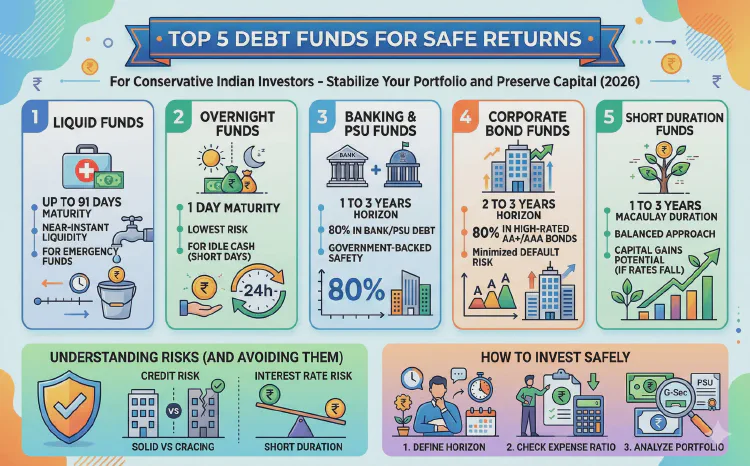
Debt mutual funds are professionally managed fixed-income investment schemes that pool money from investors to purchase government securities, treasury bills, and high-grade corporate bonds to generate stable returns with capital preservation. By allocating capital across sovereign debt, public sector undertakings, and top-tier private corporations, these schemes deliver predictable accrual income alongside opportunities for capital gains when interest rates soften.
In the Indian financial landscape, capital preservation forms the bedrock of any resilient wealth-building strategy. While equity markets attract attention during economic expansions, allocating capital to fixed-income assets provides portfolio stability, dampens equity drawdowns, and secures cash flows for predetermined financial goals. For conservative and moderate investors across India, debt funds operate as an institutional-grade, transparent alternative to traditional bank deposits, offering broad diversification across vetted issuers and daily redemption flexibility. For a detailed comparison of yield mechanics and liquidity differences between these instruments, see our analysis on Debt Mutual Funds vs Fixed Deposits: Which Wins in 2026?.
Navigating the fixed-income market as of 2026 requires understanding how monetary policy decisions by the Reserve Bank of India (RBI), systemic banking liquidity, and credit spreads influence daily net asset values (NAV). Fixed-income papers adjust continuously to shifting macroeconomic indicators. Selecting the best debt funds for your financial plan requires matching credit quality and portfolio duration directly to your holding period, insulating your principal from adverse interest rate shifts and unexpected credit events.
Key takeaways
- Debt mutual funds allocate capital across sovereign, public sector, and institutional debt papers to deliver predictable yield accrual with low drawdown risk compared to equity assets.
- For investment horizons under three months, Overnight and Liquid funds offer capital stability and rapid liquidity with negligible interest rate exposure.
- For intermediate timelines of one to three years, Banking & PSU funds and Corporate Bond funds stand out as top debt funds for steady accrual income backed by high-grade balance sheets.
- Under Section 50AA of the Income Tax Act, capital gains from pure debt mutual funds (with domestic equity exposure below 35%) are taxed at an investor’s applicable income tax slab rate upon redemption.
- Aligning a scheme’s Macaulay duration directly with your personal investment horizon is the single most effective risk-mitigation strategy to eliminate mark-to-market volatility.
How Debt Funds Work: The Dual Return Engines
To identify the best debt fund for your portfolio, it is essential to understand how a fixed-income scheme generates its Net Asset Value (NAV). Unlike equity mutual funds, where valuation depends on corporate earnings expansion and market sentiment, a debt mutual fund operates through two distinct financial mechanisms: accrual yield and duration-driven capital appreciation.
$$\text{Total Debt Fund Return} \approx \text{Accrual Yield (Coupon Payments)} \pm \text{Mark-to-Market Price Movements} - \text{Total Expense Ratio}$$
1. Accrual Yield (Coupon Income)
When a debt mutual fund purchases bonds, treasury bills, or commercial papers, the underlying issuing entities pay contracted periodic interest, known as coupons. The scheme collects these coupons, which are added directly to its assets. This steady stream of interest payments creates a continuous, compounding base return that pushes the fund’s NAV upward over time, independent of stock market swings.
2. Capital Appreciation or Depreciation (Duration Effect)
Market-traded debt instruments experience price fluctuations whenever benchmark interest rates move. Bond prices share an inverse relationship with prevailing interest rates:
- When interest rates decline: Existing bonds carrying higher coupon rates become more valuable. Their secondary market prices rise, generating capital appreciation that lifts the fund’s NAV above its base accrual rate.
- When interest rates rise: Newly issued bonds offer higher yields, making existing lower-coupon bonds less attractive. Their market value falls, creating temporary mark-to-market capital losses that suppress the fund’s NAV.
The sensitivity of a debt fund to interest rate changes is quantified by its Modified Duration. Mathematically, the approximate percentage change in a bond’s price for a 1% shift in interest rates is calculated as:
$$\text{Bond Price Change (%)} \approx -\text{Modified Duration} \times \Delta y$$
For example, if a debt fund holds an average modified duration of 4 years and the RBI reduces systemic interest rates by 50 basis points (0.50%), the scheme is expected to gain roughly 2.0% in capital appreciation over and above its underlying accrual yield. Conversely, if yields rise by 50 basis points, the fund experiences an approximate 2.0% temporary mark-to-market price drag.
To protect retail investors from mislabeled risk, the Securities and Exchange Board of India (SEBI) strictly defines mutual fund categories based on residual maturity and credit profile. For an exhaustive breakdown of these regulatory buckets, read our comprehensive guide on Understanding Debt Fund Categories in India.
What Influences Debt Fund Returns? YTM, Duration, and Expenses
Evaluating debt fund returns requires analyzing forward-looking portfolio metrics rather than relying solely on trailing historical returns. Because fixed-income market conditions change with monetary policy, a fund’s past 1-year or 3-year performance rarely predicts its future yield.
Yield to Maturity (YTM) vs. Realized Returns
A debt fund’s Yield to Maturity (YTM) represents the annualized rate of return an investor would earn if the fund held every underlying security in its portfolio until maturity, assuming no defaults and that all coupon payments are reinvested at the identical rate.
However, published YTM is a gross, theoretical figure. To project realistic net debt mutual funds returns, investors must account for two key adjustments:
- Total Expense Ratio (TER): Management fees and operating expenses are deducted daily from the NAV. If a fund reports a portfolio YTM of 7.20% and charges a Direct plan TER of 0.30%, the net starting accrual yield is approximately 6.90%.
- Reinvestment and Duration Drift: As existing bonds mature, the fund manager must reinvest the proceeds into newly issued papers at prevailing market rates, which may be higher or lower than the original portfolio YTM.
To understand how compounding mechanics translate into overall portfolio performance, review our detailed explainer on How Mutual Fund Returns Are Calculated: CAGR vs XIRR.
Direct Plans vs. Regular Plans: Protecting Fixed-Income Yields
In equity funds, an expense differential of 0.50% to 1.00% can often be masked by double-digit market swings. In debt mutual funds—where gross yields historically fall in the 6.50% to 7.50% range—an intermediary distribution commission of 40 to 80 basis points represents a significant drag on net returns.
Over a 3-year holding period on a Rs. 10,00,000 investment, choosing a Direct Plan over a Regular Plan can preserve between Rs. 15,000 and Rs. 25,000 of your total returns purely through fee savings.
Which Debt Funds Are Best? Top Categories for Every Investment Horizon
Safety in fixed-income investing is never an absolute binary; it is the deliberate minimization of credit risk (the probability of a borrower defaulting on interest or principal) and interest rate risk (volatility driven by fluctuating yields). Based on regulatory mandates and published market disclosures as of 2026, the following categories represent the top debt funds across various investment horizons.
1. Ultra Short-Term (1 Day to 3 Months): Overnight and Liquid Funds
Overnight Funds: Complete Immunity to Volatility
Overnight funds invest exclusively in securities that mature on the next business day, primarily Triparty Repos (TREPS) backed by Government of India sovereign debt securities.
- Credit Profile: Virtually pure sovereign collateral with near-zero default probability.
- Interest Rate Sensitivity: Zero duration risk, as the portfolio resets daily.
- Indicative Yield: Closely mirrors the RBI repo rate and the overnight call money rate (typically 6.25% to 6.50% as of 2026).
- Ideal For: Parking operational capital, storing emergency buffers, or holding cash for 1 to 14 days before immediate financial commitments.
Liquid Funds: The Cash Management Standard
Liquid funds allocate capital to debt and money market securities with residual maturities of up to 91 days, such as Treasury Bills, Commercial Papers (CPs), and Certificates of Deposit (CDs).
- Credit Profile: Regulated mandates restrict investments to high-grade instruments rated A1+ by credit rating agencies.
- Interest Rate Sensitivity: Extremely low duration (average maturity under 60 days), meaning interest rate moves cause minimal daily NAV variance.
- Exit Load: Structured on a graded scale for the first 7 days (from day 1 to day 7), after which redemptions carry zero exit load.
- Ideal For: Emergency funds and parking idle balances for 15 days to 3 months.
2. Short to Medium-Term (6 Months to 2 Years): Money Market and Low Duration Funds
Money Market Funds: High-Quality Accrual
Money market funds invest exclusively in money market instruments having a maturity of up to one year. They hold commercial papers issued by established corporations, certificates of deposit issued by scheduled commercial banks, and treasury bills issued by the central government.
- Credit Profile: Dominated by A1+ rated debt instruments.
- Interest Rate Sensitivity: Low to moderate, with portfolio durations typically between 4 and 10 months.
- Ideal For: Investors parking surplus funds for 6 to 12 months who want to outpace savings bank interest without taking on bond market volatility.
Ultra Short & Low Duration Funds: Stepping Out on the Yield Curve
Ultra Short Duration funds maintain a Macaulay duration between 3 and 6 months, while Low Duration schemes maintain a duration between 6 and 12 months.
- Credit Profile: Mix of AAA corporate bonds, high-yield commercial paper, and short-term sovereign paper.
- Risk Considerations: Investors should inspect portfolio fact sheets to verify that the scheme is not loading up on lower-rated (AA or below) corporate debt to artificially boost portfolio YTM.
- Ideal For: Planned expenditures scheduled 6 to 18 months ahead, such as advance income tax payments, insurance premiums, or scheduled capital outlays.
3. Medium to Long-Term (2 Years to 5+ Years): Corporate Bond and Banking & PSU Funds
Banking & PSU Debt Funds: Institutional Safety
SEBI mandates that Banking & PSU debt funds must invest at least 80% of their total assets in debt instruments issued by banks, Public Sector Undertakings (PSUs), and Public Financial Institutions (PFIs).
- Credit Profile: Exceptional sovereign and quasi-sovereign backing. PSUs carry implicit government support, keeping credit default risk exceptionally low.
- Duration Profile: Typically ranges between 2.0 and 3.5 years.
- Ideal For: Conservative investors seeking predictable accrual yield for a 2- to 4-year investment horizon without credit risk anxiety.
Corporate Bond Funds: Pure AAA Credit Focus
Corporate Bond funds are required by SEBI to invest a minimum of 80% of their total portfolio in highest-rated domestic corporate debt—specifically AAA-rated corporate bonds.
- Credit Profile: Stringent adherence to top-tier private and public corporate issuers.
- Yield Advantage: Offers a steady credit spread over government securities (typically 30 to 75 basis points) while maintaining strict credit underwriting standards.
- Ideal For: Core fixed-income allocations over a 2- to 3-year holding period.
4. Best Debt Funds for Long Term (3 Years to 7+ Years): Target Maturity and Gilt Funds
When planning for financial goals beyond 3 to 5 years, selecting the best debt funds for long term wealth preservation requires balancing duration risk against reinvestment risk.
Target Maturity Funds (TMFs): Passive Predictability
Target Maturity Funds are passive open-ended index funds or ETFs that track a specific underlying fixed-income index composed of Government of India sovereign bonds (G-Secs), State Development Loans (SDLs), and AAA-rated PSU bonds.
- Roll-Down Duration: TMFs have a predetermined maturity date (e.g., 2028, 2030, or 2032). As time passes, the fund’s maturity shortens, progressively reducing interest rate risk to zero by the maturity date.
- Locked-In Return Mechanics: If held to maturity, an investor effectively locks in the fund’s starting YTM (minus the expense ratio), eliminating mark-to-market volatility.
- Zero Reinvestment Guesswork: Provides the predictability of a bank fixed deposit combined with the credit backing of sovereign and quasi-sovereign issuers.
- Ideal For: Goal-based planning (such as higher education fees or retirement milestones) with fixed timelines of 3 to 10 years.
Gilt Funds: Sovereign Security with Active Duration Plays
Gilt funds are mandated to invest at least 80% of their assets in government securities issued by the central and state governments.
- Credit Risk: Absolute zero credit default risk, as sovereign debt is backed by the Government of India.
- Interest Rate Risk: High. Gilt funds often maintain modified durations of 5 to 9 years. If benchmark 10-year G-sec yields fall, gilt funds post substantial capital gains. Conversely, during rate-hiking cycles, long-term gilt funds can report negative short-term returns.
- Ideal For: Sophisticated investors with a multi-year horizon (5+ years) or tactical investors seeking to capitalize on anticipated rate cuts by the RBI.
Low Interest Rate Sensitivity <-------------------------> High Interest Rate Sensitivity
Overnight -> Liquid -> Money Market -> Short Duration -> Banking & PSU -> Target Maturity -> Gilt Funds
Comparison Table: Best Debt Mutual Funds Across Categories
The following table summarizes the primary debt fund categories in India as of 2026, comparing their duration parameters, risk characteristics, and ideal investor holding periods.
| Fund Category | SEBI Mandated Duration / Maturity | Primary Portfolio Holdings | Credit Risk | Interest Rate Risk | Indicative Gross YTM (as of 2026) | Recommended Holding Period |
|---|---|---|---|---|---|---|
| Overnight Fund | 1-day residual maturity | TREPS, Overnight Repos | Negligible | None | 6.25% - 6.45% | 1 to 14 days |
| Liquid Fund | Up to 91 days maturity | T-Bills, Commercial Paper, CDs | Very Low | Minimal | 6.50% - 6.80% | 1 to 3 months |
| Money Market Fund | Up to 1 year maturity | CDs, Commercial Papers, T-Bills | Low | Low | 6.90% - 7.25% | 6 to 12 months |
| Short Duration Fund | Macaulay duration 1 - 3 years | Corporate Debentures, G-Secs | Low to Moderate | Moderate | 7.10% - 7.45% | 1 to 3 years |
| Banking & PSU Fund | Flexible (typically 2 - 3.5 yrs) | Min 80% Bank, PSU & PFI Bonds | Very Low | Moderate | 7.15% - 7.50% | 2 to 4 years |
| Corporate Bond Fund | Flexible (typically 2 - 3 yrs) | Min 80% in AAA-rated Corporate Debt | Low | Moderate | 7.25% - 7.60% | 2 to 3 years |
| Target Maturity Fund | Matches target maturity date | G-Secs, SDLs, AAA PSU Debentures | Sovereign / Very Low | Decreases to zero at maturity | 7.00% - 7.35% | Matched to target year (3-8 yrs) |
| Gilt Fund | Min 80% in G-Secs (Flexible duration) | Central & State Government Bonds | Zero Credit Risk | High | 6.90% - 7.30% | 5+ years (or tactical) |
Understanding Risks in Debt Funds: What to Do and What to Avoid
While debt mutual funds offer significantly lower volatility than equities, they are not risk-free. A sound investment process requires identifying risks early and establishing rules to avoid capital drawdowns.
                    +-----------------------------+
                    | Primary Risks in Debt Funds |
                    +--------------+--------------+
                                   |
             +---------------------+---------------------+
             |                                           |
             v                                           v
    +-----------------+                         +-----------------+
    |   Credit Risk   |                         |  Duration Risk  |
    | (Default /      |                         | (Interest Rate  |
    |  Downgrade)     |                         |  Fluctuations)  |
    +-----------------+                         +-----------------+
1. Credit Risk (Default and Downgrade Shocks)
Credit risk is the danger that an issuer fails to make contracted interest payments or return principal upon maturity. A secondary form is credit downgrade risk: when a rating agency cuts an issuer from AAA to AA or lower, the secondary market price of those bonds drops immediately, forcing the mutual fund scheme to write down its NAV.
What to do:
- Prioritize schemes with at least 85% to 90% allocation to Sovereign (G-Secs, T-Bills), AAA, and A1+ instruments.
- Scrutinize the monthly portfolio disclosures published by asset management companies (AMCs) on their official websites or via Association of Mutual Funds in India (AMFI).
- Ensure issuer concentration limits are respected: no single corporate borrower should represent more than 3% to 5% of the fund’s total assets.
What to avoid:
- Avoid Credit Risk Funds unless you possess institutional-level credit evaluation capabilities. These schemes deliberately purchase lower-rated instruments (AA and below) to chase an extra 100 to 150 basis points of yield, exposing investors to illiquidity and potential defaults.
2. Duration Risk (Interest Rate Sensitivity)
When market yields climb, bond prices decline. If an investor holds a 7-year duration gilt fund during an unexpected rate-hiking cycle, the NAV will decline, resulting in temporary paper losses.
What to do:
- Match your investment horizon with the fund’s Macaulay duration. If you require capital in 2 years, select a fund with a duration under 2 years (such as a Low Duration or Short Duration fund). By the time you need the funds, the daily accrual will have smoothed out temporary interest rate swings.
- For multi-year goals, use Target Maturity Funds, where duration naturally rolls down to zero as the fund approaches its target year.
What to avoid:
- Avoid investing in long-duration bond funds or open-ended gilt funds for short-term financial needs (under 3 years).
- Avoid chasing recent 1-year trailing returns of long-term bond funds, which often look artificially elevated right after a series of rate cuts.
Taxation of Debt Mutual Funds in India (Section 50AA Explained)
The taxation of debt mutual funds in India underwent a major structural revision under the Finance Act 2023 through the insertion of Section 50AA of the Income Tax Act. Understanding this tax framework is critical for accurately forecasting your net realized debt fund returns.
The Section 50AA Tax Rules
For mutual fund schemes where the investment in domestic equity shares does not exceed 35%:
- Tax Classification: All capital gains realized from units acquired on or after April 1, 2023, are treated as short-term capital gains (STCG), regardless of the holding period.
- Indexation Benefit: Long-term capital gains (LTCG) indexation benefits—which previously allowed investors to adjust their acquisition cost against inflation—have been eliminated for fresh purchases.
- Applicable Tax Rate: Gains are added directly to the investor’s total taxable income and taxed at their applicable personal income tax slab rate upon redemption.
The Tax Deferral Advantage Over Bank Fixed Deposits
Even without indexation benefits, debt mutual funds retain a key structural advantage over traditional bank fixed deposits: tax deferral.
In a bank fixed deposit:
- Tax Deducted at Source (TDS) applies annually on accrued interest, even if the deposit matures years later.
- Investors must pay tax each financial year on interest credited, which interrupts compounding.
In a debt mutual fund:
- No tax is payable while you hold your units. The entire gross return compounds inside the scheme unhindered.
- Tax liability arises only upon redemption. If you hold a debt fund for 5 years, no tax is paid during years 1 through 4, allowing your full capital balance to compound.
- You can redeem units selectively, controlling the timing of your capital gains across financial years to optimize personal tax brackets.
- Capital losses from other eligible assets can be offset against debt fund gains as permitted by income tax regulations.
Building an All-Weather Debt Portfolio: Recommended Allocations
A disciplined approach to debt mutual funds separates capital into specific functional buckets based on liquidity requirements and time horizons.
                    +------------------------------------+
                    |  Three-Tier Debt Allocation Model  |
                    +-----------------+------------------+
                                      |
       +------------------------------+------------------------------+
       |                              |                              |
       v                              v                              v
+---------------+              +---------------+              +---------------+
| Tier 1: Cash  |              | Tier 2: Core  |              | Tier 3: Goals |
| Management    |              | Stability     |              | (Long-Term)   |
| (0 - 3 Mos)   |              | (1 - 3 Yrs)   |              | (3 - 7+ Yrs)  |
+---------------+              +---------------+              +---------------+
| Overnight &   |              | Banking & PSU |              | Target        |
| Liquid Funds  |              | / Corporate   |              | Maturity /    |
| (Emergency)   |              | Bond Funds    |              | Gilt Funds    |
+---------------+              +---------------+              +---------------+
Concrete Allocation Example (Rs. 10,00,000 Portfolio)
For an investor seeking balance across immediate liquidity and intermediate wealth preservation:
- Tier 1: Emergency Liquidity (Rs. 2,00,000 / 20%)
- Allocation: Rs. 1,00,000 in Overnight Funds + Rs. 1,00,000 in Liquid Funds.
- Objective: Immediate access to cash without exit penalties or NAV drawdowns.
- Tier 2: Core Stability (Rs. 5,00,000 / 50%)
- Allocation: Rs. 2,50,000 in Banking & PSU Debt Funds + Rs. 2,50,000 in Corporate Bond Funds (Direct Plans).
- Objective: Capture steady accrual income backed by high-grade balance sheets over a 2- to 3-year timeline.
- Tier 3: Strategic Long-Term Goals (Rs. 3,00,000 / 30%)
- Allocation: Rs. 3,00,000 in Target Maturity Funds matching a future milestone year.
- Objective: Lock in predictable yields over a multi-year horizon while eliminating reinvestment and duration risk.
FAQ
What are debt mutual funds and how do they generate returns?
Debt mutual funds are collective investment schemes that pool money to invest in fixed-income securities like government bonds, treasury bills, and corporate debentures. They generate returns through two engines: steady interest payments (accrual yield) paid by underlying issuers, and capital appreciation or depreciation resulting from bond price changes as market interest rates move.
Which are the best debt funds for long term investments?
The best debt funds for long-term horizons (3 to 7+ years) are Target Maturity Funds (TMFs) and high-quality Gilt Funds. Target Maturity Funds are particularly advantageous because their roll-down structure eliminates interest rate volatility by holding sovereign and AAA-rated PSU papers to their scheduled maturity, locking in predictable yields.
How are debt mutual funds returns taxed in India as of 2026?
Under Section 50AA of the Income Tax Act, gains from debt mutual funds with domestic equity exposure below 35% acquired on or after April 1, 2023, are classified as short-term capital gains regardless of the holding duration. These gains are added to your gross taxable income and taxed at your applicable personal income tax slab rate upon redemption.
Are debt funds safer than bank fixed deposits?
Debt funds and bank fixed deposits carry different risk profiles. Fixed deposits are insured up to Rs. 5,00,000 per depositor per bank by the DICGC, offering guaranteed nominal returns. Debt mutual funds carry market-linked duration and credit risks, but they provide greater liquidity, systemic diversification across dozens of high-grade issuers, and the benefit of tax deferral since tax is payable only upon redemption.
What is the difference between direct and regular debt mutual fund plans?
Direct plans are purchased directly from the mutual fund AMC without an intermediary distributor, meaning no distributor commissions are deducted from the scheme. Regular plans include distribution commissions of 0.40% to 0.80% annually, which directly reduces your net yield. In fixed-income investments, choosing Direct plans significantly improves long-term compounding.
Conclusion
Debt mutual funds serve as an essential foundation for a balanced investment portfolio, delivering capital preservation, predictable accrual yield, and operational liquidity. Identifying the best debt mutual funds is not about chasing the highest trailing return; it is about deliberately aligning a scheme’s credit quality and portfolio duration with your financial timeline.
By focusing on high-grade categories like Liquid, Banking & PSU, Corporate Bond, and Target Maturity funds, sticking to low-cost Direct plans, and matching your holding horizon to the fund’s Macaulay duration, you can minimize both credit and interest rate risks while keeping your capital secure and productive across market cycles.
- Tags:
- Debt Mutual Funds
- Debt Funds
- Best Debt Funds
- Fixed Income
- Mutual Funds India
- Investing