
Best AMC for Mutual Fund: Top 10 Cash Holdings
Analyze mutual fund cash holding data across top AMCs in 2026 to see how cash reserves protect your capital and where managers deploy dry powder.

- NV Trends
- 13 min read
- Updated
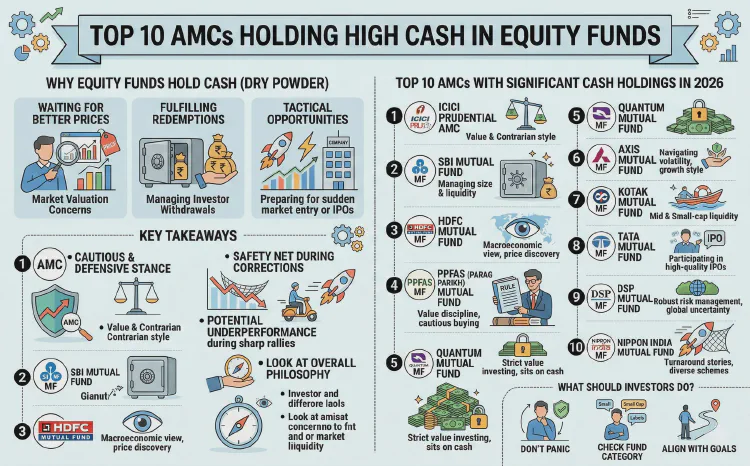
The best AMC for mutual fund investors seeking defensive cash management depends on market valuations, with disciplined fund houses like Parag Parikh (PPFAS), ICICI Prudential, and Quantum Mutual Fund historically holding between 5% and 15% in cash equivalents to cushion drawdowns and seize tactical buying opportunities. When an equity fund manager holds a portion of investor capital in liquid instruments rather than buying equities, it represents a deliberate risk-management decision rather than an oversight.
In the Indian mutual fund landscape as of 2026, benchmark equity indices have reached elevated valuation multiples, prompting several chief investment officers (CIOs) to exercise caution. While retail investors commit steady monthly inflows through Systematic Investment Plans (SIPs), professional portfolio managers often face a dilemma: deploy fresh cash into stretched balance sheets or preserve capital until better entry valuations emerge. Readers tracking portfolio analytics on NV Trends frequently ask whether sitting on cash erodes returns or acts as an essential buffer against volatility.
Evaluating mutual fund cash holding data provides an unvarnished view of institutional market sentiment. By dissecting monthly portfolio disclosures mandated by the Securities and Exchange Board of India (SEBI), smart investors can identify how top-tier asset management companies navigate market cycles, manage sudden liquidity spikes, and deploy capital when broader markets experience corrections.
Key takeaways
- High mutual fund cash holdings reflect a manager’s defensive stance, prioritizing capital preservation over chasing overvalued equities during market highs.
- Fund houses deploy cash reserves into Tri-Party Repos (TREPS) and overnight instruments earning safe, short-term yields denominated in Rs. rather than leaving money idle in bank deposits.
- While elevated cash buffers downside volatility during corrections, it creates “cash drag” that can cause a scheme to lag behind its benchmark index during strong momentum rallies.
- Analyzing mutual fund cash holding data across different fund categories helps investors determine whether a fund house’s philosophy aligns with their personal risk tolerance.
Understanding Mutual Fund Cash Holding Data in India
Before assessing individual fund houses, investors must clarify what mutual fund cash holding data actually measures. In an equity mutual fund, holding “cash” does not mean physical currency or non-earning current accounts. According to reporting guidelines framed by the Association of Mutual Funds in India (AMFI), cash and cash equivalents primarily comprise:
- Tri-Party Repo (TREPS): Short-term collateralized borrowing and lending transactions managed through the Clearing Corporation of India (CCIL).
- Reverse Repo Agreements: Short-term sovereign-backed lending to the Reserve Bank of India or authorized primary dealers.
- Treasury Bills (T-Bills): Short-term sovereign debt instruments issued by the Government of India with maturities of 91, 182, or 364 days.
- Net Current Assets: Inflows from recent SIP cycles, pending settlement balances, and net accruals awaiting investment.
These instruments generate modest, steady money-market yields (often hovering between 6.0% and 6.8% annually as of 2026) while keeping the principal completely liquid. To explore broader portfolio distribution patterns, review our detailed guide on How Indian Mutual Funds Are Allocating Cash in 2026.
Why Do Mutual Fund AMCs Hold Elevated Cash Reserves?
Investors pay asset management fees expecting full exposure to growth equities. Consequently, discovering that an equity scheme holds 8%, 12%, or even 15% in liquid assets often triggers concern. However, institutional money managers maintain high cash balances for four strategic reasons:
1. Market Valuation and Lack of Margin of Safety
When stock prices trade significantly higher than their historic price-to-earnings (P/E) and price-to-book (P/B) averages, value-oriented fund managers struggle to find businesses offering a reasonable margin of safety. Rather than buying shares at peak multiples just to remain fully invested, disciplined fund managers preserve cash to avoid permanent capital destruction during subsequent multiple contractions.
2. Managing Liquidity in Volatile Market Segments
Liquidity risk escalates rapidly outside the large-cap spectrum. If mid-cap or small-cap stocks experience panic selling, trading volumes dry up instantly. If an AMC maintains a 10% cash buffer, it can comfortably meet large investor redemptions in Rs. without liquidating high-conviction mid-cap positions at distressed valuations. For more on navigating high-volatility holdings, examine our analysis of Top 5 Mid Cap Fund Picks for High Growth in 2026.
3. Exploiting Tactical Opportunities and Primary Markets
Ready liquidity—often referred to as “dry powder”—allows an AMC to act decisively during unexpected market shocks. Whether participating in large Qualified Institutional Placements (QIPs), taking anchor allocations in prominent Initial Public Offerings (IPOs), or absorbing block deals at substantial institutional discounts, liquid funds allow managers to deploy hundreds of crores within minutes.
4. Continuous SIP Inflow Absorption
Top AMCs in India receive billions of rupees each month through automated SIP channels. When market momentum temporarily detaches from underlying corporate earnings, absorbing these continuous cash flows without driving stock prices upward requires temporary parking in overnight instruments until strategic entry points open.
Mutual Fund Cash Holding Data: Top 10 AMCs in 2026
The following comparison table highlights typical equity cash holding ranges, primary investment styles, and tactical deployment strategies across ten leading Indian asset management companies based on published monthly portfolio disclosures as of 2026.
| AMC Name | Flagship Equity Category Example | Typical Cash Holding Range (%) as of 2026 | Core Investment Style | Primary Strategic Purpose for Cash |
|---|---|---|---|---|
| ICICI Prudential AMC | Multi-Asset / Value Discovery | 7% – 14% | Contrarian & Value | Tactical hedging, counter-cyclical buying |
| SBI Mutual Fund | Flexi Cap / Large & Mid Cap | 5% – 10% | Growth at Reasonable Price (GARP) | Absorbing massive SIP inflows, liquidity management |
| HDFC Mutual Fund | Flexi Cap / Focused Equity | 6% – 11% | Macro-Driven & Value | Price discovery patience, selective accumulation |
| PPFAS Mutual Fund | Flexi Cap Fund | 10% – 18% | Disciplined Value / Global Diversification | Awaiting strict valuation entry points |
| Quantum Mutual Fund | Long Term Equity Value | 12% – 25% | Pure Unconstrained Value | Absolute downside protection, margin of safety |
| Axis Mutual Fund | Large Cap / Growth Opportunities | 4% – 8% | Quality Growth | Mitigating short-term volatility, protecting past alpha |
| Kotak Mutual Fund | Emerging Equity (Mid Cap) | 6% – 12% | Tactical / Bottom-Up Selection | Managing mid-cap liquidity, primary market entries |
| Tata Mutual Fund | Large & Mid Cap / Focused | 5% – 9% | Growth & Thematic | Participation in primary issuances and block deals |
| DSP Mutual Fund | Flexi Cap / Focus Fund | 6% – 10% | Risk-Managed Quality | Hedging macroeconomic shocks and interest-rate swings |
| Nippon India Mutual Fund | Multi Cap / Small Cap | 5% – 11% | Dynamic Growth / Turnaround | Buffering volatile small-cap redemption cycles |
Breakdown of the Top 10 Mutual Fund AMCs Holding High Cash
Understanding the distinct institutional philosophy behind each AMC helps investors distinguish between prudent risk control and unproductive cash drag.
1. ICICI Prudential AMC
ICICI Prudential AMC has established its reputation around counter-cyclical investing and dynamic asset allocation models. The fund house regularly increases cash allocations when market indicators indicate extreme investor greed. Historically, ICICI Prudential’s readiness to build cash buffers before market peaks has enabled its equity desks to deploy significant resources during deep market drawdowns, helping long-term investors capture attractive risk-adjusted returns across complete economic cycles.
2. SBI Mutual Fund
As India’s largest asset management company by total Assets Under Management (AUM), SBI Mutual Fund handles an immense quantum of retail capital. When dealing with portfolios managing tens of thousands of crores in Rs., deploying fresh capital instantly into secondary markets without triggering price surges is virtually impossible. SBI AMC routinely uses cash buffers between 5% and 10% to orchestrate phased buying, ensuring that large execution block orders do not inflate market prices.
3. HDFC Mutual Fund
HDFC Mutual Fund utilizes an investment approach grounded in macroeconomic analysis and fundamental business valuation. In select concentrated schemes, HDFC portfolio managers have historically held higher cash balances when corporate earnings growth failed to justify prevailing index multiples. This patient posture ensures that capital is deployed only when clear corporate earnings visibility aligns with realistic entry valuations.
4. PPFAS (Parag Parikh) Mutual Fund
Parag Parikh Flexi Cap Fund is renowned among retail investors for its strict adherence to value investing principles. The fund management team maintains that investor money should never be forced into suboptimal equity bets simply to maintain an arbitrary equity allocation percentage. PPFAS frequently holds between 10% and 18% of scheme assets in cash equivalents, arbitrage positions, and TREPS when stock valuations in domestic and permissible international markets appear stretched.
5. Quantum Mutual Fund
Quantum Mutual Fund follows the most conservative cash mandate in the Indian mutual fund industry. Practicing unconstrained value investing, Quantum’s fund managers operate with zero institutional pressure to stay 90% or 95% invested. If prevailing stock valuations breach their conservative safety models, published data shows their equity schemes holding upwards of 15% to 25% in liquid instruments for extended stretches, sacrificing short-term relative performance to ensure long-term capital preservation.
6. Axis Mutual Fund
Axis Mutual Fund’s core philosophy centers on high-quality secular growth businesses. During volatile phases or transitional economic cycles, the fund house has historically raised its cash allocation to insulate existing capital gains. By retaining modest tactical cash reserves of 4% to 8%, their equity teams reduce portfolio beta during macroeconomic uncertainty while retaining the capacity to average down on core high-conviction growth companies.
7. Kotak Mutual Fund
Kotak Mutual Fund actively deploys cash reserves as a tactical shock absorber, particularly across its mid-cap and small-cap offerings. Given the structural illiquidity of second-tier Indian equities during market sell-offs, Kotak’s equity desks use cash buffers to satisfy sudden institutional redemptions, entirely circumventing the need to dump thinly traded stocks in falling markets.
8. Tata Mutual Fund
Tata Mutual Fund has substantially expanded its institutional equity presence over recent years. Their investment management strategy involves keeping a dedicated cash reserve to participate in India’s booming primary capital markets. Having ready liquidity allows Tata’s portfolio managers to participate as anchor investors in quality IPO offerings and pre-placement institutional rounds without liquidating existing secondary market holdings.
9. DSP Mutual Fund
DSP Mutual Fund operates sophisticated quantitative risk-management models that actively monitor global macroeconomic indicators, currency fluctuations, and interest-rate trajectories. When international market headwinds suggest rising volatility, DSP funds deliberately increase their liquid holdings, utilizing dry powder as an explicit hedge against geopolitical and global inflationary disruptions.
10. Nippon India Mutual Fund
Nippon India Mutual Fund manages an expansive suite of diversified equity schemes across aggressive growth, turnaround, and small-cap themes. Because its schemes often attract momentum-oriented retail flows, the fund house maintains tactical cash allocations to navigate high-beta market swings smoothly, allowing managers to absorb sudden market dips and acquire turnaround candidates at sensible prices.
Cash Drag vs. Capital Protection: Trade-offs for Investors
Understanding the trade-offs of elevated cash reserves requires evaluating performance across alternating market environments. Cash holding is neither universally advantageous nor inherently flawed; it is a double-edged sword that performs differently depending on market direction.
The Cost of Cash Drag in a Bull Run
When markets enter an aggressive liquidity-driven bull phase, elevated cash levels inevitably handicap a fund’s performance. For instance, consider an equity fund managing Rs. 10,000 crore that holds a 15% cash reserve (Rs. 1,500 crore) parked in TREPS yielding 6.5% annually. If the underlying equity market rallies by 25% over a twelve-month span, the fund’s cash component generates only 6.5%, pulling overall portfolio return down to 22.2%—a cash drag of 2.8% relative to a fully invested 100% equity portfolio. Investors who hold cash-heavy funds during explosive bull runs often experience frustration as their schemes trail benchmark indices.
Downside Protection in a Market Correction
Conversely, when market exuberance unwinds and benchmark indices decline by 15%, that same 15% cash allocation acts as an invaluable cushion. The liquid portion retains its full nominal value while generating steady interest, reducing the fund’s total drawdown to approximately 11.8%. More importantly, the fund manager holds liquid Rs. 1,500 crore ready to acquire blue-chip shares from distressed sellers at substantial discounts, establishing a springboard for outsized compounding when the market eventually recovers. To prevent excessive risk accumulation across multiple equity funds, consult our practical guide on How to Avoid Overexposure in Equity Funds.
How to Choose the Best AMC for Mutual Fund Portfolios
Selecting the best AMC for mutual fund investing requires aligning an asset manager’s cash-management philosophy with your personal financial timeline and temperament:
                      Do you prefer aggressive growth or capital preservation?
                                              │
                      ┌───────────────────────┴───────────────────────┐
                      ▼                                               ▼
            Aggressive Growth                               Capital Preservation
       (Wants 95%+ Equity Exposure)                      (Comfortable with Cash Cushions)
                      │                                               │
    Look for Momentum/GARP AMCs                     Look for Value/Contrarian AMCs
    (e.g., Nippon India, Axis AMC)                  (e.g., PPFAS, Quantum, ICICI Pru)
                      │                                               │
    • Minimal cash drag during rallies              • Cushions drawdowns during crashes
    • Higher portfolio volatility                   • Tactical dry powder for corrections
- Verify the Scheme Information Document (SID): Every equity mutual fund operates under regulatory asset-allocation boundaries specified in its SID. Pure equity schemes typically commit at least 65% or 80% to equities to maintain domestic equity tax status under Indian tax laws, allowing up to 20% to 35% in debt or money-market instruments. Confirm whether your fund’s cash allocation is a temporary tactical measure or an authorized structural strategy.
- Review Long-Term Downside Capture Ratios: Independent research platforms like Value Research publish downside capture ratios for mutual fund schemes. A downside capture ratio below 80 indicates that the fund historically suffered only 80% of the benchmark’s losses during market downswings, often driven by proactive cash management.
- Assess Expense Ratio Efficiency: Retail investors pay an annual Total Expense Ratio (TER) between 0.50% and 1.75% for active portfolio management. If an AMC sits on 15% cash over multiple quarters, investors are effectively paying equity management fees on cash parked in money-market instruments. Ensure the manager demonstrates a proven track record of deploying that cash effectively during market downturns.
- Avoid Trying to Time the Fund Manager: Avoid switching out of cash-heavy funds simply because markets are climbing. Moving money back and forth between cash-conservative and fully invested funds triggers short-term capital gains taxes and exit loads, ultimately eroding overall compounding.
FAQ
Which is the best AMC for mutual fund investors seeking defensive cash management?
Parag Parikh Financial Advisory Services (PPFAS) and ICICI Prudential AMC are widely regarded as two of the most disciplined fund houses for defensive cash management in India. Both AMCs have demonstrated a long-term track record of holding significant liquid reserves during market exuberance, deploying dry powder into high-quality equities during broader market sell-offs.
Where can investors find mutual fund cash holding data?
Investors can track official mutual fund cash holding data directly through monthly portfolio disclosures published on the websites of respective AMCs and AMFI India. Furthermore, financial analytics portals such as Value Research, Morningstar India, and Moneycontrol aggregate and update these cash percentages monthly under scheme asset allocation profiles.
Why do mutual fund AMCs hold cash instead of buying equities?
Mutual fund AMCs hold cash to manage downside risk when equity valuations appear stretched, to handle daily redemption requests without fire-selling core stock holdings, and to preserve dry powder for tactical primary market opportunities like IPOs and block deals. Holding cash in short-term instruments like TREPS also generates modest interest while keeping capital fully liquid.
How do the best AMCs consider money allocation between cash and stocks?
The best AMCs consider money allocation by evaluating macroeconomic indicators, historical price-to-earnings valuations, and bottom-up corporate earnings yields against prevailing fixed-income returns. When the prospective return on incremental equity purchases fails to provide an adequate margin of safety over risk-free instruments, prudent managers increase cash allocations until sensible entry points reappear.
Does holding high cash affect the equity tax status of a mutual fund scheme in India?
As long as an equity scheme maintains an average annual allocation of at least 65% in domestic listed equities, it qualifies for equity capital gains tax rates under Section 112A of the Income Tax Act. Therefore, holding 10% to 25% in cash equivalents or debt instruments does not jeopardize the scheme’s preferential equity taxation status.
Conclusion
Elevated cash holdings among India’s top AMCs reflect prudent institutional discipline in a maturing equity market. While retail investors may instinctively view cash reserves as an unhelpful drag on performance during strong market rallies, professional money managers understand that capital preservation during market peaks is what creates sustainable, multi-decade compounding.
When evaluating mutual fund cash holding data across the top 10 AMCs as of 2026, evaluate your individual financial objectives. If you prioritize capital preservation and lower portfolio drawdown during corrections, funds that maintain disciplined cash buffers offer a significantly smoother investment journey. Always review your asset allocation periodically and consult a SEBI-registered investment advisor to ensure your equity fund choices remain aligned with your long-term financial roadmap.
- Tags:
- Best Amc for Mutual Fund
- Mutual Fund Cash Holding
- Mutual Fund Amcs
- Mutual Fund Cash Holding Data
- Equity Mutual Funds
- Indian Stock Market