
Top Performing Equity Funds FY26: Top 10 Schemes
Explore the top performing equity funds FY26 in India, compare 1-year returns, analyze risk profiles, and build a resilient long-term portfolio.

- NV Trends
- 15 min read
- Updated
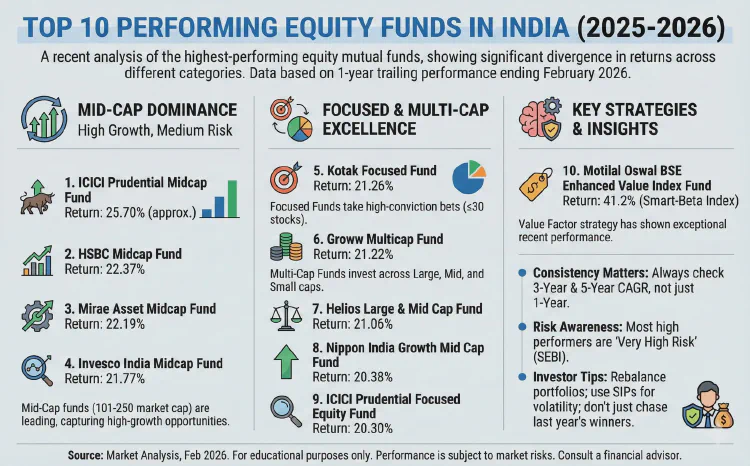
The top performing equity funds FY26 in the Indian mutual fund landscape are led by smart-beta value and mid-cap equity strategies, with standout schemes delivering between 20.30% and 41.20% in trailing one-year returns as of 2026.
The Indian equity market throughout 2025 and 2026 has witnessed a pronounced divergence across market capitalizations and investment styles. While benchmark indices like the Nifty 50 and S&P BSE Sensex demonstrated steady baseline compounding, active fund managers uncovered substantial alpha in mid-sized enterprises benefiting from corporate capital expenditures, domestic manufacturing, and financial services expansion. At the same time, retail participation through Systematic Investment Plans (SIPs) reached historic highs, creating robust domestic liquidity that cushioned intermittent market corrections and funded high-conviction portfolios.
However, market performance across mutual fund categories has not been uniform. In contrast to the broad-based small-cap rallies seen in preceding years, small-cap schemes faced heightened volatility and valuation compression in 2026, with several funds reporting muted or slightly negative annual returns. Conversely, mid-cap funds emerged as the clear frontrunners, capturing corporate earnings expansion while mitigating the severe drawdown risks common to micro-cap counters. Concurrently, focused equity funds and factor-based smart-beta index funds demonstrated that strategic concentration and value tilts could outstrip traditional blended strategies by wide margins.
For Indian wealth builders, navigating this environment requires looking beyond simple historical return numbers. Based on published data from the Association of Mutual Funds in India (AMFI) and leading portfolio tracking databases such as Value Research, category dispersion remains substantial—meaning the gap between top-quartile performers and median fund managers can exceed 600 to 1,000 basis points. In this detailed guide, we evaluate the 10 top performing equity funds FY26, examining their portfolio construction, risk profiles, and what practical lessons retail investors should apply when building their portfolios.
Key takeaways
- Mid-Caps Outperformed the Broader Market: Five of the top ten active equity schemes in FY26 belong to the mid-cap category, led by ICICI Prudential Midcap Fund delivering a 25.70% one-year return as of 2026.
- Smart-Beta Value Surged Ahead: The Motilal Oswal BSE Enhanced Value Index Fund emerged as an exceptional outperformer with a 41.20% trailing return, proving the strength of factor-based value rotation over momentum.
- High-Conviction Portfolios Delivered Alpha: Focused funds like Kotak Focused Fund (21.26%) and ICICI Prudential Focused Equity Fund (20.30%) demonstrated that holding fewer than 30 quality stocks can produce superior returns during fragmented rallies.
- Category Dispersion Is Significant: Category median returns hovered between 14% and 15%, while small-cap funds struggled, underscoring that blind fund selection can severely undermine portfolio returns.
- Asset Allocation Over Return Chasing: Every fund on the top-performer list carries a “Very High Risk” rating under SEBI classification; investors should deploy SIPs, maintain portfolio diversification, and commit to an investment horizon of at least 5 to 7 years.
Which Are the Top Performing Equity Funds FY26 in India?
Identifying the top performing equity funds FY26 requires examining trailing annual returns, portfolio mandates, and category risk metrics. The funds featured below represent the highest-performing equity schemes across the Indian mutual fund landscape over a one-year trailing period ending early 2026.
The table below summarizes the 10 top performing equity schemes, their primary investment strategies, and their standardized risk classifications according to the Securities and Exchange Board of India (SEBI) guidelines:
| Scheme Name | Fund Category | 1-Yr Trailing Return (as of 2026) | Value of Rs. 1 Lakh Investment | Core Portfolio Strategy | SEBI Riskometer |
|---|---|---|---|---|---|
| Motilal Oswal BSE Enhanced Value Index Fund | Factor / Smart-Beta | 41.20% | Rs. 1,41,200 | Rule-based value factor (low P/E, low P/B, high dividend yield) | Very High |
| ICICI Prudential Midcap Fund | Mid Cap | 25.70% | Rs. 1,25,700 | Overweight manufacturing, capital goods, and financial services | Very High |
| HSBC Midcap Fund | Mid Cap | 22.37% | Rs. 1,22,370 | High-operating-leverage market leaders in emerging industries | Very High |
| Mirae Asset Midcap Fund | Mid Cap | 22.19% | Rs. 1,22,190 | Growth at a Reasonable Price (GARP) with strict cash-flow filters | Very High |
| Invesco India Midcap Fund | Mid Cap | 21.77% | Rs. 1,21,770 | Bottom-up stock selection focusing on capital efficiency | Very High |
| Kotak Focused Fund | Focused Equity | 21.26% | Rs. 1,21,260 | High-conviction portfolio restricted to maximum 30 stocks | Very High |
| Groww Multicap Fund | Multi Cap | 21.22% | Rs. 1,21,220 | Mandatory minimum 25% allocation across large, mid, and small caps | Very High |
| Helios Large & Mid Cap Fund | Large & Mid Cap | 21.06% | Rs. 1,21,060 | Blended mandate balancing large-cap stability with mid-cap upside | Very High |
| Nippon India Growth Mid Cap Fund | Mid Cap | 20.38% | Rs. 1,20,380 | Institutional-scale execution across high-growth domestic franchises | Very High |
| ICICI Prudential Focused Equity Fund | Focused Equity | 20.30% | Rs. 1,20,300 | Concentrated contrarian bets across select cyclical and defensive themes | Very High |
As the data illustrates, active management delivered compelling outcomes when paired with mid-sized growth or high-conviction mandates. At the same time, passive factor investing demonstrated that rule-based models can exploit valuation mispricings just as aggressively as seasoned fund managers.
Detailed Breakdown of the Top Performing Equity Funds FY26
Understanding what drove the performance of these 10 schemes allows investors to evaluate whether the underlying alpha is sustainable or driven by temporary cyclical tailwinds.
1. Motilal Oswal BSE Enhanced Value Index Fund (41.20%)
Topping the entire equity universe in trailing one-year gains, this smart-beta index fund delivered a remarkable 41.20% return. The scheme tracks the BSE Enhanced Value Index, which ranks companies using factor weights based on price-to-earnings (P/E), price-to-book (P/B), and dividend yield.
The fund benefited from a massive re-rating across public sector enterprises (PSUs), energy producers, power utilities, and heavy engineering firms throughout 2025 and 2026. Because factor-based indexing systematically rebalances into unloved, deeply discounted stocks and trims expensive momentum names, it captured the cyclical expansion cycle without emotional friction. However, investors must note that pure value strategies carry cyclical drawdowns; when market sentiment pivots back to premium growth equities, value index funds can endure extended periods of underperformance.
2. ICICI Prudential Midcap Fund (25.70%)
Leading all actively managed equity schemes over the trailing one-year period, the ICICI Prudential Midcap Fund generated a 25.70% return on lumpsum investments. A capital outlay of Rs. 1 lakh made in early 2025 expanded to approximately Rs. 1.25 lakh by 2026.
The scheme’s outperformance stems largely from its proactive positioning in domestic manufacturing, industrial automation, and non-banking financial companies (NBFCs). By identifying businesses with strong domestic order books before broader institutional consensus formed, the fund manager generated substantial alpha over the Nifty Midcap 150 benchmark. Investors looking for deeper insights into sector weights can review our curated guide on the Top 5 Mid Cap Fund Picks for High Growth in 2026.
3. HSBC Midcap Fund (22.37%)
The HSBC Midcap Fund followed closely with an annual return of 22.37%. The fund manager focused on mid-tier enterprises exhibiting high operating leverage—enterprises where incremental revenue translates directly into accelerated operating margins. The fund’s consistent discipline in weeding out debt-heavy businesses provided downside protection during intermittent market pullbacks, demonstrating that risk management and aggressive capital appreciation can coexist effectively.
4. Mirae Asset Midcap Fund (22.19%)
Holding a top active spot with a 22.19% gain, the Mirae Asset Midcap Fund highlights the resilience of the “Growth at a Reasonable Price” (GARP) philosophy. In a market where certain growth stocks reached unsustainable multiples, Mirae Asset’s portfolio managers filtered candidates through rigorous valuation screens, ensuring they did not overpay for future earnings. This valuation discipline insulated the fund when expensive growth stocks suffered brief re-ratings.
5. Invesco India Midcap Fund (21.77%)
Delivering a 21.77% annual return, the Invesco India Midcap Fund achieved consistent gains through a bottom-up stock selection process focused on return on equity (RoE) and return on capital employed (RoCE). The fund held strategic allocations in niche auto-ancillary suppliers, specialty chemicals, and emerging consumer brands that maintained pricing power despite elevated input costs.
6. Kotak Focused Fund (21.26%)
Under SEBI regulations, focused funds are restricted to holding a maximum of 30 stocks. Kotak Focused Fund utilized this compact mandate to deliver a 21.26% trailing return. By concentrating capital into high-conviction ideas across private banking, defense electronics, and consumer discretionary leaders, the portfolio eliminated benchmark dilution. When top convictions rallied, their high portfolio weights drove outsized fund-level performance.
7. Groww Multicap Fund (21.22%)
Multi-cap funds operate under a strict regulatory rule: they must maintain at least 25% allocation each in large caps, mid caps, and small caps at all times. Groww Multicap Fund leveraged this structural rebalancing requirement to return 21.22%. When small caps traded at demanding multiples, the fund reallocated capital toward undervalued mid caps and sturdy large caps, generating steady risk-adjusted returns across market tiers.
8. Helios Large & Mid Cap Fund (21.06%)
The Helios Large & Mid Cap Fund posted a 21.06% return by executing a balanced strategy that blends the balance-sheet stability of top-100 large-cap stocks with the high-growth trajectory of top-250 mid-caps. This barbell structure protected the portfolio during periods of institutional selling in mega-cap counters, while allowing mid-cap holdings to propel overall net asset value (NAV) expansion.
9. Nippon India Growth Mid Cap Fund (20.38%)
As one of India’s oldest and largest mid-cap mutual funds, the Nippon India Growth Mid Cap Fund demonstrated that large asset size does not necessarily impede alpha generation. Delivering a 20.38% return, the fund capitalized on deep research desks and institutional access, executing timely entry and exit strategies across high-growth domestic franchises.
10. ICICI Prudential Focused Equity Fund (20.30%)
Rounding out the top 10 list with a 20.30% gain, ICICI Prudential Focused Equity Fund deployed a high-conviction, contrarian approach. The fund manager took decisive positions in under-owned sectors such as healthcare and select export-oriented IT services, balancing cyclical domestic manufacturing plays with defensive portfolio stabilizers.
Why Did Mid-Cap and Factor Strategies Dominate FY26?
The dominance of mid-cap and smart-beta value schemes among the top performing equity funds FY26 reflects a structural phase in India’s economic cycle. According to SEBI classification standards, mid-cap funds must invest at least 65% of their total assets in companies ranked between 101 and 250 in terms of full market capitalization.
During 2025 and 2026, companies in this bracket captured the sweet spot of corporate expansion:
- Operating Leverage: Unlike large caps, which face growth moderation due to their massive revenue bases, mid-cap firms expanded revenues rapidly by capturing market share from unorganized competitors, capitalizing on government production-linked incentives (PLI), and executing domestic infrastructure contracts.
- Balance Sheet Resilience: Unlike micro-cap and small-cap firms, mid-caps maintained sound operating cash flows and balance-sheet strength, allowing them to absorb raw material price fluctuations without taking on distress debt.
- Small-Cap Valuation Compression: Between 2023 and 2024, extreme retail exuberance drove small-cap valuations to historic premiums over large caps. As earnings growth slowed in 2025 and 2026, small-cap multiples compressed sharply. Mid-cap managers, possessing superior liquidity and institutional support, preserved capital far more effectively.
- The Rise of Smart-Beta Factor Investing: Motilal Oswal’s 41.20% performance highlighted a structural transition in the Indian market. Passive factor funds eliminate human biases—such as holding onto losing growth stocks or hesitating to buy cyclical value counters. In an environment where market leadership rotated swiftly, systematic rule-based rebalancing captured value gains faster than active funds tied to traditional quality-growth mandates.
How to Build a Balanced Portfolio with Top Performing Equity Funds FY26
While looking at trailing returns of 20% to 41% is appealing, chasing top performers without a structured framework can lead to significant portfolio drawdowns. When market cycles pivot, last year’s top-performing schemes often become the slowest compounders.
1. Control Portfolio Overlap
A common error among retail investors is purchasing three or four top-performing mid-cap funds simultaneously. Because fund managers often target the same emerging industry leaders, holding multiple funds in the same category can create an overlap of 60% to 75%. This concentrates risk rather than diversifying it. To audit your holdings, review our detailed guide on How to Avoid Overexposure in Equity Funds.
2. Maintain an Asset Allocation Anchor
Equity funds cannot operate in isolation from your broader financial goals. High-performing equity funds experience periodic 10% to 20% corrections. Maintaining an allocation to fixed-income instruments, debt funds, or liquid assets ensures you have dry powder to deploy during market dips. To understand how to structure this balance, explore our comparison on Equity vs Debt Funds: Which One Should You Choose?.
The table below outlines practical asset allocation models across three investor profiles as of 2026:
| Investor Risk Profile | Core Large-Cap Allocation | Satellite Mid-Cap & Smart-Beta | Debt / Liquid Stability | Recommended Time Horizon |
|---|---|---|---|---|
| Aggressive Growth | 30% - 40% | 45% - 55% | 10% - 15% | 7+ Years |
| Moderate Balanced | 50% - 60% | 20% - 30% | 20% | 5 - 7 Years |
| Conservative Capital Protection | 60% - 70% | 10% - 15% | 20% - 30% | 3 - 5 Years |
3. Deploy Systematic Investment Plans (SIPs)
Every fund on the top-performer list carries a “Very High Risk” SEBI rating. Deploying lump-sum capital at cyclical highs can result in multi-month capital stagnation if a sector consolidation occurs. Committing to automated monthly SIPs averages out purchase costs across volatile market phases, allowing compounding to function without emotional interference.
Key Risk and Evaluation Metrics Beyond Trailing Returns
When evaluating mutual funds, past returns show where money was made, but risk metrics show how that return was generated. Before investing in any scheme among the top performing equity funds FY26, check these four parameters:
- Sharpe Ratio: Measures risk-adjusted returns by dividing excess portfolio returns over the risk-free rate (such as the 91-day Government of India Treasury bill) by the fund’s standard deviation. A higher Sharpe ratio indicates the manager earned excess returns without taking undue volatility risk.
- Sortino Ratio: While Sharpe ratio penalizes both upside and downside volatility, the Sortino ratio focuses exclusively on downside deviations. For mid-cap and focused funds, a high Sortino ratio confirms that the fund shields capital during sharp market selloffs.
- Portfolio Turnover Ratio (PTR): A PTR of over 100% indicates that the fund manager replaces the entire portfolio within a single year. While high turnover can generate short-term alpha during rapid sector rotations, it incurs higher transaction costs and trading drag compared to low-turnover, buy-and-hold strategies.
- Rolling Returns (3-Year and 5-Year): Trailing one-year returns can be distorted by a single exceptional quarter. Examining 3-year and 5-year rolling returns reveals whether the fund consistently outperforms its benchmark across bull, bear, and sideways market phases.
Capital Gains Taxation for Equity Mutual Funds in India as of 2026
Taxation has a direct impact on net investment compounding. Investors participating in Indian equity mutual funds must consider the prevailing tax provisions:
- Equity Fund Qualification: Under the Income Tax Act, a mutual fund scheme qualifies as an equity-oriented fund if it maintains a minimum of 65% of its total portfolio in domestic equity shares. All 10 schemes highlighted in this article meet this regulatory threshold.
- Short-Term Capital Gains (STCG): If equity mutual fund units are redeemed within a holding period of 12 months or less from the date of allocation, the realized profits are categorized as STCG and taxed at a flat rate of 20% (plus applicable surcharge and cess).
- Long-Term Capital Gains (LTCG): If units are held for more than 12 months before redemption, the profits are classified as LTCG. As of 2026, long-term capital gains up to Rs. 1.25 lakh in an individual financial year are completely exempt from tax. Realized gains exceeding Rs. 1.25 lakh in a fiscal year are taxed at a flat rate of 12.5% (plus surcharge and cess), without the benefit of indexation.
- Strategic Tax Harvesting: Astute investors can redeem units periodically near the end of the financial year to utilize the annual Rs. 1.25 lakh tax-free LTCG threshold, immediately reinvesting the proceeds to reset their purchase price base.
FAQ
What are the top performing equity funds FY26 in India?
Based on trailing one-year performance as of 2026, the top performing equity funds FY26 are led by Motilal Oswal BSE Enhanced Value Index Fund (41.20%), ICICI Prudential Midcap Fund (25.70%), HSBC Midcap Fund (22.37%), and Mirae Asset Midcap Fund (22.19%). Active mid-cap schemes, focused funds, and factor-based smart-beta value indices accounted for the vast majority of outperforming equity strategies.
Should investors select mutual funds based entirely on 1-year trailing returns?
No, selecting mutual funds purely on 1-year trailing returns is one of the most common mistakes made by retail investors. Trailing annual returns reflect past market cyclicality and can lead to performance chasing right before a sector peak. Investors should examine 3-year and 5-year rolling returns, Sharpe ratios, portfolio turnover, and category consistency before committing fresh capital.
Why did mid-cap funds outperform small-cap funds in FY26?
Mid-cap funds outperformed small-cap schemes in FY26 because mid-sized companies possessed stronger balance sheets, superior pricing power, and institutional liquidity to capitalize on domestic capital expenditure trends. In contrast, small caps entered FY26 trading at unsustainable valuation multiples after years of aggressive retail bidding, leading to multiple compression and muted earnings growth.
What are the taxation rules on gains from top performing equity funds as of 2026?
Under current Indian income tax provisions as of 2026, gains from equity funds held for 12 months or less are classified as short-term capital gains (STCG) and taxed at 20%. Units held for more than 12 months attract long-term capital gains (LTCG) tax at 12.5% on gains exceeding the annual exemption limit of Rs. 1.25 lakh per financial year.
Is an SIP preferable to a lump sum for volatile equity funds in FY26?
Yes, investing via Systematic Investment Plans (SIPs) is generally recommended for mid-cap, focused, and smart-beta funds that carry a “Very High Risk” SEBI classification. Staggering contributions across monthly intervals removes market-timing risk and averages down your cost per unit during temporary equity corrections.
Conclusion
The landscape of top performing equity funds FY26 demonstrates that disciplined portfolio construction—whether executed through active mid-cap research or systematic smart-beta factor indexing—can generate remarkable wealth for Indian investors. Standout funds like Motilal Oswal BSE Enhanced Value Index Fund and ICICI Prudential Midcap Fund capitalized on India’s industrial, infrastructural, and financial expansion, rewarding investors who stayed aligned with domestic growth drivers.
However, outstanding past performance does not eliminate downside volatility. As you build your investment portfolio, avoid duplicating fund mandates, verify expense ratios and risk ratios, and maintain a diversified asset allocation between equities and fixed-income assets. By anchoring your portfolio with consistent monthly SIPs and committing to a 5- to 7-year investment horizon, you can navigate market cycles effectively and achieve sustained, long-term financial freedom.
- Tags:
- Equity Mutual Funds
- Mid Cap Funds
- Smart Beta
- Mutual Fund Returns
- Sip Investing
- Personal Finance