
Index Funds in India: How They Work and How to Buy
Understand how index funds work in India, evaluate tracking errors and expense ratios, and follow a practical guide to buying them via SIPs.

- NV Trends
- 18 min read
An index fund in India is a passive mutual fund scheme that mirrors the composition and performance of a specific benchmark index—such as the Nifty 50 or BSE Sensex—by investing in the exact same underlying securities in identical proportions. Unlike actively managed funds, where a fund manager routinely selects stocks, adjusts allocations, and attempts to beat the market, an index fund simply tracks its chosen index. The investor receives market-matching returns minus a small administrative fee known as the expense ratio.
Passive investing has experienced substantial adoption across the Indian financial ecosystem. As market efficiency improves in the large-cap segment, institutional research and strict regulatory oversight have made it increasingly difficult for active fund managers to generate consistent alpha (excess returns over the benchmark) after factoring in transaction costs and management fees. Regulatory directives by the Securities and Exchange Board of India (SEBI) mandating Total Return Index (TRI) benchmarking and standard scheme categorisation have made performance comparisons transparent, prompting retail and institutional investors alike to evaluate low-cost passive alternatives.
Whether you are starting your investment journey with a monthly systematic investment plan (SIP) of Rs. 500 or allocating large lump sums across core asset classes, index funds offer an automated, rule-based approach to wealth creation. Achieving good long-term outcomes, however, requires understanding critical metrics like tracking error, direct vs. regular expense structures, portfolio overlap, and capital gains taxation before deploying your capital.
Key takeaways
- Mechanical, rule-based investing: Index funds replicate benchmark indices like the Nifty 50 or Sensex without discretionary stock-picking or fund manager bias.
- Substantially lower costs: Direct index fund schemes in India feature Total Expense Ratios (TER) typically between 0.05% and 0.30%, compared to 0.70% to 1.50% for active large-cap equity funds.
- Performance efficiency: Long-term market data indicates that a majority of Indian active large-cap mutual funds fail to beat their benchmark indices after fees.
- Two critical selection metrics: Always evaluate an index fund on Tracking Difference (TD) and Tracking Error (TE) alongside its expense ratio, rather than past short-term returns alone.
What Is an Index Fund and How Does It Work in India?
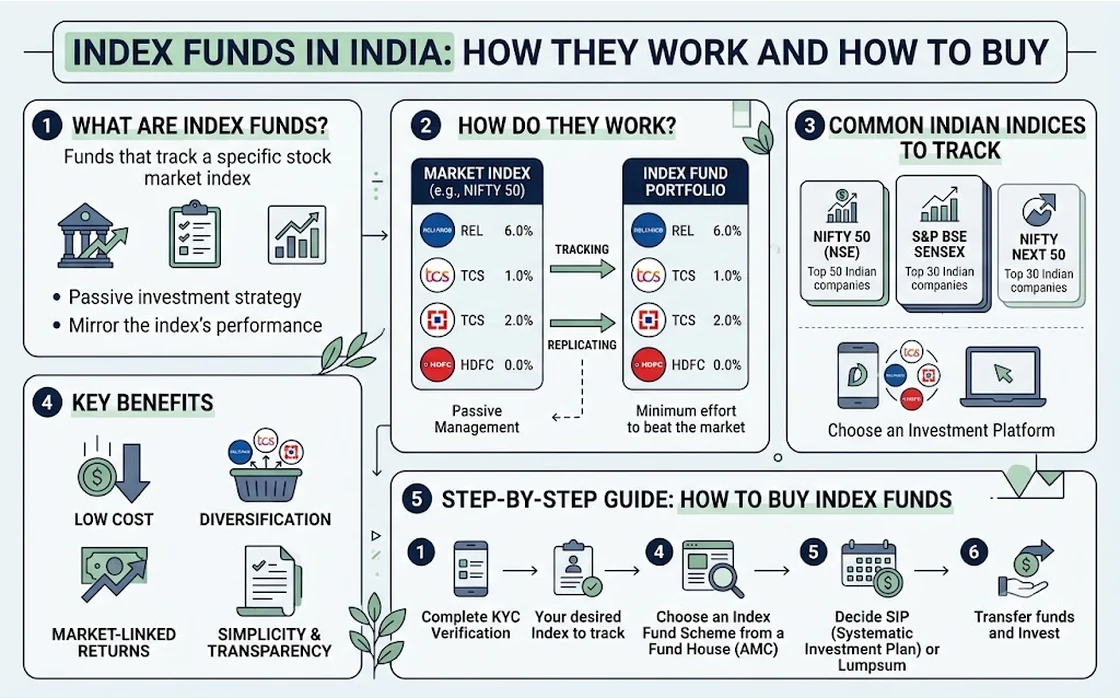
At its core, an index fund operates on a straightforward mathematical principle: replication. An equity benchmark like the Nifty 50 represents the weighted performance of 50 of the largest and most liquid companies listed on the National Stock Exchange of India (NSE). When an Asset Management Company (AMC) launches a Nifty 50 Index Fund, its mandate is to collect capital from unit holders and purchase shares of those 50 companies in the precise weightings assigned by the index methodology.
Investor Capital ---> AMC Index Fund Pool ---> Purchases Underlying Index Basket
                                                - Stock A (e.g., 10.2% weight)
                                                - Stock B (e.g., 8.5% weight)
                                                - ...
                                                - Stock N (e.g., 0.5% weight)
If HDFC Bank carries an 11% weight in the Nifty 50 and Reliance Industries carries an 8.5% weight, the fund allocates approximately 11% and 8.5% of its investable corpus to these stocks respectively. The fund manager does not forecast corporate earnings, decide when to trim an outperforming stock, or attempt to hold cash during perceived market corrections.
How Cash Flows and Rebalancing Work
An index fund experiences ongoing cash inflows (new investments and SIPs) and redemptions daily. Here is how AMCs handle underlying operations:
- Daily Subscriptions and Redemptions: When investors buy units, the fund manager purchases the proportional basket of index securities. When redemptions occur, shares are sold proportionally to generate liquidity.
- Cash Drag Management: AMCs hold a tiny buffer of liquid assets (typically 0.2% to 1%) in overnight securities or tri-party repos (TREPS) to handle day-to-day redemptions without disrupting the stock portfolio. Minimising this uninvested cash buffer is critical to avoiding “cash drag” during rapid market rallies.
- Index Reconstitution: Benchmark indices are not static. The NSE and BSE indices undergo scheduled semi-annual rebalancing (typically announced in February/August and executed in March/September). When the index committee adds or drops a constituent, the fund manager executes corresponding buy and sell trades on the effective date to realign the scheme with the revised index.
- Dividends Reinvestment: Under SEBI guidelines, mutual fund schemes are benchmarked against the Total Return Index (TRI). When underlying companies pay dividends, the cash received by the fund is immediately reinvested into the index constituents, reflecting directly in the scheme’s Net Asset Value (NAV).
Active Mutual Funds vs. Index Funds: Key Trade-offs
The decision between active and passive mutual funds centres on the trade-off between cost, risk of underperformance, and the potential for market-beating returns (alpha).
In actively managed equity funds, an investment team conducts fundamental analysis, interviews company management, and constructs a concentrated portfolio (typically 30 to 60 stocks). Investors pay a higher fee for this expertise. If the fund manager selects winners, the fund can outperform its benchmark. However, investors face manager risk—the probability that the manager makes incorrect calls, experiences style drift, or leaves the fund house altogether. For a deeper look into identifying manager risk and evaluating performance attribution, read our Fund Manager Performance Analysis: Evaluation Guide.
Published research from the S&P Indices Versus Active (SPIVA) India Scorecard has consistently shown that over 3, 5, and 10-year investment horizons, more than 60% to 80% of Indian active large-cap funds fail to outperform their benchmark indices after fees. While active management can still add value in less-researched market tiers such as mid-caps and small-caps, large-cap blue-chip equities have become highly efficient.
| Feature | Active Equity Mutual Funds | Broad-Market Index Funds |
|---|---|---|
| Primary Objective | Generate alpha (beat the benchmark index) | Mirror index performance (zero intended alpha) |
| Portfolio Construction | Discretionary stock-picking based on research | 1:1 replication of index constituents and weights |
| Fund Manager Discretion | High (determines cash calls, sector bets, stock weights) | Negligible (mandated to follow index rules) |
| Direct Plan Expense Ratio (TER) | Typically 0.70% to 1.40% | Typically 0.05% to 0.30% |
| Manager / Strategy Risk | Present (manager can underperform for years) | Absent (tied purely to systematic market risk) |
| Style Drift | Possible (large-cap funds creeping into mid-caps) | Not possible (strictly bounded by index rulebook) |
| Tracking Error | Not applicable | Applicable (lower is better; ideally < 0.15%) |
| Best Suited For | Inefficient markets (small-caps, thematic strategies) | Core large-cap equity and passive broad-market allocation |
Popular Index Categories in the Indian Market
The Indian passive investing landscape extends well beyond the standard Nifty 50. AMCs offer index schemes tracking diverse market capitalisations, smart-beta factors, and fixed-income maturities.
                    Indian Index Fund Landscape
                                 |
     +---------------------------+---------------------------+
     |                           |                           |
Broad Market / Market Cap   Factor / Smart Beta         Fixed Income
 - Nifty 50 / Sensex         - Momentum (Nifty 200 Mom 30) - Target Maturity (SDL/G-Sec)
 - Nifty Next 50             - Low Volatility (Nifty 100 Low Vol 30) - Banking & PSU Debt Index
 - Nifty Midcap 150          - Value & Quality Factors
 - Nifty 500
1. Large-Cap Market Indices
- Nifty 50 and BSE Sensex: Represent the apex of corporate India. The Nifty 50 covers 50 major companies across over a dozen sectors, accounting for a dominant share of total free-float market capitalisation on Indian exchanges. These indices carry the lowest expense ratios and lowest tracking errors in the industry.
- Nifty Next 50: Represents companies ranked 51 to 100 by market capitalisation. Known as the “junior” index, it includes emerging sector leaders. While historically offering higher growth, it also exhibits greater volatility and cyclical drawdowns than the Nifty 50.
2. Broad-Market and Mid/Small-Cap Indices
- Nifty Midcap 150 and Nifty Smallcap 250: Track mid-sized and smaller listed entities. Unlike large-cap indices, mid-cap and small-cap passive funds experience higher impact costs and wider tracking errors because liquidity in individual underlying stocks can dry up during market stress. Investors who want higher risk-reward often compare these passive options against experienced stock-pickers; explore our analysis on Top 5 Mid Cap Fund Picks for High Growth in 2026 to see where active strategies remain relevant.
- Nifty 500: Provides full-spectrum domestic exposure, comprising the top 500 listed companies (representing over 90% of total market capitalisation). It automatically balances large, mid, and small-cap segments based on free-float rules.
3. Factor-Based (Smart Beta) Indices
Smart beta indices select and weight stocks using predetermined quantifiable metrics rather than pure market capitalisation. Examples include:
- Nifty 200 Momentum 30: Selects the top 30 stocks from the Nifty 200 universe with the highest price momentum over 6 and 12-month periods.
- Nifty 100 Low Volatility 30: Weights the 30 least volatile stocks in the top 100, aiming to reduce drawdowns in bear markets.
- Nifty 50 Value 20 (NV20): Focuses on high dividend yield, low P/E, and attractive price-to-book ratios.
Smart beta funds charge slightly higher expense ratios (0.30% to 0.60%) and can go through prolonged periods of underperformance when their specific factor is out of favour.
4. Target Maturity Debt Index Funds
Debt index funds replicate fixed-income benchmarks composed of Government of India securities (G-Secs), State Development Loans (SDLs), and AAA-rated public sector bonds. Target maturity index funds have a defined expiration year (e.g., 2028 or 2032). If held to maturity, they provide predictable returns closely matching their initial Yield to Maturity (YTM), eliminating active credit risk.
Critical Metrics to Evaluate Before Picking an Index Fund
Many investors mistakenly assume that because all Nifty 50 index funds hold the same stocks, they are all identical. In reality, net returns can differ meaningfully based on four primary metrics.
1. Total Expense Ratio (TER): Direct vs. Regular Plans
The Total Expense Ratio represents the annual percentage deducted from the fund’s assets to cover management, custody, marketing, and operational expenses. In passive investing, every basis point saved is direct return in your pocket.
Always choose the Direct Plan over the Regular Plan.
- In a Direct Plan, you invest without an intermediary, and the AMC charges only the operational fee (e.g., 0.10% to 0.20%).
- In a Regular Plan, the AMC deducts an extra 0.40% to 0.80% every year to pay trail commissions to the distributor or broker.
Compounding Impact of Expense Differences
Consider two investors, each investing Rs. 10,000 per month via SIP over a 20-year period, assuming the underlying Nifty 50 index delivers a gross return of 12.0% CAGR:
- Investor A (Direct Index Fund, TER 0.15%): Net return = 11.85% CAGR. Accumulated corpus after 20 years: ~Rs. 97.4 lakh. Total invested: Rs. 24 lakh.
- Investor B (Regular Index Fund, TER 0.85%): Net return = 11.15% CAGR. Accumulated corpus after 20 years: ~Rs. 89.1 lakh. Total invested: Rs. 24 lakh.
The seemingly small 0.70% annual fee difference results in an Rs. 8.3 lakh shortfall for Investor B on identical underlying market assets.
2. Tracking Difference (TD)
Tracking Difference is the absolute divergence between the cumulative return of the index fund and the cumulative return of the benchmark Total Return Index over a defined period (e.g., 1 year, 3 years, 5 years).
$$\text{Tracking Difference} = \text{Fund Return} - \text{Benchmark TRI Return}$$
Because index funds incur administrative expenses, cash drag, and transaction charges, the tracking difference is almost always negative. For instance, if the Nifty 50 TRI returned 14.50% over a 3-year period and Fund X returned 14.25%, the tracking difference is $-0.25%$. If an index fund has an expense ratio of 0.10% but exhibits a tracking difference of $-0.65%$, the fund is suffering from operational friction or execution inefficiencies.
3. Tracking Error (TE)
Tracking Error measures the consistency of the tracking difference. Mathematically, it is the annualized standard deviation of the daily return differences between the fund and the benchmark.
$$\text{Tracking Error} = \sigma(\text{Daily Fund Return} - \text{Daily Benchmark Return}) \times \sqrt{252}$$
- A fund can have a small tracking difference over one year simply by lucky offsetting errors, but a high tracking error reveals erratic daily replication.
- Rule of thumb: For large-cap indices like Nifty 50 or Sensex, target funds with an annualized tracking error below 0.10% to 0.15%. Data on tracking errors is published on AMC portals and the Association of Mutual Funds in India (AMFI) website in scheme factsheets.
4. Scheme Assets Under Management (AUM)
While active funds can become unwieldy with excessive AUM, index funds actually benefit from larger scale. A scheme with an AUM above Rs. 1,000 crore offers significant advantages:
- Daily redemptions form a smaller percentage of total assets, reducing the need to liquidate stocks prematurely.
- Fixed operational costs are distributed over a larger asset base, keeping the expense ratio lower.
- The fund manager can access better block-deal execution in the market, minimising impact costs.
Avoid newly launched index funds with tiny AUMs (e.g., under Rs. 100 crore) if established, low-cost alternatives tracking the identical index are available.
Index Funds vs. Exchange Traded Funds (ETFs)
Before investing, you must decide whether to buy an Index Mutual Fund or an Exchange Traded Fund (ETF). Both track underlying indices, but their operational structures differ.
+------------------------------------+------------------------------------+
|         Index Mutual Fund          |       Exchange Traded Fund (ETF)   |
+------------------------------------+------------------------------------+
| - Bought/sold via AMC or MF apps   | - Bought/sold on stock exchanges   |
| - Transactions executed at end-    | - Traded at real-time market price |
|   of-day NAV                       |   during exchange trading hours    |
| - No Demat account required        | - Demat & trading account required |
| - Automated SIPs via bank mandate  | - Manual orders or broker SIPs     |
| - Zero bid-ask spread risk         | - Potential premium/discount to NAV|
+------------------------------------+------------------------------------+
Which Option Should You Choose?
- Choose Index Funds if: You want automated, disciplined investing. You do not need to monitor intraday market movements, you want to set up an automatic monthly SIP debited directly from your bank account, and you prefer avoiding the hassle of Demat AMC charges or broker order placement. Transactions execute at the official end-of-day NAV, eliminating bid-ask spreads.
- Choose ETFs if: You already maintain an active trading account, understand limit orders, and wish to capitalise on sharp intraday market dips by purchasing units in real time. Be mindful that in illiquid Indian ETFs, the market price can diverge significantly from the underlying indicative NAV (iNAV), causing you to overpay when buying or sell at a discount.
How to Buy Index Funds in India: Step-by-Step
Purchasing an index fund in India is straightforward, fully digital, and requires no paperwork if your Know Your Customer (KYC) compliance is complete.
Step 1: Complete CKYC  ===>  Step 2: Choose Platform  ===>  Step 3: Select Scheme & Direct Plan  ===>  Step 4: Set Up SIP / Lump Sum
(PAN + Aadhaar verification)  (MF Central, AMC portal, app)  (Check low TER & low Tracking Error)      (Net banking / e-Mandate)
Step 1: Complete Central KYC (CKYC)
If you have never invested in Indian securities, you must complete your one-time KYC verification:
- Requirements: Permanent Account Number (PAN), Aadhaar number linked with an active mobile number (for OTP validation), a photograph, and a cancelled cheque or bank statement showing your IFSC code and account details.
- This process can be completed online via video-KYC (v-KYC) directly on any mutual fund AMC portal or SEBI-registered intermediary platform. Once verified, a Central KYC Identifier (CKYC Number) is issued.
Step 2: Select an Investment Platform (Direct Route)
To avoid unnecessary intermediary commissions, access Direct plans via:
- MF Central: The official joint platform built by CAMS and KFintech (the primary registrar and transfer agents in India), offering zero-commission Direct plans across all AMCs.
- Direct AMC Portals: You can open an account directly on individual fund house websites (e.g., UTI AMC, HDFC AMC, ICICI Prudential AMC, Nippon India AMC, Navi AMC).
- SEBI-Registered Execution-Only Platforms (EOPs) and Direct Apps: Digital platforms that provide direct mutual fund execution without charging distributor commissions.
Step 3: Identify the Right Scheme
Use the criteria discussed:
- Search for the benchmark: for example, type “Nifty 50 Index Fund”.
- Ensure you click on the Direct Plan - Growth Option. (Avoid the “IDCW” or Income Distribution cum Capital Withdrawal option, as dividends are distributed and taxed as income rather than compounding within the fund).
- Review the current TER and 3-year tracking error on the scheme factsheet.
Step 4: Choose Investment Method (SIP vs. Lump Sum)
- Systematic Investment Plan (SIP): Designate a fixed amount (e.g., Rs. 2,000 or Rs. 10,000) and choose a monthly debit date. Set up a digital mandate (e-Mandate via NPCI UPI Autopay or Net Banking). The amount will automatically debit on your chosen date, purchasing units at that day’s closing NAV.
- Lump Sum: If deploying accumulated savings or windfalls, you can make a one-time purchase. For large sums, you can also use a Systematic Transfer Plan (STP), parking capital in a liquid fund and moving a predetermined portion into the index fund each week or month.
Step 5: Ongoing Monitoring and Portfolio Rebalancing
Because index funds run on autopilot, they require far less hands-on oversight than active portfolios. However, you should periodically verify that your chosen scheme maintains a tight tracking error and that your asset allocation remains aligned with your goals. For practical tracking strategies and rebalancing frameworks, refer to our guide on How to Track Your Mutual Fund Performance.
Common Mistakes to Avoid When Investing in Indian Index Funds
Even in passive investing, poor execution or psychological traps can impair returns. Avoid these frequent missteps:
- Purchasing Sectoral or Thematic Index Funds for Core Wealth: AMCs frequently market index funds tracking cyclical themes, such as Nifty IT, Nifty Bank, or Nifty Auto. These are not broad market proxies. Investing heavily in a sectoral index exposes you to severe cyclicality and concentration risk. Keep sectoral indices to a tactical satellite allocation (under 10-15% of your portfolio), or avoid them altogether in favour of broad market indices.
- Accidentally Selecting Regular Plans: Third-party non-direct banking portals often default to Regular plans. Always verify that the word “Direct” appears explicitly in the scheme name on your statement of account (CAS).
- Over-Diversifying with Overlapping Index Schemes: Buying a Nifty 50 index fund from AMC A, a Sensex index fund from AMC B, and a large-cap active fund leads to extreme portfolio redundancy. The Nifty 50 and Sensex share over 80% portfolio overlap by weight. One single low-cost Nifty 50 or Nifty 500 index fund is sufficient for domestic large-cap exposure.
- Stopping SIPs During Market Corrections: When benchmark indices undergo 10% to 20% drawdowns, headline panic often prompts investors to pause their SIPs. A core premise of passive investing is rupee-cost averaging: market corrections allow your fixed monthly SIP to buy more units at lower NAVs, which accelerates compounding when the market eventually recovers.
- Ignoring Tracking Error in Favour of the Lowest Nominal TER: An AMC might advertise a rock-bottom TER of 0.05%, but due to poor trading desks, cash drag, or high redemption friction, its tracking error could be 0.40%. A fund with a slightly higher TER (0.10%) and an exceptional tracking error (0.05%) will often deliver higher net returns.
Taxation of Index Funds in India
Mutual fund taxation depends on the underlying asset allocation of the scheme. Under Indian tax regulations (updated under the Finance Act 2024 revisions):
Equity-Oriented Index Funds (Holding $\ge$ 65% Domestic Equities)
Schemes tracking indices like Nifty 50, Sensex, Nifty Next 50, or Nifty Midcap 150 qualify as equity mutual funds:
- Short-Term Capital Gains (STCG):
- Applicable when units are redeemed within 12 months of purchase.
- Taxed at a flat rate of 20% (plus applicable surcharge and cess).
- Long-Term Capital Gains (LTCG):
- Applicable when units are held for more than 12 months.
- Gains up to Rs. 1.25 lakh across all equity mutual funds and equity shares combined in a financial year are exempt from tax.
- Gains exceeding Rs. 1.25 lakh are taxed at 12.5% (plus applicable surcharge and cess) without the benefit of indexation.
Debt-Oriented Index Funds (Target Maturity & Fixed Income)
Schemes tracking G-Sec, SDL, or corporate bond indices with equity exposure below 35% are treated as debt funds:
- For units acquired on or after April 1, 2023, all capital gains (regardless of holding period) are added to the investor’s total taxable income and taxed at the applicable marginal income tax slab rate.
FAQ
Are index funds better than active mutual funds in India?
For large-cap equity investing, published data from SPIVA consistently shows that a majority of active mutual funds fail to beat benchmarks like the Nifty 50 and BSE 100 after fees over 5 to 10-year horizons. In mid-cap and small-cap segments, some active managers still generate alpha due to market inefficiencies, though low-cost broad index funds remain the most predictable, low-stress choice for long-term core wealth accumulation.
Do I need a Demat account to buy index funds?
No, a Demat account is not required to buy index mutual funds in India. You can purchase and redeem index fund units directly through the AMC website, MF Central, or direct mutual fund platforms using simple net banking or UPI. A Demat and trading account is only mandatory if you decide to buy Exchange Traded Funds (ETFs).
What is an acceptable tracking error for an Indian index fund?
For large-cap funds tracking the Nifty 50 or Sensex, an acceptable annualized tracking error is typically below 0.15%, with top-performing funds maintaining levels under 0.10%. For mid-cap, small-cap, or smart-beta index funds, tracking errors can range between 0.20% and 0.50% due to higher impact costs and lower constituent liquidity.
Can beginners start an SIP with Rs. 500 in an index fund?
Yes, most Indian AMCs allow investors to start a Systematic Investment Plan (SIP) in an index fund with as little as Rs. 100 to Rs. 500 per month. This accessibility makes index funds one of the most effective and democratic tools for retail wealth building, enabling rupee-cost averaging across India’s top 50 or 500 companies.
Which index fund is safest for long-term retirement savings?
Broad-market large-cap index funds tracking the Nifty 50 or BSE Sensex are considered the lowest-risk equity mutual funds because they represent the 30 to 50 largest, most stable corporations in India. While equities inherently experience short-term volatility, holding a broad-market index fund over a 10 to 15-year horizon has historically protected capital against inflation while delivering market returns.
Conclusion
Index funds have removed the guesswork, high fees, and manager-selection headaches from modern investing. By allocating capital directly into a transparent, rule-governed basket of India’s leading enterprises, you bypass the persistent risk of active underperformance and keep frictional costs at absolute industry lows.
For most individual investors, constructing an effective equity portfolio does not require predicting the next hot sector or chasing short-term market winners. A disciplined, monthly SIP in a broad-market Direct Index Fund—combined with patience, periodic asset rebalancing, and a long-term investment horizon—provides a robust foundation for building lasting financial security in the Indian economy.
- Tags:
- Index Funds
- Mutual Funds
- Investing in India
- Nifty 50
- Passive Investing
- Personal Finance