
Gold Mutual Fund vs SGB vs Physical Gold: Which to Pick?
Compare Gold Mutual Funds, SGBs, and physical gold across returns, liquidity, and taxes to choose the best gold asset for your portfolio.

- NV Trends
- 17 min read

Choosing between a Gold Mutual Fund, a Sovereign Gold Bond (SGB), and physical gold comes down to your primary objective: select SGBs for the highest post-tax returns over a long horizon, Gold Mutual Funds for liquidity and automated monthly SIPs, and physical gold strictly for immediate personal wear or ceremonial gifting. Each vehicle represents ownership of the same underlying yellow metal, yet their real-world outcomes diverge sharply once you account for holding costs, transaction friction, and tax liabilities under current Indian tax laws.
Gold has long served Indian households as both a cultural cornerstone and a financial safe haven against domestic inflation and currency depreciation. Historically, when equity markets encounter elevated volatility or geopolitical frictions escalate, capital regularly rotates into bullion. However, treating ornamental jewellery as a wealth-building tool often blinds investors to upfront deductions that permanently dilute compounding.
Modern Indian retail investors no longer need to accept locker rental fees, safety risks, or steep making charges to capture gold’s price appreciation. Paper and digital gold alternatives offer institutional-grade purity and direct alignment with spot domestic bullion prices. Evaluating these three routes requires looking past emotional appeal and analyzing them strictly across cost structures, yield mechanics, redemption speed, and statutory taxation.
Key takeaways
- Sovereign Gold Bonds deliver the highest net yield by pairing underlying gold appreciation with an additional 2.5% annual government coupon, alongside complete capital gains tax exemption if held to full sovereign maturity.
- Gold Mutual Funds provide unmatched convenience and flexibility, allowing investors to deploy systematic investment plans (SIPs) from as low as Rs. 100 per month without requiring a Demat account or locking away capital for years.
- Physical gold carries severe structural drag, where 3% Goods and Services Tax (GST) plus 8% to 25% making charges create an immediate negative hurdle rate of 11% to 28% on day one.
- Asset allocation should remain bounded, with financial planners generally recommending a 5% to 10% portfolio allocation to gold primarily for macroeconomic hedging rather than aggressive capital appreciation.
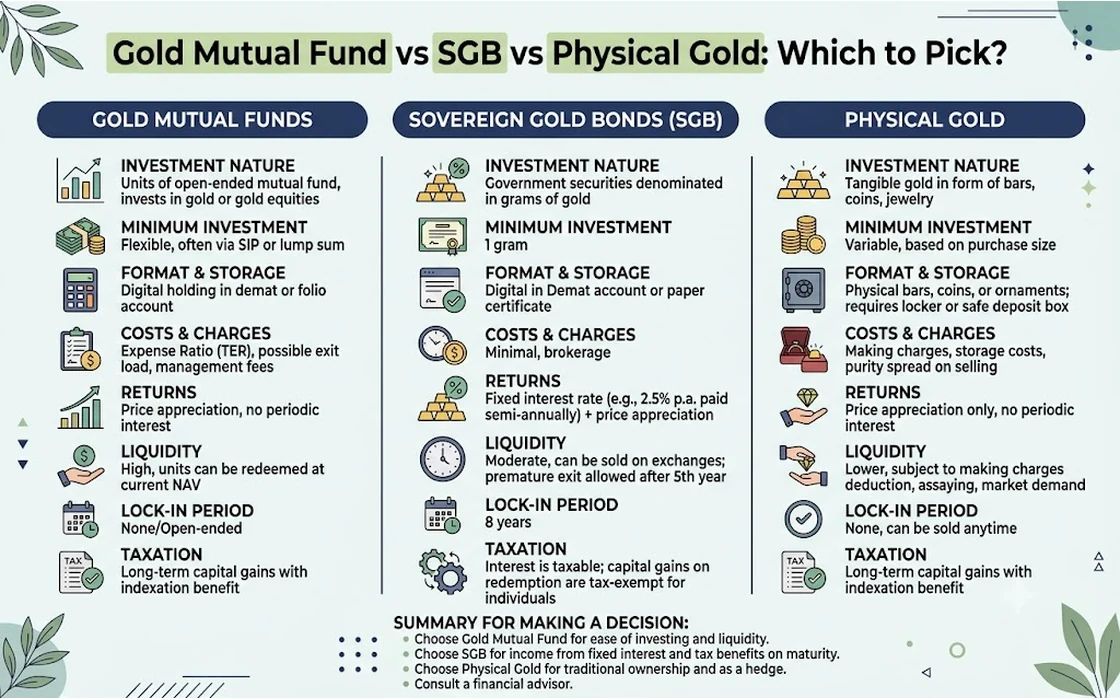
Understanding the Three Ways to Own Gold in India
Before comparing figures side by side, it helps to understand the institutional plumbing that underpins each option. While spot market bullion rates drive the baseline value of all three, their operational mechanics are fundamentally distinct.
1. Physical Gold: Jewellery, Coins, and Cast Bars
Physical gold represents tangible possession. In India, it primarily circulates as 22-karat (91.6% pure) jewellery or 24-karat (99.9% pure) minted coins and bars sold by jewellers and banks.
While holding physical bullion provides psychic comfort and eliminates counterparty risk, it introduces logistical liabilities. Buyers must arrange secure home safes or pay recurring annual locker fees at scheduled banks (typically Rs. 1,500 to Rs. 9,000 per year depending on locker size and branch tier). Furthermore, turning physical jewellery back into cash almost always incurs a melting deduction or refining haircut from the jeweller, even when accompanied by Bureau of Indian Standards (BIS) hallmark certification.
2. Sovereign Gold Bonds (SGBs): The Sovereign Debt Route
SGBs are government securities denominated in grams of gold, issued by the Reserve Bank of India on behalf of the Government of India under the Government Securities Act, 2006. When you purchase an SGB, you do not own physical gold stored in a vault; instead, you hold a sovereign-backed promise that tracks the domestic spot price of 999-purity gold published by the India Bullion and Jewellers Association (IBJA).
Each bond carries an 8-year statutory tenure, with an official premature redemption window opened by the RBI starting from the fifth year on interest payment dates. In addition to mirroring gold’s price movement, the Government pays a fixed interest coupon of 2.50% per annum on the nominal initial issue value, credited semi-annually to the investor’s registered bank account. Investors can also trade existing tranches on the secondary market via stock exchanges.
3. Gold Mutual Funds and ETFs: The Digitized Paper Route
Gold Exchange Traded Funds (ETFs) are open-ended mutual fund schemes listed on stock exchanges that invest directly in standard gold bullion of 99.5% purity or higher. One ETF unit typically represents 0.01 gram or 1 gram of physical gold held securely in institutional custodian vaults and audited regularly under regulations managed by the Securities and Exchange Board of India (SEBI).
Gold Mutual Funds (often called Gold Savings Funds or Feeder Funds) are open-ended fund-of-funds schemes operated by Asset Management Companies (AMCs). Rather than buying gold bullion directly, a Gold Mutual Fund pools retail capital and invests it directly into its underlying Gold ETF. This structure allows any retail investor to invest through automatic bank debits without needing a Demat or trading account. If you are comparing fund managers and expense structures, our guide to the Best Gold Mutual Funds in India: 2026 Top Picks breaks down the top performing schemes by tracking precision.
Comprehensive Comparison: Gold Mutual Fund vs SGB vs Physical Gold
The table below outlines the core parameters an investor must evaluate before committing capital:
| Feature / Metric | Physical Gold (Jewellery / Bars) | Sovereign Gold Bond (SGB) | Gold Mutual Fund |
|---|---|---|---|
| Primary Form | Tangible metal (ornaments, coins, bars) | Dematerialized / RBI Bond Certificate | Mutual fund units (Demat or Folio) |
| Minimum Ticket Size | Usually 1 gram (~Rs. 7,000–8,500 depending on spot rate) | 1 gram | Rs. 100 to Rs. 500 via SIP |
| Purity Guarantee | BIS Hallmarking (subject to jeweller integrity) | Sovereign guarantee (tracks 999 purity) | 99.5% institutional vault purity |
| Acquisition Overheads | 3% GST + 8% to 25% making charges | Zero GST; zero making charges | Zero GST; zero entry load |
| Annual Maintenance / Cost | Bank locker charges + insurance | Nil | 0.10% to 0.60% Expense Ratio |
| Additional Yield | None (negative yield after storage) | 2.50% per annum (simple interest on issue price) | None |
| Liquidity & Exit | Immediate at jewellers (haircuts apply) | 8-year maturity; secondary market exit or RBI window from Year 5 | T+1 or T+2 redemption via AMC directly |
| Capital Gains Tax at Maturity | Taxable under capital gains rules | 100% Tax-Exempt at 8-year sovereign maturity | Taxable under capital gains rules |
| SIP Availability | Jeweller schemes (unregulated chit risk) | No automated monthly SIP | Seamless automated monthly SIP |
| Collateral for Loans | Readily accepted by banks and NBFCs | Accepted by major banks as collateral | Can be pledged via loan against securities |
Deep Dive: Costs, Fees, and Hidden Deductions
The true performance of any gold investment depends heavily on the frictional drag encountered during purchase, holding, and sale.
The Real Cost of Physical Gold
When you walk into a showroom to purchase Rs. 1,00,000 worth of 22-karat gold jewellery, the billing invoice includes two non-recoverable charges:
- Making Charges: Typically range from 8% for simple machine-cast coins to 25% (or more) for intricate bridal jewellery.
- Goods and Services Tax (GST): A statutory 3% levy applied to the cumulative value of the gold and making charges.
Illustrative Invoice for Jewellery:
Base Gold Value:              Rs. 1,00,000
Making Charges (at 12%):      Rs.   12,000
Subtotal:                     Rs. 1,12,000
GST (at 3%):                  Rs.    3,360
Total Cash Outflow:           Rs. 1,15,360
If you walk back into that store the following afternoon to liquidate the ornament, neither the Rs. 12,000 making fee nor the Rs. 3,360 GST is refunded. Furthermore, standard jeweller buyback terms often deduct a 2% to 4% melting/refining margin. Your liquid salvage value drops immediately to around Rs. 96,000 to Rs. 98,000. Physical gold requires gold spot prices to climb roughly 15% to 20% simply for the buyer to break even.
Expense Ratios and Exit Loads in Gold Mutual Funds
Gold Mutual Funds do not incur GST on unit allotment or demand storage fees. Instead, their cost is reflected inside the scheme’s Total Expense Ratio (TER).
Because a Gold Mutual Fund invests into an underlying ETF, investors face a two-layer expense structure:
- The direct Gold ETF expense ratio: typically 0.15% to 0.35%.
- The Gold Savings Fund management fee: typically 0.05% to 0.25% under Direct plans (Regular plans add distributor commissions of 0.30% to 0.50%).
In total, a Direct Gold Mutual Fund will deduct between 0.25% and 0.55% annually from the Net Asset Value (NAV). Additionally, many AMCs apply an exit load of 1.00% if units are redeemed within 15 to 30 days of purchase to discourage speculative churn. Review our breakdown of Understanding Fund Exit Loads and Charges to see how premature redemptions eat into short-term returns.
Sovereign Gold Bonds: The Cleanest Balance Sheet
SGBs stand out because they impose zero ongoing asset management fees, zero custody deductions, and zero transaction GST at primary issuance. An investor buying 10 grams at an official issue price of Rs. 7,200 per gram transfers exactly Rs. 72,000. Every single rupee works toward holding the asset.
Returns and Yield: The 2.5% SGB Edge Explained
The single most consequential divergence between these products is the Sovereign Gold Bond’s 2.50% annual coupon payout.
Gold bullion is inherently an unproductive commodity; a bar locked in a vault does not generate earnings, dividends, or interest. SGBs transform this dynamic by combining the price action of gold with sovereign interest payments.
Hypothetical 8-Year Growth Scenario
Consider an investor deploying Rs. 1,00,000 across all three instruments. Assume spot gold prices appreciate at an annualized rate (CAGR) of 9.0% over an 8-year holding cycle:
Starting Investment: Rs. 1,00,000
Assumed Gold Price Growth: 9.0% CAGR over 8 Years
Gross Underlying Asset Value after 8 Years: ~Rs. 1,99,256
Physical Gold (24K Minted Bar):
- Initial purchase cost: Rs. 1,00,000 + 3% GST (Rs. 3,000) = Rs. 1,03,000.
- Final gross bullion value: Rs. 1,99,256.
- Net bank locker expenses (Rs. 2,000/year for 8 years): -Rs. 16,000.
- Approximate pre-tax net wealth: ~Rs. 1,83,256.
Gold Mutual Fund (Direct Plan):
- Initial purchase cost: Rs. 1,00,000 (0% GST).
- Ongoing TER drag (compounded at ~0.40% annually):
- Terminal NAV value after internal expense deduction: ~Rs. 1,93,120.
Sovereign Gold Bond (Held to Sovereign Maturity):
- Initial purchase cost: Rs. 1,00,000 (0% GST).
- Terminal redemption value at IBJA gold spot: Rs. 1,99,256.
- Cumulative 2.5% simple interest received over 8 years: Rs. 2,500 × 8 = Rs. 20,000.
- Total pre-tax cash generated: Rs. 2,19,256.
When you add the Rs. 20,000 sovereign interest payments to the terminal capital, SGBs generate an unassailable financial lead over physical metal and mutual funds.
Liquidity, Redemption, and Flexibility
A portfolio hedge is only effective if you can convert it into cash when an emergency strikes or when rebalancing your asset allocation.
Redemption Friction & Settlement Velocity:

Physical Gold:  [Instant Cash at Store] ---> Heavy Haircuts & Safety Risk
Gold Mutual Fund: [Click Redeem in App]  ---> T+1/T+2 Bank Credit at Exact NAV
SGB (Secondary): [Sell on Stock Broker] ---> Low Volumes & Price Discounts (1-3%)
SGB (RBI Window): [Available at Year 5] ---> Window Opens Semi-Annually Only
Gold Mutual Funds: Maximum Accessibility
Gold Mutual Funds lead the category in execution convenience.
- Redemption Pipeline: You can log into your mutual fund application at any time, submit a redemption request for any amount (even Rs. 500), and receive money directly into your bank account within one to two business days at published NAV.
- SIP Execution: You can automate investments using standard bank mandates (NACH). If your cash flows dip, you can pause or modify the SIP with zero penalty.
- For disciplined wealth tracking alongside equity holdings, consult our step-by-step framework on How to Track Your Mutual Fund Performance.
Sovereign Gold Bonds: Liquidity Constraints
While SGBs appear flexible on paper, secondary market execution requires care.
- Secondary Market Disconnects: If you hold SGB units in a Demat account and wish to sell them on the NSE or BSE prior to the 5th year, trading volumes can be thin. SGB tranches on the secondary market often trade at a 1% to 3% discount to actual spot gold value due to low market liquidity.
- Official Buyback Windows: The RBI offers formal premature redemption windows starting from the 5th year, but only on coupon payment dates twice a year. If you face a cash crunch in month 54, you must either wait until month 60 or accept market discounts on the exchange.
Physical Gold: Instant but Inefficient
Physical gold offers immediate emergency liquidity: pawn shops, NBFCs, and jewellers will disburse cash or gold loans within an hour. However, this speed comes at a price. Finding a buyer who honors authentic spot rates without taking deductions for purported impurities or melting margins requires effort and risk.
Taxation Breakdown: What You Keep After the Taxman
Tax efficiency is often the deciding factor in portfolio performance. Under the regulatory provisions administered by the Income Tax Department, the tax code distinguishes between sovereign paper instruments, mutual funds, and physical assets.
Tax Treatment Summary:

+---------------------+-------------------------------+-------------------------------+
| Asset               | Short-Term Capital Gains      | Long-Term Capital Gains       |
+---------------------+-------------------------------+-------------------------------+
| SGB (At Maturity)   | N/A                           | 100% EXEMPT (Sec 47)          |
| SGB (Secondary Mkt) | Slab Rate (held <= 12 months) | 12.5% flat (held > 12 months) |
| Gold Mutual Funds   | Slab Rate (held <= 24 months) | 12.5% flat (held > 24 months) |
| Physical Gold       | Slab Rate (held <= 24 months) | 12.5% flat (held > 24 months) |
+---------------------+-------------------------------+-------------------------------+
*Note: SGB semi-annual 2.5% interest is taxable at your applicable income tax slab rate every year.
1. Sovereign Gold Bond Tax Rules
- Maturity Exemption: Under Section 47 of the Income-tax Act, capital gains arising upon redemption of SGBs at the end of the full 8-year tenure (or during the RBI’s official premature exit windows from Year 5 onwards) are completely exempt from tax. You pay zero capital gains tax on the appreciation.
- Interest Income: The 2.5% annual coupon is classified under “Income from Other Sources.” It is added to your gross total income and taxed at your applicable income tax slab rate. No Tax Deducted at Source (TDS) is withheld by the RBI, but you must report it in your annual tax filings.
- Secondary Market Sale: If you sell your SGB units on an exchange to another investor before sovereign maturity, the exemption does not apply. If held for more than 12 months, the gains are treated as long-term capital gains (LTCG) and taxed at 12.5% (without indexation). If held for 12 months or less, they are treated as short-term capital gains (STCG) and taxed at your income slab rate.
2. Gold Mutual Funds and Physical Gold Tax Rules
Following the rationalization of holding periods across financial and non-financial assets under recent Finance Acts:
- Holding Period Threshold: The qualifying period for long-term status on physical gold and mutual funds is 24 months.
- LTCG Rate: If held for more than 24 months, profits are taxed at a flat rate of 12.5% without indexation benefits.
- STCG Rate: If redeemed within 24 months, gains are added to your personal taxable income and taxed at your applicable slab rate.
Which One Should You Pick? Strategic Portfolio Blueprints
To eliminate analysis paralysis, map your choice directly to your investment time horizon and cash flow structure.
Decision Flowchart:

Is the gold intended for a wedding or immediate personal wear?
 ├── YES ──> Buy Physical Gold (Prioritize BIS 916 Hallmarked bars or light jewellery)
 └── NO
      │
      Can you lock away funds for 5 to 8 years without needing premature liquidity?
       ├── YES ──> Buy Sovereign Gold Bonds (Primary issues or discounted Demat tranches)
       └── NO
            │
            Do you want automated monthly investments starting from Rs. 100 - Rs. 500?
             └── YES ──> Invest in Gold Mutual Funds (Direct Plans via SIP)
Scenario A: The Long-Term Wealth Compounder (Horizon: 5 to 8+ Years)
- Your Profile: You want gold as a hedge against currency weakness and market shocks. You do not need to touch this capital for over five years.
- Recommended Pick: Sovereign Gold Bonds.
- Why: The combination of an annual 2.5% coupon and absolute tax exemption upon sovereign redemption yields a mathematically superior outcome. No other gold asset matches its net post-tax return.
Scenario B: The Disciplined Salaried Saver (Horizon: Flexible)
- Your Profile: You earn a regular monthly salary and want to allocate Rs. 1,000 to Rs. 5,000 every month toward gold, similar to your equity index funds.
- Recommended Pick: Gold Mutual Funds (Direct Plan).
- Why: SGB primary tranches open erratically throughout the year, making disciplined dollar-cost averaging difficult. A Gold Mutual Fund allows you to schedule an automated SIP directly from your bank account. You can track performance through the Association of Mutual Funds in India (AMFI) portal, pause contributions when necessary, and avoid brokerage commissions.
Scenario C: The Near-Term Wedding or Gifting Planner (Horizon: 1 to 3 Years)
- Your Profile: You anticipate family marriage expenses or ceremonial requirements within the next two to three years.
- Recommended Pick: Gold Mutual Funds (Accumulate) → Convert to Physical Gold Later.
- Why: Never buy physical jewellery years in advance. Trends and personal design preferences change, ornaments in lockers incur storage costs, and making charges are non-refundable. Instead, accumulate your target gold weight in a liquid Gold Mutual Fund. When the wedding date approaches, liquidate the units at spot NAV and purchase the exact jewellery designs required.
Common Pitfalls to Avoid When Investing in Gold
Even experienced investors fall into traps when navigating precious metals. Keep these safeguards in mind:
- Treating Traditional Jewellery as an Investment: Ornaments are lifestyle purchases, not financial assets. High making charges (which can hit 20% to 30% for intricate designs) and non-refundable GST ensure that jewellery consistently underperforms pure bullion.
- Over-Allocating to Gold: Gold generates no operational cash flows or earnings growth; its price appreciation depends strictly on macroeconomic sentiment and currency devaluation. Restrict your overall gold exposure to between 5% and 10% of your total portfolio, reserving the remainder for productive wealth-compounding engines like equities, provident funds, and fixed-income assets.
- Buying Illiquid SGB Tranches at High Premiums: When purchasing SGBs on stock exchanges, check the prevailing domestic spot gold rate first. Retail buyers often place unhedged market orders and mistakenly pay a 3% to 5% premium over spot price due to illiquid order books. Always use limit orders pegged strictly to fair spot value.
- Subscribing to Unregulated Jeweller Savings Schemes: Many local jewellers run 11-month “gold deposit schemes” where they waive the final installment. These schemes fall outside the regulatory oversight of the RBI or SEBI and expose your principal to retailer solvency risk. Regulated mutual funds and sovereign bonds provide far safer alternatives.
FAQ
Is Sovereign Gold Bond still worth it in 2026?
Yes, Sovereign Gold Bonds remain one of the most cost-efficient instruments for long-term investors seeking gold exposure. The additional 2.5% annual sovereign interest and complete capital gains tax exemption at maturity make their post-tax yield unmatched. However, investors must be prepared for the 8-year structural tenure (with official RBI redemption windows starting from year five).
Can I set up a monthly SIP in Sovereign Gold Bonds like a mutual fund?
No, you cannot set up a standard automated monthly SIP directly into SGBs because the government issues primary tranches periodically throughout the year. While you can manually purchase SGB units every month through a stockbroker on the secondary market, trading volumes fluctuate. If automated monthly investing is your goal, a Gold Mutual Fund is the more practical vehicle.
What happens to my Gold Mutual Fund if gold prices crash?
Gold Mutual Funds invest directly in physical gold bullion or Gold ETFs, meaning their Net Asset Value (NAV) mirrors domestic spot prices. If gold prices decline due to macroeconomic shifts or currency movements, the NAV of your Gold Mutual Fund will decrease by an equivalent percentage, minus the fund’s expense ratio.
Do I need a Demat account to invest in Gold Mutual Funds?
No, a Demat account is not required to invest in a Gold Mutual Fund. You can invest through mutual fund investment platforms or directly via the asset management company using a standard mutual fund folio. Demat accounts are only required if you choose to purchase Gold ETFs or trade Sovereign Gold Bonds on the stock exchanges.
How do I check the authenticity and purity of physical gold?
To verify physical gold purity in India, ensure the item carries the mandatory BIS Hallmark, which includes three distinct marks: the BIS logo, the purity grade (such as 22K916 for 22-karat or 24K999 for 24-karat), and a unique 6-digit alphanumeric Hallmark Unique Identification (HUID) code. You can verify this HUID code directly through the official BIS Care mobile application.
Conclusion
Gold Mutual Funds, Sovereign Gold Bonds, and physical gold each serve distinct financial and personal needs. Physical gold remains unmatched for ceremonial utility, but its high making charges, storage costs, and transaction friction make it a poor vehicle for pure investment.
For long-term capital preservation over five to eight years, Sovereign Gold Bonds offer the strongest financial proposition, delivering superior post-tax compounding through their 2.5% annual coupon and tax-exempt maturity status. Meanwhile, for investors who prioritize systematic monthly investing, immediate redemption flexibility, and automated portfolio management, Gold Mutual Funds provide the ideal balance of liquidity and low operational friction. Align your selection with your time horizon and cash-flow requirements, and keep your overall allocation capped at 5% to 10% of your total net worth.
- Tags:
- Gold Mutual Fund
- Sovereign Gold Bond
- Physical Gold
- Gold Investment
- Personal Finance
- Tax Planning