
Xiaomi Pad 8: Full Specs, Features & 2026 Review
Discover the official Xiaomi Pad 8 specifications, 2026 launch details, 3.2K display capabilities, and expected India pricing in this deep-dive guide.

- NV Trends
- 16 min read
- Updated
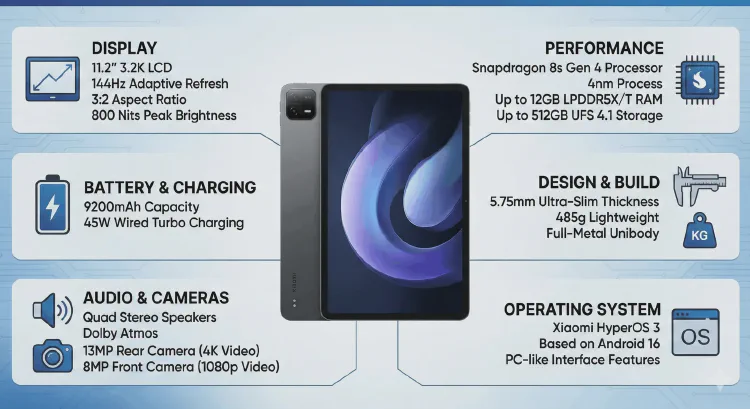
The Xiaomi Pad 8 is an 11.2-inch productivity tablet officially launched globally on February 28, 2026, combining Qualcomm’s 4nm Snapdragon 8s Gen 4 chipset, a high-resolution 3.2K 3:2 display, and Xiaomi HyperOS 3 to deliver a versatile workstation experience for students and working professionals. Designed to bridge the gap between multimedia slates and ultraportable laptops, the device refines the hardware formula established by its predecessors with a thinner profile, larger battery capacity, and improved desktop-style multitasking software.
At NV Trends, our technology coverage focuses on real-world utility, hardware longevity, and architectural value. Tablets in 2026 occupy a unique space: while smartphones have grown larger and laptops more efficient, mid-tier tablets must justify their place in your daily bag by handling heavy digital reading, multi-window office work, and creative tasks without friction. The Xiaomi Pad 8 aims directly at that sweet spot by departing from standard widescreen entertainment ratios in favor of a taller, document-friendly display format.
For tech enthusiasts and buyers in India planning their next hardware upgrade, understanding the exact specifications, component trade-offs, and software capabilities of the Xiaomi Pad 8 is essential. This comprehensive review and guide analyzes the released hardware specifications, examines how the tablet performs across academic and professional use cases, breaks down the accessory ecosystem, and clarifies expectations surrounding rumored additions like the Xiaomi Pad 8 Max and Xiaomi Pad 8 Ultra.
Key takeaways
- Official 2026 Launch: Globally unveiled on February 28, 2026, running Xiaomi HyperOS 3 based on Android 16.
- Productivity-First Display: Features an 11.2-inch 3.2K (3200 x 2136) 144Hz screen with a 3:2 aspect ratio that increases vertical reading space compared to standard widescreen tablets.
- Modern Silicon: Powered by the Qualcomm Snapdragon 8s Gen 4 processor (4nm) paired with up to 12GB of RAM and 512GB of fast UFS storage.
- Extended Battery Setup: Equipped with a 9,200mAh battery supporting 45W fast charging and 22.5W wired reverse charging.
- Workstation Accessories: Compatible with the redesigned Xiaomi Focus Pen Pro and the Focus Keyboard with a mechanical trackpad.
Xiaomi Pad 8 Release Specs (2026): Silicon, Memory, and Hardware Architecture
According to the official spec sheet published by Xiaomi, the Xiaomi Pad 8 introduces several structural and architectural improvements over older tablet generations. At the core of the system is the Qualcomm Snapdragon 8s Gen 4 platform, built on an advanced 4nm fabrication process. Designed to deliver flagship-adjacent responsiveness at a lower thermal and battery cost, this processor integrates modern core architectures and dedicated neural processing capabilities developed by Qualcomm.
The processing architecture handles sustained multitasking, high-bitrate media processing, and split-screen document management effortlessly. In real-world productivity workflows, processor efficiency matters just as much as peak bursts of power. Tablets have passive cooling, which means sustained high-performance tasks—such as processing local code scripts or large spreadsheets—depend heavily on the thermal ceiling of the silicon.
+-------------------------------------------------------------------+
|                     Xiaomi Pad 8 Core Architecture                |
+-------------------------------------------------------------------+
| Processor:   Qualcomm Snapdragon 8s Gen 4 (4nm Process)           |
| Memory Bus:  LPDDR5X / LPDDR5T Architecture (8GB / 12GB)          |
| Storage:     UFS 3.1 (128GB) | UFS 4.1 (256GB / 512GB)            |
| Operating:   Xiaomi HyperOS 3 (Built on Android 16)               |
+-------------------------------------------------------------------+
Memory Bandwidth and Storage Tiers
One crucial technical detail that prospective buyers must note is the divergence in storage protocols across different capacity configurations:
- 8GB RAM + 128GB Storage: This base variant utilizes UFS 3.1 storage flash. While still plenty fast for standard application caching and web browsing, it operates at lower sequential read and write speeds compared to newer flash standards.
- 8GB / 12GB RAM + 256GB / 512GB Storage: These upper configurations utilize modern UFS 4.1 flash memory, delivering roughly double the theoretical sequential read bandwidth of UFS 3.1.
If you plan to use your tablet for heavy local file indexing, moving large video containers, or running experimental local AI tools like MiMo Code: Xiaomi’s Open-Source AI Challenger to Claude Code, choosing a 256GB or 512GB model with UFS 4.1 storage yields noticeable advantages in sustained file operations and system responsiveness.
Display and Ergonomics: The 3:2 Aspect Ratio Advantage
The most impactful design decision in the Xiaomi Pad 8 is its shift to a 3:2 aspect ratio. For years, Android tablets defaulted to 16:9 or 16:10 aspect ratios. While 16:10 is suitable for widescreen video playback, it creates a narrow, cramped canvas when oriented vertically for reading research papers or holding side-by-side app windows horizontally.
Aspect Ratio Comparison (Work Surface Efficiency):
+-----------------------------+     +-----------------------+
|                             |     |                       |
|         16:10 Ratio         |     |       3:2 Ratio       |
|    (Great for 1080p Video)  |     |  (Optimal for Docs,   |
|                             |     |   PDFs & Multi-task)  |
+-----------------------------+     |                       |
                                    +-----------------------+
Display Specifications at a Glance
- Screen Diagonal: 11.2 inches
- Panel Resolution: 3.2K (3200 x 2136 pixels)
- Pixel Density: 345 PPI (Pixels Per Inch)
- Refresh Rate: Up to 144Hz adaptive refresh
- Peak Brightness: 800 nits
- Eye Care Certifications: TÜV Rheinland Low Blue Light, Flicker Free, and Circadian Friendly
A pixel density of 345 PPI ensures that fine typography, mathematical formulas, and spreadsheet cells render without visible subpixel pixelation or jagged edges. Furthermore, the 800-nit peak brightness provides adequate legibility in well-lit indoor environments, lecture halls, and transit settings, though direct outdoor sunlight will still produce reflections on the glossy glass surface.
Ergonomics and Build Quality
Despite housing an expansive 11.2-inch screen and a large power cell, Xiaomi managed to engineer a chassis that measures just 5.75mm in thickness and weighs 485g. The unibody metal enclosure features flat, chamfered side rails and gently curved corners that distribute weight evenly across your palms.
For students and knowledge workers spending several hours per day reviewing digital study materials, reducing hand fatigue is critical. Digital reading habits demand ergonomic hardware; as discussed in our analysis on Why College Students Are Losing the Ability to Read, the physical format and visual comfort of the medium directly influence how deeply readers absorb complex, long-form material. The 3:2 aspect ratio on the Pad 8 displays almost an entire standard A4 page without requiring constant pinching and zooming.
The tablet is offered in three anodized matte finishes: Gray, Blue, and Pine Green, all of which resist greasy fingerprint smudges better than high-gloss polycarbonate surfaces.
HyperOS 3 and Productivity Software: Can It Replace a Laptop?
The Xiaomi Pad 8 runs Xiaomi HyperOS 3, built on the Android 16 platform. Android on tablets has historically faced scrutiny over whether its software could support serious, uninterrupted work. In HyperOS 3, Xiaomi addresses this concern through substantial system-level windowing improvements.
Desktop Workstation Mode
When connected to an external display or when toggled manually, HyperOS 3 activates an upgraded workstation mode that replaces the standard mobile full-screen app launcher with a desktop layout:
- Floating Windows: Up to four active application windows can be resized, snapped, and arranged freely across the display.
- Persistent Dock: A dynamic taskbar allows one-click switching between active workspaces and shows recently used apps alongside pinned utilities.
- Desktop-Layout Browser: The native browser requests desktop-formatted user agents by default, ensuring that web apps, cloud dashboards, and collaborative suites render full navigation sidebars instead of collapsed mobile hamburger menus.
- Drag-and-Drop Pipelines: You can drag images, text snippets, and PDF attachments directly from file managers into email composers or collaborative documents.
AI Integration and Focus Utilities
HyperOS 3 incorporates on-device AI productivity tools designed for daily administrative tasks, including AI Writing (summarization, tone rewriting), AI Speech-to-Text for transcribing lectures, and contextual translation.
While these tools streamline repetitive tasks, digital devices can also introduce constant distraction. If you use your tablet for deep research or study sessions, implementing deliberate workflow routines—such as the strategies outlined in our guide on Tips to Improve Focus and Concentration—can help keep notifications from breaking your cognitive flow.
Software Limitations to Keep in Mind
While HyperOS 3 makes great strides, prospective buyers should recognize the inherent boundaries of an Android tablet:
- No Native x86 / Full Desktop IDEs: While web-based coding environments and terminal emulators run smoothly, native development tools designed exclusively for macOS or Windows cannot run on Android without emulation layers.
- Specialized Software Constraints: Advanced CAD modeling, high-end 3D rendering, or specific corporate accounting suites with proprietary Windows dependencies still require a full desktop or remote desktop connection.
Battery Endurance and Fast Charging Architecture
Battery reliability determines whether an ultraportable tablet is genuinely useful on the road or merely an indoor companion tethered to an AC outlet. Xiaomi engineered a 9,200mAh (typical) battery inside the 5.75mm frame of the Pad 8.
+-------------------------------------------------------------+
|               Xiaomi Pad 8 Power Specifications             |
+-------------------------------------------------------------+
| Typical Capacity:         9,200 mAh                         |
| Wired Turbo Charging:     45W Fast Charging Protocol        |
| Wired Reverse Power:      22.5W Output Support              |
| Manufacturer Video Rating: Up to 17 Hours Continuous Video  |
| Meeting / Call Rating:    Up to 13 Hours Online Conferencing|
+-------------------------------------------------------------+
Real-World Power Consumption Scenarios
According to official published battery test metrics, the 9,200mAh pack provides:
- Over 17 hours of continuous local video streaming playback.
- Over 13 hours of active online video conferencing and enterprise team calls.
- Approximately 1.5 to 2 full working days of mixed intermittent usage (document editing, web research, email triage, and note-taking).
Charging Speeds and Reverse Power Delivery
The Pad 8 supports 45W wired turbo charging. While some modern smartphones exceed 100W, a controlled 45W charging curve for a 9,200mAh cell balances rapid energy top-ups with thermal management, preventing excessive internal heat buildup that can degrade lithium-ion cells over multi-year lifecycles.
Additionally, the tablet supports 22.5W wired reverse charging. Using a standard USB-C to USB-C cable, the Pad 8 functions effectively as an emergency power bank to charge your smartphone, wireless earbuds, or smartwatch while traveling. In power-scarce scenarios during long commutes, this high-wattage reverse charging feature transforms the tablet into a practical backup energy hub.
Camera, Audio, and Video Conferencing Setup
While tablets are rarely selected for primary photography, camera placement and microphone quality are essential for remote work, virtual classrooms, and document archiving.
Camera Hardware
- Rear Camera (13MP): Capable of recording 4K video at 30fps. The sensor includes automated document detection and perspective correction, allowing you to photograph physical whiteboard notes or paper invoices and instantly convert them into cropped, legible PDF scans.
- Front Camera (8MP): Optimized for 1080p video conferencing at 30fps. The front camera is positioned along the horizontal bezel, ensuring that your gaze remains natural and centered when the tablet is docked horizontally in a keyboard case or kickstand.
Quad-Speaker Acoustic Setup
Audio quality is a standout feature of the Pad 8. The device houses four stereo speakers with Dolby Atmos acoustic tuning. The speaker enclosures feature a specialized 200% volume boost setting, which amplifies dialogue frequencies during video calls or lectures in noisy spaces without introducing harsh harmonic distortion.
For voice input, an integrated array of directional microphones uses noise-reduction algorithms to isolate the speaker’s voice while filtering out background ambient sounds, such as ceiling fans or typing clatter.
Official Accessories: Stylus and Keyboard Integration
To unlock the workstation potential of HyperOS 3, Xiaomi offers two official hardware accessories designed specifically for the Pad 8 (sold separately):
+--------------------------------------------------------------------------+
|                  Xiaomi Pad 8 Workstation Accessories                   |
+--------------------------------------------------------------------------+
| Xiaomi Focus Pen Pro:                                                    |
|  - Buttonless seamless cylindrical barrel                                |
|  - 240Hz touch sampling rate with ultra-low latency                      |
|  - Active haptic feedback simulating physical friction on paper          |
|  - Magnetic wireless pairing and charging on top frame                   |
+--------------------------------------------------------------------------+
| Xiaomi Pad 8 Focus Keyboard:                                             |
|  - Floating cantilever hinge with 124-degree stepless adjustment         |
|  - Large keycaps with comfortable tactile scissor switches               |
|  - Full-range mechanical glass-finish trackpad with gesture recognition  |
|  - Pogo-pin physical connector (no Bluetooth latency or pairing delays)   |
+--------------------------------------------------------------------------+
Xiaomi Focus Pen Pro
The Focus Pen Pro caters to digital illustrators, annotators, and students taking handwritten notes. Unlike earlier stylus designs with stiff plastic tips, this pen incorporates a fine-grain active haptic engine inside the barrel. As you sketch or write, the stylus emits minute micro-vibrations that replicate the subtle tactile resistance of graphite moving across textured paper. The 240Hz touch sampling rate keeps latency imperceptible during fast cursive note-taking.
Xiaomi Pad 8 Focus Keyboard
The Focus Keyboard converts the tablet into a laptop-style workstation. Its floating cantilever mechanism allows you to adjust the screen angle continuously up to 124 degrees. Because the keyboard connects via physical pogo-pin connectors along the lower frame, it eliminates Bluetooth connection latency, battery drainage, and wireless pairing dropouts. The integrated mechanical trackpad supports standard multi-finger gestures, including three-finger app switching, two-finger web scrolling, and pinch-to-zoom.
Detailed Specification and Model Comparison
The following table provides a complete breakdown of the official Xiaomi Pad 8 release specifications alongside structural comparisons between its primary configurations:
| Feature / Metric | Xiaomi Pad 8 (Base Tier) | Xiaomi Pad 8 (Mid Tier) | Xiaomi Pad 8 (Top Tier) |
|---|---|---|---|
| Global Launch Date | February 28, 2026 | February 28, 2026 | February 28, 2026 |
| Display Size & Type | 11.2-inch 3.2K LCD | 11.2-inch 3.2K LCD | 11.2-inch 3.2K LCD |
| Aspect Ratio | 3:2 | 3:2 | 3:2 |
| Resolution & PPI | 3200 x 2136 (345 PPI) | 3200 x 2136 (345 PPI) | 3200 x 2136 (345 PPI) |
| Refresh Rate | 144Hz Adaptive | 144Hz Adaptive | 144Hz Adaptive |
| Processor | Snapdragon 8s Gen 4 (4nm) | Snapdragon 8s Gen 4 (4nm) | Snapdragon 8s Gen 4 (4nm) |
| RAM Configuration | 8GB LPDDR5X | 8GB / 12GB LPDDR5X | 12GB LPDDR5T |
| Internal Storage | 128GB (UFS 3.1) | 256GB (UFS 4.1) | 512GB (UFS 4.1) |
| Battery Capacity | 9,200mAh (typical) | 9,200mAh (typical) | 9,200mAh (typical) |
| Charging Standards | 45W Wired, 22.5W Reverse | 45W Wired, 22.5W Reverse | 45W Wired, 22.5W Reverse |
| Cameras | 13MP Rear / 8MP Front | 13MP Rear / 8MP Front | 13MP Rear / 8MP Front |
| Dimensions & Weight | 5.75mm, 485g | 5.75mm, 485g | 5.75mm, 485g |
| Operating System | HyperOS 3 (Android 16) | HyperOS 3 (Android 16) | HyperOS 3 (Android 16) |
| Expected India Price (as of 2026) | ~Rs. 28,999 – Rs. 31,999 | ~Rs. 33,999 – Rs. 36,999 | ~Rs. 39,999 – Rs. 42,999 |
Note: Pricing figures reflect anticipated Indian retail brackets based on historical launch pricing for the Xiaomi Pad series in India and import duties as of 2026. Official regional pricing for Indian retail channels is confirmed upon local rollout.
What About the Xiaomi Pad 8 Max and Xiaomi Pad 8 Ultra?
As with every major tablet generation, search queries and tech forums in 2026 frequently ask about potential larger siblings: specifically, the Xiaomi Pad 8 Max and Xiaomi Pad 8 Ultra. Understanding where these models fit into Xiaomi’s historical naming structure helps separate verified product announcements from speculative rumors.
The Xiaomi Pad 8 Max Context
In previous hardware generations, Xiaomi utilized the “Max” moniker to denote extra-large display tablets measuring between 12.4 inches and 14 inches. These larger form factors are designed primarily to compete with large-format enterprise slates.
- Current Status: As of 2026, Xiaomi’s official global launch on February 28 focused specifically on the core 11.2-inch Xiaomi Pad 8.
- What to Expect: While industry reporting suggests that a larger 12.4-inch or 14-inch variant may debut in specific regional markets later in the product cycle, no official specifications or launch dates for a “Xiaomi Pad 8 Max” have been formally confirmed by the manufacturer.
The Xiaomi Pad 8 Ultra Speculation
Queries surrounding a potential “Xiaomi Pad 8 Ultra” generally envision a top-of-the-line tablet featuring tandem OLED display panels, Qualcomm Snapdragon 8 Elite or Gen 4 tier processors, and waterproof ingress ratings designed to rival the highest-end flagship tablets on the market.
- Current Status: Xiaomi has not officially announced or detailed a “Pad 8 Ultra” variant for 2026.
- Practical Advice: Buyers needing a productivity device today should base their purchasing decisions on the officially released Xiaomi Pad 8 rather than delaying for an unannounced Ultra tier. The standard Pad 8’s 3.2K 144Hz screen and Snapdragon 8s Gen 4 silicon already provide more than enough performance for the vast majority of personal, academic, and office workloads.
Buyer’s Guide: What to Do and What to Avoid
To make the best use of your budget when shopping for an Android tablet in 2026, consider these concrete practical recommendations:
What to Do
- Prioritize the 256GB Storage Tier: If your budget allows, opt for the 256GB model over the 128GB base variant. The upgrade from UFS 3.1 to UFS 4.1 significantly improves data transfer speeds when backing up local documents, and the extra headroom prevents storage throttling.
- Budget for the Keyboard Case: If your primary objective is replacing a laptop for travel, the floating keyboard is an essential investment. The physical trackpad and desktop browser in HyperOS 3 deliver a far superior experience compared to typing on bare glass.
- Use the 22.5W Reverse Charging Feature: When traveling, carry a durable USB-C to USB-C cable in your bag. The Pad 8’s 9,200mAh battery can easily recharge a drained smartphone to 50% capacity in under an hour without requiring a dedicated power bank.
What to Avoid
- Avoid Relying on It as a Sole Machine for Heavy Compiling: Do not buy an Android tablet expecting it to run heavy local Docker containers or full Visual Studio builds natively. For heavy coding workloads, use a dedicated workstation or laptop, and treat the Pad 8 as a portable companion for reading documentation, reviewing pull requests, or attending meetings.
- Avoid Cheap Third-Party Passive Styluses: The Xiaomi Pad 8 display relies on active digitizer protocols. Inexpensive generic rubber-tipped styluses lack palm rejection, pressure sensitivity, and the haptic feedback engine built into the official Focus Pen Pro.
- Avoid Neglecting Display Scaling Settings: In HyperOS 3, ensure you adjust the display scaling slider in system settings to “Small” to maximize the amount of information displayed on the 3:2 canvas when working in split-screen mode.
FAQ
When was the Xiaomi Pad 8 officially launched in 2026?
The Xiaomi Pad 8 was officially launched globally on February 28, 2026. Regional availability across India and other retail territories follows Xiaomi’s standard staged rollout schedule.
What are the key official specifications of the Xiaomi Pad 8?
The Xiaomi Pad 8 features an 11.2-inch 3.2K (3200 x 2136) 144Hz display with a 3:2 aspect ratio, a Qualcomm Snapdragon 8s Gen 4 (4nm) processor, 8GB or 12GB of RAM, 128GB to 512GB of internal storage, and a 9,200mAh battery supporting 45W turbo charging and 22.5W wired reverse charging.
Is there an official Xiaomi Pad 8 Max or Xiaomi Pad 8 Ultra in 2026?
As of 2026, Xiaomi has not officially announced a “Pad 8 Max” or “Pad 8 Ultra.” While rumors and leaks often discuss potential larger-screen or OLED variations, only the core 11.2-inch Xiaomi Pad 8 has been officially detailed and released.
What is the expected Xiaomi Pad 8 price in India as of 2026?
Based on historical pricing structures and prevailing component costs as of 2026, the Xiaomi Pad 8 is expected to start around Rs. 28,999 to Rs. 31,999 for the 8GB/128GB base variant in India, with top-tier configurations reaching up to approximately Rs. 42,999.
Can the Xiaomi Pad 8 fully replace a traditional laptop?
The Xiaomi Pad 8 can comfortably replace a laptop for administrative workflows, document editing, spreadsheet management, web research, and media consumption thanks to HyperOS 3 workstation mode and the official Focus Keyboard. However, users requiring specialized x86 software, advanced programming compilers, or heavy 3D rendering will still need a traditional desktop or laptop OS.
Related reading
Conclusion
The Xiaomi Pad 8 stands out as one of the most balanced, well-conceived productivity tablets introduced in 2026. By choosing an 11.2-inch 3:2 aspect ratio screen over conventional widescreen layouts, Xiaomi directly addresses the needs of readers, writers, students, and professionals who require vertical workspace over cinematic letterboxing.
Paired with the energy-efficient Snapdragon 8s Gen 4 chipset, a massive 9,200mAh battery with 22.5W reverse charging, and the refined windowing capabilities of HyperOS 3, the Pad 8 establishes a competitive standard in the sub-flagship tablet category. For Indian buyers seeking a high-performance productivity slate that punches above its price bracket without ballooning into laptop-tier expenses, the Xiaomi Pad 8 presents a compelling, future-proof option.
- Tags:
- Xiaomi Pad 8
- Xiaomi Tablet
- Android Tablet
- Technology
- Snapdragon 8s Gen 4
- Hyperos 3