
How to Avoid Common Investment Mistakes: Complete Guide
Learn how to avoid common investment mistakes in India, optimize asset allocation, lower taxes, and protect long-term portfolio growth.

- NV Trends
- 16 min read
- Updated
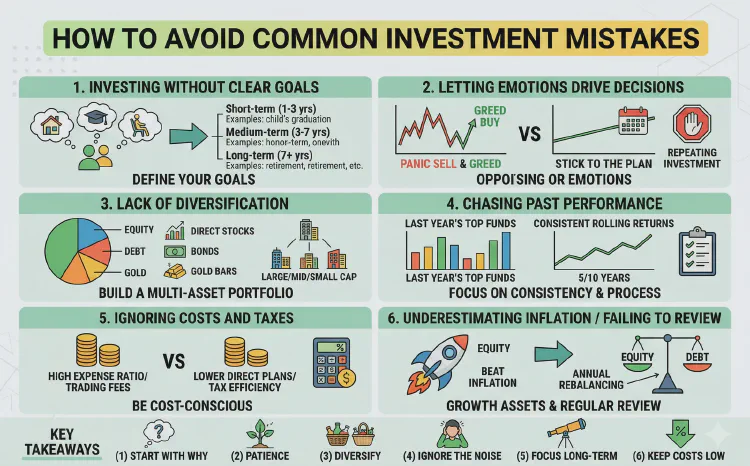
To avoid common investment mistakes, you must align every rupee with a specific financial goal, maintain a disciplined multi-asset allocation, automate your contributions, and eliminate the behavioral urge to time market cycles or chase speculative tips. Sustainable wealth generation in financial markets is rarely about discovering the next multibagger stock; it is determined by systematically eliminating unforced errors that erode compounding returns over time.
In the Indian financial landscape, retail participation across equity markets, mutual fund folios, and debt instruments has expanded at an unprecedented pace. However, increased market access has also amplified common behavioral traps. Investors regularly deploy capital at market peaks out of the fear of missing out (FOMO), liquidate assets in panic during routine market corrections, or mistake short-term speculative luck for sound financial strategy.
Navigating the market successfully requires a structured, repeatable framework. By recognizing how emotional biases, hidden product fees, mismatched time horizons, and structural tax drags compromise long-term returns, you can insulate your capital and build a resilient investment portfolio.
Key takeaways
- Link capital to timelines: Map every investment to a defined time horizon (short, medium, or long term) to prevent forced liquidations during market downturns.
- Separate insurance from investing: Avoid traditional endowment or unit-linked insurance plans that deliver sub-inflation yields, opting instead for pure term cover paired with equity mutual funds.
- Eliminate intermediary drag: Switch from regular mutual fund schemes to Direct Plans to prevent distributor commissions from compounding against your portfolio over decades.
- Automate and rebalance: Rely on Systematic Investment Plans (SIPs) to neutralize market volatility, and rebalance your asset allocation once a year to systematically lock in gains.
- Control inflation and tax friction: Account for post-tax real yields rather than nominal returns, and stay mindful of capital gains tax rules when managing portfolio turnover.
1. Investing Without Defined Goals and Time Horizons
One of the most widespread errors among retail investors is investing capital arbitrarily without linking it to a concrete financial objective. Deploying money simply because surplus cash is sitting in a bank account or because a peer started an equity Systematic Investment Plan (SIP) creates portfolio instability. Without a designated purpose, you cannot determine your required rate of return, liquidity needs, or suitable risk threshold.
When you invest without a defined horizon, you risk allocating short-term money into aggressive, volatile assets. For instance, placing savings needed for a house down payment in eighteen months into a small-cap equity fund leaves your capital vulnerable to a normal 15% to 25% cyclical drawdown. If the market corrects just as the payment falls due, you are forced to lock in paper losses.
The Fix: Match Assets to Defined Time Corridors
Segment your financial life into three clear objective categories:
- Short-Term (0 to 3 years): Goals such as an emergency fund, upcoming vacations, or vehicle purchases. Capital preservation and liquidity take precedence over high returns. These funds belong in liquid mutual funds, short-duration debt instruments, or bank fixed deposits.
- Medium-Term (3 to 7 years): Objectives like child schooling expenses or a planned business transition. These benefit from balanced advantage funds, multi-asset allocation funds, or equity savings funds that provide moderate capital appreciation with controlled volatility.
- Long-Term (7+ years): Retirement planning, higher education funding, or multi-decade wealth compounding. This capital can comfortably withstand stock market cycles and should be allocated heavily toward diversified equity instruments. If you are structuring your core equity base for the first time, review our Beginner’s Guide to Stock Market Investment for fundamental asset allocation frameworks.
2. Letting Emotions Dictate Market Timing
Human psychology is fundamentally misaligned with market dynamics. When benchmark indices like the Nifty 50 or Sensex hit record highs and financial media sentiment is euphoric, retail investors feel confident and aggressively inject lump sums. Conversely, when geopolitical unrest, interest rate hikes, or macroeconomic slowdowns trigger sharp market drops, fear dominates, leading investors to halt their SIPs or sell assets at deep discounts.
Attempting to time market entries and exits is statistically detrimental. Long-term market returns are heavily concentrated in a handful of high-performance trading days. If an investor exits the market to avoid a correction and misses the ten best trading days over a fifteen-year investment horizon, their annualized portfolio return can be cut nearly in half.
The Fix: Automate Through Systematic Execution
Market volatility is not a defect of capital markets; it is the fundamental mechanism that generates equity risk premiums over risk-free assets. By automating investments through monthly SIPs, you execute rupee-cost averaging: your fixed monthly sum automatically purchases more mutual fund units when prices are depressed and fewer units when prices are elevated. Establish your monthly investment schedule to trigger right after salary disbursement, and commit to ignoring day-to-day market commentary.
3. Mixing Life Insurance with Wealth Accumulation
A uniquely persistent mistake in India is treating life insurance policies as investment vehicles. For generations, traditional endowment plans, money-back policies, and unit-linked insurance plans (ULIPs) have been marketed as safe, tax-deductible avenues for long-term savings. In reality, these hybrid products combine inadequate insurance protection with mediocre investment yields.
The net internal rate of return (IRR) on traditional endowment and money-back policies historically falls between 4.5% and 5.5% per annum. When measured against retail inflation, the real purchasing power of the maturity proceeds is virtually stagnant. Furthermore, the life cover provided is usually a modest ten times the annual premium—meaning an annual premium of Rs. 50,000 yields only Rs. 5 lakh of life coverage, which is grossly insufficient to protect a family’s financial future.
The Fix: Strict Separation of Protection and Investment
Unbundle your financial safety net from your wealth-building portfolio:
- Purchase Pure Term Insurance: Secure a pure term life insurance policy that offers high life coverage (typically 15 to 20 times your annual income) at a fraction of the cost of an endowment policy.
- Channel the Balance into Pure Investment Assets: Direct the premium savings you achieve into low-cost index funds, diversified equity funds, or Public Provident Fund (PPF) accounts. This separation delivers both comprehensive family protection and superior compounding potential.
4. Chasing Past Performance and Sector Hype
Retail investors frequently select mutual funds or stocks by sorting performance tables by “Highest Returns over the Past 1 Year.” This tendency—known as recency bias—often leads capital straight into overvalued, cyclical market peaks. A fund that outperformed the broader market by 30% in the preceding twelve months rarely maintains that outperformance in the subsequent cycle.
Often, top-ranking funds achieve their short-term numbers because a specific sector (such as Information Technology, Public Sector Undertakings, or Infrastructure) experienced a localized bull run. Entering these thematic or sectoral funds after substantial price appreciation exposes your capital to severe mean-reversion risks. If you want to identify common portfolio design flaws, read our guide on the Top 10 Mutual Fund Mistakes to Avoid to refine your fund selection methodology.
The Fix: Analyze Rolling Returns and Broad Diversification
Instead of evaluating point-to-point trailing returns, examine rolling returns over five- to ten-year periods. Rolling returns measure a fund’s performance across multiple market peaks and troughs, demonstrating whether outperformance stems from consistent portfolio management or a temporary speculative surge. Furthermore, prioritize diversified flexi-cap or broad market index funds over narrow thematic funds. To ensure your equity holdings are not overweighted toward individual sectors, consult our detailed analysis on How to Avoid Overexposure in Equity Funds.
5. Overlooking the Compounding Drag of Fees, Commissions, and Taxes
When calculating returns, many investors focus entirely on gross nominal gains and ignore the friction caused by intermediary commissions, annual expense ratios, and capital gains taxes. Over multi-decade horizons, small percentage fees extract a substantial portion of your terminal wealth.
A prime example is the structural difference between Regular Plans and Direct Plans of mutual funds. Regular plans carry an embedded distributor commission of roughly 0.5% to 1.2% per year paid to the intermediary. While a 1% difference may sound trivial in any single year, compounding makes it severe over time:
Terminal Value of Rs. 10,000 Monthly SIP Over 25 Years at 12% vs. 11% Net Return:
- Direct Plan (12.0% Net Annualized): ~Rs. 1.89 Crore
- Regular Plan (11.0% Net Annualized): ~Rs. 1.59 Crore
- Wealth Lost to Intermediary Commissions: ~Rs. 30 Lakh
According to industry metrics published by AMFI, direct plans allow investors to bypass this intermediary leakage, ensuring that the full value of the underlying assets compounds inside the folio.
Taxation Rules and Turnover Friction
Frequent buying and selling also triggers avoidable capital gains tax liabilities. Under the tax framework in India as of 2026, equity investments held for more than 12 months qualify as Long-Term Capital Gains (LTCG) and are taxed at 12.5% on gains exceeding Rs. 1.25 lakh in a financial year, as specified by the Income Tax Department. Short-Term Capital Gains (STCG) on equity held for 12 months or less stand at 20%. In addition, debt mutual funds purchased on or after April 1, 2023, do not receive indexation benefits and are taxed at individual income tax slab rates. Constantly switching funds or trading stocks resets your compounding clock and incurs immediate tax deductions that drag down overall portfolio growth.
6. Lack of True Asset Diversification
Diversification is often misunderstood as merely owning multiple assets. Many retail investors hold fifteen to twenty different equity mutual funds, believing they are thoroughly diversified. In reality, examining the underlying portfolios often reveals an 80% overlap in identical large-cap stocks. Conversely, some investors concentrate almost their entire net worth in physical real estate, resulting in extreme illiquidity, heavy maintenance costs, and vulnerability to regional property cycles.
True diversification requires allocating across non-correlated asset classes that respond differently to macroeconomic shifts:
flowchart TD
    A["Total Portfolio"] --> B["Equities (Growth)"]
    A --> C["Fixed Income (Stability)"]
    A --> D["Commodities / Gold (Hedge)"]
    B --> B1["Large Cap / Flexi Cap"]
    B --> B2["Mid & Small Cap"]
    C --> C1["EPF / PPF / Debt Mutual Funds"]
    C --> C2["Sovereign / High-Grade Corporate Bonds"]
    D --> D1["Sovereign Gold Bonds / Gold ETFs"]
The Fix: Construct a Balanced Multi-Asset Foundation
A balanced portfolio distributes capital across:
- Equities: Acts as the primary engine for capital appreciation and long-term purchasing power expansion.
- Fixed Income / Debt: Provides portfolio stability, steady accrual income, and emergency liquidity during equity bear markets.
- Gold: Allocating 5% to 10% of your portfolio to Sovereign Gold Bonds (SGBs) or Gold ETFs serves as a hedge against currency depreciation and systemic geopolitical stress.
7. Underestimating Inflation and Over-Relying on Bank FDs
A cultural preference for guaranteed capital preservation leads many Indian households to park substantial wealth in bank Fixed Deposits (FDs) or savings accounts. While FDs carry minimal nominal default risk, they suffer from severe purchasing power risk over extended horizons.
Consider an individual in the 30% tax bracket investing in an FD offering a 7.0% nominal interest rate as of 2026:
- Gross Nominal Interest: 7.0%
- Post-Tax Return (after 30% tax + cess): ~4.8%
- Prevailing Retail Inflation (CPI): ~5.0% to 5.5%
- Net Real Post-Tax Return: -0.2% to -0.7%
Over a ten-year holding period, an investment delivering negative real returns steadily diminishes the actual goods and services your capital can purchase. Relying exclusively on fixed deposits for goals more than five years away virtually guarantees that your savings will fall short of lifestyle, healthcare, and educational inflation.
The Fix: Anchor Long-Term Portfolios in Growth Assets
Reserve bank fixed deposits for immediate emergency reserves and financial commitments occurring within 12 to 24 months. For time horizons exceeding five years, allocate a sufficient portion of your capital to equities and equity-oriented funds to achieve a positive real spread of 4% to 6% over prevailing consumer inflation.
8. Speculating on High-Risk Derivatives and Unregulated Advice
The proliferation of mobile trading applications and financial social media channels has blurred the line between disciplined investing and speculative gambling. A massive influx of retail participants has entered the equity Futures and Options (F&O) segment, enticed by promises of rapid wealth creation and leverage.
In an exhaustive empirical study on retail derivative participation, the capital markets regulator SEBI reported that over 90% of retail individual traders in the equity F&O segment incurred net financial losses, with the average loss compounded significantly by transaction and brokerage costs. Retail participants routinely trade against sophisticated institutional algorithmic setups with inadequate risk management, treating speculative derivative contracts like lottery tickets.
The Fix: Eliminate Speculative Noise
Adhere to the core tenets of capital stewardship:
- Never Trade on Tips: Treat unsolicited stock recommendations from Telegram groups, WhatsApp channels, and social media influencers as hazardous to your capital.
- Differentiate Investment from Leverage: Direct options trading is a risk-management instrument designed for institutional portfolio hedging, not a get-rich-quick mechanism for retail accounts.
- Verify Registration: Only consume investment guidance from SEBI-Registered Investment Advisers (RIAs) or Research Analysts who are legally mandated to disclose conflicts of interest.
9. Failing to Periodically Review and Rebalance
Investing is not a passive “set-and-forget” exercise. Left unattended, your asset allocation naturally drifts over time due to divergent performance across asset classes.
For instance, during a sustained equity bull run, an initial target portfolio of 60% equity and 40% debt can rapidly drift into an 80% equity and 20% debt configuration. While your portfolio balance appears to be surging, your overall risk exposure has grown substantially. If a severe market correction occurs when you are at an 80% equity weighting, your capital experiences far greater absolute drawdowns than your personal risk tolerance can comfortably absorb.
The Fix: Establish an Annual Rebalancing Protocol
Rebalancing systematically forces you to execute the oldest rule in finance: sell high and buy low. You can implement rebalancing through two straightforward methods:
- Calendar-Based Rebalancing: Review your portfolio once every twelve months (for example, every April at the start of the new financial year). If your equity allocation has drifted beyond your target by more than 5%, rebalance.
- Cash-Flow Rebalancing: Instead of selling equity units (which may trigger capital gains taxes), direct new monthly SIP allocations or annual bonuses into your underweighted asset class (such as debt funds) until your target ratio is restored.
Comparison: Investment Mistakes vs. Corrective Strategies
The following table summarizes common investment pitfalls, their long-term financial consequences, and the systematic corrections required to protect portfolio capital:
| Investment Mistake | Primary Risk / Financial Drag | Corrective Action | Benchmark or Metric to Track |
|---|---|---|---|
| Investing Without Goals | Forced liquidation of volatile assets during market drawdowns | Segment capital into short, medium, and long-term buckets | Time horizon matching (e.g., equity only for 7+ year goals) |
| Market Timing / Panic Selling | Missing top performance days; permanently locking in notional losses | Automate investments via fixed-date monthly SIPs | SIP continuity rate through market corrections |
| Endowment & ULIP Policies | Low returns (4.5%–5.5% IRR) paired with inadequate life cover | Separate pure term insurance from pure mutual fund investments | Life cover = 15x–20x annual income; Term + SIP approach |
| Chasing Past Year’s Winners | Buying overvalued, cyclical sectoral assets right at their peak | Evaluate 5- to 10-year rolling returns; use flexi-cap funds | Rolling return consistency vs. category benchmark |
| Using Regular Mutual Fund Plans | 0.5%–1.2% annual commission leakage eroding compounding over decades | Switch folio holdings to Direct Plans via AMFI-registered platforms | Expense ratio differential (aim for minimum fee drag) |
| Over-Reliance on Bank FDs | Negative real returns after factoring in 30% tax slab and CPI inflation | Restrict FDs to emergency funds; allocate long-term capital to equity | Post-tax real return (Nominal yield minus inflation minus tax) |
| Retail F&O Speculation | Severe capital loss (over 90% of retail traders lose money per SEBI data) | Cease leveraged derivative trading; focus on spot cash equities/funds | Percentage of portfolio allocated to long-term compounding assets (100%) |
| Portfolio Drift (No Rebalancing) | Unintended risk escalation due to equity overconcentration in bull runs | Execute calendar or cash-flow rebalancing back to target allocation | Annual asset allocation variance within +/- 5% of target |
A 4-Stage Framework for Mistake-Proof Investing
Building an investment structure that minimizes errors requires a sequential process rather than isolated financial decisions. Follow this four-stage framework to build long-term financial stability:
Stage 1: Construct Defensive Foundations
Before allocating a single rupee toward equity or wealth-generation products, ensure your downside risk is fully covered:
- Emergency Reserve: Maintain six to twelve months of mandatory living expenses in a combination of high-yield savings accounts and liquid mutual funds.
- Pure Risk Protection: Secure an adequate term life insurance policy for all earning members and a standalone family floater health insurance policy to prevent medical emergencies from depleting your investment capital.
Stage 2: Define Asset Allocation Rules
Determine your strategic asset split based on your age, financial liabilities, and emotional risk tolerance:
- A classic starting framework for long-term goals is 60% equity, 30% fixed income, and 10% gold.
- Adjust these proportions based on your goal’s specific time horizon; ensure that any capital needed within three years remains insulated from equity markets entirely.
Stage 3: Execute via Cost-Effective Instruments
Deploy your capital using modern, low-cost investment vehicles:
- Choose Direct Plans of broad-market index funds (such as Nifty 50 or Nifty Next 50) and active flexi-cap funds.
- Utilize employer-matched Employee Provident Fund (EPF), Public Provident Fund (PPF), or high-credit debt mutual funds for the fixed-income portion of your portfolio.
- Automate all contributions to execute within forty-eight hours of your monthly income deposit.
Stage 4: Maintain Annual Portfolio Governance
Conduct an annual portfolio audit to keep your strategy on track:
- Calculate your current asset allocation percentages to identify any portfolio drift exceeding 5%.
- Take advantage of annual tax provisions, such as utilizing the Rs. 1.25 lakh annual LTCG tax-free threshold on equity where suitable.
- Remove redundant, underperforming, or overlapping funds, consolidating your portfolio to a manageable structure of four to six total holdings.
FAQ
What is the most common investment mistake made by beginners in India?
The most frequent mistake is chasing recent returns by purchasing speculative stocks or thematic mutual funds based on informal social media tips or recent 1-year performance charts. Beginners often enter the market during peak bull runs with lump sums and then panic-sell during routine corrections, locking in severe losses instead of holding through market cycles.
How do direct mutual fund plans differ from regular plans?
Direct plans are purchased directly from the asset management company without an intermediary, which eliminates distributor commissions and results in a lower annual expense ratio. Regular plans include an ongoing commission paid to distributors (typically 0.5% to 1.2% annually), which compounds into substantial wealth loss over a 15- to 25-year investment horizon.
Why is market timing dangerous for retail investors?
Market timing requires you to make two correct decisions consistently: identifying the exact peak to exit and the exact trough to re-enter. Because the market’s strongest recovery days often occur immediately after sharp downturns, missing just a handful of top-performing days substantially reduces your overall annualized returns compared to staying consistently invested through an automated SIP.
How often should I rebalance my investment portfolio?
You should rebalance your portfolio once a year or whenever an individual asset class drifts more than 5% away from your target asset allocation. Annual rebalancing ensures you systematically trim profits from outperforming assets and redeploy capital into undervalued assets without triggering unnecessary transaction costs or short-term tax liabilities.
Conclusion
Avoiding investment mistakes is fundamentally an exercise in discipline, patience, and emotional control rather than intellectual complexity. Market history consistently shows that the most successful long-term investors in India are not those who repeatedly pick high-flying speculative winners, but those who avoid catastrophic financial errors and allow compounding to work uninterrupted.
By anchoring your investments to clear financial goals, separating insurance protection from investment assets, minimizing fees and tax friction through direct plans, and establishing an automated, diversified asset allocation, you build a portfolio capable of weathering any economic cycle. Focus on controlling what is within your reach—your savings rate, asset allocation, investment costs, and temperament—and let the growth of the broader economy compound your wealth over the decades ahead.