
Google Play Store Certifies Registered App Stores
Learn how Google's certification for registered Android app stores improves sideloading security and app distribution outside the US.

- NV Trends
- 14 min read
Google has begun certifying official “Registered App Stores” on Android devices across select international markets while explicitly excluding the United States, according to reporting by Ars Technica and regulatory filings. This certification program establishes an official framework that allows vetted third-party app stores to install and update software with fewer security barriers, bridging the gap between the default Google Play Store and unverified direct APK sideloading. By establishing formal criteria for third-party marketplaces, Google is reshaping how application distribution operates on hundreds of millions of Android smartphones worldwide.
The divergence between Google’s international rollout and its US strategy stems directly from differing legal and regulatory pressures. In jurisdictions such as the European Union—under the Digital Markets Act (DMA)—and in India, following decisive antitrust enforcement by the Competition Commission of India (CCI), regulators have demanded that mobile operating systems treat competing distribution channels fairly. In contrast, Google’s operational posture in the United States remains heavily shaped by ongoing federal court litigation, including the remedies and appellate proceedings emerging from the Epic Games v. Google antitrust verdict, leading the company to isolate its domestic deployment schedule.
For mobile developers and smartphone users across international regions like India, this development represents a structural change in mobile ecosystem economics. India represents Android’s largest single user base by volume, home to indigenous platforms like the PhonePe-backed Indus Appstore as well as native storefronts bundled by device manufacturers like Samsung and Xiaomi. Establishing a formal certification standard provides alternative marketplaces with system-level parity, enabling automated background updates while attempting to preserve essential malware vetting and device security.
Key takeaways
- Structured Verification: Google has introduced a certification path for “Registered App Stores” outside the United States, granting compliant third-party stores streamlined package installation privileges.
- Reduced Sideloading Friction: Certified marketplaces can push automated, unattended app updates without forcing users through repetitive confirmation dialogues or scary permission prompts.
- Geographic Segmentation: The initiative addresses antitrust directives across international markets like the EU and India, while US availability remains stalled amid ongoing federal court remedies.
- Economic Shifts for Publishers: Developers distributing via certified stores can bypass standard 15% to 30% platform commissions, retaining higher margins on software subscriptions and in-app purchases.
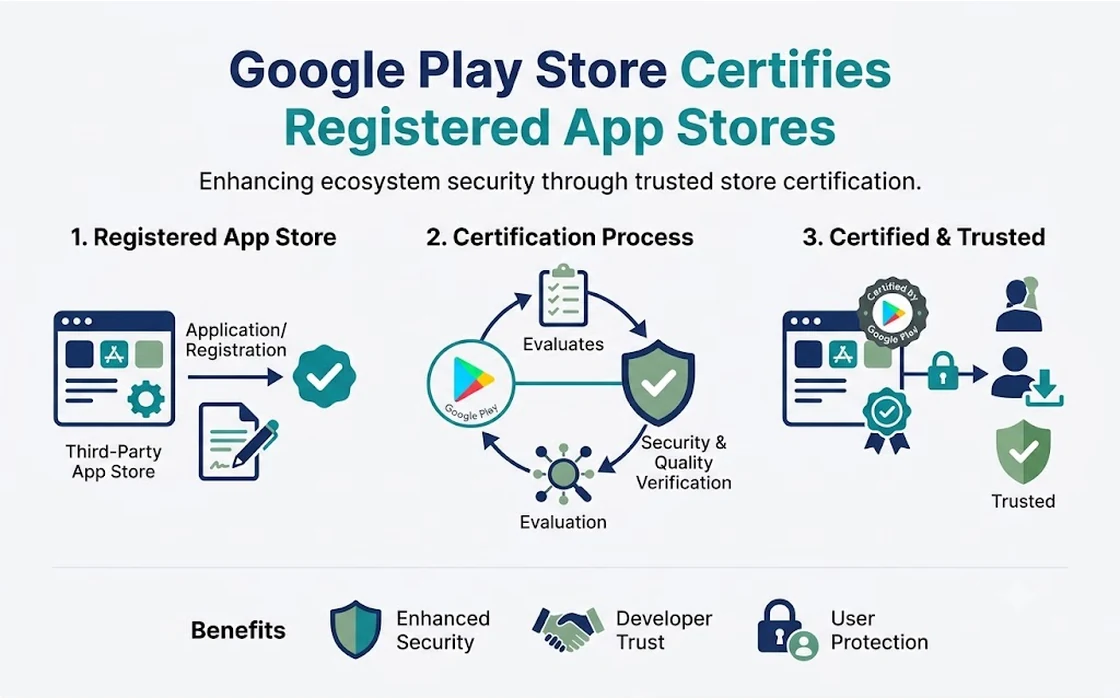
- Security Protections Maintained: Certified stores must comply with technical baselines, meaning devices retain automated scanning protections without exposing consumers to arbitrary raw APK risks.
Understanding the “Registered App Store” Architecture on Android
Historically, installing an application on Android outside the Google Play Store has been treated by the operating system as an exception rather than a standard operational flow. When a user downloads an installation package (APK) from a web browser or an alternative client, Android flags the action under its untrusted sideloading mechanisms. The user must manually grant the REQUEST_INSTALL_PACKAGES permission, acknowledge persistent warnings regarding malware risks, and manually approve every subsequent application update.
The Registered App Store program introduces a verified middle tier. Under this mechanism, an alternative app distribution platform undergoes technical validation by Google. Once certified, the marketplace interfaces with Android’s modern package management architecture—specifically utilizing extensions to the PackageInstaller API documented in the official Android developer documentation.
Through these APIs, a certified store can execute “unattended updates.” When a developer releases a bug fix or feature patch, the registered store can download and install the package silently in the background, provided the user originally obtained the application from that specific store and granted initial installation rights. This parity eliminates one of the biggest historic barriers that made third-party stores uncompetitive compared to the pre-installed Google Play Store.
For software engineers working across modern engineering pipelines, understanding these platform mechanics is increasingly vital. As outlined in our architectural breakdown of What is Mobile App Development?, distribution targets directly govern how applications must be bundled, signed, and maintained across distinct runtime environments.
Why Is the US Excluded? The Regulatory Backdrop
The exclusion of the United States from Google’s Registered App Store rollout highlights the stark divergence between statutory regulation abroad and adversarial litigation at home.
+--------------------------------------------------------------------------+
|                       Global Regulatory Pressures                        |
+------------------------------------+-------------------------------------+
| International Markets (EU, India)  | United States Market                |
+------------------------------------+-------------------------------------+
| • Proactive statutory mandates     | • Adversarial antitrust lawsuits    |
|   (EU Digital Markets Act)         |   (Epic Games v. Google)            |
| • Direct antitrust orders          | • Contested court injunctions       |
|   (CCI directives in India)        | • Pending federal appellate reviews |
| • Clear technical compliance terms | • Tactical delays pending litigation|
+------------------------------------+-------------------------------------+
The US Antitrust Landscape
In the United States, changes to Google’s Android ecosystem have been driven primarily by private litigation rather than preemptive legislative acts. Following the jury verdict in Epic Games v. Google, the presiding US District Court ordered extensive remedies designed to dismantle the Play Store’s distribution exclusivity. These proposed remedies mandated that Google open Android to third-party catalogs, share application catalog data, and eliminate anti-steering rules for three years.
However, Google has contested the scope and implementation timetable of these court orders through federal appellate courts, securing administrative stays on specific remedies. Because the legal parameters of what Google must deliver within the US market are subject to ongoing litigation and potential judicial modification, Google has avoided deploying voluntary certification programs domestically that could conflict with or prejudice ongoing court proceedings.
International Statutory Mandates
Outside the US, regulatory agencies moved earlier and with broader statutory authority:
- The European Union: The Digital Markets Act (DMA) formally classified Google as a digital “gatekeeper,” legally compelling the company to allow third-party app stores, permit uninhibited sideloading, and provide equal access to underlying operating system capabilities without discriminatory hurdles.
- India and the Competition Commission of India (CCI): The CCI levied significant financial penalties against Google and issued detailed operational directives. The Indian regulator mandated that Google must not restrict device manufacturers (OEMs) from pre-installing competing app stores, nor could it use restrictive Mobile Application Distribution Agreements (MADA) to penalize alternative storefronts.
Faced with mandatory compliance deadlines backed by heavy turnover-based fines in Europe and Asia, Google engineered the Registered App Store architecture as a structured compliance mechanism for international jurisdictions, leaving the US market on an isolated track.
Technical Comparison: Play Store vs. Registered App Stores vs. Sideloading
Navigating this changing landscape requires understanding how different distribution channels on Android handle privileges, security, and developer economics.
| Feature / Metric | Google Play Store | Certified Registered App Store | Raw APK Sideloading |
|---|---|---|---|
| Installation Flow | Single-tap direct install | Single-tap direct install (after initial setup) | Multi-step warning screens, manual permission overrides |
| Background Updates | Seamless, automatic, silent | Seamless, automatic (via PackageInstaller API) | Manual confirmation required for every version bump |
| Security Screening | Google Play Protect + automated pipeline | Independent store vetting + Play Protect baseline | None by default; relies solely on device-side scans |
| Platform Commission | 15% (first $1M) up to 30% | Determined by store (often 0% to 10%) | 0% (developer handles all payment gateway fees) |
| Payment Gateway Choice | Mandatory Google Play Billing (or User Choice Billing) | Open; third-party payment processors allowed | Open; proprietary merchant integrations |
| Regional Availability | Global (where services operate) | Select international markets (EU, India, etc.; not US) | Global (unrestricted on open Android builds) |
| OEM Pre-installation | Bundled via Google Mobile Services (GMS) | Allowed via commercial OEM agreements | Requires manual user download |
As the comparison demonstrates, certified stores combine the operational convenience of the primary Play Store with the economic flexibility traditionally found only in raw sideloading.
Economic Implications for Developers and Indian Merchants
For technology businesses, consumer startups, and indie creators, platform fees have historically represented one of the largest friction points in mobile monetization. Under Google’s standard billing structure, digital goods and subscriptions incur platform service fees ranging between 15% and 30%.
Consider an Indian ed-tech or SaaS platform offering an annual premium subscription priced at Rs. 4,999:
- Under Google Play Billing: At a standard tier of 15% to 30%, the platform fee deducts roughly Rs. 750 to Rs. 1,499 per transaction, excluding applicable taxes.
- Under an Alternative Certified Store: Platforms operating with local payment gateways (such as Razorpay, Cashfree, or direct UPI rails) typically encounter payment processing fees around 1% to 2% (Rs. 50 to Rs. 100), accompanied by store commission fees that are either zero or substantially lower.
Annual Subscription: Rs. 4,999
├── Google Play Route (15%-30% cut):
│   ├── Net Developer Payout: Rs. 3,500 – Rs. 4,249
│   └── Platform Take: Rs. 750 – Rs. 1,499
│
└── Certified Alternative Store (2% gateway + nominal store cut):
    ├── Net Developer Payout: Rs. 4,600 – Rs. 4,899
    └── Distribution Cost: Rs. 100 – Rs. 399
This differential allows digital businesses to pass cost savings back to consumers or reinvest capital into software engineering. Furthermore, the rise of certified regional stores like the Indus Appstore caters directly to Indian regional language demographics, offering discovery algorithms customized for Tier 2 and Tier 3 cities that the global Google Play Store often overlooks.
However, distributing across multiple platforms requires careful architectural planning. In our analysis of Android vs iOS App Development, we examined how fragmented distribution environments demand robust modular engineering. If a mobile development team must build, test, and release separate binaries for the Google Play Store, Samsung Galaxy Store, and Indus Appstore, the operational overhead can quickly erode margin gains if continuous integration workflows are poorly managed.
System Performance and Device Integrity
Allowing multiple app stores to manage background services, package downloads, and runtime updates introduces critical technical considerations regarding battery life, memory management, and system responsiveness.
Preventing Device Jitter and Background Drain
Every application marketplace running on an Android device operates background services to poll servers, check for available updates, and parse metadata. On mid-range hardware common in India, having three or four competing app stores simultaneously running background polling loops can degrade responsiveness.
When poorly optimized store updaters run intensive input/output (I/O) write operations while the user is actively navigating other software, frame drops and UI freezes can occur. As detailed in our guide on Every Frame Perfect: Why Modern Apps Feel Janky, excessive thread contention and unconstrained background disk writes directly compromise system fluidity. To counter this, Google’s certification standards enforce strict limits on background wake-locks, requiring certified stores to utilize Android’s JobScheduler and WorkManager components so update routines run during device idle and charging states.
Security, Signing Keys, and Play Protect
A core question surrounding third-party certification is how Android handles package provenance and digital signatures. Android enforces application integrity through cryptographic signing keys:
- Signature Alignment: An application installed from Store A cannot be arbitrarily overwritten or hijacked by an update pushed from Store B unless the updating binary is signed with the exact same developer private key.
- Ownership Enforcement: Modern Android versions enforce update ownership. Even if two stores carry the same app, Android prompts the user if a different store attempts to update an existing package, preventing unauthorized cross-store package substitution.
- Google Play Protect Layer: Google Play Protect continues to monitor devices at the operating system level, regardless of whether an app originated from the Play Store or a certified partner. If a certified store inadvertently distributes a binary identified as containing malicious payloads, Play Protect retains the capability to disable or quarantine the offending package.
For privacy-conscious users, the isolation between operating system privileges and app distribution remains a paramount design choice. Projects exploring extreme system sandboxing, such as GrapheneOS Ported to Android 17: Privacy Redefined for 2026, demonstrate that robust security models do not require a single corporate gatekeeper, provided the underlying operating system rigorously validates cryptographic signatures and restricts ambient permissions.
Practical Guide for Android Developers: Building for Multi-Store Distribution
Software teams planning to leverage Registered App Stores must adopt structured engineering practices to avoid codebase divergence.
                    Base Application Architecture
                                 │
         ┌───────────────────────┴───────────────────────┐
         ▼                                               ▼
┌──────────────────┐                           ┌──────────────────┐
│  Core Domain &   │                           │   Abstracted     │
│   UI Components  │                           │ Service Layers   │
└────────┬─────────┘                           └────────┬─────────┘
         │                                              │
         ├──────────────────────────────────────────────┤
         ▼                                              ▼
┌──────────────────────────────┐              ┌──────────────────────────────┐
│     Google Play Flavor       │              │  Registered Partner Flavor   │
├──────────────────────────────┤              ├──────────────────────────────┤
│ • Play Integrity API         │              │ • Open Hardware Attestation  │
│ • Google Play Billing v7+    │              │ • Standard Payment Gateway   │
│ • Firebase Cloud Messaging   │              │ • Unified Push / WebSockets  │
└──────────────────────────────┘              └──────────────────────────────┘
1. Decouple Proprietary Google Dependencies
Do not hardcode Google Mobile Services (GMS) dependencies directly into your application’s domain logic. If your software uses Google Play In-App Billing, extract those calls behind a generic interface:
interface PaymentProcessor {
    suspend fun purchaseProduct(productId: String): PurchaseResult
    suspend fun verifyEntitlement(userId: String): Boolean
}
Implement separate concrete classes—one utilizing Google Play Billing for the Play Store build, and another wrapping standard UPI/card SDKs (such as Razorpay or Stripe) for alternative storefront builds.
2. Implement Gradle Build Flavors
Configure your build.gradle.kts file using modular product flavors. This structure generates targeted artifacts while keeping business logic unified:
flavorDimensions += "distribution"

productFlavors {
    create("googlePlay") {
        dimension = "distribution"
        applicationIdSuffix = ""
    }
    create("registeredStore") {
        dimension = "distribution"
        applicationIdSuffix = ".indus" // Optional: if isolating user data
    }
}
3. Maintain Complete Ownership of Your Private Signing Keys
Never rely exclusively on Google Play App Signing (where Google generates and holds your application’s release key in the cloud) if you intend to distribute across multiple stores. If Google holds the only copy of your key, you cannot produce cryptographically identical binaries for third-party stores. Manage your primary signing key securely through local Hardware Security Modules (HSMs) or enterprise key vaults, ensuring that builds uploaded to external stores share the same provenance as your primary distributions.
What to Do and What to Avoid
To maximize the benefits of the changing Android distribution framework without jeopardizing user trust, engineering leaders should adhere to clear operational guardrails.
What to Do
- Evaluate Regional Unit Economics: Calculate your effective take-rate across billing methods. If in-app purchases represent a large percentage of revenue, distributing on certified platforms in India can yield immediate gross margin improvements.
- Audit Update Lifecycles: Ensure your QA team tests how your application behaves when receiving updates via third-party package installers, verifying that database migrations and user sessions persist smoothly.
- Use Standard Android Attestation: Instead of relying solely on proprietary Play Integrity tokens for bot detection, implement standard hardware-backed attestation (such as
KeyStorekey attestation) that works reliably across non-GMS and certified alternative environments.
What to Avoid
- Avoid Fragmented Versioning: Never release divergent feature sets across stores unless legally required. Maintaining disparate codebases creates customer support confusion and increases technical debt.
- Do Not Ignore Local Regulations: Distributing outside Google Play means you assume direct responsibility for processing refunds, invoicing, and adhering to local financial frameworks such as GST compliance in India.
- Avoid Unvetted Repositories: Steer clear of uncertified distribution portals that lack automated vulnerability analysis or fail to implement cryptographic signature verification.
FAQ
Is the Google Play Store still required on Android phones in 2026?
No, the Google Play Store is not technically required for an Android device to function, though it remains pre-installed on the vast majority of commercial devices certified under Google Mobile Services. With Google certifying Registered App Stores, verified third-party marketplaces can now handle app distribution and automated updates independently without needing Google Play as an intermediary.
Why did Google exclude the United States from registered app store certification?
Google excluded the US market primarily due to ongoing domestic antitrust litigation, particularly the appeals and structural remedy negotiations stemming from the federal Epic Games v. Google lawsuit. While international markets like the European Union and India operate under established statutory or administrative orders that forced Google’s hand, the US legal framework remains contested in federal court, prompting Google to delay domestic implementation.
How does registered app store certification affect app developers in India?
For developers in India, certification lowers the technical friction of publishing to local platforms like the Indus Appstore or OEM storefronts, providing direct access to single-tap installations and unattended background updates. This shift allows developers to leverage direct UPI integration and alternative payment gateways, reducing platform commission expenses from traditional 15–30% rates down to single-digit processing costs.
Will downloading apps from certified third-party stores void my phone warranty?
No, using certified third-party app stores will not void your smartphone warranty. Registered app stores operate within Android’s standard permission architecture and do not require rooting your phone or unlocking the device bootloader, meaning all factory hardware protections and manufacturer warranties remain intact.
Conclusion
Google’s decision to begin certifying Registered App Stores on Android marks a notable transition in mobile software distribution. By establishing a formal technical pathway for third-party marketplaces to execute streamlined installations and background updates, the operating system is moving away from its historical binary—where users were forced to choose between the walled garden of the Google Play Store and the high-friction risks of raw sideloading.
While the exclusion of the United States underscores how deeply geopolitical and legal borders shape software platforms, the international rollout across Europe, India, and other key regions delivers immediate practical benefits. Developers gain greater commercial leverage and alternative revenue pathways, while smartphone users benefit from broader catalog choices without sacrificing device stability or fundamental malware protections. As certified stores expand their footprints through 2026 and beyond, the teams that thrive will be those that engineer modular, adaptable codebases built for an open, multi-store ecosystem.
- Tags:
- Android
- Play Store
- App Stores
- Mobile Tech
- App Development
- Android Security