
How to Invest in IPOs Safely: Step-by-Step Guide
Learn how to invest in IPOs safely in India by vetting DRHPs, assessing realistic valuations, using ASBA, and avoiding common speculative traps.

- NV Trends
- 14 min read
- Updated
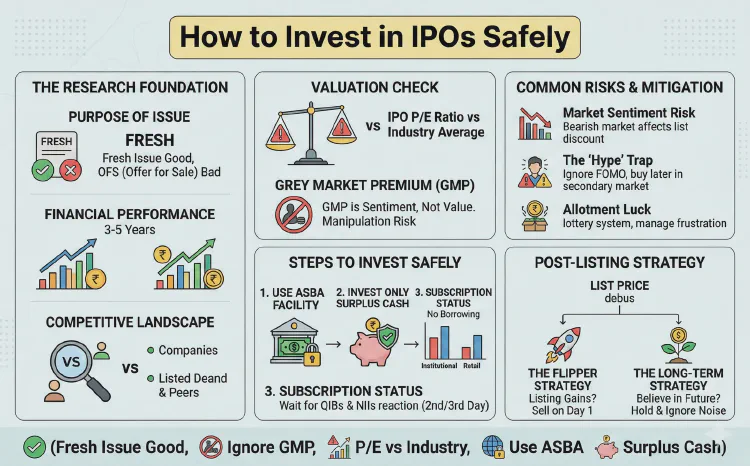
To invest in IPOs safely, an investor must base their bidding decision on a thorough review of the Draft Red Herring Prospectus (DRHP), confirm that issue proceeds are allocated toward productive corporate growth rather than promoter exits, benchmark valuations against listed competitors, and apply strictly through the Applications Supported by Blocked Amount (ASBA) facility using surplus capital.
The Indian primary market has witnessed dramatic retail participation across the National Stock Exchange (NSE) and Bombay Stock Exchange (BSE). From fast-growing technology platforms to mature manufacturing enterprises, dozens of companies enter the public market each year seeking capital. For individual investors, an Initial Public Offering (IPO) is frequently promoted as a chance to acquire shares at the inception of a company’s public journey. However, the aggressive marketing campaigns and speculative discussions that accompany new listings can easily overshadow fundamental investment diligence.
Relying on market euphoria or viewing an IPO as a guaranteed lottery ticket for listing-day gains often leads to severe capital erosion. A new listing lacks a public price discovery track record, making it inherently more volatile than an established stock. To protect hard-earned savings, investors must transition from speculative momentum chasing to a structured evaluation framework. Developing a sound foundation through a Beginner’s Guide to Stock Market Investment can help clarify how primary market issues fit into a broader, disciplined financial plan.
Key takeaways
- Scrutinize the Issue Structure: Prioritize companies issuing substantial “Fresh Capital” over those where the issue consists predominantly of an “Offer for Sale” (OFS) by exiting private equity or promoters.
- Dismantle Grey Market Myths: Treat Grey Market Premium (GMP) as an unregulated, volatile sentiment gauge rather than a reliable indicator of intrinsic business value.
- Track Institutional Bidding: Observe Qualified Institutional Buyer (QIB) subscription numbers on Day 2 and Day 3 before locking in retail bids.
- Protect Capital with ASBA: Apply exclusively through bank-backed ASBA or verified UPI mandates to keep application money earning interest in your bank account until allotment is finalized.
How to Research an IPO Using the DRHP
Safe IPO investing begins long before opening a brokerage application. Under guidelines established by the Securities and Exchange Board of India (SEBI), every company intending to go public must file a Draft Red Herring Prospectus (DRHP) and later a final Red Herring Prospectus (RHP). These regulatory documents provide exhaustive disclosures regarding business operations, operating risks, capitalization history, and financial statements.
Fresh Issue vs. Offer for Sale (OFS): Where Does Your Money Go?
The total size of an IPO is divided into two distinct components: Fresh Issue and Offer for Sale (OFS). Understanding the split is the first filter in separating sustainable businesses from exit liquidity events.
- Fresh Issue: The company creates and issues brand-new equity shares. The capital raised flows directly onto the company’s balance sheet to fund capital expenditures, research, debt repayment, or working capital requirements. A high proportion of Fresh Issue indicates that the enterprise is raising funds to fuel future earnings growth.
- Offer for Sale (OFS): Existing shareholders—such as founders, venture capital funds, or private equity firms—sell their existing stakes to incoming public investors. The proceeds go straight to the selling shareholders’ accounts; the company receives none of this cash.
While an OFS is standard practice for early venture investors seeking liquidity, a public issue where 80% to 100% of the funds represent an OFS deserves heightened scrutiny. If promoters and early institutional backers are aggressively paring down their holdings while leaving little capital for business expansion, retail investors must question whether the current owners see limited upside ahead.
Evaluating the “Objects of the Issue”
Within the DRHP, the “Objects of the Issue” section itemizes precisely how management plans to deploy the proceeds. Safe investments generally feature clear, quantifiable objectives, such as:
- Constructing new manufacturing capacity or logistics infrastructure.
- Retiring expensive long-term debt to reduce interest costs and boost profit margins.
- Strategic technology investments with verifiable return-on-capital targets.
Conversely, broad and ambiguous objectives should raise concern. If a significant percentage of the fresh capital is earmarked for “General Corporate Purposes” (GCP) without itemized milestones, management retains wide discretion over expenditure, which can dilute shareholder returns.
Examining Promoter Background and Outstanding Litigation
A viable business model run by questionable management remains a high-risk proposition. The RHP discloses the background, past regulatory actions, and operational history of the promoter group.
Review the “Outstanding Litigation and Material Developments” chapter in the prospectus. Evaluate whether the company, its subsidiaries, or promoters face substantial tax disputes, criminal proceedings, or intellectual property challenges that could jeopardize operating licenses or create major contingent liabilities.
Analyzing Financial Health and Valuation Metrics
A prominent brand name does not automatically translate into a durable equity investment. Before committing capital, examine at least three full financial years of audited statements in the prospectus.
Financial Health Check:
[Consistent Revenue Growth] + [Stable Operating Cash Flows (CFO)] + [Prudent Debt/Equity < 1.0] = Lower Fundamental Risk
Key Financial Ratios to Benchmark Against Listed Peers
To assess whether a business is fundamentally viable, evaluate three core dimensions:
- Revenue and Net Profit Consistency: Look for steady Compound Annual Growth Rates (CAGR) in top-line revenue alongside stable or expanding operating (EBITDA) margins. Be skeptical of sudden, uncharacteristic spikes in net profit during the fiscal year immediately preceding the public issue.
- Cash Flow from Operations (CFO): A company may report accounting profits on its Income Statement while draining cash on its Cash Flow Statement due to delayed receivables or mounting inventories. Persistent negative CFO alongside positive net profit is a common indicator of aggressive revenue recognition.
- Return on Capital Employed (ROCE) and Debt Levels: Calculate ROCE to verify whether management generates adequate operating profit from the capital deployed. An over-leveraged company (Debt-to-Equity ratio above 1.5 to 2.0) that fails to use IPO funds for debt reduction carries elevated insolvency risk in high-interest environments.
Detecting Pre-IPO Window Dressing
Companies preparing for a public listing often optimize their financial presentation to attract peak valuations. Common patterns include cutting discretionary marketing or maintenance spending to temporarily inflate operating margins, recognizing one-off asset sales as other income, or writing back past provisions. Checking the notes to the restated financial statements in the RHP helps identify whether operating profits reflect ongoing business activities or short-term accounting maneuvers. Learning How to Avoid Common Investment Mistakes: Complete Guide provides additional perspective on spotting balance-sheet irregularities before allocating capital.
Comparing IPO Valuation: Real Value vs. Market Euphoria
Determining whether an IPO is priced fairly requires benchmarking its valuation multiples against existing, publicly traded peers in India.
The most widely referenced metric is the Price-to-Earnings (P/E) ratio, which compares the upper end of the IPO price band against the company’s Diluted Earnings Per Share (EPS). If an IPO demands a P/E multiple of 65 while established industry leaders on the National Stock Exchange of India (NSE) trade at an average P/E of 28 with superior return metrics, the issue demands an unsustainable premium. Unless the new entrant possesses an impregnable economic moat or vastly superior growth rates, overpaying at the IPO stage frequently results in protracted drawdowns once initial market excitement normalizes.
For early-stage or loss-making companies where traditional P/E ratios are not applicable, institutional analysts rely on Enterprise Value-to-Sales (EV/Sales) or EV/EBITDA. If an unprofitable firm seeks a rich EV/Sales multiple without demonstrating a verified path toward positive unit economics and operating cash flow, retail investors assume an asymmetric downside risk.
IPO Safety Checklist: Green Flags vs. Red Flags
Before submitting a bid, benchmark the offering against this risk-assessment matrix:
| Evaluation Criterion | Green Flag (Lower Risk) | Red Flag (Higher Risk) | Investor Action |
|---|---|---|---|
| Issue Structure | Fresh issue represents >60% of total offer size. | Offer for Sale (OFS) accounts for >80% of issue size. | Avoid if promoters/PE exit aggressively without capital for growth. |
| Use of Proceeds | Specific capex, debt retirement, or capacity expansion. | High allocation to “General Corporate Purposes” with vague milestones. | Demand clear payback timelines for capital expenditure. |
| Profitability & Cash | Consistently positive CFO matching or exceeding net profit. | Consecutive years of net losses or negative operating cash flows. | Verify cash runway and unit economics for loss-making firms. |
| Valuation (P/E Ratio) | At or below listed peer average with comparable growth. | Significant premium over mature, profitable market leaders. | Pass on the issue; wait for post-listing secondary market price discovery. |
| Corporate Governance | Clean auditor reports, independent board, minimal litigation. | Frequent auditor resignations, major tax disputes, related-party transactions. | Strict avoidance if promoter integrity or disclosures are disputed. |
| Anchor Book Quality | Backed by Tier-1 domestic mutual funds and sovereign funds. | Dominated by obscure entities or short-term speculative entities. | Check anchor allocation details published one day before opening. |
Understanding Market Mechanics: GMP, Subscription Data, and Timing
Navigating an IPO safely requires separating genuine institutional demand from artificial retail excitement.
The Truth About Grey Market Premium (GMP)
In the Indian ecosystem, the “Grey Market” is an over-the-counter, unregulated network where unofficial applications and shares are traded prior to exchange listing. The Grey Market Premium (GMP) reflects the unofficial price difference over the issue price.
While retail participants frequently treat a soaring GMP as an infallible predictor of opening gains, it carries structural risks:
- The grey market operates completely outside the regulatory purview of SEBI, NSE, and BSE.
- Volumes in unofficial trading can be thin and susceptible to localized price manipulation by syndicates attempting to generate retail enthusiasm.
- GMP can evaporate overnight due to broad macroeconomic shifts, geopolitical events, or sudden market corrections.
GMP can be viewed as an informal barometer of short-term sentiment, but it should never replace fundamental balance-sheet analysis. Bidding on an overvalued company solely because of high GMP is a speculative gamble, not an investment strategy.
Reading Subscription Data: Why QIB Interest Matters Most
An IPO bidding window typically remains open for three consecutive business days. Rather than rushing to submit bids within the first hour of Day 1, disciplined investors observe the subscription breakdown across three distinct investor categories:
- Qualified Institutional Buyers (QIBs): Comprises domestic mutual funds, foreign portfolio investors (FPIs), insurance companies, and banks. These institutions employ dedicated research teams and conduct extensive on-ground due diligence.
- Non-Institutional Investors (NIIs): High-net-worth individuals and corporate treasuries bidding between Rs. 2 lakh and Rs. 10 lakh (small NII or sNII) or above Rs. 10 lakh (big NII or bNII).
- Retail Individual Investors (RIIs): Retail bids where the total application value does not exceed Rs. 2 lakh.
Three-Day Subscription Strategy:
Day 1: Track retail excitement & initial anchor response.
Day 2: Monitor NII participation & QIB momentum.
Day 3 (Pre-close): Check final QIB institutional demand before committing retail capital.
Because QIBs typically submit the bulk of their bids in the final hours of Day 2 and throughout Day 3, evaluating QIB subscription figures on the afternoon of the final bidding day provides genuine institutional validation. If the QIB portion remains undersubscribed or struggles to cross 1.0x while retail is heavily oversubscribed, it indicates that professional institutional capital is sitting out the valuation—a clear warning signal for retail investors.
How to Apply for an IPO Safely: Bidding Rules and Best Practices
Executing your application properly prevents procedural rejection and ensures your capital remains protected throughout the allotment process.
Utilizing the ASBA Facility and UPI Block Mechanisms
Under SEBI mandates, paper cheques and direct money transfers for IPOs have been entirely replaced by Applications Supported by Blocked Amount (ASBA).
When you apply via ASBA through your net-banking portal or utilize a UPI-based mandate via a registered stockbroker, your funds are never debited immediately. Instead, the application amount (typically around Rs. 14,000 to Rs. 15,000 per retail lot, as of 2026) is placed under a bank lien. The funds continue to reside in your own savings account and earn interest. The amount is debited only if you receive an allotment; if unallotted, the lien is automatically revoked within the T+3 listing cycle.
Never transfer funds directly to individual brokers or third-party advisory channels claiming to guarantee IPO share allocations. All legitimate bidding must flow through verified ASBA channels or SEBI-compliant UPI mandate authorizations.
Allotment Math: Retail Category vs. HNI (sNII and bNII)
Understanding the mathematical mechanics of share allotment prevents wasted capital allocation.
In the Retail Individual Investor (RII) category (bids up to Rs. 2 lakh), oversubscription rules dictate that shares are allotted on a computerized lottery basis. Every successful applicant receives a minimum of one lot, regardless of whether they bid for a single lot or maximum retail lots. Therefore, applying for five lots in your own Demat account in an oversubscribed IPO does not increase your statistical chances of getting an allotment over applying for one lot.
For investments exceeding Rs. 2 lakh, applications shift into the Non-Institutional Investor (NII) category:
- sNII (Small NII): Applications between Rs. 2 lakh and Rs. 10 lakh.
- bNII (Big NII): Applications above Rs. 10 lakh.
In the NII categories, proportional allotment has been replaced with a lottery system for minimum lot allocations when oversubscribed, aligning risk more closely with institutional bidding.
Increasing Allotment Odds Legally
Opening multiple Demat accounts under the same Permanent Account Number (PAN) will not increase your allotment chances; SEBI and registrar algorithms automatically consolidate applications by PAN and reject duplicate bids within the same investor category.
The only legal and mathematically effective method to improve allotment probability in an oversubscribed retail IPO is to submit one minimum-lot bid from separate bank and Demat accounts registered under distinct PANs of family members (e.g., spouse, parents, or adult children).
Post-Listing Strategy: Listing Gains vs. Long-Term Holding
Securing an allotment is only half the process; you must have a predefined exit plan before the stock debuts on the exchanges.
Managing Exit Strategy on Listing Day
Establish your time horizon before bidding:
- For Listing Gain Participants: If your sole objective was capturing short-term listing momentum, execute your sale during the opening session or set a trailing stop-loss. Avoid letting a short-term momentum trade morph into an involuntary long-term holding if the stock opens at a discount.
- For Long-Term Investors: If your DRHP analysis confirmed strong fundamental moats, sustainable ROCE, and fair entry valuations, short-term listing volatility is secondary. Monitor the company’s quarterly earnings reports (starting with its first public quarter) to verify whether management executes against the operational objectives stated in the prospectus.
Protecting Your Portfolio During Market Volatility
IPO performance does not exist in isolation from macroeconomic realities. If the broader market experiences a sharp correction, even high-quality IPOs can open at a discount or surrender their opening gains within weeks.
To maintain portfolio safety, avoid allocating more than 5% to 10% of your total equity portfolio to newly listed, unseasoned stocks. Understanding tactical capital allocation by reviewing How to Invest During Market Corrections helps prevent sudden market-wide selloffs from destabilizing your broader financial foundation.
FAQ
What is the safest way to apply for an IPO in India?
The safest way to apply for an IPO is via the Applications Supported by Blocked Amount (ASBA) facility through your bank’s net banking portal or via a SEBI-registered broker using a UPI mandate. This system blocks the required application funds directly inside your savings account rather than transferring them to the company. The money only leaves your bank if you receive an allotment, completely eliminating refund delays.
How can I know if an IPO is fairly valued?
To evaluate whether an IPO is fairly valued, compare its Price-to-Earnings (P/E) or Enterprise Value-to-EBITDA (EV/EBITDA) multiple with established, publicly traded competitors listed on the NSE or BSE. If the IPO company demands a significant valuation premium over mature peers with similar or superior financial track records, it is likely overvalued. You should also verify that recent profit growth is supported by positive cash flow from operations rather than one-time accounting gains.
Can I apply for an IPO from multiple Demat accounts to increase allotment chances?
No, submitting multiple applications under the same Permanent Account Number (PAN) will cause registrar systems to automatically reject all your bids in that category. The allotment system cross-references applications using your PAN rather than your Demat account number. To legally increase your allotment odds in an oversubscribed IPO, you can submit separate minimum-lot applications from distinct accounts belonging to adult family members with their own individual PANs.
Is it safe to invest in an IPO solely based on Grey Market Premium (GMP)?
No, investing in an IPO based exclusively on Grey Market Premium is an unreliable and speculative practice. The grey market operates outside regulatory oversight, and reported premiums can be manipulated or evaporate overnight due to shifts in broader market sentiment. Sustainable investing requires grounding your decisions in the financial fundamentals, competitive moats, and valuation disclosures found in the company’s Red Herring Prospectus.
Conclusion
Participating in Initial Public Offerings provides an exciting avenue to partner with expanding companies entering the Indian capital markets. However, safety in IPO investing is achieved through rigorous preparation rather than speculative optimism. By reading the DRHP, confirming that capital flows into fresh business infrastructure rather than excessive promoter exits, benchmarking valuation multiples against industry peers, and strictly utilizing ASBA facilities, retail investors can insulate themselves from market hype.
Never treat an IPO as a mandatory event. If an offering exhibits weak operational cash flows, inflated valuations, or minimal institutional backing, passing on the issue preserves your hard-earned capital for higher-conviction opportunities. In equity markets, protecting capital is the foundational prerequisite to compounding wealth sustainably over the long term.
- Tags:
- Ipo Investing
- Stock Market India
- Asba
- Drhp Analysis
- Retail Investor
- Personal Finance