
Mahanadi Coalfields IPO SEBI Approval: What to Know
Learn the verified regulatory facts behind the Mahanadi Coalfields IPO SEBI approval buzz, how PSU listings work, and how to verify filings directly.

- NV Trends
- 15 min read

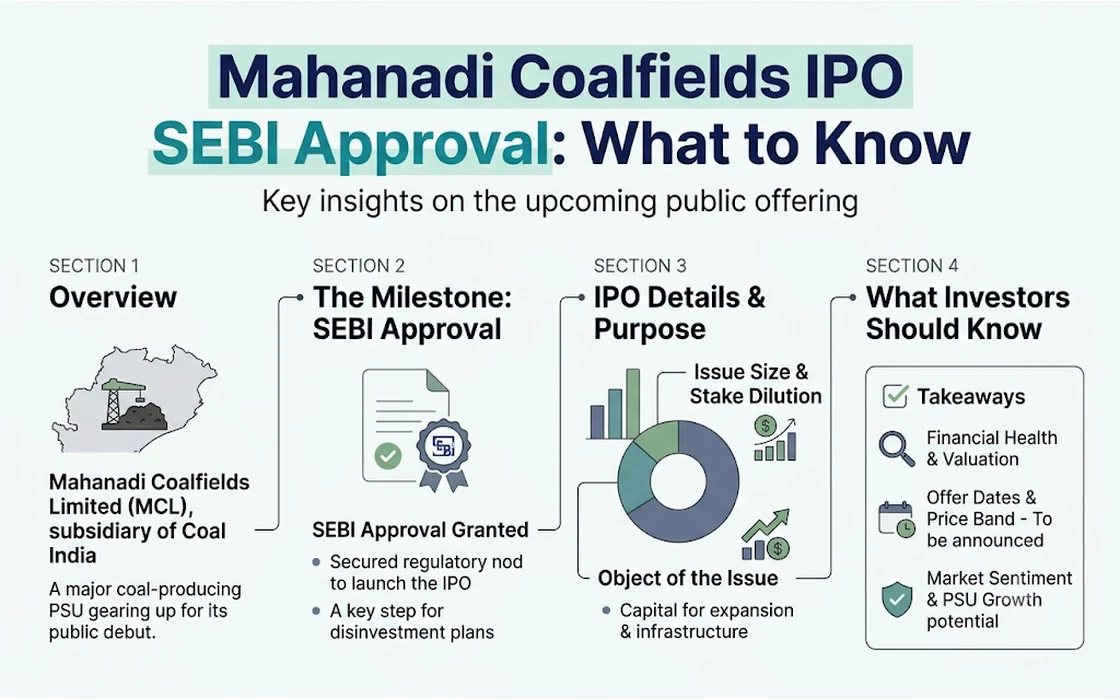
Searches regarding the Mahanadi Coalfields IPO SEBI approval reflect growing retail investor interest in public sector disinvestment, but as of 2026, the Securities and Exchange Board of India (SEBI) has not issued a final observation letter or public listing date for Mahanadi Coalfields Limited (MCL). While the Government of India, through the Ministry of Coal and the Department of Investment and Public Asset Management (DIPAM), has periodically evaluated proposals to list profitable subsidiaries of Coal India Limited (CIL), retail investors often conflate preliminary cabinet discussions with statutory regulatory clearance.
Mahanadi Coalfields Limited, headquartered in Sambalpur, Odisha, stands as one of the most prolific coal-producing arms of Coal India, generating substantial operational revenue and contributing heavily to India’s thermal energy security. When search interest spikes by thousands of percent over a single week, it is typically triggered by social media chatter, speculative unlisted share platforms, or general media reports citing internal inter-ministerial reviews rather than an official Draft Red Herring Prospectus (DRHP) landing on SEBI’s desk.
Understanding the gap between policy intent and regulatory execution is essential for protecting your capital in India’s primary markets. This guide explains what the Mahanadi Coalfields IPO proposal actually entails, breaks down the multi-stage statutory journey from ministerial nod to SEBI clearance, examines MCL’s underlying business fundamentals, and demonstrates how to verify official regulatory filings on primary exchange portals.
Key takeaways
- Status Check: As of 2026, no final SEBI observation letter or confirmed bidding window exists for a standalone Mahanadi Coalfields Limited IPO; search spikes reflect market anticipation rather than formal regulatory clearance.
- SEBI’s Role: The regulator does not “approve” or endorse an IPO’s investment viability; it reviews the Draft Red Herring Prospectus (DRHP) to ensure compliance with the SEBI (Issue of Capital and Disclosure Requirements) Regulations, 2018.
- Corporate Structure: MCL remains a 100% owned subsidiary of Coal India Limited; any partial listing requires formal approvals from CIL’s board, DIPAM, the Cabinet Committee on Economic Affairs (CCEA), and SEBI.
- Verification Imperative: Retail investors must cross-check unverified IPO claims against official registers on SEBI and stock exchange portals rather than relying on unofficial social media speculation or unauthorized pre-IPO platforms.
What is Mahanadi Coalfields Limited (MCL)?
Mahanadi Coalfields Limited was formed in 1992, carved out of South Eastern Coalfields Limited (SECL) to manage and expand coal mining operations across the state of Odisha. As one of the flagship subsidiaries of Coal India Limited—a Maharatna Central Public Sector Enterprise (CPSE)—MCL holds a commanding position in domestic fossil fuel production.
The company operates predominantly across two major coalfields:
- Talcher Coalfield: Located in Angul district, Talcher contains massive reserves of power-grade thermal coal. It houses major opencast projects, including Bharatpur, Ananta, Jagannath, and Bhubaneswari, which supply major power generation stations across eastern and southern India.
- Ib Valley Coalfield: Situated across Jharsuguda and Sundargarh districts, Ib Valley features major mining complexes such as Lajkura, Samaleswari, and Belpahar, benefiting from rail connectivity along the Howrah-Mumbai trunk line.
According to published operational reports from Coal India Limited, MCL consistently contributes over 25% to 30% of Coal India’s aggregate annual coal output. In recent fiscal years, its production figures have crossed 190 to 200 million tonnes per annum (MTPA), positioning it alongside South Eastern Coalfields Limited as one of the two commercial engines driving the parent company’s consolidated balance sheet.
Because MCL operates primarily open-cast mines with relatively low stripping ratios compared to deep underground pits, its extraction cost per tonne is among the lowest in Coal India’s portfolio. This operational efficiency generates robust operating cash flows and consistent dividend upstreaming to the parent company and the Ministry of Coal.
Decoding “SEBI Approval”: Rumor vs. Capital Market Reality
When market participants search for “Mahanadi Coalfields IPO SEBI approval,” there is often a fundamental misunderstanding of how the Indian capital market functions. SEBI does not operate as an investment approval agency that greenlights companies based on merit. Instead, SEBI acts as a market conduct regulator enforcing disclosure integrity.
The Mechanics of SEBI ICDR Regulations
Under the SEBI (Issue of Capital and Disclosure Requirements) Regulations, 2018 (commonly known as ICDR Regulations), an issuer company seeking to raise capital or execute an Offer for Sale (OFS) must file a detailed draft prospectus through registered Book Running Lead Managers (BRLMs).
Here is what actually happens behind closed doors:
- The DRHP Submission: The company and its merchant bankers compile all historical audited financials, litigation records, environmental clearances, and risk factors into a Draft Red Herring Prospectus (DRHP) and submit it to SEBI.
- Public Inspection Window: The DRHP is hosted on SEBI’s official portal for a mandatory period of at least 21 days to invite public comments and institutional scrutiny.
- Regulatory Review: SEBI scrutinizes the document to ensure that disclosures are exhaustive, accurate, and compliant with statutory accounting norms.
- Issuance of Observations: If SEBI is satisfied with the clarifications submitted by the merchant bankers, it issues an “Observation Letter.” In financial parlance, this observation letter is what the media often terms “SEBI approval.”
- Validity Period: Once the observation letter is issued, the company has an exact window of one year to launch the IPO. If the issue does not launch within 12 months, a fresh DRHP must be filed.
As of 2026, no DRHP for Mahanadi Coalfields Limited has been published for public review or received an observation letter from SEBI. Speculation generally surfaces when government committees discuss listing state-owned non-core businesses or unlocking value in subsidiary firms. To understand how offer documents translate into retail public offerings, review our analysis of the Maxwell Engineering IPO guide, which traces disclosures from filing to listing.
The Five-Stage Lifecycle of a Central PSU IPO
Unlike private companies where promoters and private equity backers make fast-tracked listing decisions, a Central Public Sector Enterprise must navigate an elaborate multi-tiered bureaucratic and statutory roadmap. An investor evaluating PSU disinvestment prospects should understand each distinct stage.
+-------------------------------------------------------------+
| Stage 1: Inter-Ministerial Review & DIPAM In-Principle Nod   |
+-------------------------------------------------------------+
                              |
                              v
+-------------------------------------------------------------+
| Stage 2: CCEA (Cabinet Committee) Clearance                 |
+-------------------------------------------------------------+
                              |
                              v
+-------------------------------------------------------------+
| Stage 3: Appointment of Merchant Bankers, Legal Advisers    |
+-------------------------------------------------------------+
                              |
                              v
+-------------------------------------------------------------+
| Stage 4: DRHP Filing & SEBI Observation Letter Review       |
+-------------------------------------------------------------+
                              |
                              v
+-------------------------------------------------------------+
| Stage 5: RoC Filing, Price Band Fixation & Bidding Window   |
+-------------------------------------------------------------+
Stage 1: Inter-Ministerial Policy Initiation
The Ministry of Coal and DIPAM evaluate the capital structure of Coal India Limited and its subsidiaries. Disinvestment targets set in the Union Budget frequently trigger scoping studies to determine whether an Offer for Sale (OFS) of a subsidiary will dilute the parent company’s valuation or unlock incremental enterprise value.
Stage 2: Cabinet Committee on Economic Affairs (CCEA) Approval
Because MCL is a wholly owned subsidiary of a Maharatna CPSE, selling shares to the public involves divesting government-held assets indirectly. The proposal must be cleared by the CCEA, chaired by the Prime Minister. Without formal CCEA approval, no merchant banker can be formally tasked with preparing public offer documents.
Stage 3: Appointment of Intermediaries
Once administrative approval is granted, DIPAM issues a public Request for Proposals (RFP) to appoint:
- Book Running Lead Managers (investment banks)
- Legal counsels (domestic and international)
- Registrar and transfer agents
- Advertising agencies and independent asset valuers
This process is conducted via public tenders on the Press Information Bureau (PIB) and DIPAM websites.
Stage 4: Filing the DRHP with SEBI
The appointed merchant bankers spend several months conducting statutory due diligence. They audit land acquisition titles in Odisha, environmental clearances from the Ministry of Environment, Forest and Climate Change (MoEFCC), and existing Fuel Supply Agreements (FSAs). Only after this diligence is finalized is the DRHP filed with SEBI and simultaneous draft listings submitted to the National Stock Exchange of India (NSE) and the BSE.
Stage 5: Price Discovery and Public Subscription
After receiving SEBI’s observation letter, the company files the Red Herring Prospectus (RHP) with the Registrar of Companies (RoC). The issuer announces the floor price and price band, holds institutional roadshows, opens the anchor investor book for one day, and subsequently opens the bidding window for Qualified Institutional Buyers (QIBs), Non-Institutional Investors (NIIs), and Retail Individual Investors (RIIs).
Comparison: PSU Disinvestment Stages vs. Retail Action
The following table contrasts what occurs inside the regulatory machinery against the verified actions a retail investor should take at each stage:
| Stage | Responsible Authority | Publicly Auditable Document | Investor Verification Step |
|---|---|---|---|
| 1. Policy Scoping | Ministry of Coal / DIPAM | Ministry press releases, budget disinvestment targets | Ignore speculative WhatsApp tips; track official statements on pib.gov.in. |
| 2. Strategic Clearance | Cabinet Committee on Economic Affairs (CCEA) | Official Gazette notifications, Cabinet briefings | Confirm whether formal approval for subsidiary listing was granted. |
| 3. Banker Mandate | DIPAM / CIL Board | RFP documents for Merchant Banker selection | Review scope of mandate; this confirms preliminary structuring has begun. |
| 4. Regulatory Filing | SEBI & Stock Exchanges | Draft Red Herring Prospectus (DRHP) on sebi.gov.in | Read the DRHP thoroughly; inspect operational risk factors and balance sheet notes. |
| 5. Observation Letter | SEBI Primary Market Division | SEBI Processing Status / Final Observation Letter | Note the 12-month validity period; track merchant bank announcements. |
| 6. Issue Launch | Issuer, RoC, Merchant Bankers | Red Herring Prospectus (RHP) containing Price Band | Apply via ASBA or UPI through authorized depository participants. |
Fundamentals to Evaluate If Mahanadi Coalfields Lists
If an IPO for Mahanadi Coalfields materializes through official channels in the future, retail investors must look beyond sovereign ownership. Investing in a public sector mining utility involves distinct structural trade-offs between cash-flow reliability and regulatory constraints.
1. Operational Realization and Fuel Supply Agreements (FSAs)
MCL sells the vast majority of its extracted coal through long-term Fuel Supply Agreements with power generation utilities such as NTPC, state electricity boards, and independent power producers (IPPs).
- Regulated Pricing: FSA coal is sold at notified prices that are typically lower than international benchmark prices (e.g., Newcastle or Indonesian thermal indices). This protects domestic utilities from global energy inflation but caps MCL’s gross realization per tonne.
- E-Auction Sales: The remaining balance of coal is sold through commercial e-auctions. During periods of peak industrial demand, e-auction premiums expand dramatically, boosting operating margins. An investor must review the historical proportion of FSA versus e-auction sales in the company’s revenue mix.
2. Evacuation Logistics and Rail Corridors
Mining coal is only half the battle; evacuating hundreds of millions of tonnes requires massive logistics infrastructure. MCL has historically faced evacuation bottlenecks during peak monsoon periods or railway wagon shortages. Investors should examine:
- Construction progress on dedicated rail lines (such as the Jharsuguda-Barpali-Sardega rail link).
- Adoption of mechanized First Mile Connectivity (FMC) projects, including rapid loading systems, conveyor belts, and coal handling plants (CHPs). Mechanization reduces reliance on road transport, lowers diesel costs, and minimizes environmental dust pollution penalties.
3. Environmental and Land Acquisition Risks
Coal mining in Odisha involves significant social and ecological clearances:
- Forest Clearance Stage I & II: Open-cast expansion requires statutory approvals from the MoEFCC. Delays in forestry clearances directly postpone mine commissioning.
- Rehabilitation and Resettlement (R&R): Land acquisition in tribal belts requires negotiated compensation, physical resettlement, and employment commitments under state and central policies. Outstanding litigation or community resistance can idle heavy earth-moving machinery (HEMM), incurring idle depreciation costs.
4. Capital Expenditure and Diversification
As part of India’s broader energy transition commitments, MCL has initiated capital deployment into thermal power generation projects and solar installations. Investors must assess whether these capital expenditures yield attractive returns on capital employed (ROCE) or whether they depress the high return on equity (ROE) historically earned through pure-play open-cast mining.
Navigating the Trade-Offs: PSU Mining Assets
Investing in a major public sector undertaking carries structural characteristics that differ significantly from high-growth private corporate offerings. Understanding these trade-offs prevents misplaced expectations regarding capital appreciation versus yield.
+-----------------------------------------------------------+
|              PSU Mining Asset Allocation Profile          |
+-----------------------------------------------------------+
| PROS:                                                     |
| * Monopolistic domestic market position                   |
| * Robust balance sheet with minimal net debt              |
| * Steady dividend payout record                           |
|                                                           |
| CONS:                                                     |
| * Statutory pricing caps on FSA thermal coal              |
| * Long-term carbon transition & ESG divestment pressures  |
| * Heavy capital reinvestment in regulated power projects  |
+-----------------------------------------------------------+
Potential Advantages
- Sovereign Support and Market Scale: As a vital arm of Coal India, MCL faces virtually zero risk of domestic market displacement in the medium term. India’s base-load electricity generation remains heavily reliant on domestic thermal coal to meet industrial demand.
- Dividend Yield Profile: Central public sector enterprises are governed by Department of Public Enterprises (DPE) guidelines requiring minimum annual dividend distributions (generally 30% of net profit or 5% of net worth, whichever is higher). This makes cash-generative subsidiaries attractive for income-oriented portfolios.
Structural Drawbacks
- ESG Headwinds: Global institutional capital (foreign portfolio investors and international sovereign wealth funds) faces strict Environmental, Social, and Governance (ESG) mandates restricting investment in thermal coal miners. This restriction can compress the price-to-earnings (P/E) multiple of the stock, limiting capital appreciation even if earnings grow.
- Policy Overhang: The central government holds the prerogative to alter royalty structures, coal cess, or environmental mitigation levies, which directly impact bottom-line profitability.
For a grounded framework on filtering public offerings and managing portfolio risk, explore our detailed walkthrough on how to invest in IPOs safely.
Practical Guide: How to Verify IPO Filings Directly
When search trends surge for an unconfirmed public offering, retail investors frequently fall prey to unauthorized pre-IPO share brokers, fraudulent subscription portals, or fictitious grey market premium (GMP) updates.
Follow this rigorous verification sequence whenever you read rumors of an impending public offering:
Step 1: Query the SEBI Public Database
Do not rely on screenshots or secondary blog commentary. Open your browser and visit the official portal of the Securities and Exchange Board of India.
- Navigate to the Filings tab on the homepage.
- Select Public Issues from the dropdown menu.
- Click on Draft Offer Documents filed with SEBI.
- Use the search field to enter the company name (e.g., “Mahanadi Coalfields”).
- If no document is listed, no formal public offering process has been initiated with the capital markets regulator.
Step 2: Check Exchange Pre-Listing Portals
Both the BSE India and the National Stock Exchange of India maintain real-time tracking pages for initial public offerings:
- On BSE, navigate to
Public Issues>Offer Documents>Draft Red Herring Prospectus. - On NSE, visit the
Investtab >Initial Public Offerings (IPO)>Upcoming Issues. If an issuer is genuinely progressing toward market listing, their draft filings will appear simultaneously across both exchange directories.
Step 3: Scrutinize Coal India’s Corporate Disclosures
Under Regulation 30 of the SEBI (Listing Obligations and Disclosure Requirements) Regulations, 2015, any decision by Coal India Limited to list, divest, or restructure a material subsidiary like MCL is classified as unpublished price-sensitive information (UPSI).
- CIL is legally obligated to file an immediate corporate announcement with the stock exchanges the moment its board approves a listing plan.
- You can verify these filings directly by checking Coal India Limited’s corporate announcement page on the NSE or BSE website. If no regulatory disclosure regarding a subsidiary IPO is archived, any circulating news report represents speculative commentary.
What to Do and What to Avoid During IPO Rumor Cycles
Market cycles regularly experience bursts of enthusiasm around potential mega-listings. When internet searches spike around unconfirmed public issues, follow these practical rules:
What to Do
- Monitor Official DIPAM Announcements: The Department of Investment and Public Asset Management routinely publishes its disinvestment pipeline and tender notices for asset monetisation. Review official government notifications to confirm whether transaction advisers have been selected.
- Track Parent Company Filings: Because Mahanadi Coalfields is wholly consolidated under Coal India, review CIL’s quarterly investor presentations. Management commentary on subsidiary restructuring provides factual timelines directly from executive leadership.
- Prepare Your Depository Account: Ensure your Demat account, linked PAN card, and UPI mandate limits are configured with your bank. For retail investors in India, UPI IPO mandates are capped at Rs. 5,00,000 per application. Familiarize yourself with Application Supported by Blocked Amount (ASBA) mechanisms via net banking.
What to Avoid
- Avoid Unregulated “Pre-IPO” Platforms: Unscrupulous intermediaries often claim to offer “unlisted pre-IPO shares” of state-owned subsidiaries. In many cases, these shares either do not exist or are held under opaque custodial arrangements with extensive lock-in restrictions. Unlisted shares in unapproved offerings carry high counterparty and liquidity risk.
- Avoid Relying on Grey Market Premiums (GMP): Grey market premiums represent unorganized, unregulated OTC bids that are easily manipulated by small syndicates to create artificial subscription hype. GMP provides no legal guarantee of listing-day performance.
- Avoid Borrowing Funds for Applications: Never take short-term personal loans or high-interest non-banking financial company (NBFC) funding to apply for an IPO based on social media trends. If the listing underperforms or market conditions sour, debt servicing costs will erode your net returns.
FAQ
Has SEBI officially approved the Mahanadi Coalfields IPO in 2026?
No, as of 2026, SEBI has not issued an observation letter or public approval for a Mahanadi Coalfields Limited IPO. No Draft Red Herring Prospectus (DRHP) has been made available on SEBI’s public register, indicating that the proposal has not entered the statutory filing stage with capital market regulators.
What is the difference between DIPAM clearance and SEBI approval?
DIPAM clearance is an internal administrative decision by the Government of India approving the financial sale or dilution of a state-owned enterprise. In contrast, SEBI does not approve asset sales; it examines the Draft Red Herring Prospectus to confirm that the company meets statutory disclosure and legal standards under the ICDR Regulations before opening for public bidding.
Can retail investors buy Mahanadi Coalfields shares in the unlisted market?
Retail investors should exercise extreme caution regarding unlisted share claims for wholly owned government subsidiaries. Mahanadi Coalfields is a 100% subsidiary of Coal India Limited, meaning there are no genuine public pre-IPO equity shares circulating in secondary unlisted markets. Claims to the contrary often involve speculative or unauthorized derivative arrangements.
How does Mahanadi Coalfields affect the stock performance of Coal India Limited?
MCL is one of the largest financial contributors to Coal India Limited, accounting for over 25% of its total output and a major portion of consolidated profits. Any operational development at MCL—such as output expansion, rail evacuation upgrades, or wage revisions—directly impacts the quarterly financial statements and dividend payouts of Coal India on the BSE and NSE.
Conclusion
The sudden surge in searches for “Mahanadi Coalfields IPO SEBI approval” highlights the high level of investor appetite for cash-generative, asset-heavy public sector enterprises in India. However, prudent capital allocation requires distinguishing between preliminary administrative proposals and formal capital market milestones.
Mahanadi Coalfields Limited remains a foundational subsidiary of Coal India Limited, delivering millions of tonnes of coal each month under long-term supply agreements. Should the Government of India and Coal India formalize a public disinvestment strategy, the process will leave an auditable paper trail: cabinet approvals, appointment of merchant bankers via DIPAM tenders, and the submission of a public DRHP on SEBI’s portal.
Until those statutory documents appear on primary exchange directories, retail investors should treat viral listing dates as speculative rumors, verify regulatory data directly through official market sources, and evaluate energy sector investments through registered, transparent primary market mechanisms.
- Tags:
- Mahanadi Coalfields
- Ipo
- Sebi Approval
- Coal India
- Psu Stocks
- Stock Market India