
Vivo Smartphone Price Increase India: Full Explainer
Understand why Vivo smartphone prices fluctuate in India, how retail pricing works, and how to verify official rates before making a purchase.

- NV Trends
- 13 min read
A surge in searches for a Vivo smartphone price increase in India generally indicates consumer surprise over revised retail tags, sudden model tier adjustments, or broader component-driven price shifts across the domestic market. When mobile device prices rise or appear higher than expected, the adjustment is rarely arbitrary; it typically stems from shifts in manufacturer-dictated Minimum Operating Prices (MOP), raw component cost pressures, foreign exchange fluctuations, or the phasing out of launch incentives. Understanding these mechanisms helps buyers distinguish between genuine manufacturer-led revisions and normal retail pricing fluctuations.
Vivo maintains one of the largest retail footprints in the Indian smartphone industry, operating across tens of thousands of multi-brand stores, exclusive brand outlets, and major e-commerce platforms. Because the brand relies heavily on traditional offline retail channels alongside digital storefronts, any systemic shift in distributor pricing or introductory pricing structures becomes immediately noticeable to shoppers across Tier-1, Tier-2, and Tier-3 cities alike.
Before assuming a blanket price increase has occurred across an entire product catalog, consumers need to examine how smartphone pricing works in the country. Official retail revisions usually follow clear regulatory guidelines, while temporary market factors—such as expiring bank cashbacks or seasonal inventory resets—can often mimic the appearance of a permanent price hike.
Key takeaways
- Price changes in the Indian smartphone sector typically reflect adjustments to the Minimum Operating Price (MOP) rather than arbitrary dealer markups.
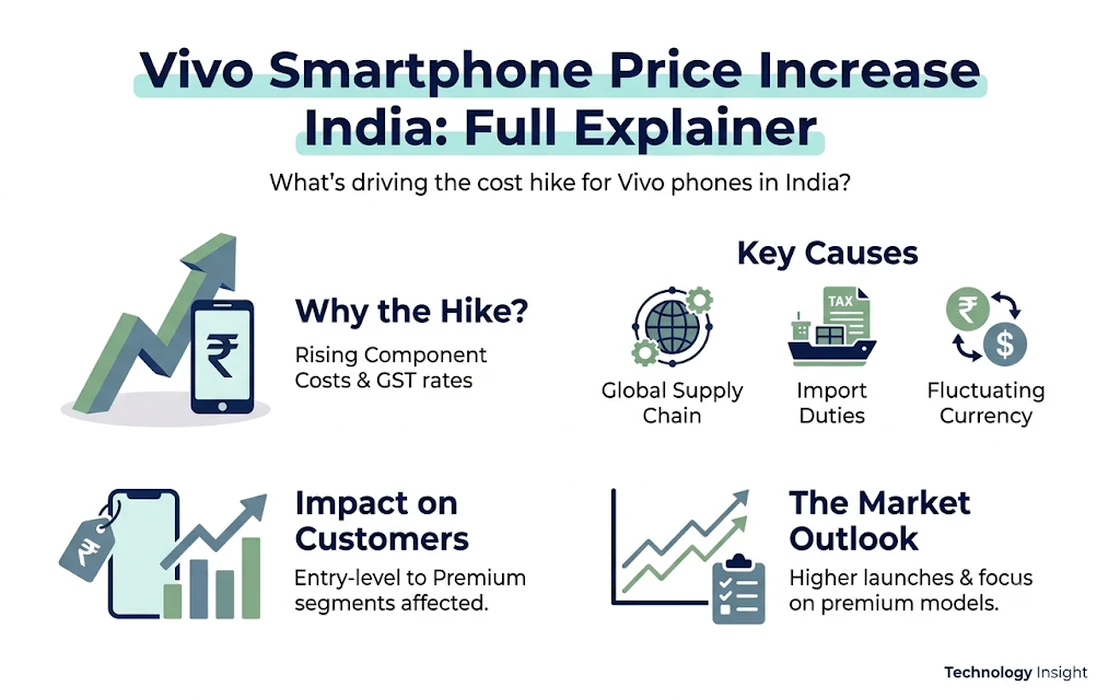
- Upward price movements are primarily driven by rising semiconductor costs, volatile currency exchange rates, and statutory import duties on semi-knocked-down (SKD) kits.
- Vivo’s extensive offline network means retail prices are tightly managed through dealer margins and price-protection mechanisms to preserve parity with online channels.
- Buyers should verify official pricing through authorized portals and check the Maximum Retail Price (MRP) declared under Indian metrology laws before purchasing.
Understanding Smartphone Pricing in India: MRP vs. MOP
To understand why a phone’s price tag shifts, one must first understand the distinction between Maximum Retail Price (MRP) and Minimum Operating Price (MOP). In the Indian consumer electronics ecosystem, these two numbers serve very different functions.
The Role of MRP Under Indian Law
The Maximum Retail Price is a statutory ceiling mandated under the Legal Metrology (Packaged Commodities) Rules, enforced by the Ministry of Consumer Affairs. By law, no retailer in India can sell a packaged consumer device for a price higher than the printed MRP on the box.
However, smartphones are almost never sold at their printed MRP. Manufacturers intentionally set the MRP substantially higher—often by 15% to 25%—than the intended selling price. This spread creates legal headroom for price elasticity, dealer commissions, and state-level freight variances without requiring the brand to reprint packaging or update legal declarations across thousands of warehouse units.
The Function of MOP (Minimum Operating Price)
The Minimum Operating Price (MOP), also referred to in retail channels as the Best Buy or Market Operating Price, is the actual floor price established by the manufacturer. Brands like Vivo mandate that neither offline authorized dealers nor online e-commerce partners sell below this specific threshold.
When consumers search for news regarding price increases, they are usually noticing an increase in the MOP. If a manufacturer raises the MOP of an active handset from Rs. 17,999 to Rs. 18,999, every authorized retail partner is required to update their point-of-sale billing systems to reflect the new floor price. Retailers who violate this floor risk losing brand marketing support, display inventory, or direct distributor incentives.
Primary Drivers Behind Smartphone Price Adjustments
Smartphone price shifts are rarely confined to a single brand; they generally reflect industry-wide macroeconomic pressures. When brands adjust price points in India, several structural cost factors are typically responsible.
+-----------------------------------------------------------+
|               Primary Cost Pressure Vectors               |
+-----------------------------------------------------------+
                             |
         +-------------------+-------------------+
         |                                       |
+-----------------+                     +-----------------+
| Component Costs |                     | Macro & Fiscal  |
| - DRAM / NAND   |                     | - USD/INR FX    |
| - Image Sensors |                     | - BCD / Tariffs |
| - 4nm/3nm Nodes |                     | - Freight / GST |
+-----------------+                     +-----------------+
1. Global Semiconductor and Memory Chip Costs
Smartphones rely on globally sourced components priced in international currencies. Core elements such as Dynamic Random-Access Memory (DRAM), NAND flash storage, camera image sensors, and advanced processor chipsets follow cyclical pricing models governed by global foundry capacity.
When foundries face capacity constraints or transition to denser fabrication nodes, bill-of-materials (BOM) costs rise across the board. This dynamic is not limited to mid-range devices; even premium ecosystem players experience similar supply headwinds, as seen when Apple faced potential price increases due to rising memory chip costs. When memory suppliers raise wafer contract rates, smartphone makers must choose between absorbing the margin erosion or passing the cost along via revised retail price points.
2. Foreign Exchange Rates (USD vs. INR)
Although most smartphones sold in India are assembled domestically under the Phased Manufacturing Programme overseen by the Ministry of Electronics and Information Technology (MeitY), critical sub-assemblies are still imported. Items like printed circuit board assemblies (PCBAs), specialized camera lenses, display panels, and radio-frequency front-end modules are procured internationally in US Dollars (USD).
When the Indian Rupee depreciates against the USD, the landed cost of these semi-knocked-down (SKD) kits increases. Even a modest depreciation of 2% to 3% can add hundreds of rupees to the manufacturing cost of a mid-tier phone. While brands absorb minor currency swings over short quarters, prolonged currency weakness eventually forces a revision in the local MOP.
3. Statutory Tariffs and Assembly Economics
India’s domestic manufacturing framework relies on a combination of the standard 18% Goods and Services Tax (GST) on mobile phones and varying Basic Customs Duty (BCD) rates on non-localized inputs. According to industry analyses published by financial media outlets such as The Economic Times, tariff recalibrations on components like camera modules, display assemblies, or imported connectors immediately impact unit margins. If tariff exemptions expire or duty structures are rationalized upwards, manufacturers adjust retail pricing across affected SKUs to preserve channel health.
4. Generational Tier Repositioning
Often, what consumers perceive as a “price increase” is actually generational bracket creep. As entry-level and mid-range devices adopt features previously reserved for flagships—such as periscope zoom lenses, curved AMOLED displays, IP68/IP69 water resistance, and larger silicon-carbon batteries—the baseline cost to produce the handset rises.
For instance, when comparing successive iterations in the competitive mid-range space—a dynamic detailed in our Redmi Note 15 Pro review and pricing analysis—brands frequently launch successive generations at higher starting prices while retiring older, cheaper hardware.
How Price Movements Impact Different Vivo Lineups
Vivo segments its product offerings in India into distinct series, each catering to different buyer demographics and price sensitivity levels. Price adjustments manifest differently across these tiers.
       [ Vivo X-Series ]  --> Premium Tier (Zeiss Optics, Flagship SoCs)
              ^
              |
       [ Vivo V-Series ]  --> Upper Mid-Range (Slim Design, Portrait Cameras)
              ^
              |
       [ Vivo Y-Series ]  --> Mass Market / Value (Battery, Essential 5G)
The Budget and Mass-Market Segment: Vivo Y-Series
The Vivo Y-series serves the high-volume, price-sensitive segment ranging typically between Rs. 9,000 and Rs. 20,000. In this category, consumer purchasing decisions are highly sensitive to even small price variations of Rs. 500 to Rs. 1,000.
Because margins in this segment are narrow, budget models are the most susceptible to sudden MOP revisions caused by spikes in low-density RAM or display panel costs. When component prices rise, brands either bump the price of an existing model by Rs. 500 or quietly introduce a refreshed variant with adjusted storage configurations to hit the required price point.
The Mid-Range Portrait Segment: Vivo V-Series
The V-series represents Vivo’s core offline strength, competing directly in the Rs. 25,000 to Rs. 45,000 bracket. These devices focus heavily on industrial design, specialized front and rear camera setups, and rapid charging speeds.
Price movements in the V-series rarely happen mid-cycle on existing models. Instead, revisions usually occur during the transition between generations. If global logistics or sensor costs elevate the BOM, the successor model might debut at Rs. 33,999 rather than the Rs. 31,999 launch price of its predecessor, accompanied by higher introductory trade-in bonuses to soften the transition.
The Premium Flagship Segment: Vivo X-Series
The X-series serves as the brand’s technology showcase, featuring co-engineered Zeiss optics, custom imaging chips, and top-tier silicon from MediaTek or Qualcomm. Positioned above Rs. 60,000, buyers in this segment are less sensitive to incremental price changes than buyers in the Y-series.
Price increases here are driven almost entirely by raw hardware ambition: 1-inch type camera sensors, complex periscope mechanisms, ultrasonic fingerprint scanners, and cutting-edge battery chemistries. Because these components carry substantial development overheads, flagship prices can shift between release cycles depending on global foundry yields and specialized lens supply contracts.
Comparing Price Adjustment Factors Across Device Segments
The following table breaks down the primary factors that trigger price adjustments in the Indian mobile market, their typical impact level, and how consumers can identify them:
| Cost Factor | Primary Driver | Affected Segments | Consumer Visibility | What to Verify |
|---|---|---|---|---|
| Component Inflation | Foundry wafers, DRAM, NAND flash supply cycles | Budget to Mid-Range (Y-series, lower V-series) | High (Immediate Rs. 500–Rs. 1,500 retail price rise) | Compare base variant storage specs against older listings |
| Currency Depreciation | Rupee weakening against the US Dollar | All imported SKD assemblies | Moderate (Gradual mid-cycle MOP adjustments) | Check authorized offline MOP lists versus launch press releases |
| Tariff / Duty Changes | Revisions to BCD or component import exemptions | Assembled hardware across all price tiers | Low to Moderate (Usually rolled into base pricing) | Look for official brand notifications or regulatory circulars |
| Generational Creep | Addition of premium hardware (OIS, IP ratings, curved screens) | Upper Mid-Range and Flagship (V-series, X-series) | High (New models launch at higher initial price bands) | Check predecessor pricing versus the newly launched generation |
| Incentive Expiration | Phasing out of launch-window instant bank discounts | All newly released handsets | Very High (Appears as a sudden price hike after week 2) | Verify whether the base price increased or the card rebate ended |
What to Check Before Buying: A Verification Guide
If you encounter reports of a price increase on a smartphone you plan to purchase, taking a systematic approach will help you determine the true cost and avoid overpaying.
Step 1: Check Box MRP
  └── Verify the physical sticker; retailer cannot charge above this number.

Step 2: Check Brand Portal
  └── Visit the official brand store online to verify the current official MOP.

Step 3: Distinguish Cashbacks
  └── Check whether the base price rose or a temporary bank discount expired.

Step 4: Compare Offline vs. Online
  └── Ask authorized local dealers for their best billed rate with bundled offers.
1. Confirm the Baseline Through Official Channels
Never rely solely on third-party marketplace listings or unverified social media claims to judge whether a phone’s price has changed. E-commerce algorithms frequently adjust prices based on merchant stock levels, regional warehouse availability, and seller margins.
To find the true current price:
- Check the official brand online store in India. The price listed on the manufacturer’s own storefront reflects the active, nationwide MOP.
- Review major authorized multi-brand retail chains (such as Reliance Digital, Croma, Poorvika, or Sangeetha). Authorized partners maintain strict price parity with the brand’s official directives.
2. Separate Base Price Hikes from Expired Promotions
In many cases, an alleged “price hike” is simply the scheduled conclusion of an early-bird promotional window. During device launches, brands frequently offer:
- Instant bank card discounts (e.g., Rs. 2,000 to Rs. 4,000 off via partner credit cards).
- Introductory exchange bonuses on older devices.
- Free bundled accessories, such as wireless earphones or screen replacement protection plans.
When these limited launch programs expire after the first few weeks of sale, the effective price paid by the consumer returns to the standard MOP. While this feels like an increase at checkout, the device’s actual invoice list price has remained unchanged.
3. Check the Box MRP and Physical Packaging
If you are buying from a physical retail shop, inspect the product packaging before billing. Under Indian law, the retail billing system cannot charge you more than the printed MRP displayed on the official manufacturer label. If an offline vendor attempts to charge an amount above the box MRP—citing sudden shortages or market adjustments—that transaction violates consumer protection regulations.
4. Evaluate Predecessor Alternatives
If a newly launched model has entered the market at a significantly higher price point than expected, consider whether the previous generation meets your operational requirements. In the Android ecosystem, year-over-year performance gains between consecutive mid-range processor tiers have stabilized.
An outgoing V-series or Y-series model running on a stable software build, often discounted by Rs. 3,000 to Rs. 6,000 to clear channel inventory, can deliver comparable real-world utility at a substantially lower cost.
Common Pitfalls to Avoid
When market prices fluctuate, misinformation and rushed buying decisions can lead to unnecessary spending. Keep the following practices in mind:
- Avoid Unverified Grey-Market Sellers: During periods of supply constraints or rumored price hikes, unauthorized third-party vendors may claim that prices are about to surge and demand an immediate premium. Handsets purchased outside authorized distribution channels may carry invalid invoices, voiding standard warranty coverage.
- Do Not Confuse Temporary Seller Markups with Official Revisions: On open marketplaces, third-party sellers who run low on stock often artificially raise their listing prices to avoid pausing their product listings. Always check who the seller is (e.g., whether they are an authorized platform-managed distributor) before assuming the brand increased the price.
- Avoid Buying Immediately at the End of a Festive Cycle: E-commerce sales cycles (such as festival promotions) introduce temporary price cuts. Immediately after these events conclude, prices return to their baseline MOP. If you miss a promotional window, waiting for the next monthly sale cycle is often wiser than purchasing during the immediate post-sale reset.
- Do Not Overlook Offline Retail Bargaining: Unlike online storefronts with fixed automated pricing, physical smartphone dealers in India often have access to dealer-level margin flexibilities. Even if an official MOP has increased slightly, physical retailers may offer store-level accessories, extended warranty packs, or zero-cost EMI processing fee waivers that offset the increase.
FAQ
Why do Vivo smartphone prices increase in India?
Price increases typically occur when global component costs—such as memory chips and image sensors—rise, or when the Indian Rupee depreciates against the US Dollar, raising the landed cost of imported assembly kits. In other cases, perceived increases simply reflect the end of introductory bank discounts or higher starting prices for newly launched device generations.
Can an offline mobile shop in India charge more than the printed MRP?
No. Under the Legal Metrology (Packaged Commodities) Rules, no retailer anywhere in India can charge a price higher than the Maximum Retail Price (MRP) printed on the product packaging. If an offline dealer attempts to charge above the printed MRP, it is a statutory violation regardless of market supply conditions.
What is the difference between MRP and MOP for Vivo phones?
MRP is the legal maximum price ceiling printed on the packaging, while MOP (Minimum Operating Price) is the actual baseline selling price set by Vivo for authorized retailers. While the printed MRP might be Rs. 24,999, the official MOP could be set at Rs. 19,999, which serves as the uniform retail price across both online and offline channels.
Is it better to buy an older Vivo model if current prices increase in 2026?
Choosing an outgoing generation is often practical if new models experience price increases without substantial hardware upgrades. Outgoing models frequently receive price cuts to clear channel inventory, offering similar battery life, display quality, and day-to-day performance at a significantly lower total outlay.
Conclusion
Reports and searches surrounding a Vivo smartphone price increase in India highlight the delicate balance between consumer expectations and the economic realities of hardware manufacturing. Price movements across the smartphone industry are driven by measurable commercial factors: international semiconductor contract rates, currency valuation trends, statutory import tariffs, and the rising cost of incorporating advanced mobile technology.
For buyers, the most effective response to shifting prices is careful verification. By distinguishing between official MOP adjustments and expiring promotions, checking authorized retailer networks, and comparing consecutive model generations, consumers can make well-informed purchasing decisions regardless of temporary market fluctuations.
- Tags:
- Vivo
- Smartphones
- India
- Smartphone Prices
- Mobile Technology
- Consumer Tech