
How to Rebalance Your Investment Portfolio
Learn how to rebalance your investment portfolio in India to control risk, optimize taxes, and maintain asset allocation across market cycles.

- NV Trends
- 14 min read
- Updated
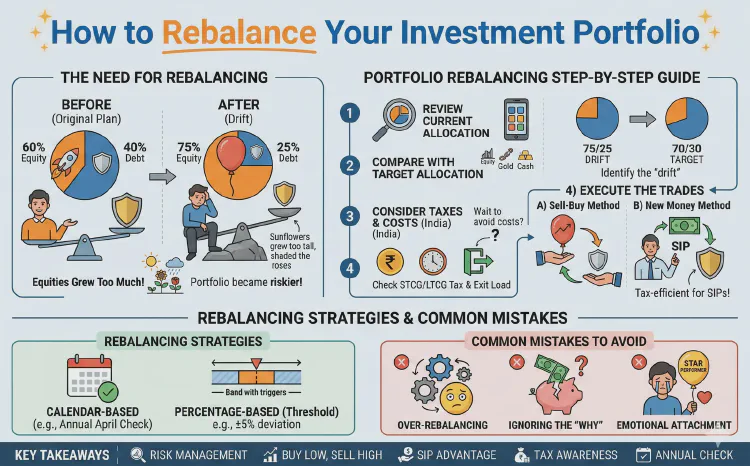
Rebalancing your investment portfolio involves periodically adjusting the weightings of your asset classes—such as equity, debt, and gold—back to your target allocation to maintain an optimal balance between risk and return. Rather than attempting to forecast market movements, rebalancing provides an objective, rules-based mechanism that keeps your portfolio aligned with your original financial goals and risk tolerance.
In the Indian financial landscape, prolonged market trends can quietly reshape your portfolio. During significant equity bull runs, such as major rallies in the Nifty 50 or mid-cap indices, equity allocations can expand well beyond initial projections. An investor who began with a balanced allocation of 60% equity mutual funds and 40% debt funds might discover that uncurbed capital growth has driven equity exposure to 75% or 80%. While this expanded equity base enhances nominal portfolio value on paper, it simultaneously magnifies vulnerability to severe drawdowns when market cycles turn.
Many retail investors mistakenly view portfolio management through a “set it and forget it” lens, assuming that high-performing assets should always run unchecked. However, academic research and historical market behavior demonstrate that asset class leadership is cyclical. By systematically realigning your asset weights, you establish a disciplined framework to take calculated profits from overextended assets and channel capital into undervalued or stabilizing instruments.
Key takeaways
- Controls portfolio volatility: Rebalancing prevents unmanaged equity rallies from turning a moderate-risk portfolio into an aggressive, vulnerable one.
- Enforces disciplined investing: It systematically executes the core principle of buying low and selling high without relying on emotional market timing.
- Minimizes tax drag through smart inflows: Using fresh SIPs and cash inflows to rebalance avoids immediate capital gains taxes and fund exit loads in India.
- Relies on structured rules: Implementing calendar-based schedules or percentage-based tolerance bands eliminates emotional decision-making.
What Is Portfolio Rebalancing and Why Does Drift Occur?
Portfolio drift is the natural deviation of your asset weights away from your baseline target over time, caused by divergent rates of return across different asset classes. Equities, fixed income, sovereign gold bonds, and cash equivalents do not move in tandem. When one asset experiences rapid compounding while another delivers modest, stable yields, the proportional composition of your total wealth shifts.
Consider a practical example based on published market data. Suppose an investor in India constructs a portfolio worth Rs. 10,00,000 with a strategic asset allocation of 60% equity (Rs. 6,00,000) and 40% debt (Rs. 4,00,000). During a strong macroeconomic growth cycle, domestic equities deliver an annual return of 30%, while fixed-income debt funds yield 7%.
At the end of the year, the equity segment grows to Rs. 7,80,000, and the debt segment rises to Rs. 4,28,000, bringing the total portfolio value to Rs. 12,08,000. Recalculating the asset weights reveals that equity now constitutes roughly 64.6% of the portfolio, while debt has dropped to 35.4%.
If the broader stock market experiences a sudden 25% correction the following year, the investor experiences that drawdown on Rs. 7,80,000 rather than their planned risk envelope. To design a resilient base allocation before managing drift, review our detailed guide on how to build a diversified investment portfolio.
Primary Rebalancing Strategies: Calendar vs. Threshold vs. Hybrid
Choosing the right rebalancing strategy depends on your operational preferences, portfolio size, and willingness to monitor asset fluctuations. Financial planners and market practitioners generally rely on three foundational methodologies.
1. Calendar-Based Rebalancing
The calendar approach involves reviewing and realigning holdings at predetermined time intervals, regardless of market volatility. Common intervals include annual, semi-annual, or quarterly reviews. For Indian investors, conducting an annual portfolio review in April—aligning with the beginning of the financial year—simplifies record-keeping and integrates smoothly with tax planning.
- Advantages: Minimal maintenance, highly predictable, and prevents over-monitoring.
- Drawbacks: Can fail to respond to sharp intra-year market fluctuations, or conversely, force unnecessary transactions when drift is negligible.
2. Threshold-Based (Tolerance Band) Rebalancing
Under this method, rebalancing occurs only when an asset class deviates from its target allocation by a pre-established percentage, often referred to as a tolerance band. Common tolerance thresholds range between absolute deviations of 5% and 10%.
For instance, with a 60% equity target and a 5% absolute tolerance band, rebalancing triggers only if equity exposure rises above 65% or drops below 55%. If the equity weighting stays within 55% to 65%, no trades are initiated.
- Advantages: Directly responsive to real market conditions; initiates trades only when structural risk changes significantly.
- Drawbacks: Requires frequent portfolio tracking, which can lead to behavioral anxiety during volatile market phases.
3. The Hybrid Approach
The hybrid strategy merges calendar discipline with tolerance bands. Under this framework, you review your portfolio at fixed calendar points (such as every six or twelve months), but you only execute rebalancing trades if an asset class has breached its designated tolerance threshold. This prevents trading just because a calendar date has arrived, while keeping monitoring obligations manageable.
Comparing Rebalancing Frameworks
| Rebalancing Strategy | Monitoring Frequency | Transaction Costs | Tax Friction | Best Suited For |
|---|---|---|---|---|
| Calendar-Based (Annual) | Low (Once per year) | Low | Low | Passive investors, long-term index fund holders |
| Calendar-Based (Quarterly) | Moderate (4 times per year) | Moderate to High | High | Dynamic portfolios, high-net-worth investors |
| Threshold-Based (5% Band) | High (Monthly checks) | Variable | Moderate | Active retail investors with volatile holdings |
| Hybrid (Semi-Annual Check) | Low to Moderate | Low | Very Low | Working professionals using monthly SIPs |
Execution Methods: Sell-and-Buy vs. Inflow-Driven Rebalancing
Once drift exceeds your acceptable threshold, you must choose an execution path. There are two primary techniques for resetting portfolio weights, each with distinct tax and cash flow consequences.
Portfolio Rebalancing Execution Paths
 ├── 1. The Sell-and-Buy Method (Triggers capital gains & exit loads)
 └── 2. Cash Inflow / SIP Redirection (Tax-efficient, ideal for earners)
The Sell-and-Buy Method
This traditional approach involves selling a calculated portion of an appreciated asset class and deploying the realized capital into under-allocated asset classes. While this method restores asset equilibrium immediately, it exposes the investor to transaction friction:
- Redemption triggers: Selling equity mutual fund units or stocks triggers applicable capital gains taxes under Indian tax laws.
- Exit loads: If redeemed units were purchased within a fund’s exit load window (frequently 365 days for equity funds), asset management companies deduct a redemption penalty, typically around 1%.
The Cash Inflow and SIP Redirection Method
For salaried individuals and active investors deploying regular monthly savings, the inflow-driven method offers superior tax efficiency. Instead of selling appreciated funds, you redirect new capital—such as systematic investment plans (SIPs), annual bonuses, or dividend payouts—exclusively into lagging asset classes until target allocations are restored.
Example: Restoring Allocation with New Inflows
Baseline Portfolio: Rs. 10,00,000 (Target: 60% Equity / 40% Debt)
Current State: Rs. 7,50,000 Equity (68.2%) | Rs. 3,50,000 Debt (31.8%)
Target Equity (60% of Rs. 11,00,000): Rs. 6,60,000
Target Debt (40% of Rs. 11,00,000): Rs. 4,40,000

Execution: Rather than selling Rs. 90,000 of equity, direct an incoming
bonus of Rs. 1,00,000 into debt funds, lifting debt to Rs. 4,50,000
and instantly moderating equity concentration without incurring taxes.
By using fresh capital, you avoid selling mutual fund units prematurely, preserve your compounding trajectory, and bypass unnecessary friction. To ensure you do not inadvertently sabotage your returns through avoidable portfolio churn, consult our guide on how to avoid common investment mistakes.
Tax Implications and Transaction Costs for Indian Investors
In India, portfolio rebalancing must account for statutory tax obligations and asset management fees. Selling investments to rebalance without calculating the resulting tax drag can reduce your overall net compound returns. Official tax guidelines outlined by the Income Tax Department define specific holding periods and tax rates across asset classes.
1. Equity Mutual Funds and Domestic Stocks (As of 2026)
- Short-Term Capital Gains (STCG): Gains realized from equity units held for 12 months or less are classified as short-term and taxed at a flat rate of 20%.
- Long-Term Capital Gains (LTCG): Units held for more than 12 months qualify as long-term assets. As of 2026, LTCG on equity assets is taxed at 12.5% on cumulative gains exceeding Rs. 1,25,000 in a single financial year.
- Securities Transaction Tax (STT): Applicable on redemption transactions across equity funds and listed shares on recognized stock exchanges like the National Stock Exchange of India (NSE).
2. Debt Mutual Funds
Following legislative amendments to the Indian tax code, capital gains arising from debt mutual funds acquired on or after April 1, 2023 (where equity investment does not exceed 35%) are treated as short-term capital gains regardless of the holding period. These gains are added directly to your taxable income and taxed at your applicable personal income tax slab rate, without the benefit of indexation.
3. Exit Loads and Brokerage Charges
Mutual fund fund houses impose exit loads to discourage short-term redemptions. According to statutory product filings tracked by the Association of Mutual Funds in India (AMFI), most active equity mutual funds levy an exit load of 1% if units are redeemed within 365 days of allotment.
Always execute redemptions on a First-In, First-Out (FIFO) basis, redeeming older units that have cleared both the exit load window and the 12-month short-term tax horizon.
Step-by-Step Guide: How to Rebalance Your Portfolio
Following a standardized operational process prevents emotional guesswork and ensures mathematical consistency.
Step 1: Aggregate All Asset Holdings
Step 2: Determine Current Asset Percentages
Step 3: Measure Drift Against Target Allocations
Step 4: Audit Tax Lots and Exit Load Windows
Step 5: Execute Redirection or Trade Orders
Step 6: Log the Rebalancing Actions
Step 1: Aggregate Your Entire Portfolio
Log into your investment consolidator, broker platforms, or mutual fund central utilities to gather the net market value of all holdings. Classify them into core asset categories:
- Domestic Equity: Large-cap, mid-cap, flexi-cap, and index funds.
- Debt / Fixed Income: Liquid funds, banking & PSU debt funds, target maturity funds, Public Provident Fund (PPF), and Voluntary Provident Fund (VPF).
- Commodities / Gold: Sovereign Gold Bonds (SGBs) and Gold ETFs.
- Cash Equivalents: High-interest savings accounts and sweep-in fixed deposits.
To monitor these valuations effectively, follow our practical walkthrough on how to track your mutual fund performance.
Step 2: Calculate Current Allocations
Sum the current values of all categories to calculate your total portfolio worth. Divide the value of each category by the total to establish your current percentage distribution.
$$\text{Current Allocation (%)} = \left(\frac{\text{Current Value of Asset Class}}{\text{Total Portfolio Value}}\right) \times 100$$
Step 3: Identify the Drift
Compare your calculated current percentages against your target allocation document. If your strategic asset allocation is 65% Equity, 30% Debt, and 5% Gold, but your current weights stand at 73% Equity, 23% Debt, and 4% Gold, your equity component has drifted positive by +8%, while debt has contracted by -7%.
Step 4: Audit Tax Lots and Exit Loads
If you plan to rebalance by selling, inspect your holding statements to identify units that have been held for more than 365 days. Prioritize selling units that qualify for the annual Rs. 1,25,000 equity LTCG exemption to harvest gains tax-free. Avoid selling units subject to 20% STCG or 1% exit loads unless risk considerations heavily outweigh transaction costs.
Step 5: Execute Rebalancing Orders
- If using the inflow method, adjust your ongoing monthly SIP mandates. Temporarily pause or reduce allocations to your equity schemes and raise allocations to debt or fixed-income funds until equilibrium is restored.
- If using the redemption method, submit redemption orders for the target amount in the over-allocated fund. Once the proceeds clear in your bank account, submit lump-sum purchase orders in the under-allocated asset class.
Step 6: Log Your Trades and Set a Review Date
Document the date, trade value, realized capital gains, and post-trade asset weights in your portfolio tracking sheet. Schedule your next portfolio review 6 or 12 months ahead, committing to avoid ad-hoc interventions in the interim.
Common Rebalancing Pitfalls to Avoid
Even seasoned investors encounter structural missteps when adjusting their portfolios. Watch out for these common hazards:
1. Over-Rebalancing on Market Noise
Attempting to maintain exact mathematical percentages down to single basis points leads to over-trading. Reacting to minor 1% to 2% swings results in unnecessary transaction fees, stamp duties, and administrative burdens. Establish a minimum drift band—such as 5% absolute change—before taking action.
2. Confusing Tactical Underperformance with Fundamental Decay
Rebalancing assumes that lagging asset classes will eventually revert to their historical mean performance. While this holds true for broad asset classes like broad-market equities versus government bonds, it does not apply to broken individual stocks or poorly managed mutual funds. If a specific active fund consistently lags its benchmark over rolling three-year periods due to structural issues, reallocating capital into it without evaluating fund management can harm your returns.
3. Ignoring Portfolio Rebalancing Inside Hybrid Funds
Many investors hold standalone allocations in balanced advantage funds, multi-asset allocation funds, or aggressive hybrid funds while also maintaining pure equity and pure debt portfolios. These hybrid instruments already manage internal asset allocation dynamically using internal valuation models. Be sure to account for their underlying equity-debt breakdown when calculating your overall portfolio exposure.
4. Letting Emotional Attachment Stall Profit Taking
During aggressive bull runs, investors often resist trimming their top-performing equity funds, viewing rebalancing as an unnecessary penalty on their winners. Conversely, during severe bear markets, investors frequently hesitate to move capital from safe debt funds into battered equity funds. Overcoming this emotional resistance is essential; rebalancing is a risk-control mechanism designed to protect your capital, not a tool for short-term market speculation.
Life-Stage Portfolio Transitions: Glide Paths and De-risking
As your time horizon shrinks, rebalancing takes on a secondary role: structurally transitioning your asset allocation along a planned glide path.
Retirement Glide Path Progression
├── Age 30-40: 70% Equity / 30% Debt (Growth Phase: Rebalance for volatility control)
├── Age 45-55: 50% Equity / 50% Debt (Consolidation: Systematic de-risking)
└── Age 58+:   25% Equity / 75% Debt (Preservation: Capital protection & regular cash flow)
In early accumulation years (ages 25 to 40), portfolio rebalancing focuses on maintaining an aggressive growth posture while preventing equity exposure from exceeding prudent risk boundaries. However, as investors approach major financial goals—such as financing higher education within three years or entering retirement within five years—the target asset allocation itself must shift toward debt and capital preservation.
In this consolidation phase, annual rebalancing involves systematically locking in accumulated equity profits and permanently shifting capital into high-quality liquid, short-duration, or government fixed-income options. This ensures that a sudden market crash right before your target date does not compromise your financial independence.
FAQ
How often should an Indian retail investor rebalance their portfolio?
For most retail investors in India, an annual review conducted once every 12 months is sufficient. This timeframe keeps portfolio monitoring manageable, allows mutual fund units to clear 365-day exit loads, and minimizes short-term capital gains tax liabilities while keeping asset drift within acceptable risk boundaries.
Does rebalancing an investment portfolio reduce total returns?
Rebalancing is designed primarily to manage portfolio volatility and protect capital rather than maximize returns. While it may slightly constrain nominal returns during prolonged, uninterrupted bull markets by trimming winning equity positions, it consistently improves risk-adjusted returns (such as your Sharpe ratio) and prevents severe drawdowns during market downturns.
What is the most tax-efficient way to rebalance mutual funds in India?
The most tax-efficient method is cash-flow rebalancing through regular SIPs or fresh capital allocations. By routing new savings exclusively into under-allocated asset classes, you avoid selling existing fund units, completely bypassing exit loads and capital gains taxes under Indian tax rules.
What is the 5% rule in portfolio rebalancing?
The 5% rule is a threshold-based strategy where an investor takes rebalancing action only when an asset class deviates by 5% or more in absolute terms from its target allocation. For instance, if your baseline equity target is 60%, you rebalance only if equity weighting rises to 65% or drops to 55%, preventing unnecessary trading triggered by routine market noise.
Can I use systematic transfer plans (STP) to rebalance?
Yes, Systematic Transfer Plans (STP) are a structured way to execute portfolio rebalancing between schemes within the same fund house. However, remember that under Indian tax regulations, every STP installment from an equity or debt fund is treated as a redemption event, making each transfer subject to capital gains tax calculations and potential exit loads.
Conclusion
Managing an investment portfolio requires periodic maintenance rather than passive neglect. Asset allocations naturally drift over time as broader markets fluctuate, often exposing investors to unexpected portfolio risks during late-stage market rallies. Rebalancing restores control over your wealth, ensuring that your financial plan is driven by clear personal objectives rather than uncontrolled market swings.
By establishing defined tolerance bands, planning around Indian capital gains tax structures, and prioritizing cash-flow rebalancing through fresh SIP allocations, you can safeguard your returns against severe market contractions. Review your asset allocation today, measure your current drift, and take the measured steps necessary to keep your portfolio balanced and resilient across all market cycles.
- Tags:
- Portfolio Rebalancing
- Asset Allocation
- Mutual Funds India
- Investment Strategy
- Personal Finance
- Risk Management