
Shopify Order Fraud Prevention: Rules That Actually Work
Protect your store margins by setting up automatic screening rules that block fake orders, reduce RTO losses, and eliminate payment chargebacks.

- NV Trends
- 15 min read
Automatic order screening rules protect Shopify merchants from catastrophic margin erosion by intercepting fraudulent card payments, card-testing bots, and bogus Cash on Delivery (COD) orders before inventory is packaged or dispatched. For digital retail brands, order fraud is not merely an occasional nuisance; it represents direct inventory loss, non-recoverable shipping expenditures, and payment processor penalties. While payment gateways handle basic transaction authorizations, merchants bear the ultimate financial liability once a parcel leaves the fulfillment center.
In the Indian e-commerce landscape, fraud presents a dual challenge that differs fundamentally from Western retail markets. On prepaid orders, merchants contend with classic credit card fraud and international chargebacks where banks levy dispute fees ranging from Rs. 1,000 to Rs. 1,500 per incident, regardless of whether the merchant wins the arbitration. Simultaneously, the dominance of Cash on Delivery introduces Return to Origin (RTO) fraud, where fictitious addresses, impulse purchases, or competitor sabotage inflict forward and reverse logistics costs of Rs. 80 to Rs. 160 per failed delivery.
Relying on manual verification for every order creates severe operational bottlenecks and delays shipping cutoffs. Conversely, leaving fulfillment entirely unattended allows automated fraud scripts and fake buyers to drain working capital within hours. The solution lies in configuring deterministic, automatic screening rules that evaluate order risk at the moment of checkout and execute rule-based actions such as tagging, holding fulfillment, or prompting customer verification.
Key takeaways
- Domestic prepaid orders in India benefit from mandatory two-factor authentication, making international card purchases and unverified COD orders the primary exposure points for online merchants.
- Default Shopify Fraud Analysis flags suspicious traits using machine learning, but it does not automatically stop fulfillment pipelines or hold logistics syncs on its own.
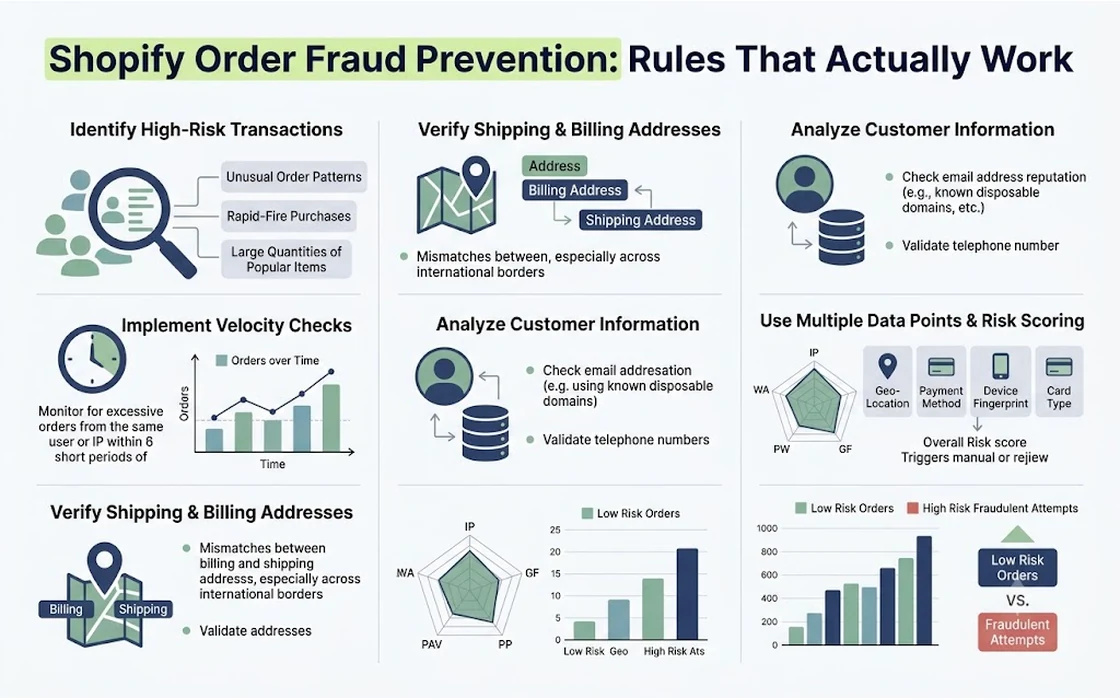
- Automated screening rules should isolate high-risk patterns—such as IP-to-address geodistance, card attempt velocities, and incomplete delivery addresses—before shipping labels generate.
- Implementing an automated “hold and verify” workflow prevents costly false positives, giving legitimate buyers an opportunity to confirm details without outright order cancellation.
Understanding the Two Faces of Ecommerce Order Fraud
To construct automated screening rules that actually work, merchants must separate order fraud into two distinct risk vectors: prepaid payment fraud and non-delivery cash fraud. Each vector operates on different economic incentives and requires distinct screening triggers.
       ┌───────────────────────────────┐
       │     Incoming Shopify Order    │
       └───────────────┬───────────────┘
                       │
         ┌─────────────┴─────────────┐
         ▼                           ▼
┌──────────────────┐       ┌──────────────────┐
│  Prepaid Orders  │       │    COD Orders    │
└────────┬─────────┘       └────────┬─────────┘
         │                          │
  Vectors to Screen:         Vectors to Screen:
  • Stolen card details      • Bogus phone numbers
  • Proxy / VPN IP usage     • Incomplete addresses
  • Gateway chargebacks      • High RTO pin codes
  • International cards      • Bulk impulse buying
Prepaid Card Fraud and Chargebacks
Prepaid fraud occurs when bad actors use compromised credit or debit card credentials to purchase goods online. Under regulations established by the Reserve Bank of India, domestic card transactions require mandatory Additional Factor of Authentication (AFA/OTP), which significantly suppresses domestic card skimming. However, vulnerabilities remain prominent in two areas:
- International Transactions: When an Indian store accepts payments from foreign cards, 3D-Secure authentication may not be enforced by the issuing bank abroad. If a stolen foreign card is processed, the genuine cardholder inevitably files a chargeback once the monthly statement arrives.
- Card Testing Attacks: Automated botnets use Shopify checkout pages to test stolen card databases. These bots execute dozens of low-value transactions in rapid succession to identify which card numbers remain active, burdening the store with authorization fees and gateway scrutiny.
When a chargeback is finalized against an unshielded store, the merchant forfeits the transaction value, the exported merchandise, and a standard dispute fee charged by the payment aggregator.
Cash on Delivery (COD) and RTO Manipulation
In COD transactions, the merchant finances the packaging, transit insurance, and courier fees upfront, anticipating payment upon delivery. The fraud vector here does not involve stolen card numbers; instead, it exploits the absence of upfront financial commitment:
- Fictitious Addresses: Users input randomly generated street names or non-existent landmarks, causing courier delivery failures.
- Competitor Exhaustion: Rival sellers flood an inventory-limited SKU with fake COD bookings to tie up stock during flash sales or festive peaks.
- Impulse Buyer Ghosting: Customers place identical orders on multiple websites to see which package arrives first, casually rejecting slower deliveries at the doorstep.
Industry delivery benchmarks indicate that average RTO rates for unverified COD orders can exceed 25% to 35% in apparel and consumer electronics categories. When forward and reverse freight fees consume Rs. 100 to Rs. 200 per returned shipment, high RTO percentages can turn a seemingly profitable marketing campaign into an operational loss.
The Limits of Default Shopify Fraud Analysis
Shopify provides built-in fraud analysis for orders processed through its platform. For stores utilizing Shopify Payments or external gateways, the platform assigns each order a risk tier: Low, Medium, or High. Indicators include Address Verification System (AVS) responses, Card Verification Value (CVV) checks, IP address geolocations, and proxy detection.
While these built-in indicators provide valuable diagnostic data, they suffer from two major operational limitations:
- Passive Flagging Without Enforcement: Shopify displays a visual indicator in the admin dashboard, but the core platform does not intercept orders by default. If your store uses a direct API integration with third-party logistics (3PL) providers or automated shipping aggregators, a “High Risk” order can be transmitted to the warehouse, packed, and labeled within minutes before any human sees the warning badge.
- Absence of COD Context: Shopify’s global risk model is tuned primarily for Western credit card fraud patterns. It lacks contextual heuristics for Indian delivery dynamics, such as validating ten-digit mobile numbers, identifying high-RTO delivery pin codes, or detecting repetitive cash order attempts from the same physical address using different customer names.
To close these gaps, merchants must layer automatic screening rules that read checkout attributes immediately upon order creation, evaluate those attributes against defined thresholds, and execute defensive actions inside Shopify. Using specialized tools such as Order Validation & Automation - automatic order screening for Shopify, store operators can translate raw risk signals into automated fulfillment holds, tags, and validation workflows.
Essential Automatic Screening Rules That Actually Work
Effective fraud screening does not require complex machine learning infrastructure. Instead, it relies on strict, deterministic criteria that target the mechanical behavior of malicious users. Below are six core screening rules designed to protect both prepaid and COD fulfillment pipelines.
Rule 1: Geolocation and IP-to-Shipping Mismatch
Card thieves rarely operate from the physical jurisdiction of their victims. When an order is placed, Shopify records the customer’s IP address and maps it to a geographic location.
- The Trigger: The country or state associated with the customer’s IP address does not match the billing address, or the distance between the IP location and the shipping address exceeds 1,000 kilometers on a high-value order.
- Additional Flag: The customer accessed the site using a known commercial VPN, web proxy, or hosting facility (e.g., AWS or DigitalOcean data center IP) rather than a residential ISP.
- Automated Action: Apply an administrative tag
hold:ip-mismatch, suspend fulfillment synchronization, and request secondary verification if the order value exceeds Rs. 5,000.
Rule 2: Order Velocity and Card-Testing Detection
Automated scripts and professional fraudsters frequently test multiple card numbers in quick succession or purchase identical high-resale items repeatedly.
- The Trigger: More than two orders created within 15 minutes sharing the same IP address, device fingerprint, or contact email.
- Card-Testing Heuristic: An order that succeeds after three or more consecutive authorization failures during the same checkout session.
- Automated Action: Immediately set the order fulfillment status to “On Hold” and tag the transaction as
fraud:velocity-alert. If more than five attempts occur within an hour from a single IP address, cancel subsequent unfulfilled orders automatically.
Rule 3: High-Value Thresholds on First-Time Accounts
Fraudsters rarely establish long-term purchasing history with an account before running fraudulent charges.
- The Trigger: A customer account with zero completed historical purchases submits an order whose total basket size is significantly higher than your store’s Average Order Value (AOV)—for example, an order exceeding Rs. 12,000 when your average cart is Rs. 1,500.
- Specific Exposure: Carts containing multiples of a single SKU known for rapid secondary market liquidity (such as smartphones, luxury watches, or premium designer goods).
- Automated Action: Hold the order from warehouse dispatch. Route the order to customer service for manual phone or identity verification.
Rule 4: Address and Contact Hygiene Validation
Bogus orders and malicious COD bookings regularly feature dummy information entered to bypass basic checkout validation forms.
- The Trigger:
- Phone numbers containing repeating digits (e.g.,
9999999999,1234567890) or invalid telecom prefixes. - Shipping address fields that omit building/flat numbers or contain gibberish strings (e.g.,
asdfghjkl,near temple xyz). - Pin codes that do not match the state or city designated in the address line.
- Phone numbers containing repeating digits (e.g.,
- Automated Action: Tag as
hold:invalid-addressand trigger an automated notification to the buyer to update shipping details.
Rule 5: Prepaid Discrepancy (AVS and CVV Failures)
When accepting international card payments where 3D-Secure is not universally enforced, card security parameters must be enforced at the gateway and order screening layer.
- The Trigger: The payment gateway reports an AVS status of “No Match” or a CVV status of “Failed/Not Provided”, but the issuing bank allows the transaction authorization anyway.
- Automated Action: Automatically cancel the order, issue a full refund to the originating payment instrument, and restock the reserved inventory. Disallowing zero-CVV orders eliminates the vast majority of stolen-credential chargebacks.
Rule 6: COD Verification and Order History Whitelisting
Cash on Delivery requires a dedicated screening funnel that balances conversion with logistics protection.
- The Trigger: A COD order placed by a customer who has no prior successful delivery record on the store, or an account associated with a previously returned (RTO) shipment.
- Automated Action: Place fulfillment on hold, tag the order as
cod:unconfirmed, and transmit an automated confirmation message with an interactive verification link via WhatsApp or SMS. If the customer does not verify within 24 hours, automatically cancel the order. If the customer has two or more successfully delivered historical orders, bypass the hold entirely and tag ascod:whitelisted.
Comparison Table: Screening Rule Configurations, Triggers, and Actions
The following table summarizes the recommended rule configurations, identifying the targeted fraud mechanism, the immediate action to take in Shopify, and the associated false positive risk:
| Screening Rule | Target Vector | Primary Trigger Condition | Recommended Shopify Action | False Positive Risk |
|---|---|---|---|---|
| IP / Geolocation Mismatch | Stolen foreign cards; identity theft | IP location != Billing country, or commercial proxy detected | Tag review:ip-mismatch & Hold fulfillment | Low to Moderate (legitimate users may use travel Wi-Fi or privacy VPNs) |
| Velocity Threshold | Card-testing bots; automated order scripts | > 2 orders in 15 mins from same IP / device | Hold fulfillment & Tag alert:velocity | Very Low |
| High Basket Value (New User) | Inventory liquidation; unauthorized card use | Cart value > 4x AOV on customer’s first purchase | Tag review:high-value & Require ID/phone check | Moderate (seasonal gifters or wealthy buyers) |
| Address Hygiene Filter | Fictitious COD orders; unserviceable pin codes | Repeating phone digits; missing house numbers; pin mismatch | Tag hold:address-error & Request address correction | Very Low |
| CVV / AVS Rejection | Stolen credit card databases | Gateway reports CVV failure or complete AVS mismatch | Auto-cancel order, issue refund, restock SKU | Extremely Low |
| Unverified COD First-Timer | Impulse ghosting; competitor sabotage | COD payment mode with 0 lifetime delivered orders | Tag cod:unconfirmed & Send OTP/WhatsApp confirmation | Low (resolved quickly upon buyer response) |
Designing the Post-Detection Workflow: Holds, Notifications, and Edits
Configuring screening rules is only half the battle; the operational response must be equally disciplined. Outright cancellation of every flagged order drives up customer acquisition costs by inadvertently alienating legitimate buyers who made typing errors or used corporate VPN networks.
                  ┌───────────────────────────────┐
                  │    Order Triggered Rule       │
                  └───────────────┬───────────────┘
                                  │
                                  ▼
                  ┌───────────────────────────────┐
                  │ 1. Tag Order & Hold In API    │
                  │    (Prevent 3PL Label Print)  │
                  └───────────────┬───────────────┘
                                  │
                                  ▼
                  ┌───────────────────────────────┐
                  │ 2. Automated Buyer Outreach   │
                  │    (WhatsApp / SMS Ping)      │
                  └───────┬───────────────┬───────┘
                          │               │
        Customer Confirms │               │ No Response / Refusal
        or Corrects Info  │               │ (24-Hour Timeout)
                          ▼               ▼
          ┌─────────────────────────┐   ┌─────────────────────────┐
          │ Release Hold to Shipping│   │ Auto-Cancel & Restock   │
          └─────────────────────────┘   └─────────────────────────┘
The “Triage and Hold” Protocol
When an order triggers an automated screening threshold, the fulfillment status should automatically shift to “On Hold,” accompanied by descriptive internal tags (e.g., hold:address-check or hold:suspicious-card).
Ensuring your warehouse management software (WMS) or courier integration listens to order tags is critical. If your shipping connector ignores Shopify’s fulfillment hold status, the screening rule is bypassed entirely. Configure your warehouse rules to exclude any order containing tags prefixed with hold: or review:.
Automated Verification via Messaging
For flagged COD orders or address discrepancies, an automated outreach message can resolve uncertainty within minutes. Integrating direct communication channels—such as providing real-time support via NV WhatsApp Chat - WhatsApp chat button for Shopify—allows store owners to deliver direct, professional verification prompts where Indian consumers are most active.
A standard verification template should display the items ordered, the delivery address, and a single-click button to “Confirm Order” or “Cancel Order.” If the customer confirms delivery intent, the tag shifts automatically to status:verified, releasing the fulfillment hold.
Post-Order Adjustments Without Rebuilding Carts
In cases where screening catches an incomplete street address, an invalid contact number, or a customer who decides to switch from COD to an online payment link, cancelling the order outright risks losing the sale entirely.
Rather than voiding the order and asking the customer to re-enter their details through standard checkout flows, store teams can modify existing order data. Merchants can review operational steps on How to Edit a Shopify Order After It’s Placed to correct pin codes, update delivery notes, or adjust line items directly while preserving original analytics and conversion attribution.
What to Avoid: Common Fraud Screening Mistakes
Overly aggressive fraud filters can destroy store profitability just as effectively as fraud itself. When tuning automatic screening rules, avoid these standard pitfalls:
- Blanket Blocking of All VPN Connections: As privacy consciousness and corporate telecommuting grow, a measurable fraction of legitimate shoppers browse while connected to VPNs. Blocking all VPN traffic outright causes immediate conversion drops. Instead, combine VPN detection with additional risk signals (such as high cart value or mismatched country codes) before taking action.
- Setting Low Value Thresholds on COD: Limiting COD to tiny purchase values (e.g., below Rs. 800) can suppress genuine customer volume in competitive categories. It is significantly more effective to permit higher COD cart sizes while enforcing automated WhatsApp/OTP delivery confirmation.
- Silent Order Cancellations: Cancelling an order without an immediate, automated notification explaining the reason damages customer goodwill. If a transaction is voided due to failed card verification, send an immediate notification suggesting an alternative payment method, such as UPI or net banking.
- Ignoring Courier Pin Code Blacklists: National logistics carriers frequently maintain updated lists of non-serviceable pin codes or geographic clusters known for exceptionally high transit delays and delivery failures. Failing to incorporate courier serviceability data into checkout screening rules forces shipments into predictable delivery bottlenecks.
Step-by-Step Implementation Framework for Shopify Merchants
Implementing an automated screening architecture requires a structured rollout to prevent operational disruption. Follow this five-step process to calibrate your store’s defenses:
Step 1: Historical Data Audit
Review order history over the preceding six months. Calculate your baseline metrics:
- Overall chargeback dispute rate on prepaid orders.
- Average RTO percentage across various Indian states and tier-1 versus tier-3 pin codes.
- Common characteristics of past fraudulent orders (e.g., specific item categories, average order amounts, time of day).
Step 2: Establish Minimum Hygiene Thresholds
Begin by setting up non-controversial screening rules that carry negligible false-positive risk:
- Block transactions where the CVV code is completely absent or returned as mismatched by the payment processor.
- Flag any order containing invalid telephone numbers (fewer than 10 digits or repeating sequences).
- Hold international card purchases where the billing country does not match the issuing bank’s territory.
Step 3: Implement Automated Fulfillment Tagging
Set up automated workflows to tag flagged orders instantly. Ensure your logistics connectors, ERP, and internal warehouse teams do not generate waybills or pack products for orders tagged with active holds.
Step 4: Configure Buyer Confirmation Channels
Deploy automated SMS or WhatsApp confirmation flows for all first-time Cash on Delivery buyers. Set a definitive window (e.g., 18 to 24 hours) for buyers to verify their orders before automated inventory cancellation triggers.
Step 5: Weekly Calibration and Threshold Adjustments
Monitor your cancellation and hold metrics weekly. If your customer service team reports that more than 5% of flagged orders turn out to be genuine customers making standard purchases, widen your risk tolerances (e.g., increase the high-value order threshold from Rs. 6,000 to Rs. 10,000).
FAQ
What is an acceptable chargeback threshold for a Shopify store?
Card networks such as Visa and Mastercard monitor merchant dispute activity closely. In general, maintaining a chargeback-to-transaction ratio below 0.65% to 0.9% is critical; exceeding a 1.0% threshold can result in merchant account termination, mandatory monitoring programs, and elevated payment processing fees.
Does Shopify automatically stop fulfillment for high-risk orders?
No, Shopify does not automatically cancel or hold order fulfillment by default. While Shopify Fraud Analysis highlights high-risk orders with an alert badge in the admin panel, third-party logistics apps, fulfillment APIs, and automatic shipping label generators will continue processing the order unless explicit automation rules are configured to intercept them.
How can Indian Shopify merchants effectively eliminate fake COD orders?
The most reliable method combines automated address hygiene filters with instant WhatsApp or SMS confirmation. Requiring first-time COD buyers to confirm their address via a two-way message or OTP authentication intercepts non-serious buyers, reduces courier RTO rates by up to 40% to 60%, and ensures courier waybills are only generated for committed customers.
Are third-party fraud screening apps worth the investment in 2026?
Yes, especially for stores generating more than 300 to 500 orders monthly. The cost of a dedicated order validation app is typically recovered by preventing just one or two major international chargebacks or stopping a handful of high-freight RTO returns each billing cycle.
Related reading
- Order Validation & Automation - automatic order screening for Shopify
- NV Order Editor - edit and duplicate Shopify orders
- NV WhatsApp Chat - WhatsApp chat button for Shopify
Conclusion
Protecting an e-commerce business from order fraud is not about sealing off checkout so tightly that legitimate buyers encounter friction at every step. Rather, sustainable fraud prevention relies on setting silent, automated screening rules that evaluate risk in the background, intercepting only genuine anomalies before inventory leaves the fulfillment dock.
By distinguishing between prepaid chargeback threats and cash-on-delivery RTO patterns, Shopify store owners can implement targeted defenses tailored to their operating reality. Deploying automated fulfillment holds, enforcing contact hygiene, and giving borderline customers a seamless pathway to verify their identity preserves working capital, protects shipping margins, and ensures warehouse teams focus strictly on profitable, verifiable fulfillment.
- Tags:
- Shopify Fraud
- Order Screening
- Fraud Prevention
- Ecommerce Security
- Shopify Automation
- Rto Reduction