
New UPI Charges 2026: 0.4% Merchant Fee Explained
Understand how the 0.4% UPI merchant fee above Rs 2,000 impacts your business costs, consumer payments, and digital checkout margins in 2026.

- NV Trends
- 13 min read
Everyday consumers using the Unified Payments Interface (UPI) will not pay any extra transaction fees under the 2026 commercial payment updates, but merchants processing business transactions exceeding Rs 2,000 now face a targeted 0.4% merchant fee, capped at Rs 300 per transaction. A gazette notification dated September 14, 2026 formally bars any charge on UPI or RuPay debit card transactions up to Rs 2,000, while NPCI’s 0.4% merchant fee on larger Person-to-Merchant (P2M) payments takes effect from October 15, 2026. The fee structure applies strictly to commercial transactions routed through formal payment gateways and commercial acquiring channels, leaving routine peer-to-peer transfers completely free.
The introduction of this tiered charge addresses years of industry debate regarding the financial sustainability of India’s digital payments infrastructure. Since the Indian government implemented a zero-MDR (Merchant Discount Rate) regime on UPI in January 2020, banks, payment service providers (PSPs), and payment aggregators have relied on central government budgetary subsidies to cover network switching, server maintenance, and fraud prevention costs. As transaction volumes expanded to billions of monthly payments, sustaining high system uptime and dispute resolution without commercial revenue became increasingly difficult for financial institutions.
For small retail shopkeepers, online brands, and digital direct-to-consumer (D2C) founders, navigating this fee requires understanding how transaction categories are classified, how acquiring banks deduct fees during settlement, and how to prevent profit margin erosion without violating regulatory guidelines. Below is an exhaustive operational and economic breakdown of the 2026 UPI fee structure, its underlying mechanics, and practical guidance for businesses.
Key takeaways
- Consumers pay Rs 0: Routine peer-to-peer (P2P) transfers between friends, relatives, and personal bank accounts remain 100% free with no transaction fees.
- Strict Rs 2,000 threshold: The 0.4% merchant fee applies exclusively to commercial payments exceeding Rs 2,000; all commercial transactions below this threshold remain entirely exempt.
- Merchants bear the fee: The fee is an interchange and acquiring cost deducted at settlement by payment aggregators, not an added surcharge on the consumer’s bill.
- Cheaper than card rails: At 0.4%, UPI remains substantially more cost-effective for businesses than traditional debit and credit card networks that routinely charge 1.2% to 2.5% MDR.
- Surcharging is illegal: Merchants cannot add an extra 0.4% convenience charge to retail customers at the cash counter under established regulatory rules.
What Is the 0.4% UPI Merchant Fee in 2026?
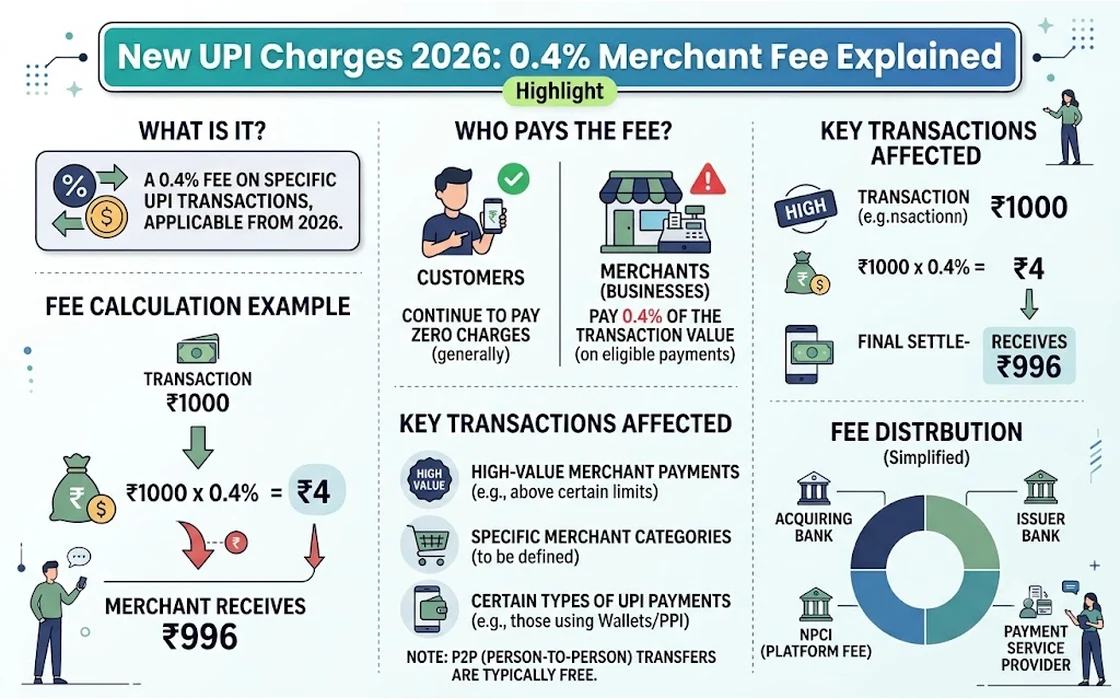
The 0.4% charge is an interchange and processing fee levied on high-value commercial UPI payments settled into merchant accounts. When a customer scans a merchant’s dynamic or static commercial QR code and pays an amount greater than Rs 2,000 using their bank account, the merchant’s acquiring partner deducts 0.4% of the transaction value before settling the net payout.
To understand how this functions in day-to-day business operations, consider three distinct transaction amounts:
- Transaction A (Rs 850 grocery purchase): Because the ticket size is below Rs 2,000, the fee is Rs 0. The merchant receives the full Rs 850 in their bank account.
- Transaction B (Rs 3,000 apparel purchase): Because the transaction exceeds Rs 2,000, the 0.4% fee applies to the entire amount. The merchant pays Rs 12 (0.4% of Rs 3,000) plus applicable Goods and Services Tax (GST) on the fee component. The merchant receives a net settlement of Rs 2,985.84 (assuming 18% GST on the Rs 12 service fee).
- Transaction C (Rs 15,000 electronics purchase): The 0.4% fee equals Rs 60. With 18% GST on the processing fee (Rs 10.80), the merchant pays a total processing cost of Rs 70.80, receiving a net payout of Rs 14,929.20.
- Transaction D (Rs 1,00,000 large-ticket purchase): A flat 0.4% would work out to Rs 400, but the fee is capped at Rs 300 per transaction. So the merchant pays Rs 300 plus 18% GST (Rs 54) — Rs 354 total — not Rs 472. The cap means the effective rate keeps shrinking as ticket size grows past roughly Rs 75,000.
According to regulatory frameworks highlighted by the Reserve Bank of India, digital payment systems require balanced pricing frameworks that promote broad adoption among retail users while allowing payment system operators to recover capital expenditure on cybersecurity, high-concurrency database clusters, and dispute management. The 0.4% rate was selected as an equilibrium point: low enough to prevent merchants from abandoning QR codes in favor of cash, yet sufficient to generate essential operating revenue for acquiring and issuing banks.
Consumers vs Merchants: Who Pays What?
Viral social media claims routinely create confusion whenever payment regulations change in India. The division between who pays and who is exempt is straightforward.
                   UPI Transaction Types (2026)
                               |
         +---------------------+---------------------+
         |                                           |
   P2P Transfers                               P2M Payments
 (Personal to Personal)                    (Customer to Business)
         |                                           |
    ALWAYS FREE                             +--------+--------+
 (Rs 0, Any Amount)                         |                 |
                                      Up to Rs 2,000    Above Rs 2,000
                                            |                 |
                                        NO CHARGE         0.4% Fee
                                      (All Parties)    (Merchant Only)
Peer-to-Peer (P2P) Transfers
P2P transactions represent money sent between individuals—such as splitting a restaurant bill among colleagues, transferring rent directly to a landlord’s individual bank account, or sending funds to family members.
- Customer Cost: Rs 0
- Recipient Cost: Rs 0
- Threshold: No threshold; transfers remain completely free whether the amount is Rs 50 or Rs 1,00,000.
Peer-to-Merchant (P2M) Retail Payments
P2M transactions occur whenever a customer transfers money to a commercial entity, designated business account, or registered payment aggregator QR code (such as those powered by Pine Labs, Paytm, PhonePe, Google Pay, or Razorpay).
- Customer Cost: Rs 0. The customer’s bank account is debited solely for the invoice amount.
- Merchant Cost (Ticket size up to Rs 2,000): Rs 0. Neighborhood vegetable vendors, milk delivery agents, chai stalls, and small kirana counters do not incur fees because the overwhelming majority of daily purchases fall well below Rs 2,000.
- Merchant Cost (Ticket size above Rs 2,000): 0.4% plus GST on the fee, capped at Rs 300 per transaction, deducted automatically by the payment aggregator prior to bank account payout.
Why the Zero-MDR Policy Needed Revision
To assess why the fee exists, it is necessary to examine the unit economics of processing digital payments. Between 2020 and 2025, the volume of digital retail payments exploded across tier-1, tier-2, and rural Indian districts. Official data published via the Press Information Bureau showed digital transactions reaching historic highs year after year.
However, processing a single UPI payment involves multiple technical entities:
- Payer PSP App: The consumer app initiating the payment (e.g., Google Pay, PhonePe, BHIM).
- Remitter Bank: The customer’s bank, which must authenticate the UPI PIN, verify account balances, and execute the core banking system (CBS) debit.
- NPCI Switch: The centralized telecommunication and switching infrastructure that connects thousands of financial institutions.
- Beneficiary Bank: The merchant’s bank, which credits the business account.
- Acquiring PSP / Aggregator: The tech partner that provisions the soundbox, terminal, dynamic QR, or online checkout plugin.
Every single hop requires server capacity, fraud-monitoring engines, encryption hardware, and human operations teams for chargebacks. Under the zero-MDR mandate, the central government allocated an annual budgetary outlay to partially subsidize these costs for banks. Industry participants reported through financial journals such as The Economic Times that government subsidies covered only a fraction of total operating costs, causing public and private banks to deprioritize API upgrades and infrastructure expansion.
By introducing a modest 0.4% fee exclusively on higher-value commercial transactions, the payments network secures sustainable, non-subsidized recurring capital. This model ensures that core banking infrastructure stays resilient during peak shopping festivals like Diwali without imposing charges on low-income citizens or neighborhood micro-enterprises.
How UPI Interchange Compares to Traditional Card Networks
To place a 0.4% fee into perspective, businesses must compare it against traditional debit card, credit card, and net banking processing rates. For decades, retail merchants have paid substantial fees to accept card payments.
In our detailed guide on what Visa and Mastercard do and how card networks operate, we explained how card interchange and acquiring margins routinely total 1.5% to 2.5% for standard credit cards and up to 3.0% for premium corporate cards. Even basic RuPay and Visa debit cards have carried regulated merchant discount rates near 0.9% for large businesses.
| Payment Method | Typical MDR / Fee (2026) | Applicable Threshold | Who Bears the Cost? | Settlement Timeline |
|---|---|---|---|---|
| UPI (P2P) | 0% | No threshold | Free for both parties | Instant (Real-time) |
| UPI (P2M Bank Account) | 0% | Up to Rs 2,000 | Free for both parties | Instant / T+0 |
| UPI (P2M Bank Account) | 0.4% + GST, capped at Rs 300/txn | Above Rs 2,000 | Merchant only | T+0 to T+1 |
| UPI via PPI Wallets | Reportedly higher than bank-account UPI (exact rate not officially confirmed) | Above Rs 2,000 | Merchant only | T+1 |
| RuPay Credit Card on UPI | Separate interchange framework, reportedly closer to card rates (exact rate not officially confirmed) | Above Rs 2,000 | Merchant only | T+1 |
| Standard Credit Card (POS/Online) | 1.8% – 2.5% | Applies to all amounts | Merchant only | T+1 to T+2 |
| Debit Card (Large Merchants) | 0.9% | Applies to all amounts | Merchant only | T+1 |
As shown in the table above, standard bank-to-bank UPI remains by far the most economical non-cash settlement rail available to Indian businesses. Accepting a Rs 5,000 purchase via a standard credit card costs a business roughly Rs 100 to Rs 125 in merchant fees. The identical transaction processed via standard UPI costs only Rs 20 under the 0.4% fee structure.
Financial Impact on Indian Businesses and E-Commerce
The economic impact of the 0.4% fee varies significantly depending on business size, average order value (AOV), and customer payment mix.
1. Small Offline Retailers and Kiranas
For neighborhood grocery stores, stationery shops, pharmacies, and street vendors, the vast majority of consumer purchases sit between Rs 50 and Rs 800. Because transactions below Rs 2,000 are explicitly exempt, these micro-merchants experience zero change in their daily ledger. Their transactions remain completely free of charge.
2. Mid-Tier Consumer Retail and Dining
Restaurants, boutique fashion outlets, footwear chains, and mid-range retail establishments frequently see ticket sizes ranging from Rs 2,200 to Rs 6,000. For these businesses, the 0.4% fee is a real operating expense that must be tracked.
For example, a restaurant that generates Rs 10,00,000 in monthly sales through UPI transactions exceeding Rs 2,000 will pay: $$\text{Base Fee} = \text{Rs } 10,00,000 \times 0.004 = \text{Rs } 4,000$$ $$\text{GST (18% on fee)} = \text{Rs } 4,000 \times 0.18 = \text{Rs } 720$$ $$\text{Total Monthly Processing Cost} = \text{Rs } 4,720$$
While Rs 4,720 represents an additional operating cost, it remains far lower than the Rs 20,000 to Rs 25,000 that the same restaurant would have paid had those customers used credit cards. This math holds as long as individual bills stay well under the roughly Rs 75,000 mark where the per-transaction Rs 300 cap takes over — a realistic assumption for a restaurant, but not for a business with occasional very large single-ticket sales.
3. Shopify Merchants, D2C Brands, and Online Checkouts
Online merchants operating on platforms like Shopify or custom headless checkouts integrate payment aggregators such as Razorpay, Cashfree, or PayU. Online checkouts have higher operating costs due to gateway routing and risk management APIs.
Online store founders must monitor these payment gateway deduction lines carefully. In commercial cash flow management, failing to track small percentage fees across high transaction volumes can silently compress gross margins. This principle is familiar in portfolio management: investors who study fee drag recognize that seemingly minor recurring expenses compound over time, much like how evaluating fund expense structures and understanding fund exit loads and charges protects net portfolio returns over long horizons.
Merchant Best Practices: What to Do and What to Avoid
To maintain smooth business operations, manage payment reconciliation accurately, and stay compliant with payments law, business owners should implement systematic internal procedures.
What to Do
- Audit your Average Order Value (AOV): Pull your payment gateway reports for the past 90 days. Calculate the exact percentage of your monthly sales volume that falls above the Rs 2,000 threshold to forecast your monthly fee deductions accurately.
- Verify Merchant Category Codes (MCC): Ensure your payment aggregator has categorized your enterprise under the correct MCC. Certain specialized categories (such as government utility billers or specific educational institutions) may have distinct fee caps or negotiated processing structures.
- Reconcile GST Invoices: Payment aggregators issue monthly tax invoices for the interchange fees and GST deducted from your settlements. Provide these invoices to your chartered accountant to claim Input Tax Credit (ITC) on the 18% GST component paid on payment fees.
- Encourage Bank-to-Bank UPI over PPI Wallets: Where possible, prompt customers to pay using direct bank account UPI rather than prepaid wallets or non-RuPay credit instruments, which reportedly carry higher interchange rates than the 0.4% bank-account fee.
What to Avoid
- Avoid illegal customer surcharging: Do not attempt to add a 0.4% or Rs 10 “UPI service charge” onto the customer’s bill at the cash counter. The Reserve Bank of India and consumer protection regulations strictly prohibit passing acquiring fees directly to buyers as checkout surcharges for standard retail payments. Violations can lead to the termination of your merchant acquiring account.
- Avoid artificial bill splitting: Do not split a single Rs 4,000 transaction into two separate Rs 2,000 transactions on your point-of-sale system to evade the 0.4% fee. Automated fraud detection algorithms deployed by acquiring banks detect sequential identical-account payments and can flag your business for transaction structuring and terms-of-service violations.
- Avoid using personal savings accounts for business sales: Many small business owners attempt to bypass merchant fees by displaying a personal savings account QR code. Banks deploy automated transaction monitoring on savings accounts. If a personal account displays commercial transaction frequency and high-velocity incoming credits, banks will freeze the account, demand commercial re-registration, or levy retroactive penalties for violating savings account usage rules.
The Broader Digital Economy: Why Stability Matters
The transition to a capped 0.4% fee structure on larger transactions reflects the maturation of India’s digital economy. During the initial growth phase from 2016 through 2022, government policy prioritized total consumer onboarding and displacement of physical cash. Achieving that goal required zero-cost operations across all touchpoints.
However, an economy processing tens of billions of digital transactions each month cannot remain reliant on temporary state subsidies without compromising infrastructure quality. When payment processors lack predictable unit economics, investment in backup server hubs, dispute arbitration portals, and fraud prevention engines slows down. A modest, predictable fee on commercial transactions above Rs 2,000 establishes a sustainable funding model while safeguarding low-income users, students, and neighborhood vendors from financial friction.
FAQ
Will I be charged extra as a consumer when sending money on Google Pay or PhonePe?
No, regular consumers do not pay any fee when making UPI transactions. Whether you are transferring money to a friend, paying house rent, or buying groceries at a local store, the transaction is completely free for you as a buyer.
Can a shopkeeper legally charge me 0.4% extra if my bill exceeds Rs 2,000?
No, merchants are legally prohibited from adding a surcharge or convenience fee to retail customers for paying via standard UPI. The 0.4% fee is an operational merchant discount cost that the merchant must absorb as a cost of doing business, exactly as they do with debit card acceptance.
Does the 0.4% fee apply to RuPay credit card payments made via UPI?
No, RuPay credit cards linked to UPI operate under a separate interchange framework from NPCI, reportedly closer to standard credit card processing rates than the 0.4% bank-account rate (the exact figure hasn’t been officially published). The 0.4% fee applies strictly to standard bank-account-to-bank-account UPI merchant transfers.
How is the 0.4% fee deducted from a merchant’s bank account?
The fee is not debited after the fact; it is deducted automatically at source during daily settlement. When an acquiring bank or payment gateway aggregates your daily collections and settles the funds to your registered current account, they withhold the 0.4% fee plus applicable 18% GST on that fee, transferring the net amount.
Conclusion
The 2026 UPI fee update balances two critical priorities: preserving zero-cost digital payments for everyday citizens while establishing financial sustainability for the banks and fintech platforms that run the network. Everyday consumers and neighborhood kiranas operating below the Rs 2,000 mark will see no difference in their daily digital transactions.
For growing businesses, Shopify store owners, and organized retailers, the 0.4% fee represents a manageable operational cost that remains dramatically cheaper than traditional card networks. By maintaining proper accounting reconciliation, claiming Input Tax Credit on processing fees, and utilizing authorized merchant accounts, businesses can embrace modern digital checkouts without compromising their operating margins.
- Tags:
- Upi Charges
- Digital Payments
- Fintech India
- Merchant Discount Rate
- Npci
- Business Finance