
Edge Computing vs Cloud Computing: Complete Guide
Compare edge computing and cloud computing architecture, latency, costs, and use cases to choose the right infrastructure for your workload.

- NV Trends
- 18 min read
- Updated
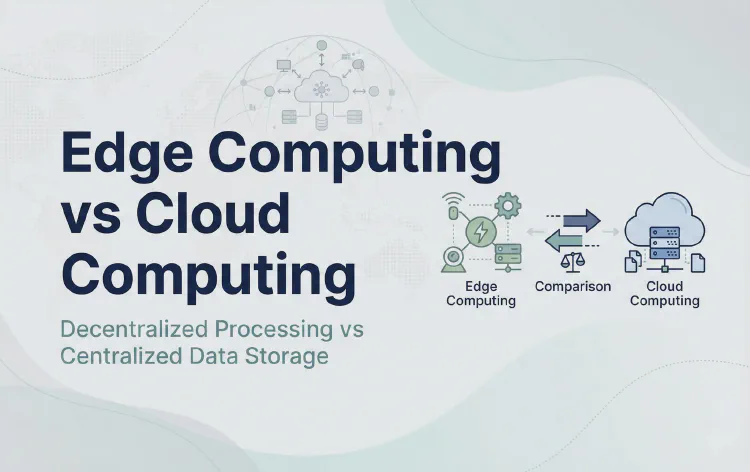
The fundamental difference between edge computing and cloud computing lies in where data processing takes place: cloud computing aggregates and processes workloads in centralized, hyperscale data centers, whereas edge computing executes computations locally at or near the physical perimeter where data originates.
In India’s rapidly modernizing digital economy, enterprise infrastructure is handling unprecedented volumes of telemetry from industrial machinery, connected automobiles, smart city sensors, and retail point-of-sale terminals. Historically, the architectural default was to route all raw telemetry over wide-area networks (WAN) directly into centralized cloud regions established in hubs like Mumbai, Chennai, or Hyderabad. However, as real-time automation and bandwidth-heavy applications expand, relying exclusively on distant server farms introduces latency bottlenecks, escalates telecommunications expenses, and creates single points of failure during backhaul network drops.
To address these constraints, technology teams are adopting distributed compute topologies that bring processing closer to the data source. While centralized hyperscalers provide near-limitless on-demand scale and economical cold storage, edge nodes provide the localized responsiveness required for mission-critical operations. Understanding how to divide responsibilities between centralized facilities and distributed edge hardware is now a baseline requirement for software architects, systems engineers, and technology leaders. As of 2026, the question is no longer whether edge will replace the cloud, but how both paradigms integrate into a resilient, cost-effective hybrid infrastructure.
Key takeaways
- Latency Disparity: Centralized cloud facilities in India typically yield round-trip latencies of 30 ms to 90 ms depending on geographic distance, whereas on-premise edge nodes deliver deterministic sub-10 ms response times.
- Bandwidth and Transit Economics: Edge nodes filter, preprocess, and compress data at the perimeter, preventing lakhs of rupees in recurring cellular data transmission and cloud network ingress/egress fees.
- Operational Autonomy: Edge infrastructure preserves continuous site operations during regional ISP disruptions, ensuring manufacturing lines, medical monitors, and payment checkouts remain functional offline.
- Centralized Scale vs. Edge Fleet Complexity: The cloud simplifies management through unified APIs and elastic compute, whereas edge architectures require specialized tooling for remote firmware provisioning, zero-touch deployment, and physical security across distributed sites.
- A Complementary Hybrid Model: Modern enterprise deployments combine edge computing for real-time inference and safety-critical reflexes with centralized cloud computing for longitudinal data analysis, machine learning model training, and long-term regulatory archiving.
What is Cloud Computing? Centralized Scale and Elasticity
Cloud computing is the delivery of on-demand computing services—including compute instances, managed object storage, relational and NoSQL databases, message queues, and artificial intelligence platforms—over private or public networks using an elastic, pay-as-you-go pricing structure. Instead of purchasing, racking, and cooling physical hardware in private server rooms, organizations consume virtualized resources hosted inside hyperscale facilities. For those getting started with cloud fundamentals, our explainer on What is Cloud Computing? Explained for Beginners details how these virtualized layers operate.
In India, hyperscalers such as Amazon Web Services, Microsoft Azure, and Google Cloud have invested billions of dollars establishing physical availability zones and local regions across Mumbai, Hyderabad, Chennai, Pune, and the Delhi National Capital Region (NCR). These centralized hubs aggregate thousands of physical servers connected by multi-gigabit redundant network fabrics, delivering economies of scale that individual companies cannot replicate on-premises.
Core Strengths of Centralized Cloud
The greatest asset of centralized cloud infrastructure is virtually infinite elasticity. A startup or enterprise can provision a single virtual machine (VM) or deploy thousands of parallel container instances in minutes without capital hardware investment (CapEx). Centralized clouds offer:
- Massive Parallel Compute: Suitable for training large foundational AI models, running multi-variable risk simulations in finance, and aggregating nationwide e-commerce transaction logs.
- Managed Resilience: High availability through distributed availability zones, automated disk replication, managed backup snapshots, and programmatic failover mechanisms.
- Ecosystem Breadth: Immediate access to specialized hardware accelerators (such as high-end GPUs and TPUs), serverless runtimes, and managed software stacks without local administrative overhead.
However, the rapid expansion of these centralized facilities also brings spatial, electrical, and urban resource trade-offs, a dynamic we analyzed in Data Centers vs. Parks: The Cost of Digital Progress. Furthermore, physical distance remains governed by the laws of physics: optical signals traveling through fiber cables between a manufacturing plant in Surat and a data center in Mumbai experience unavoidable propagation delays, packet queuing, and router hops.
What is Edge Computing? Processing at the Network Periphery
Edge computing is a distributed computing paradigm that positions processing power, data storage, and network logic physically close to the endpoints producing or consuming data. Instead of transmitting raw signals across thousands of kilometers to a centralized data center, an edge node ingests, processes, and acts on signals locally.
The “edge” is not a single uniform hardware category; it exists across multiple tiers along the network topology:
- Device Edge: Microcontrollers, on-board vehicle computers, and smart cameras equipped with specialized Neural Processing Units (NPUs) executing local inference directly on silicon.
- On-Premise Gateway Edge: Industrial Personal Computers (IPCs), micro-data center cabinets, or 1U/2U rackmount servers positioned on factory floors, inside hospital server closets, or within retail outlets.
- Network / Telco Edge (Multi-Access Edge Computing - MEC): Compute clusters co-located inside telecom base stations or regional telephone exchanges, operating within the radio access network (RAN) perimeter maintained by cellular operators.
The Impact of 5G and Telecom Rollouts
As 5G connectivity has matured across India, network operators have implemented localized sub-network slicing and local breakout (LBO) gateways under the regulatory oversight of the Telecom Regulatory Authority of India (TRAI). Rather than routing mobile packet traffic through centralized Gateway GPRS Support Nodes (GGSN) hundreds of kilometers away, telecom edge architectures terminate traffic at regional towers.
On the software side, containerized runtimes and lightweight orchestration engines allow developers to deploy microservices onto edge gateways. Orchestrators designed for resource-constrained environments—such as K3s or MicroK8s—enable engineering teams to operate container fleets across hundreds of distributed facilities using standard deployment manifests, building upon concepts covered in our overview of Kubernetes Explained in Simple Terms.
Edge Computing vs Cloud Computing: Architectural Comparison
To determine the appropriate platform for a given workload, architects must evaluate technical requirements across latency, network consumption, hardware lifecycle, and regulatory constraints.
| Evaluation Parameter | Centralized Cloud Computing | Distributed Edge Computing | Practical Impact for Indian Deployments |
|---|---|---|---|
| Primary Location | Regional hyperscale facilities (e.g., Mumbai, Hyderabad, Chennai) | Local devices, on-premise gateways, or regional 5G base stations | Cloud traffic must traverse public ISP routing hops; edge stays on local LAN/WLAN. |
| Round-Trip Latency | 30 ms to 100+ ms depending on end-user geography | 1 ms to 10 ms (deterministic local response) | Critical for automated manufacturing, robotics safety, and surgical telemetry. |
| Bandwidth & Transit Costs | High recurring egress and ingress network charges | Minimal WAN transit; raw data filtered locally | Saves significant telecom costs on high-frequency IoT and 4K video feeds. |
| Scalability Mechanism | Elastic, programmatic resource provisioning via APIs | Physical hardware provisioning and site deployment | Cloud scales instantly; edge hardware requires physical deployment lead times. |
| Offline Autonomy | Zero; operations stall if WAN backhaul is interrupted | High; local nodes continue processing without internet | Protects remote logistics depots, mines, and retail checkouts from ISP outages. |
| Security Surface | Centralized perimeter, managed hypervisors, IAM | Distributed endpoints with physical tampering risks | Edge limits bulk data leaks but increases physical and device attack vectors. |
| DevOps & Fleet Ops | Unified control plane, centralized CI/CD pipelines | Over-The-Air (OTA) updates, fleet orchestration | Edge requires robust rollbacks to avoid bricking unmonitored remote nodes. |
| Cost Model | OpEx dominant (compute hours, gigabytes transferred) | CapEx dominant (hardware, installation) + local ops | Edge yields lower long-term variable costs for predictable, data-heavy feeds. |
| Regulatory Posture | Relies on hyperscaler regional data sovereignty zones | Data processed within physical enterprise boundary | Simplifies compliance with India’s DPDP Act for sensitive biometric and health PII. |
Latency and Real-Time Responsiveness
Network latency is the most significant operational differentiator between edge and cloud. In a cloud architecture, a sensor reading must be packetized, routed through local networking gear, handed off across multiple autonomous system (AS) boundaries on the public internet, decrypted at a cloud load balancer, processed by an application server, and sent back across the same chain.
[Local Sensor / Camera]
        │
        ├─► Local LAN (<2 ms) ──► [Edge Gateway / IPC] ──► Instant Actuator Trigger (<5 ms total)
        │
        └─► Local Network ──► ISP Backhaul ──► Cloud Gateway ──► Hyperscale VM ──► Response (40-100 ms)
For business applications such as processing an e-commerce credit card transaction or running monthly payroll, an end-to-end latency of 150 ms is imperceptible to users. However, in an industrial packaging facility running high-speed optical sorters, an automated arm operating at 1,200 parts per minute has an error window measured in single-digit milliseconds. Waiting 60 ms for a cloud vision model to flag a defect causes physical collisions or damaged inventory. Edge computing brings inference to the machine interface, keeping round-trip times consistently below 5 ms.
Bandwidth Optimization and Data Egress Economics
Modern sensors and video streams generate massive volumes of data. Consider a commercial warehouse in Gurugram deploying twenty 4K security cameras for automated inventory tracking and perimeter surveillance. Streaming twenty uncompressed or lightly compressed video streams at 15 Mbps generates approximately 300 megabits per second of continuous outbound traffic.
Over a 30-day billing cycle, that single installation produces roughly 97 terabytes of outbound network traffic:
$$\text{Monthly Data} = \frac{300 \text{ Mbps} \times 3,600 \text{ sec/hr} \times 24 \text{ hrs/day} \times 30 \text{ days}}{8 \times 1,000,000} \approx 97.2 \text{ TB}$$
Purchasing dedicated commercial leased-line bandwidth in India to support continuous 300 Mbps upstream transmission can cost between Rs. 35,000 and Rs. 70,000 per month per facility, excluding cloud data ingestion and storage costs. If the enterprise operates 40 distribution centers nationwide, transmitting raw streams to a central cloud can cost lakhs of rupees each month solely for network transport.
By placing an edge gateway equipped with an AI accelerator on-site, the video streams are analyzed locally. The edge node detects and tracks inventory items in real time, discarding unchanged video frames. It transmits only structured JSON events (such as timestamp, SKU identifier, and bounding box coordinates) and occasional compressed 50 KB image snapshots to the central cloud. This approach reduces outbound data traffic from 97 TB to less than 20 GB per month per site, lowering ongoing telecom overhead by more than 99%.
Data Privacy, Localization, and the DPDP Framework
Data governance is a critical architectural requirement for Indian organizations. Under guidelines established by the Ministry of Electronics and Information Technology (MeitY) and provisions of the Digital Personal Data Protection (DPDP) Act, enterprises managing sensitive personal data—including biometric markers, personal health identifiers, and financial authentication data—face strict consent and localization requirements.
When data is transmitted to centralized cloud regions, it passes through intermediary network routing infrastructure. Even with transport layer security (TLS), transmitting raw sensitive data increases regulatory liability and potential exposure. Edge architectures allow organizations to process personally identifiable information (PII) at the device boundary. For example, facial recognition authentication terminals in corporate offices can calculate mathematical vector embeddings locally, authenticate the user against an on-device encrypted database, and immediately discard the raw camera image without transmitting facial photographs across the WAN.
Operational Complexity and Fleet Management
While edge computing provides latency and bandwidth benefits, it introduces substantial operational complexity. Managing a centralized cloud workload involves interfacing with consolidated dashboards, unified API endpoints, and established observability stacks. If a cloud server crashes, automated health checks trigger container replacements or spin up replacement virtual machines within seconds.
Managing 500 edge gateways dispersed across manufacturing plants in Pune, retail stores in Bengaluru, and branch offices in tier-3 towns introduces logistical challenges:
- Physical Security: Edge hardware is vulnerable to power cord disconnections, dust accumulation, thermal throttling, local network tampering, and physical theft.
- Network Asymmetry: Remote sites may experience frequent IP changes, carrier-grade NAT (CGNAT) configurations, and erratic connectivity, preventing direct SSH access from engineering workstations.
- Firmware and OS Provisioning: Applying an operating system patch or model update to an edge fleet requires automated Over-The-Air (OTA) deployment systems with A/B partitioning. If an update corrupts a bootloader on a cloud VM, an engineer can access an out-of-band serial console; if an update corrupts an edge gateway in an unstaffed warehouse, restoring it requires dispatching a field technician.
Real-World Industry Deployments in India
The structural trade-offs between edge and cloud determine how real-world systems are built across core Indian industrial sectors.
Smart Manufacturing in Industrial Corridors
In industrial hubs like Sriperumbudur (Tamil Nadu), Sanand (Gujarat), and Chakan (Maharashtra), automotive and electronics component manufacturers use automated optical inspection (AOI) on high-speed assembly lines.
- Edge Role: Ruggedized industrial PCs fitted with specialized vision accelerators capture camera frames, execute object segmentation models in 8 ms, and issue hardware control signals to pneumatic rejector pins on the conveyor belt.
- Cloud Role: Every hour, edge nodes transmit aggregated defect counts, machine operating temperatures, and statistical cycle times to a central cloud data warehouse. Reliability engineers use this data across multi-plant facilities to perform predictive maintenance forecasting and supply chain inventory planning.
Quick-Commerce and Retail Fulfillment Hubs
India’s quick-commerce and hyper-local delivery companies operate dark stores across major metropolitan areas, requiring rapid order picking and dispatch.
- Edge Role: Local dark-store servers coordinate handheld barcode scanners, compute optimal walking paths for warehouse pickers, and manage local inventory states with zero external network dependency. Even if local fiber lines are temporarily severed, staff continue fulfilling orders without disruption.
- Cloud Role: The central cloud platform tracks real-time inventory balances across hundreds of dark stores, dynamically adjusts catalog availability on customer smartphone apps, optimizes rider routing algorithms, and manages centralized payment settlement workflows.
Smart Mobility and Highway Tolling Systems
National highway plazas operating FASTag readers and Automated Number Plate Recognition (ANPR) systems process thousands of vehicles per hour under variable environmental conditions.
- Edge Role: Roadside optical character recognition (OCR) units process high-resolution camera feeds to extract registration plate characters locally in under 50 ms, validating plate details against local whitelists and issuing toll barrier lift commands instantly.
- Cloud Role: The local tolling controller syncs transaction logs, encrypted vehicle metadata, and balance deductions with national banking switches and central transport databases during background polling cycles.
Designing the Hybrid Architecture: Cloud Brain, Edge Reflexes
The most resilient production systems avoid treating edge and cloud as mutually exclusive choices. Instead, they implement a complementary hybrid architecture where the cloud acts as the analytical brain and the edge operates as the immediate physical reflex.
┌────────────────────────────────────────────────────────────────────────┐
│                        CENTRALIZED CLOUD TIER                          │
│                                                                        │
│  - Historical Data Lake & Analytics         - Foundation Model Training│
│  - Nationwide Fleet Observability           - Long-Term DPDP Archival  │
│  - Multi-Site Inventory Optimization        - Core Financial Billing   │
└───────────────────────────────────▲────────────────────────────────────┘
                                    │
                  Secure TLS / MQTT │ Periodic Model Weights & Config Sync
                  Aggregated Telemetry (JSON Events)
                                    │
┌───────────────────────────────────▼────────────────────────────────────┐
│                         DISTRIBUTED EDGE TIER                          │
│                                                                        │
│  - Sub-5ms Vision / Sensor Inference        - Local Actuator Control   │
│  - Local Cache & Store-and-Forward Ops      - PII Removal / Scrubbing  │
│  - Offline Failover Logic                   - Real-Time Safety Trips   │
└────────────────────────────────────────────────────────────────────────┘
This hybrid pattern uses a continuous operational lifecycle:
- Local Real-Time Execution: Edge units ingest high-rate telemetry, evaluate safety rules, execute pre-trained neural networks for anomaly detection, and write events to a local write-ahead log.
- Store-and-Forward Telemetry: The edge runtime aggregates and deduplicates telemetry. When external WAN connectivity is healthy, the node batches these compressed summaries to cloud object storage using lightweight protocols like MQTT or gRPC over TLS. If the internet connection drops, data buffers locally without data loss.
- Centralized Continuous Training: The centralized cloud ingests aggregated summaries from thousands of distributed edge devices. Data scientists pool edge failure samples to retrain and fine-tune computer vision or predictive maintenance models across scalable GPU clusters.
- Automated Fleet Deployment: Updated, quantized model weights are packaged into container images or binary blobs and pushed down to the edge fleet through controlled canary deployment pipelines.
Total Cost of Ownership: CapEx vs. OpEx Analysis
When comparing the economics of edge computing versus cloud computing, finance and engineering leaders must balance initial capital expenditures against long-term operational expenditures.
Cloud Cost Profile (Primarily OpEx)
- Zero Upfront Hardware: No capital outlays for physical server chassis, high-grade uninterruptible power supplies (UPS), or cooling infrastructure.
- Variable Scaling Costs: Costs scale directly with utilization. However, unchecked cloud consumption—such as unoptimized serverless invocations, unattached elastic block storage volumes, and high outbound data transfer rates—can lead to unexpected monthly bill spikes.
- Network Egress Penalties: Hyperscale cloud providers charge measurable fees per gigabyte for data moving out of their regions to the public internet, which becomes expensive for media streaming or distributed device sync workloads.
Edge Cost Profile (CapEx + Local OpEx)
- Initial Hardware Procurement: Industrial-grade edge gateways designed to withstand Indian ambient temperatures (often exceeding 42°C in non-climate-controlled factory sheds), power fluctuations, and dust ingress cost between Rs. 40,000 and Rs. 2,50,000 per unit, depending on onboard NPU/GPU compute capacity.
- Installation and Physical Security: Deploying hardware across remote branches requires certified electricians, secure wall-mounted enclosures, network cabling, and battery backup systems.
- Predictable Ongoing Costs: Once deployed, edge nodes process petabytes of local sensor data with zero incremental cloud compute or data transit fees. The primary ongoing expenses are physical maintenance, periodic hardware refresh cycles (typically every 4 to 6 years), and electricity.
The Economic Inflection Point
Cumulative Cost (Rs.)
       ▲
       │                                     / (Centralized Cloud - Pure Streaming)
       │                                    /
       │                                   /   ◄── Inflection Point (Edge becomes cheaper)
       │                                  /
       │   (Edge + Hybrid Cloud)         /
       │  ┌─────────────────────────────/───────────────────────────────
       │  │ Initial CapEx
       │  │ (Hardware & Installation)
       └──┴─────────────────────────────────────────────────────────────► Time (Months)
For workloads with low data rates—such as periodic temperature pings from 100 weather sensors—centralized cloud computing is far more cost-effective than purchasing dedicated edge hardware.
Conversely, for high-bandwidth, high-frequency telemetry (such as continuous multi-channel acoustic vibration analysis or multi-camera optical inspection), edge computing reaches an economic break-even point quickly. The initial CapEx of edge hardware is frequently offset within 9 to 18 months by eliminating leased-line bandwidth upgrades and recurring cloud processing fees.
Common Architecture Mistakes to Avoid
Deploying distributed infrastructure requires addressing operational factors absent in pure cloud environments. Engineering teams should avoid these common implementation pitfalls:
1. Over-Engineering Edge Hardware
A frequent error is deploying overpowered x86 rackmount servers at edge locations where low-power ARM-based gateways or microcontrollers with integrated AI accelerators would suffice. Over-engineered nodes consume excessive power, generate high heat loads, require specialized cooling, and inflate initial CapEx. Profile workloads thoroughly and choose hardware matched to specific inference and memory footprints.
2. Treating Edge Devices Like Static Cloud VMs
Attempting to manage edge hardware using manual SSH scripts or unmanaged OS configurations leads to configuration drift and operational failure. Unlike cloud instances that can be terminated and re-spun from clean base images, edge nodes require declarative, immutable operating system designs. System software should reside on read-only root filesystems, and application updates should deploy via atomic container updates with automated rollback capabilities.
3. Neglecting Local Storage Endurance
Edge devices often write intensive telemetry logs to onboard storage media. Using standard consumer-grade micro-SD cards or low-end flash memory in edge gateways operating on factory floors frequently results in drive corruption within months due to excessive write cycles. Production edge architectures must specify high-endurance, industrial-grade pSLC or eMMC flash memory, combined with circular in-memory logging buffers that flush to disk only during critical system events.
4. Overlooking Environmental and Power Instability
In many industrial areas and tier-2/tier-3 cities across India, voltage fluctuations, brownouts, and brief power cuts are common. Edge hardware lacking wide-voltage DC input tolerance (e.g., 9V to 36V DC) or coupled with inadequate power conditioning can suffer hardware resets or corrupted write cycles. Always budget for industrial-grade power supplies and integrated power-loss protection (PLP) storage controllers.
FAQ
What is the main difference between edge computing and cloud computing?
The core distinction is geographic and network proximity to the data source: cloud computing processes and aggregates workloads within centralized hyperscale data centers, whereas edge computing processes data locally on devices, on-premise gateways, or nearby network nodes where the data originates.
Can edge computing completely replace cloud computing?
No, edge computing is designed to complement the cloud rather than replace it. While edge nodes handle low-latency processing, real-time control loops, and local data filtering, centralized cloud infrastructure remains essential for long-term historical analytics, large-scale machine learning model training, and broad resource orchestration across multiple sites.
Which model is more cost-effective for an Indian enterprise?
Cost efficiency depends entirely on your data volume, latency tolerance, and deployment scale. Workloads with low data throughput and elastic demand benefit from the pay-as-you-go, zero-CapEx structure of centralized cloud services; conversely, operations involving high-bandwidth sensor networks or continuous computer vision inspection achieve a lower total cost of ownership by deploying edge hardware to eliminate recurring cloud egress and telecommunications bandwidth fees.
How does 5G deployment in India impact edge computing adoption?
The expansion of 5G networks across Indian cities accelerates edge computing by providing low-latency cellular access and enabling Multi-Access Edge Computing (MEC). 5G allows enterprises to connect distributed edge sensors and autonomous mobile robots to local radio towers equipped with edge processing capabilities without laying expensive physical fiber across industrial or urban environments.
What security challenges are unique to edge computing compared to the cloud?
Unlike centralized cloud environments protected inside physically guarded data centers with strict biometric access, edge nodes are physically distributed across remote, unmonitored sites where they are vulnerable to hardware tampering, port exploitation, and theft. Consequently, edge deployments require hardware root-of-trust authentication, encrypted storage volumes, disabled external ports, and automated certificate renewal to maintain security parity with cloud platforms.
Conclusion
The evolution of modern infrastructure has moved past the simplistic framing of edge computing versus cloud computing as competing paradigms. Each approach serves distinct, complementary engineering and business purposes within the modern enterprise technology stack.
Centralized cloud computing remains unmatched for heavy analytical processing, long-term archival storage, elastic resource provisioning, and managing core business logic. Conversely, edge computing provides the real-time reflexes, deterministic latency, bandwidth optimization, and offline resilience that modern physical systems demand.
For technology leaders, systems architects, and software engineers designing systems in 2026, the optimal approach is a balanced hybrid architecture. By evaluating operational requirements against latency constraints, telecommunications expenses, operational management overhead, and data governance frameworks, organizations can place each workload precisely where it performs best—utilizing the edge for immediate action and the cloud for centralized intelligence.
- Tags:
- Edge Computing
- Cloud Computing
- Cloud Architecture
- IoT
- 5g India
- Enterprise Infrastructure