
Understanding Systematic Investment Plans (SIP)
Learn how Systematic Investment Plans (SIP) build wealth in India through rupee cost averaging, compounding, and disciplined mutual fund investing.

- NV Trends
- 15 min read
- Updated
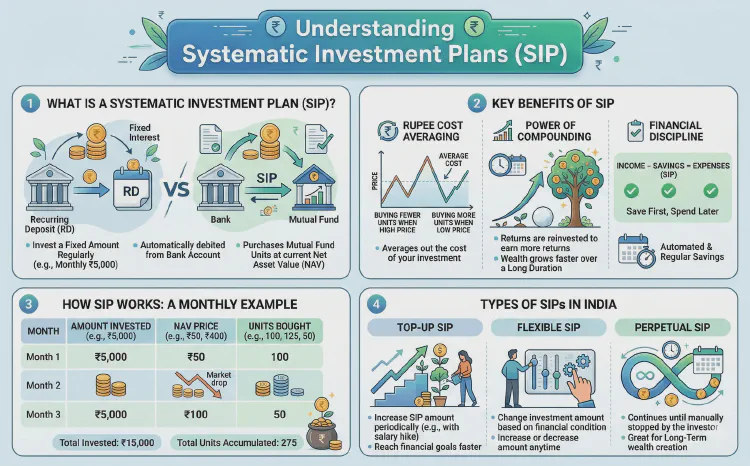
A Systematic Investment Plan (SIP) is a disciplined investment method offered by mutual funds that allows you to invest a fixed sum of money at predetermined intervals—typically monthly or quarterly—into a selected mutual fund scheme. Rather than requiring a large lump sum, an SIP automates small, recurring investments that purchase fund units at the prevailing Net Asset Value (NAV), making long-term market participation accessible to any individual with a bank account.
For Indian retail investors, the SIP route has largely reshaped domestic savings habits, transitioning household capital from physical assets like gold and real estate into organized capital markets. Monthly inflows tracked by the Association of Mutual Funds in India (AMFI) demonstrate how regular automated deductions have established a culture of steady, goal-based investing across tier-1, tier-2, and tier-3 cities.
By converting the unpredictable challenge of market timing into a mechanical schedule, an SIP matches the natural cash flow of salaried employees and small business owners. Understanding how units accumulate, how risk averages out across market cycles, and how compounding drives long-term portfolio growth is essential for anyone seeking financial independence.
Key takeaways
- Automated accumulation: An SIP is an execution mechanism, not an asset class, designed to purchase mutual fund units on a set calendar schedule.
- Rupee cost averaging: Regular purchases automatically acquire more mutual fund units when markets drop and fewer when markets rally, lowering your average cost per unit over time.
- Compounding over timing: Extended investment horizons amplify returns as reinvested gains generate secondary gains, making early starts far more impactful than trying to predict market peaks.
- Structural flexibility: Investors can pause, modify, step up, or redeem SIP investments without penalty, provided fund-specific exit criteria are respected.
- Taxation considerations: Each SIP installment is treated as an independent purchase under Indian tax rules, requiring separate calculation for holding periods and capital gains tax.
What is a Systematic Investment Plan (SIP) and How Does It Work?
At its core, a Systematic Investment Plan operates like an automated subscription to a mutual fund. Instead of making an emotional choice every month about whether the equity market is “too high” or “too low,” an investor schedules an automated debit mandate (via National Automated Clearing House, or NACH, or UPI Autopay) from their savings account to the Asset Management Company (AMC).
On the chosen date each month, the designated installment amount is debited and transferred to the mutual fund scheme. The fund house calculates the purchase using that day’s Net Asset Value (NAV)—the per-unit market value of the fund’s underlying securities after deducting operating expenses.
To visualize how unit allotment works in practice, consider a monthly SIP allocation of Rs. 5,000 across three consecutive months with fluctuating market values:
- Month 1: The fund’s NAV is Rs. 50. Your Rs. 5,000 allocation buys exactly 100 units (Rs. 5,000 / Rs. 50).
- Month 2: The equity market corrects, causing the NAV to decline to Rs. 40. Your Rs. 5,000 allocation buys 125 units (Rs. 5,000 / Rs. 40).
- Month 3: The market recovers strongly, lifting the NAV to Rs. 62.50. Your Rs. 5,000 allocation buys 80 units (Rs. 5,000 / Rs. 62.50).
Over these three months, you have invested a cumulative Rs. 15,000 and accumulated 305 units.
To understand the mathematical benefit, examine the numbers closely:
- Simple average NAV across the three months:
(50 + 40 + 62.50) / 3 = Rs. 50.83 - Your effective average acquisition cost per unit:
Rs. 15,000 / 305 units = Rs. 49.18 - Total portfolio valuation at Month 3:
305 units * Rs. 62.50 = Rs. 19,062.50
Because your fixed monthly sum automatically purchased a larger volume of units during the Month 2 price drop, your average acquisition cost remained lower than the average market NAV. To project how this mechanism scales across multi-year horizons with custom return assumptions, NV Toolkit’s free SIP Calculator models expected corpus growth against varying investment amounts and tenures.
Why SIP is Ideal for the Indian Retail Investor
Investing directly in the stock market often exposes retail investors to psychological traps—greed at market peaks and fear during sharp corrections. SIP investing removes human discretion from execution, replacing speculation with structural discipline.
1. Rupee Cost Averaging in Volatile Markets
Market cycles in India are inherently volatile due to global macroeconomic factors, corporate earnings cycles, and liquidity shifts. Investors who try to time entry points frequently hold back cash in fear during corrections, only to buy near the top during euphoric bull runs.
Rupee cost averaging removes this psychological dilemma. Because your investment size is constant in rupee terms, market downturns turn into buying opportunities. For an in-depth review of how volatility affects different asset classes, read our guide on Understanding Market Volatility and Investment Risks.
2. The Exponential Power of Compounding
Albert Einstein famously referred to compound interest as the eighth wonder of the world. In equity mutual funds, compounding works when the returns generated by your portfolio are reinvested into underlying securities, producing incremental returns on both your principal and accumulated profits.
The critical variable in compounding is not merely the monthly contribution amount, but the total time your capital remains invested. Consider the difference time makes for an investor putting away Rs. 5,000 per month at an illustrative 12% annualized return:
- After 10 Years: Total invested = Rs. 6,00,000; Approximate corpus value = Rs. 11,61,695
- After 15 Years: Total invested = Rs. 9,00,000; Approximate corpus value = Rs. 25,22,880
- After 20 Years: Total invested = Rs. 12,00,000; Approximate corpus value = Rs. 49,95,740
- After 25 Years: Total invested = Rs. 15,00,000; Approximate corpus value = Rs. 94,88,175
Between year 15 and year 25, the investor adds just Rs. 6,00,000 in fresh capital, but the estimated portfolio corpus jumps by nearly Rs. 70,00,000. Delaying the start of an SIP by even five years substantially increases the monthly capital required to achieve the same end-state wealth.
3. Structural Financial Discipline
The conventional personal finance habit practiced by many households is: $$\text{Income} - \text{Expenses} = \text{Savings}$$
Under this approach, discretionary lifestyle spending, shopping, and unforeseen small expenses consume leftover balances, leaving unpredictable amounts for wealth accumulation. An automated SIP inverts this dynamic into: $$\text{Income} - \text{Investments (SIP)} = \text{Available Expenses}$$
By scheduling an automated debit mandate on or immediately after your monthly salary credit date, investing becomes an unavoidable non-negotiable expense. You budget your remaining living expenses around an already-funded future.
SIP vs Lumpsum vs Bank Recurring Deposit (RD)
Before establishing an investment plan, investors must evaluate how an SIP compares with alternative options like a one-time lumpsum mutual fund allocation or a traditional bank Recurring Deposit.
| Feature / Metric | Systematic Investment Plan (SIP) | Lumpsum Investment | Bank Recurring Deposit (RD) |
|---|---|---|---|
| Asset Class | Market-linked (Equity / Hybrid / Debt) | Market-linked (Equity / Hybrid / Debt) | Fixed-income bank deposit |
| Minimum Capital Required | Starts as low as Rs. 100 to Rs. 500 | Typically Rs. 5,000 minimum | Typically Rs. 500 to Rs. 1,000 |
| Market Timing Risk | Very low; averaged over time | High; vulnerable to buying at market peaks | Zero market risk; capital guaranteed up to DICGC limit |
| Return Potential | Inflation-beating (10–14% CAGR historically for equity) | Inflation-beating over long horizons | Fixed return (typically 6.5–7.5% as of 2026) |
| Rupee Cost Averaging | Built-in automatically | None | Not applicable |
| Liquidity & Lock-in | High (except ELSS schemes with 3-year lock-in) | High (except ELSS schemes) | Premature penalty charges often apply |
| Tax Treatment | Capital gains tax applies based on scheme category | Capital gains tax applies on redemption | Interest added to annual income; taxed at marginal slab rates |
| Ideal Use Case | Salaried income, long-term wealth building | Deployment of bonuses, property sale proceeds | Short-term capital preservation (6–18 months) |
A lumpsum investment is financially optimal if you hold significant idle cash and equity valuations are deeply depressed following a major market correction. However, for recurring monthly income, an SIP remains the most practical and behaviorally sound vehicle.
Types of SIP Options Available in India
The Indian mutual fund ecosystem, regulated by the Securities and Exchange Board of India (SEBI), offers several functional variations of the standard SIP to match evolving career earnings and financial objectives.
1. Step-Up (Top-Up) SIP
A Step-Up SIP automatically increases your monthly installment by a fixed percentage (e.g., 10%) or a fixed rupee amount (e.g., Rs. 1,000) at predefined intervals, such as once every calendar year.
Because corporate salaries and business incomes generally rise annually, keeping your SIP contribution flat across a decade artificially depresses your savings rate. For example, starting with Rs. 10,000 monthly with a 10% annual step-up will build a significantly larger portfolio over 15 years than maintaining a static Rs. 10,000 contribution, without straining your day-to-day budget.
2. Flexible (Flexi) SIP
A Flexible SIP allows an investor to adjust their contribution amounts based on short-term liquidity or market conditions. Under preset formulas or manual controls, an investor can increase their monthly contribution when scheme NAVs decline and reduce contributions during market rallies. Alternatively, freelance professionals with fluctuating cash flows can alter contribution sizes month-to-month without cancelling their mandate.
3. Perpetual SIP vs Goal-Based Fixed Tenure SIP
When registering an SIP mandate, investors specify an end date.
- Fixed Tenure SIP: Carries an explicit expiry date (e.g., 60 months or 120 months) tied to a defined milestone, such as a child’s undergraduate education.
- Perpetual SIP: Leaves the end-date field open-ended (often defaulted to December 2099 on registrar forms). The SIP continues indefinitely until the investor submits a formal stop instruction. Perpetual SIPs prevent accidental lapses in wealth accumulation caused by expired mandates.
4. Trigger SIP
Designed for experienced market participants, a Trigger SIP executes purchases only when specific market benchmarks are met—such as when the Nifty 50 or BSE Sensex declines by a specified percentage on a single trading day, or when a scheme’s NAV drops below a target threshold.
How to Select the Right Mutual Fund Scheme for Your SIP
An SIP is simply an execution vehicle; the ultimate returns depend entirely on the underlying mutual fund schemes you select. Aligning your scheme selection with your time horizon, risk profile, and investment fees is critical.
Matching Horizons with Fund Categories
- Ultra Long-Term Goals (7 to 10+ Years): Equity diversified funds, such as Flexi Cap, Large & Mid Cap, and broad market index funds (Nifty 50 / Nifty Midcap 150), are appropriate. These categories absorb short-term cyclical downturns while delivering real, inflation-beating capital appreciation.
- Medium-Term Goals (3 to 5 Years): Aggressive Hybrid Funds or Dynamic Asset Allocation (Balanced Advantage) funds combine equity upside with debt stabilization, reducing downside drawdown risk.
- Short-Term Goals (Under 3 Years): Equity SIPs are unsuitable for timelines under three years due to the danger of catching a cyclical bear market. Short-term funds should focus on stability. To understand how non-equity vehicles operate, consult our detailed analysis of Understanding Debt Fund Categories in India.
Cost Matters: Direct Plans vs Regular Plans
Every mutual fund in India is offered in two variants: Direct Plan and Regular Plan.
- Regular plans include distributor commissions paid to intermediaries, brokers, or banks.
- Direct plans eliminate intermediary commissions, resulting in a lower annual Expense Ratio.
While a difference of 0.5% to 1.0% in annual management fees may appear negligible initially, compounded over a 20-year SIP horizon it can erode hundreds of thousands of rupees from your final terminal corpus. To understand how fee structures chip away at compounding, review our explainer on Understanding Expense Ratios in Mutual Funds.
How SIPs are Taxed in India (As of 2026)
A common misconception among beginners is that an SIP portfolio is taxed as a single financial asset. Under Indian Income Tax guidelines, every individual SIP installment is treated as an independent investment with its own distinct purchase date and acquisition cost.
When mutual fund units are redeemed, the tax department applies the First-In, First-Out (FIFO) method. The units purchased in your earliest SIP installments are treated as the first units sold.
Taxation Rules for Equity-Oriented Mutual Funds (As of 2026)
For funds investing at least 65% of their total assets in domestic equity shares:
- Short-Term Capital Gains (STCG): Units held for 12 months or less prior to redemption are categorized as short-term. The realized capital gains are taxed at a flat rate of 20%.
- Long-Term Capital Gains (LTCG): Units held for more than 12 months qualify as long-term. Realized long-term gains across all equity assets are exempt up to an aggregate threshold of Rs. 1.25 lakh per financial year. Any long-term gains exceeding this Rs. 1.25 lakh limit are taxed at a flat rate of 12.5% without indexation benefits.
The FIFO Tax Implication on SIP Redemptions
If you run a monthly SIP for three years (36 installments) and redeem the entire portfolio on month 37:
- The units purchased in installments 1 through 24 have completed a holding period of more than 12 months and qualify for the 12.5% LTCG rate (with the Rs. 1.25 lakh annual exemption applied to net gains).
- The units purchased during the most recent 12 installments (months 25 through 36) have not completed 12 full months of holding. Those specific gains are classified as STCG and taxed at 20%.
Once you reach the end of an accumulation journey, you can systematically draw income back out in a tax-efficient manner using an SWP rather than withdrawing your entire corpus at once. Learn more in our guide on Understanding Systematic Withdrawal Plans (SWP).
Critical Mistakes to Avoid When Investing via SIP
While an SIP automates portfolio contributions, poor strategy and behavioral missteps can still undermine your returns:
- Stopping SIPs During Market Crashes: When headline indices drop 15% or 20%, nervous investors often pause their SIPs to “prevent further losses.” Halting your plan during a downturn defeats the core benefit of rupee cost averaging. Bear markets are precisely when your fixed installment acquires the highest volume of cheap units that fuel subsequent portfolio recovery.
- Portfolio Overcrowding: Holding 10 to 15 different mutual funds creates unnecessary operational complexity and causes portfolio overlap. Holding three large-cap funds often means owning the exact same top 20 underlying stocks three times over. A focused portfolio of 3 to 4 complementary funds (e.g., an Index/Large Cap fund, a Flexi Cap fund, and a Mid Cap fund) provides ample diversification.
- Ignoring the Power of Annual Step-Ups: Keeping a monthly SIP static at Rs. 5,000 for a decade while your income doubles creates an imbalance between your actual earning capacity and your retirement targets. Ensure your contribution increases alongside career progression.
- Selecting Funds Based Solely on Past 1-Year Returns: Chasing the top-performing fund of the previous twelve months frequently leads to disappointment. High recent performance often reflects a thematic sector reaching the peak of its cycle. Look instead for rolling 5-year and 7-year performance consistency across market cycles.
- Checking Portfolio Balances Daily: Unlike intraday equity trading, an SIP is an ultra-long-term wealth building mechanism. Monitoring daily NAV fluctuations generates needless anxiety and leads to emotional, counterproductive interventions.
Step-by-Step Guide: How to Start an SIP in India
Setting up an SIP in India can be completed fully online in a few straightforward steps:
- Complete One-Time KYC (Know Your Customer): In compliance with SEBI mandates, you must have an active PAN, Aadhaar, and a bank account in your name. Digital KYC can be completed via any SEBI-registered intermediary, mutual fund website, or KYC Registration Agency (KRA) using Aadhaar-linked OTP verification.
- Establish Financial Goals and Time Horizons: Determine whether your investment horizon is short (under 3 years), intermediate (3–5 years), or long (7+ years). This determines whether your asset allocation should focus on debt, hybrid, or equity funds.
- Select Direct Plans: Open an account either directly through the Asset Management Company (AMC) portal, through official registrar portals (like CAMS or KFintech / MF Central), or through SEBI-registered direct mutual fund investment platforms. Always select “Direct Plan - Growth” to minimize recurring expenses.
- Choose Your SIP Date and Amount: Select an installment date 3 to 5 business days after your monthly salary or primary income arrives. This ensures sufficient account liquidity and prevents missed debit attempts.
- Set Up an E-Mandate: Authorize an electronic mandate using Net Banking, Debit Card, or UPI Autopay. Once approved by your bank, recurring monthly debits will proceed automatically without manual intervention.
FAQ
What happens if my bank account lacks sufficient balance on the SIP date?
If your bank account does not have adequate funds on the scheduled debit date, the mutual fund will not allot units for that month, but they will not fine you. However, your bank may levy a ECS/NACH mandate bounce charge (typically Rs. 250 to Rs. 500 plus GST). If an SIP installment fails for three consecutive months, the asset management company will automatically terminate the mandate.
Can I pause or modify my SIP without cancelling the entire mandate?
Yes, most asset management companies and investment platforms provide an online “SIP Pause” facility that allows you to suspend monthly installments for a specified window (typically 1 to 6 months) during financial emergencies. Once the pause duration concludes, the SIP resumes automatically without requiring a fresh bank mandate.
Is a weekly or daily SIP more profitable than a monthly SIP?
Historical backtesting across Indian market cycles shows virtually no meaningful difference in long-term annualized returns (CAGR) between daily, weekly, and monthly SIPs. Because equity markets move in multi-month cycles rather than micro-day swings, a monthly SIP provides optimal rupee cost averaging while keeping your bank statements clean and your tax accounting manageable.
Are SIP returns guaranteed by SEBI or the mutual fund house?
No, mutual funds are market-linked instruments and do not offer guaranteed returns or capital protection under SEBI regulations. The final value of your portfolio fluctuates according to the price performance of the underlying stocks, bonds, or commodities held by the fund scheme.
How are capital gains taxes calculated on an SIP portfolio upon withdrawal?
Capital gains are calculated separately for each individual installment using the First-In, First-Out (FIFO) accounting method. Installments held for more than 12 months in equity funds are taxed under Long-Term Capital Gains (12.5% on net gains exceeding Rs. 1.25 lakh per financial year as of 2026), while units held for 12 months or less are taxed as Short-Term Capital Gains at 20%.
Conclusion
A Systematic Investment Plan remains one of the most effective financial instruments for Indian retail investors seeking sustainable, long-term wealth creation. By stripping away emotional biases, automating savings habits, and capturing market discounts through rupee cost averaging, an SIP turns market volatility into an ally rather than an obstacle.
Achieving substantial results through an SIP does not require forecasting market directions or tracking daily stock tickers. It requires patience, steady annual contribution step-ups, and the discipline to maintain automated deductions during economic downturns. Start with an amount that comfortably fits your monthly cash flow, choose direct mutual fund schemes aligned with your long-term life goals, and allow the mathematical engine of compound growth to build your financial security.
- Tags:
- Sip
- Mutual Funds
- Rupee Cost Averaging
- Investing in India
- Wealth Creation
- Personal Finance