
Retirement Planning Using Mutual Funds: Complete Guide
Master retirement planning using mutual funds in India. Discover asset allocation strategies, SIP growth projections, tax rules, and SWP withdrawal methods.

- NV Trends
- 13 min read
- Updated
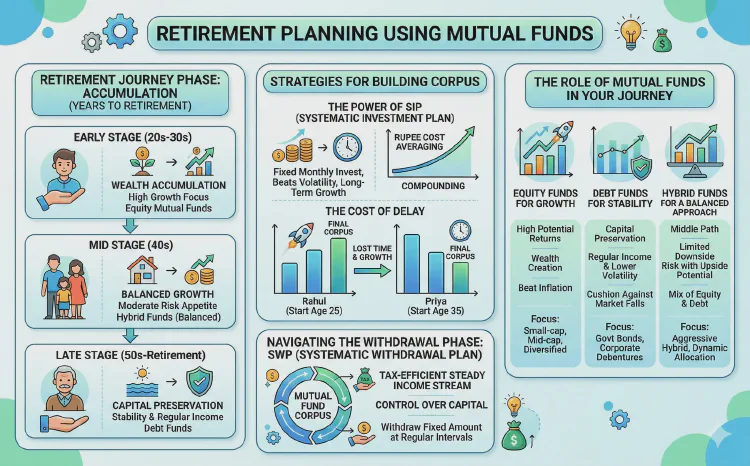
Retirement planning using mutual funds is a goal-oriented investment strategy where you build a dedicated nest egg through equity and hybrid funds during your working years, then transition into debt funds and Systematic Withdrawal Plans (SWP) to generate dependable, tax-advantaged monthly income post-retirement. Unlike fixed-income avenues that struggle to outpace rising living costs, mutual funds provide the necessary asset diversification to beat inflation across multi-decade horizons.
In India, the structural shift away from defined-benefit corporate pensions and joint family support systems means individuals must self-fund their post-work years. At the same time, expanding longevity—with average post-retirement spans frequently exceeding 25 to 30 years—demands a corpus capable of enduring prolonged drawdown phases. Compounding this challenge is healthcare inflation, which industry reports estimate runs between 10% and 14% annually in urban India, alongside general consumer inflation that continuously erodes currency purchasing power.
Achieving financial independence requires more than parking surplus cash into bank fixed deposits or traditional endowment policies. Fixed-return instruments often deliver negative real yields once adjusted for tax brackets and inflation. By harnessing the compounding engine of mutual funds across distinct life phases, investors can systematically accumulate wealth, defend their capital against macro risks, and construct a predictable income stream throughout their golden years.
Key takeaways
- Beat Inflation with Equities: Equity mutual funds are vital during the accumulation phase to produce real, inflation-adjusted returns that traditional fixed deposits cannot match.
- Compounding Rewards Early Starters: Starting a Systematic Investment Plan (SIP) in your 20s or 30s exponentially reduces the monthly capital required to reach a multi-crore corpus.
- Dynamic Asset Allocation: Gradually shift your portfolio from aggressive equity growth to capital-preserving debt funds as your target retirement year approaches.
- Tax-Efficient Retirement Income: Systematic Withdrawal Plans (SWP) offer significantly higher post-tax income and liquidity compared to traditional taxable pension annuities.
Why Mutual Funds Are Essential for Indian Retirement Planning
The arithmetic of retirement planning in India has fundamentally changed. A household budget of ₹50,000 per month today will require roughly ₹1,93,500 per month in 20 years, assuming a modest 7% average inflation rate. Over 30 years, that same lifestyle demands upwards of ₹3,80,000 every single month.
Future Monthly Expense = Current Expense × (1 + Inflation Rate)^Years
₹50,000 × (1 + 0.07)^20 ≈ ₹1,93,484
Traditional retirement instruments like the Public Provident Fund (PPF) and Employees’ Provident Fund (EPF) play a useful foundational role, but their sovereign statutory caps and fixed returns limit their capacity to carry an entire retirement plan alone. Bank fixed deposits (FDs) present an even steeper hurdle: when interest yields hover around 6.5% to 7.0% and interest is taxed at peak personal income tax slab rates (up to 30% plus surcharge), the post-tax return often falls below prevailing inflation rates, resulting in real wealth destruction.
Mutual funds solve this structural dilemma through asset diversification and market participation. Regulated by the Securities and Exchange Board of India and tracked via guidelines from AMFI India, mutual funds allow retail investors to access high-quality corporate equity, sovereign debt, money market papers, and commodities through professionally managed vehicles. This flexibility enables your money to generate true economic surplus during the wealth-accumulation stage.
The Two Crucial Phases: Accumulation vs. Distribution
Retirement planning with mutual funds is divided into two distinct operating phases, each with separate risk mandates, asset allocations, and fund selection strategies:
Working Years (Age 25–58)          Retirement (Age 60+)
┌────────────────────────┐         ┌────────────────────────┐
│   ACCUMULATION PHASE   │  ────>  │   DISTRIBUTION PHASE   │
│  Equity SIPs + Step-Up │         │  Debt Funds + SWP Flow │
│  Aggressive Compounding│         │  Capital Preservation  │
└────────────────────────┘         └────────────────────────┘
1. The Accumulation Phase (Wealth Creation)
During your earning years, the exclusive focus is aggressive capital expansion. Because your investment horizon spans 15 to 35 years, interim market volatility is an advantage rather than a hazard. By consistently buying fund units through monthly SIPs, you capitalize on rupee cost averaging, buying more units during market pullbacks and fewer during bull runs.
2. The Distribution Phase (Income and Capital Preservation)
Once active professional income halts, capital preservation and steady cash flow take precedence over capital appreciation. The distribution phase relies on systematic rebalancing, shifting accumulated equity wealth into conservative debt, arbitrage, and hybrid funds, from which a predictable monthly sum is drawn to cover daily living expenses.
Mutual Fund Categories for Retirement: Strategic Comparison
A successful retirement portfolio does not rely on a single fund category. Instead, it balances growth engines with capital shock absorbers.
| Fund Category | Primary Role in Retirement | Typical Asset Mix | Historical Risk Profile | Ideal Lifecycle Phase |
|---|---|---|---|---|
| Flexi-Cap / Large-Cap Equity | Core growth engine to beat long-term inflation | Minimum 65% domestic equity across market caps | High (volatile short-term, compounding long-term) | Accumulation (10+ years to retirement) |
| Aggressive Hybrid Funds | Balanced growth with equity cushion | 65%–80% equity, 20%–35% debt instruments | Moderate to High | Mid-career transition (5–10 years to retirement) |
| Balanced Advantage Funds (BAF) | Dynamic asset allocation to curb drawdowns | Dynamic equity-debt mix adjusted by market valuation | Moderate | Pre-retirement preservation (2–5 years to retirement) |
| Corporate Bond / Banking & PSU Debt | Capital preservation and liquidity foundation | High-rated corporate bonds, sovereign papers | Low to Moderate | Distribution / Retirement phase (Immediate cash needs) |
| Arbitrage Funds | Tax-efficient short-term parking | Equity cash-futures arbitrage, short debt | Very Low | Distribution buffer (1–2 years of living expenses) |
Selecting the wrong fund style can lead to painful portfolio drawdowns right before you retire. Investors should review our detailed analysis on Top 10 Mutual Fund Mistakes to Avoid to identify and eliminate structural portfolio weaknesses early.
The Compounding Advantage: SIPs and the Cost of Delay
The most influential variable in retirement planning is not how much money you invest each month—it is how long that money is permitted to compound.
Rahul vs. Priya: A Practical Demonstration
Consider two individuals, Rahul and Priya, both aiming to retire at age 60 with a long-term equity mutual fund portfolio delivering a projected annualized return of 12%:
- Rahul starts at age 25: He invests ₹10,000 per month via SIP for 35 years (until age 60). His total out-of-pocket investment is ₹42,00,000 (₹42 lakh). At a 12% annualized return, Rahul’s estimated corpus at age 60 reaches approximately ₹6.49 Crore.
- Priya starts at age 35: She waits 10 years, then invests the exact same ₹10,000 per month for 25 years (until age 60). Her total out-of-pocket investment is ₹30,00,000 (₹30 lakh). At a 12% annualized return, Priya’s estimated corpus at age 60 reaches approximately ₹1.90 Crore.
Rahul (Started at 25): Invested ₹42 Lakh  ──> Final Corpus: ₹6.49 Crore
Priya (Started at 35): Invested ₹30 Lakh  ──> Final Corpus: ₹1.90 Crore
Net Difference in Corpus: ₹4.59 Crore (for an investment difference of just ₹12 Lakh!)
By delaying her start by a single decade, Priya ended up with less than a third of Rahul’s final retirement wealth, despite investing only ₹12 lakh less in absolute capital. In financial planning, lost time cannot easily be made up with larger capital injections later.
Supercharging Wealth with Step-Up SIPs
As your career advances and your salary rises, leaving your retirement SIP stagnant undermines your potential. A Step-Up SIP automatically increments your monthly investment by a predetermined figure (such as 10% per annum).
For example, starting an initial SIP of ₹10,000 per month with a 10% annual step-up over 25 years can expand your eventual corpus from ~₹1.90 Crore to over ₹4.15 Crore at a 12% projected return. This mechanism aligns your investment velocity directly with your lifestyle inflation.
To optimize compounding efficiency, always select the Growth option over the Dividend (IDCW) option. Choosing growth ensures your capital gains are continually reinvested without triggering interim taxation, a strategy detailed in our guide on How to Choose Between Growth and Dividend Funds.
Asset Allocation Across Life Stages
A disciplined asset allocation protects your savings against market crashes while sustaining necessary purchasing power.
Age 25–35: Early Career
┌───────────────────────────────────────┬────────────┐
│ Equity: 75%–85%                       │ Debt: 15%  │
└───────────────────────────────────────┴────────────┘

Age 36–50: Mid Career
┌───────────────────────────────┬────────────────────┐
│ Equity: 60%–70%               │ Debt: 25%–30%      │
└───────────────────────────────┴────────────────────┘

Age 51–58: Pre-Retirement Glide Path
┌───────────────────────┬────────────────────────────┐
│ Equity: 40%–50%       │ Debt: 45%–55%              │
└───────────────────────┴────────────────────────────┘

Age 60+: Post-Retirement Distribution
┌───────────┬────────────────────────────────────────┐
│ Equity:30%│ Debt & Arbitrage: 70%                  │
└───────────┴────────────────────────────────────────┘
1. In Your 20s and 30s: Aggressive Wealth Creation
- Target Allocation: 75% to 85% Equity, 15% to 25% Fixed Income.
- Fund Selection: Broad-market index funds (Nifty 50, Nifty Next 50), Flexi-Cap funds, and Mid-Cap funds. A minor 5% to 10% allocation to gold mutual funds can be integrated as an external currency hedge; review top allocations in our guide on Best Gold Mutual Funds in India: 2026 Top Picks.
2. In Your 40s to Early 50s: Consolidation and Risk Calibration
- Target Allocation: 60% to 70% Equity, 25% to 30% Debt, 5% to 10% Gold.
- Fund Selection: Shift new incremental capital toward Large & Mid-Cap and Aggressive Hybrid funds. Gradually reduce exposure to high-beta, concentrated thematic or small-cap funds.
3. The De-Risking Glide Path (Ages 55 to 60)
- Target Allocation: 40% to 50% Equity, 50% to 60% Debt/Arbitrage.
- Execution: Do not liquidate your equity holdings in a single transaction. Instead, initiate a Systematic Transfer Plan (STP) moving funds from equity schemes into short-duration debt or banking & PSU debt funds over a 36-to-48-month window. This insulates your accumulated nest egg against sudden market corrections on the eve of your retirement date.
The Distribution Phase: Generating Income via SWP
Once retired, investors face the challenge of generating predictable monthly cash flow without liquidating capital during market downturns. Traditional commercial life insurance annuities generally lock in capital permanently and yield around 5.5% to 6.5% taxable income.
A Systematic Withdrawal Plan (SWP) in mutual funds provides a far more flexible, liquid, and tax-efficient alternative.
Retirement Corpus (e.g., ₹2 Crore in Hybrid / Debt Funds)
       │
       ├──> Monthly SWP Payment (e.g., ₹70,000 to Bank Account)
       │
       └──> Remaining Corpus Stays Invested & Continues Compounding
The Three-Bucket Retirement Strategy
To implement an SWP safely without falling victim to sequence-of-returns risk, structure your post-retirement corpus into three distinct functional buckets:
- Bucket 1: Immediate Cash Flow (Years 1 to 3): Hold 36 months of living expenses in ultra-short duration debt funds, liquid funds, or arbitrage funds. Your automated monthly SWP directly pulls from this bucket, guaranteeing stable income regardless of stock market conditions.
- Bucket 2: Medium-Term Stability (Years 4 to 8): Park intermediate capital in Corporate Bond funds, Conservative Hybrid funds, or Balanced Advantage funds. These funds generate moderate returns while refilling Bucket 1 as it depletes.
- Bucket 3: Long-Term Inflation Defense (Years 9 and Beyond): Maintain 25% to 35% of your total corpus in diversified large-cap and flexi-cap equity funds. Because this capital will not be touched for at least 8 to 10 years, it can comfortably ride out interim bear markets, compounding to protect your portfolio against future inflation.
To explore drawdown mechanics, withdrawal rates, and safety buffers in depth, read our companion breakdown on Understanding Systematic Withdrawal Plans (SWP).
Taxation of Mutual Funds for Retirees (As of 2026)
Taxes directly determine how long your retirement corpus will last. Mutual fund gains are taxed according to asset class categories under provisions outlined by the Income Tax Department of India:
1. Equity Mutual Funds (≥ 65% Domestic Equity)
- Long-Term Capital Gains (LTCG): Units held for more than 12 months qualify as long-term assets. LTCG realized up to ₹1.25 lakh in a financial year is completely exempt from tax. Gains exceeding ₹1.25 lakh are taxed at a flat rate of 12.5% (without indexation).
- Short-Term Capital Gains (STCG): Units held for 12 months or less are taxed at 20%.
2. Debt Mutual Funds (< 35% Equity Exposure)
- Taxation Rate: Capital gains from specified debt mutual funds acquired on or after April 1, 2023, are treated as short-term capital gains, regardless of the holding period. These gains are added to your gross total income and taxed according to your applicable slab rates.
3. The Unique Tax Advantage of SWP Over Fixed Deposits
When you earn interest on a bank fixed deposit, the entire interest earned is taxed annually at your top income tax slab.
In contrast, every monthly withdrawal via an SWP is treated as a partial redemption of units, consisting of two parts:
- Return of Principal Capital: Completely non-taxable.
- Capital Gains Component: Only the gain component of that specific unit redemption is subject to taxation.
In the early years of an SWP, the principal component constitutes the majority of the redeemed sum, keeping your effective tax liability exceptionally low. Furthermore, by utilizing equity-oriented hybrid funds for a portion of the SWP, retirees can take advantage of the annual ₹1.25 lakh tax-free LTCG threshold every financial year.
Common Retirement Planning Traps to Avoid
Even disciplined investors can stumble into critical strategic mistakes that put their post-retirement stability at risk:
- Retiring 100% Into Cash or FDs: Fleeing equity entirely at age 60 exposes your capital to severe longevity risk. If your retirement lasts 30 years and annual inflation averages 6%, your purchasing power drops by roughly 80% over that period. A conservative 25% to 35% equity sleeve is vital.
- Ignoring Healthcare Contingency Reserves: Never blend medical emergency reserves into your primary retirement SWP bucket. Maintain a standalone senior citizen comprehensive health insurance policy supplemented by a dedicated health emergency fund parked in liquid mutual funds.
- Stopping SIPs During Market Corrections: Equity market drawdowns are normal economic cycles. Pausing or canceling monthly SIP contributions during market corrections destroys the mathematical benefit of rupee cost averaging.
- Drawing Unrealistic SWP Rates: Drawing an aggressive 8% to 10% withdrawal rate from your corpus during retirement drastically increases the risk of depleting your funds early. Keep initial withdrawal rates within a conservative range of 3.5% to 5.0% of the total starting portfolio.
For a deeper dive into avoiding behavioral biases and execution errors, consult our detailed walkthrough on How to Avoid Common Investment Mistakes: Complete Guide.
FAQ
How much monthly SIP is required to build a ₹5 Crore retirement corpus in 20 years?
Assuming an annualized long-term return expectation of 12% from diversified equity mutual funds, an investor requires an SIP of approximately ₹50,000 per month for 20 years to accumulate ₹5 Crore. Alternatively, if you begin with an SIP of ₹25,000 per month and step it up by 10% annually to match salary increments, you can hit the same ₹5 Crore milestone over the same 20-year window.
Can an investor rely solely on mutual funds for retirement instead of EPF or NPS?
Yes, mutual funds offer superior liquidity, transparency, and portfolio customization compared to statutory retirement accounts. However, a prudent financial strategy combines the sovereign security and tax benefits of EPF or the National Pension System (NPS) with the dynamic growth potential of mutual funds, creating a balanced and resilient overall asset architecture.
What is the safest mutual fund category for retirees during the SWP distribution phase?
Retirees typically use Balanced Advantage Funds (BAFs), Equity Savings Funds, or High-Quality Corporate Bond funds to anchor their Systematic Withdrawal Plans. These categories maintain lower volatility than pure equity funds while offering superior tax efficiency and liquidity compared to traditional fixed deposits.
What happens to my mutual fund retirement investments in the event of an untimely death?
Mutual fund investments pass smoothly to designated nominees upon submission of the death certificate, identity verification, and transmission request documents. It is essential to ensure that every mutual fund folio has up-to-date registered nominees with correct identification details to avoid complicated legal inheritance processes for your surviving dependents.
Conclusion
Retirement planning using mutual funds is not about market timing or picking speculative winners. It is an organized, lifelong discipline centered on asset allocation, early accumulation, and structured distribution. By committing to systematic investing throughout your career and executing a smooth glide path toward debt-backed SWPs near retirement, you can ensure lifelong financial freedom, dignified self-reliance, and enduring peace of mind.
- Tags:
- Retirement Planning
- Mutual Funds
- Sip
- SWP
- Personal Finance
- Investing in India