
Best ELSS Funds 2026: Top Tax Savers in India
Discover the best ELSS funds 2026 to maximize Section 80C tax deductions and long-term equity growth with a 3-year lock-in and proven risk-adjusted returns.

- NV Trends
- 17 min read
- Updated
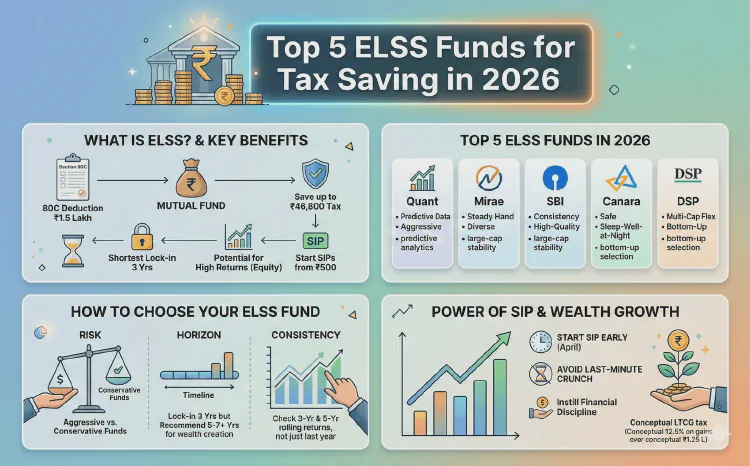
The best ELSS funds 2026 to invest in for dual tax-saving and capital growth are Quant ELSS Tax Saver Fund, Mirae Asset ELSS Tax Saver Fund, SBI Long Term Equity Fund, Canara Robeco ELSS Tax Saver Fund, and DSP ELSS Tax Saver Fund. These five schemes consistently lead their peer category based on published long-term risk-adjusted performance data, portfolio resilience across distinct market cycles, and transparent investment frameworks tailored to varying investor risk profiles.
In 2026, Equity Linked Savings Schemes (ELSS) stand out as the most growth-oriented tax-saving instrument available to Indian taxpayers under Section 80C of the Income Tax Act. While conventional fixed-income products like the Public Provident Fund (PPF) and 5-year bank tax-saving fixed deposits protect capital at modest, fixed interest rates, ELSS mutual funds invest at least 80% of their total corpus in equities as mandated by the Securities and Exchange Board of India (SEBI). This statutory mandate provides retail investors with an inflation-beating asset class wrapped in the shortest mandatory holding period among all Section 80C deductions.
However, selecting an ELSS fund in 2026 requires navigating a modified fiscal landscape. With the New Tax Regime operating as the default regime for individual taxpayers, claiming deductions under Section 80C is viable only if you actively choose the Old Tax Regime. For taxpayers remaining in the 30% tax slab under the Old Regime, deploying up to Rs. 1.5 lakh into ELSS yields direct tax savings of up to Rs. 46,800 annually (inclusive of the 4% health and education cess). To make that allocation count, investors must focus on portfolio construction, downside protection, and rolling returns rather than chasing short-term trailing gains.
Key takeaways
- Shortest Mandatory Lock-In: ELSS schemes mandate a statutory lock-in period of only 3 years, offering significantly faster capital release than PPF (15 years) or Tax-Saving FDs (5 years).
- Substantial Section 80C Deductions: Eligible taxpayers opting for the Old Tax Regime can deduct up to Rs. 1.5 lakh per financial year, translating to tax savings of up to Rs. 46,800 for high-income earners.
- Inflation-Beating Equity Allocation: By investing at least 80% of assets across equities and equity-related securities, ELSS schemes generate superior wealth-compounding potential over multi-year business cycles.
- Updated Capital Gains Taxation: As of 2026, Long-Term Capital Gains (LTCG) from equity mutual funds exceeding Rs. 1.25 lakh in a financial year are taxed at 12.5%.
- SIP Rolling Lock-In Mechanics: When investing via a Systematic Investment Plan (SIP), each individual monthly installment is locked for 36 months from its respective unit allotment date.
What Are ELSS Mutual Funds and How Do They Work?
An Equity Linked Savings Scheme (ELSS) is a diversified, open-ended equity mutual fund engineered to deliver capital growth alongside statutory tax deductions under Section 80C. Under regulatory classifications managed by SEBI and monitored by the Association of Mutual Funds in India (AMFI), ELSS schemes must allocate a minimum of 80% of their total assets to equities, with the remaining balance held in money market instruments, cash equivalents, or debt securities for liquidity management.
The defining characteristic of an ELSS fund is its statutory 3-year lock-in period. From the exact calendar date your mutual fund units are allotted, you cannot redeem, switch to another scheme, or pledge units as loan collateral for a duration of 36 months. Once this holding period concludes, the investment does not automatically mature or liquidate. Instead, it converts into a fully liquid open-ended diversified equity scheme, empowering you to leave your capital invested for 5, 10, or 20 years to harvest uninterrupted compounding returns.
When planning an annual tax strategy, investors studying broader tax-saving strategies through mutual funds frequently choose ELSS because it bridges the gap between passive year-end tax compliance and active wealth accumulation for major life milestones, such as retirement corpuses or children’s higher education.
2026 Tax Rules for ELSS: Section 80C, LTCG, and Regime Selection
Evaluating an ELSS investment in 2026 requires understanding the precise tax implications on both entry (investment deduction) and exit (redemption of gains). The rules set forth by the Income Tax Department establish distinct boundaries that determine whether ELSS makes financial sense for your specific income profile.
1. Section 80C Deduction Mechanics (Entry Tax)
Under the Old Tax Regime, investments in ELSS qualify for a deduction from gross total income up to a cap of Rs. 1.5 lakh per financial year.
- For an investor in the 20% tax bracket, investing the full Rs. 1.5 lakh saves Rs. 31,200 (including 4% cess).
- For an investor in the 30% tax bracket, the same Rs. 1.5 lakh allocation saves Rs. 46,800 (including 4% cess).
- Note: If you file taxes under the New Tax Regime, Section 80C deductions are not available.
2. Capital Gains Taxation on Redemption (Exit Tax)
Because ELSS carries a statutory 3-year lock-in period, every single unit redeemed is categorized as a long-term asset. Short-Term Capital Gains (STCG) tax under Section 111A cannot apply to ELSS under standard conditions. For a comprehensive overview of how equity taxation is structured across asset categories, review our detailed guide to capital gains tax rules in India.
As of 2026, the equity mutual fund taxation framework operates under the following parameters:
- Exemption Limit: Long-Term Capital Gains (LTCG) across all equity mutual funds and listed equities combined are tax-exempt up to Rs. 1.25 lakh per financial year.
- Tax Rate on Excess Gains: Any cumulative LTCG exceeding Rs. 1.25 lakh in a given financial year is taxed at a flat rate of 12.5% (plus applicable surcharge and 4% cess).
- Indexation: Indexation benefits are not available for equity-oriented mutual fund schemes.
Comprehensive Comparison: Best ELSS Funds to Invest in 2026
The table below provides a practitioner-focused comparison of the five best ELSS funds 2026, evaluating their investment philosophies, market-cap allocation tendencies, portfolio turnover, and investor suitability based on published scheme disclosures.
| Scheme Name | Core Investment Style | Market-Cap Bias | Portfolio Volatility (Beta) | Portfolio Turnover Ratio | Ideal Investor Profile |
|---|---|---|---|---|---|
| Quant ELSS Tax Saver Fund | Dynamic Momentum & Active Rotation (VLRT) | Multi-Cap (Tactical Large/Mid/Small) | High (> 1.05) | High (> 150%) | Aggressive investors seeking top-tier alpha who tolerate sharp pullbacks |
| Mirae Asset ELSS Tax Saver Fund | Growth at a Reasonable Price (GARP) | Large-Cap Oriented (65-75% Large) | Moderate (~ 0.95) | Low (< 40%) | Moderate-risk investors seeking consistent, disciplined core compounding |
| SBI Long Term Equity Fund | Growth-Value Blend & Contrarian Plays | Flexi-Cap (Balanced Across Caps) | Moderate (~ 0.92) | Moderate (40-70%) | Long-term investors who appreciate institutional research depth and cyclical bets |
| Canara Robeco ELSS Tax Saver Fund | Quality-Focused & Low Drawdown Defense | Large-Cap Bias (70%+ Large) | Low (< 0.90) | Low (< 35%) | Conservative or first-time equity investors prioritizing downside protection |
| DSP ELSS Tax Saver Fund | Bottom-Up Fundamental Multi-Cap Growth | Multi-Cap (Balanced Large/Mid) | Moderate (~ 0.98) | Moderate (50-80%) | Investors wanting high-conviction stock picking and business-cycle resilience |
Detailed Analysis: What Are the Best ELSS Funds 2026?
Selecting the best ELSS funds to invest in 2026 requires looking beyond trailing three-year returns. A durable mutual fund portfolio must exhibit disciplined underwriting, consistent capital allocation, and strong risk-adjusted ratios like the Sharpe ratio and Sortino ratio during market drawdowns. In-depth research also involves evaluating fund manager performance over multi-year market cycles. Below is an objective analysis of the leading ELSS schemes in India.
1. Quant ELSS Tax Saver Fund
Quant ELSS Tax Saver Fund has delivered notable active returns over multiple market cycles through its proprietary VLRT framework, which evaluates Valuation, Liquidity, Risk, and Timing. The fund does not follow a passive buy-and-hold philosophy; instead, the management team dynamically shifts sector weightings and adjusts asset allocations based on predictive quantitative analytics and macro indicators.
- Portfolio Architecture: The fund maintains an active multi-cap structure, shifting capital rapidly between large-cap bellwethers and high-momentum mid- or small-cap companies. The portfolio turnover ratio is characteristically high, reflecting opportunistic sector rotation.
- Risk-Reward Dynamic: While the fund has demonstrated significant upside capture during bull markets, its active positioning exposes it to elevated standard deviation. Sharp market trend reversals can lead to pronounced short-term portfolio drawdowns.
- Investor Fit: Suited for experienced, aggressive equity investors with a minimum investment horizon of 5 to 7 years who prioritize capital expansion over portfolio stability.
2. Mirae Asset ELSS Tax Saver Fund
Mirae Asset ELSS Tax Saver Fund is one of the most established schemes in the Indian tax-saving domain, known for disciplined execution of a Growth at a Reasonable Price (GARP) methodology. The management team seeks out companies with sustainable economic moats, superior return on equity (ROE), and robust cash conversion cycles without overpaying for projected growth.
- Portfolio Architecture: The scheme maintains a core foundation of large-cap leaders (typically 65% to 75% of assets) complemented by selective mid-cap holdings. It spreads capital across 50 to 70 individual securities, ensuring minimal single-stock concentration risk.
- Risk-Reward Dynamic: The fund delivers a steady beta profile close to market benchmarks. While it may not capture speculative peaks during mid-cap and small-cap momentum rallies, it consistently limits downside leakage when market valuations compress.
- Investor Fit: Ideal for moderate-risk investors seeking a dependable, institutional-grade equity pillar that balances steady wealth growth with structural risk controls.
3. SBI Long Term Equity Fund
As the longest-running ELSS scheme in India, SBI Long Term Equity Fund provides decades of operational pedigree. Managed by India’s largest asset management house, the fund deploys a pragmatic blend of growth and value investing, frequently taking contrarian positions in out-of-favor sectors poised for cyclical recoveries.
- Portfolio Architecture: The fund maintains a true flexi-cap approach, adjusting allocations between large, mid, and small caps based on prevailing valuation spreads. The team leverages domestic institutional research to establish exposure in structural themes like manufacturing, banking, and infrastructure.
- Risk-Reward Dynamic: Because the fund occasionally establishes positions in turnaround candidates or cyclical sectors ahead of widespread market recognition, it can go through phases of performance consolidation before fundamental corporate earnings materialize.
- Investor Fit: Suited for conservative to moderate equity investors who value deep balance-sheet analysis, stable fund stewardship, and a balanced exposure across economic sectors.
4. Canara Robeco ELSS Tax Saver Fund
Canara Robeco ELSS Tax Saver Fund has built a reputation as one of the most stable, low-volatility offerings in the tax-saving category. The fund’s mandate prioritizes business quality, strong corporate governance, and consistent free cash flow generation over chasing speculative momentum.
- Portfolio Architecture: The scheme exhibits a strong large-cap orientation with a low portfolio turnover ratio, reflecting high conviction in its holdings. The fund managers focus on companies with clean balance sheets and pricing power within their respective industries.
- Risk-Reward Dynamic: The scheme exhibits lower beta and standard deviation compared to category averages. Its defensive characteristics protect investor capital during turbulent market corrections, though upside capture during explosive bull runs may lag hyper-aggressive peers.
- Investor Fit: Perfect for first-time equity investors transitioning from traditional banking instruments, PPF, or endowment plans who require Section 80C deductions without enduring high portfolio swings.
5. DSP ELSS Tax Saver Fund
DSP ELSS Tax Saver Fund deploys a bottom-up fundamental stock selection framework anchored by a multi-cap mandate. The investment team filters prospective businesses through strict accounting standards, capital allocation history, and competitive moats across economic cycles.
- Portfolio Architecture: The fund maintains a moderately concentrated portfolio, allowing top high-conviction ideas to drive aggregate performance. Allocations between large-cap industry leaders and emerging mid-cap compounders are balanced based on fair valuation bands.
- Risk-Reward Dynamic: The fund displays a balanced capture ratio, absorbing moderate market pullbacks while participating effectively in earnings-led broad market rallies.
- Investor Fit: Well-suited for investors with a 5-year investment perspective who prefer active bottom-up stock selection backed by rigorous balance sheet verification.
ELSS vs. PPF vs. Tax-Saver FD: Performance and Liquidity Comparison
To understand why ELSS remains a preferred Section 80C vehicle for long-term wealth creation, consider how it stacks up against traditional fixed-income tax-saving options.
+------------------+------------------+-------------------+--------------------+
| Feature          | ELSS Mutual Fund | Public Prov. Fund | 5-Year Bank FD     |
+------------------+------------------+-------------------+--------------------+
| Asset Class      | Equity (>= 80%)  | Sovereign Debt    | Bank Deposit (Debt)|
| Lock-in Period   | 3 Years          | 15 Years          | 5 Years            |
| Return Profile   | Market-Linked    | Govt-Declared     | Fixed at Inception |
| Inflation Hedge  | High Potential   | Moderate / Low    | Low (Often Negative|
|                  |                  |                   | after inflation)   |
| Section 80C Cap  | Up to Rs. 1.5 L  | Up to Rs. 1.5 L   | Up to Rs. 1.5 L    |
| Exit Tax Impact  | 12.5% over 1.25L | Fully Exempt (EEE)| Taxed at Slab Rate |
+------------------+------------------+-------------------+--------------------+
Key Trade-Offs Analyzed:
- Liquidity Advantage: ELSS unlocks your capital in 36 months. A 5-year bank tax-saving FD locks money for half a decade with zero early-withdrawal provisions. The Public Provident Fund (PPF) requires a 15-year statutory commitment, allowing only partial, conditional withdrawals after year seven.
- Real Returns vs. Inflation: Over 7-to-10-year holding windows, equity as an asset class historically outpaces inflation. Fixed deposits offering 6.5% to 7.0% nominal yields often result in sub-par or negative real returns after accounting for retail inflation and personal slab-rate taxation.
- Risk Profile: Fixed deposits and PPF offer capital certainty and zero market risk. ELSS carries equity market risk; your portfolio value fluctuates daily based on underlying Net Asset Value (NAV) movements.
Investment Strategy: How to Approach ELSS in 2026
Achieving optimal outcomes with ELSS requires implementing a structured investment strategy rather than rushing to invest lump sums in mid-March.
1. SIP vs. Lumpsum: Managing the Rolling Lock-In
The most critical execution detail when investing in ELSS is understanding the difference in lock-in mechanics between lumpsum investments and Systematic Investment Plans (SIP):
- Lumpsum Investment: If you invest a single lumpsum of Rs. 1.5 lakh on 15 March 2026, the entire investment unlocks on 15 March 2029.
- Systematic Investment Plan (SIP): When investing via monthly SIPs (e.g., Rs. 12,500 per month across the financial year), each installment creates a separate 36-month lock-in period. The installment allotted on 10 April 2026 unlocks on 10 April 2029; the installment allotted on 10 May 2026 unlocks on 10 May 2029; and so forth.
Monthly SIP Installment (Allotment Date) ----> Unlocks Exactly 36 Months Later
  [Apr 2026 Installment] ====================> [Available to Redeem: Apr 2029]
  [May 2026 Installment] ====================> [Available to Redeem: May 2029]
  [Jun 2026 Installment] ====================> [Available to Redeem: Jun 2029]
Practitioner Recommendation: If your cash flow permits, starting a monthly SIP in April or May of the financial year mitigates market timing risk through Rupee Cost Averaging, while eliminating the stress of making an eleventh-hour lumpsum tax commitment in March.
2. Growth vs. IDCW (Dividend) Option
ELSS funds offer two plans: Growth and Income Distribution cum Capital Withdrawal (IDCW).
- Growth Plan: All dividends and underlying portfolio gains are reinvested into the fund corpus, increasing the scheme’s NAV.
- IDCW Plan: The mutual fund periodically distributes cash payouts to unitholders, reducing the fund NAV by an equivalent amount.
Why Growth is Superior: In 2026, IDCW payouts are added directly to your taxable income and taxed at your personal income tax slab rate. In contrast, staying in the Growth plan lets your returns compound uninterrupted. When you eventually redeem units after the 3-year lock-in, your gains benefit from the Section 112A annual exemption of Rs. 1.25 lakh, with the excess taxed at a favorable 12.5% rate rather than your higher marginal slab rate.
3. Portfolio Concentration: How Many ELSS Funds Should You Hold?
A frequent mistake among retail investors is buying a new ELSS fund every year. After five years of tax planning, an investor often ends up holding five or six distinct ELSS schemes. This approach causes severe portfolio overlap, dilutes performance, and creates an administrative burden during tracking and tax filing.
Best Practice: Choose one or at most two complementary ELSS funds. For instance, pairing a core, low-volatility large-cap fund (such as Canara Robeco ELSS or Mirae Asset ELSS) with an active multi-cap or momentum fund (such as Quant ELSS or SBI Long Term Equity) provides balanced diversification across investment styles without unnecessary fragmentation.
When to Exit an ELSS Fund vs. Staying Invested
Reaching the 3-year lock-in date does not mean you must immediately sell your mutual fund units. Making an informed exit decision requires evaluating your asset allocation, upcoming financial goals, and the tax implications of redemption.
                             [3-Year Lock-In Concludes]
                                         |
               +-------------------------+-------------------------+
               |                                                   |
       [Fund Underperforming?]                             [Fund Performing Well?]
               |                                                   |
    Verify against benchmark over                       Examine your asset allocation
      3 consecutive rolling years                                  and goals
               |                                                   |
      +--------+--------+                                 +--------+--------+
      |                 |                                 |                 |
    [Yes]              [No]                            [Near Goal]     [Long-Term Goal]
      |                 |                                 |                 |
  Redeem units;     Temporary cycle;                  Redeem up to      Remain invested;
  reallocate to     remain invested                   Rs. 1.25L tax-    allow compounding
  better scheme                                       free threshold    to continue
Actionable Exit Guidelines:
- Harvesting the Rs. 1.25 Lakh Exemption: If you need liquidity or wish to rebalance your asset allocation, you can strategically redeem unlocked ELSS units so that total LTCG across your equity portfolio stays under Rs. 1.25 lakh in a given financial year. This yields zero exit tax liability.
- Underperformance Assessment: Never exit a fund simply because it experienced one weak year. Compare the fund’s 3-year rolling returns against its benchmark index (e.g., Nifty 500 TRI) and category average. If the fund has underperformed its benchmark over two to three consecutive years across falling and rising markets, redeeming unlocked units and reallocating capital is a sensible move.
- Aligning with Financial Goals: If the ELSS investment was initiated to fund a specific goal (such as a home down payment or university tuition) that matures in 3 to 5 years, systematically move the unlocked units into low-duration debt funds or liquid instruments as the goal approaches to protect your accumulated capital from equity volatility.
Common Mistakes to Avoid with ELSS Funds
- Procrastinating Until March: Delaying tax-saving investments until the final weeks of the financial year often forces investors into rushed decisions, choosing underperforming schemes based on superficial recent returns.
- Treating the 3-Year Lock-In as a 3-Year Horizon: While units unlock after 36 months, equity funds are designed for 5- to 7-year horizons. Cashing out an equity portfolio during an economic downturn right at the 3-year mark can lock in unrealized losses.
- Selecting the IDCW Option for “Passive Income”: With IDCW receipts taxed at your marginal slab rate, opting for dividend distribution diminishes long-term compounding efficiency.
- Ignoring Regime Suitability: Investing in ELSS solely for tax savings without checking whether the Old Tax Regime or New Tax Regime serves you better financially. If your deductions total less than the New Regime’s tax differential, choosing the Old Regime just to invest in ELSS is counterproductive.
FAQ
Which are the best ELSS funds to invest in 2026 for conservative investors?
For conservative investors seeking low portfolio volatility and stable downside protection, Canara Robeco ELSS Tax Saver Fund and Mirae Asset ELSS Tax Saver Fund are proven selections. Both schemes prioritize high-quality companies with clean balance sheets and maintain a solid allocation to large-cap market leaders, minimizing steep portfolio drawdowns during broad market corrections.
How are capital gains taxed on ELSS mutual funds as of 2026?
Because ELSS funds carry a statutory 3-year lock-in period, all redemptions are classified as Long-Term Capital Gains (LTCG). As of 2026, cumulative LTCG from equity investments up to Rs. 1.25 lakh per financial year is entirely tax-exempt, while gains exceeding Rs. 1.25 lakh are taxed at a flat rate of 12.5% plus applicable cess and surcharges.
Can I stop or pause an ELSS SIP before the 3 years are over?
Yes, you can cancel or pause your monthly ELSS SIP mandate at any time without paying a financial penalty. However, any mutual fund units that were already allotted prior to your cancellation remain subject to the statutory 3-year lock-in from their respective allotment dates and cannot be redeemed until those individual 36-month periods conclude.
What happens to my ELSS mutual fund units after the 3-year lock-in ends?
When the 3-year lock-in concludes, your ELSS units do not liquidate or expire automatically. The fund continues to run as an open-ended diversified equity scheme, allowing you to remain invested indefinitely to compound returns, or redeem units partially or in full at your discretion based on prevailing market conditions and financial goals.
Conclusion
The best ELSS funds 2026—led by Quant ELSS Tax Saver Fund, Mirae Asset ELSS Tax Saver Fund, SBI Long Term Equity Fund, Canara Robeco ELSS Tax Saver Fund, and DSP ELSS Tax Saver Fund—continue to provide Indian taxpayers with an effective dual-action financial instrument for Section 80C tax optimization and long-term equity growth. With the shortest lock-in period among all statutory tax-saving assets and an 80% minimum equity allocation, ELSS holds a distinct structural edge over fixed-income options like PPF and tax-saving FDs.
To make the most of your investment, confirm that opting for the Old Tax Regime aligns with your broader financial plan, commit to a disciplined monthly SIP strategy to smooth out equity market valuations, and limit your holdings to one or two well-managed funds aligned with your personal risk tolerance.
- Tags:
- Elss Mutual Funds
- Tax Saving Funds
- Best Elss Funds 2026
- Section 80c Deductions
- Equity Mutual Funds
- Tax Planning India