
Understanding Capital Gains Tax in India
Master capital gains tax in India with our complete 2026 guide to STCG, LTCG rates, property indexation rules, exemptions, and loss set-off strategies.

- NV Trends
- 18 min read
- Updated
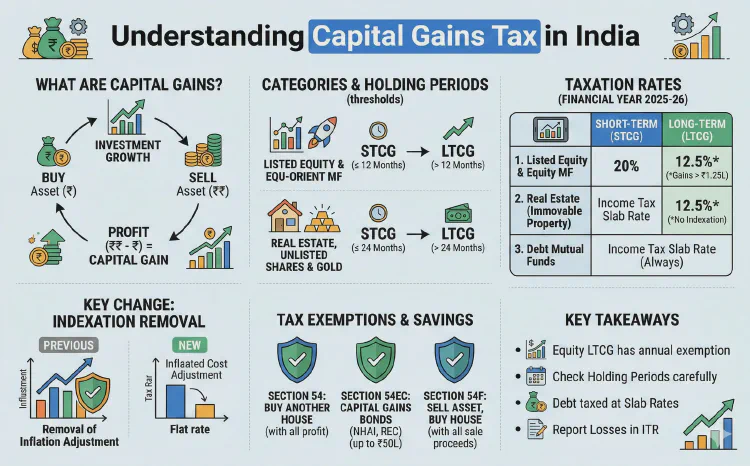
Capital gains tax in India is the statutory levy imposed on the profits realized from the transfer or sale of a capital asset—such as listed stocks, equity and debt mutual funds, real estate, precious metals, and unlisted securities—categorized into Short-Term Capital Gains (STCG) or Long-Term Capital Gains (LTCG) depending on how long you hold the asset before selling it.
Navigating capital gains taxation has become far more critical as of 2026 following sweeping structural reforms designed to rationalize rates, compress holding periods, and phase out indexation. For years, individual taxpayers and portfolio managers had to juggle three separate holding period benchmarks (12, 24, and 36 months) across diverse asset classes alongside disparate rate structures. Under the streamlined framework, capital assets are consolidated into two primary holding windows—12 months for listed securities and 24 months for all other assets—while setting a broad long-term capital gains tax baseline of 12.5%.
For Indian retail investors, wealth creation is not merely about picking outperforming equities or acquiring prime real estate; it is equally dictated by your post-tax yield. A misunderstanding of how the tax code treats debt instruments, sudden changes in the taxation of residential property, or an incorrectly handled capital loss set-off can quickly erode years of compounded returns. Understanding the underlying mechanics of capital gains empowers you to optimize portfolio rebalancing, time your market exits prudently, and utilize legitimate tax relief provisions under the law.
Key takeaways
- Unified 12.5% LTCG Benchmark: Long-term capital gains across listed equities, real estate, physical gold, and unlisted equity are standardized at a flat base rate of 12.5% as of 2026.
- Enhanced Exemption on Listed Equities: Long-term gains on listed equity shares and equity-oriented mutual funds are exempt up to Rs. 1.25 lakh per financial year under Section 112A, with gains above this threshold taxed at 12.5%, while STCG is taxed at 20%.
- Two Simplified Holding Horizons: Assets are classified as long-term using only two timelines: 12 months for listed securities and 24 months for unlisted shares, immovable properties, and physical commodities.
- Slab-Rate Taxation for Pure Debt Funds: Mutual funds with 35% or less invested in domestic equities are stripped of long-term tax status and taxed at your applicable income tax slab rate regardless of holding duration.
- Grandfathering Protection for Property: For residential real estate acquired prior to July 23, 2024, resident individual sellers can compute tax liability at both 20% with indexation and 12.5% without indexation, paying whichever produces the lower tax bill.
What Are Capital Assets and Capital Gains Under Indian Tax Law?
Under Section 2(14) of the Indian Income Tax Act, 1961, a “capital asset” encompasses property of any kind held by an assessee, whether or not connected with their business or profession. This includes movable assets like listed company shares, corporate debentures, mutual fund units, and gold, as well as immovable assets such as agricultural land situated within specified urban limits, residential plots, apartments, and commercial office units.
Statutory exceptions apply to specific personal effects. For example, personal apparel, furniture, and rural agricultural land situated outside designated municipal boundaries do not fall under the purview of capital assets. However, items such as jewelry, archaeological collections, drawings, paintings, and sculptures are explicitly treated as capital assets even if held for personal use.
A capital gain arises strictly upon the “transfer” of such assets. Under Section 2(47), a transfer encompasses not just a direct cash sale, but also the exchange of one asset for another, the relinquishment or extinguishment of any rights in an asset, or the compulsory acquisition of property under any law. If an asset is sold for an amount higher than its cost of acquisition (plus permissible improvements and transfer expenses), the resultant surplus is deemed a capital gain and brought to tax in the financial year in which the transfer takes place.
Holding Periods: How Does Holding Duration Determine STCG vs. LTCG?
The classification of a profit as either a Short-Term Capital Gain or a Long-Term Capital Gain determines the tax rate applied, the exemptions available, and how associated losses can be adjusted. Following reforms enacted to simplify the tax code, the holding periods across all major investment classes in India are grouped into two primary tiers:
1. The 12-Month Holding Window (Listed Securities)
Any capital asset that is publicly listed on a recognized Indian stock exchange (such as the NSE or BSE) qualifies for long-term treatment if held for more than 12 months (1 year):
- Listed equity shares where Securities Transaction Tax (STT) is paid.
- Units of equity-oriented mutual funds (funds with at least 65% exposure to domestic equities).
- Units of business trusts (REITs and InvITs).
- Listed zero-coupon bonds.
If these instruments are sold within 12 months from the date of purchase, any profit generated is classified as STCG. If held for more than 12 months, the profit is categorized as LTCG.
2. The 24-Month Holding Window (All Other Assets)
For almost all non-listed and immovable assets, the long-term qualification threshold is 24 months (2 years):
- Immovable property (residential houses, commercial buildings, and urban land).
- Unlisted shares of private limited companies.
- Physical gold, silver, gold bullion, and jewelry.
- Sovereign Gold Bonds (SGBs) traded in secondary markets prior to redemption.
Assets sold at or prior to 24 months generate STCG; assets liquidated after 24 months qualify for LTCG. The older 36-month threshold that historically applied to real estate and gold has been phased out.
Capital Gains Tax Rates in India: Asset-by-Asset Breakdown
The exact tax liability you face depends heavily on the underlying asset class. The Income Tax Department enforces specific tax schedules for equities, real estate, fixed-income vehicles, and commodities.
Listed Equity Shares and Equity Mutual Funds
Investments in listed shares and equity-oriented mutual funds remain a primary engine for long-term retail wealth creation, though rates were recalibrated upward to align with broader capital taxation structures:
- Short-Term Capital Gains (Section 111A): If liquidated within 12 months, gains are taxed at a flat rate of 20% (plus applicable surcharge and 4% Health and Education Cess).
- Long-Term Capital Gains (Section 112A): If held for over 12 months, gains enjoy an aggregate exemption of up to Rs. 1.25 lakh per financial year. Any net long-term equity gain exceeding Rs. 1.25 lakh is taxed at a flat rate of 12.5% without indexation.
For instance, if an investor books an LTCG of Rs. 2,00,000 on listed equities during a financial year, the first Rs. 1,25,000 is completely tax-free. The remaining Rs. 75,000 is taxed at 12.5%, resulting in a base tax liability of Rs. 9,375 (before cess and surcharge).
Real Estate and Immovable Property
Immovable property taxation underwent a foundational shift with the removal of mandatory indexation:
- Short-Term Capital Gains: If a property is sold within 24 months of purchase, the net profit is added directly to the seller’s gross total income and taxed according to their applicable income tax slab rate (up to 30% or higher under progressive slabs).
- Long-Term Capital Gains: If held for more than 24 months, the gain is taxed at a flat 12.5% without the benefit of indexation. However, a significant grandfathering relief provision exists for properties acquired before July 23, 2024. Resident individuals and Hindu Undivided Families (HUFs) selling older properties can calculate tax liability using both the old method (20% with indexation) and the new method (12.5% without indexation) and pay the lower calculated amount.
Debt Mutual Funds and Market-Linked Debentures
Fixed-income investors must navigate strict tax classifications introduced under Section 50AA of the Income Tax Act. For investors looking to optimize the fixed-income portion of their portfolio, reviewing a detailed guide to understanding debt fund categories in India clarifies how various fund mandates are structured.
- Specified Mutual Funds: Mutual funds that invest 35% or less of their total proceeds in equity shares of domestic companies (pure debt funds, liquid funds, conservative hybrid funds) acquired on or after April 1, 2023, do not receive long-term capital gains status regardless of whether you hold them for 3 years or 10 years.
- Taxation Rate: All realized profits are deemed short-term capital gains and taxed at the investor’s individual income tax slab rate.
- Legacy Holdings: Debt fund units purchased before April 1, 2023, retain grandfathered long-term status if held past 36 months, taxed at 12.5% without indexation upon redemption as of 2026.
Physical Gold, Silver, and Precious Metals
Gold has traditionally served as a key hedge for Indian families, but its tax treatment is strictly aligned with the 24-month horizon:
- Short-Term (held up to 24 months): Net gains are pooled with regular income and taxed at progressive slab rates.
- Long-Term (held beyond 24 months): Net gains are taxed at a flat rate of 12.5% without indexation.
- Sovereign Gold Bonds (SGBs): Redemption of SGBs directly with the Reserve Bank of India (RBI) at the end of the statutory 8-year tenure remains fully exempt from capital gains tax for individual investors. However, if SGBs are sold on secondary stock exchanges prior to maturity, they are subject to standard listed security capital gains rules (12-month holding threshold, 12.5% LTCG).
Unlisted Shares and Private Equity
Holdings in private limited companies, unlisted pre-IPO shares, and startup equity carry distinct tax rates:
- Short-Term (held up to 24 months): Taxed at the individual investor’s applicable slab rate.
- Long-Term (held beyond 24 months): Taxed at 12.5% without indexation, bringing parity between listed and unlisted long-term investments.
Capital Gains Tax Rates Comparison Table
The following table summarizes the statutory holding periods, applicable tax rates, and annual exemption thresholds across primary asset categories as of 2026:
| Asset Category | STCG Holding Period | STCG Tax Rate | LTCG Holding Period | LTCG Tax Rate | Primary Relief / Grandfathering Provisions |
|---|---|---|---|---|---|
| Listed Equity Shares & Equity Mutual Funds | <= 12 Months | 20% flat | > 12 Months | 12.5% flat | Annual aggregate exemption of up to Rs. 1.25 Lakh under Section 112A |
| Immovable Property (Land & Buildings) | <= 24 Months | Applicable Slab Rate | > 24 Months | 12.5% flat | Grandfathering option: Pay lower of 12.5% (no indexation) or 20% (with indexation) for pre-July 23, 2024 assets |
| Debt Mutual Funds (<= 35% Equity, post-April 2023) | All durations | Applicable Slab Rate | N/A | Applicable Slab Rate | Treated as short-term capital assets under Section 50AA; no LTCG rates apply |
| Physical Gold & Silver | <= 24 Months | Applicable Slab Rate | > 24 Months | 12.5% flat | No indexation benefit; Section 54F available for residential reinvestment |
| Unlisted Company Shares | <= 24 Months | Applicable Slab Rate | > 24 Months | 12.5% flat | Parity with listed assets; no indexation permitted |
| SGBs (Redeemed via RBI at 8-yr Maturity) | N/A | N/A | Held to Maturity | 0% (Fully Exempt) | Exemption available strictly to individual resident investors |
The Removal of Indexation: What It Means in Practice
One of the most consequential changes in Indian capital gains taxation has been the systematic withdrawal of the “indexation” benefit. Historically, the Income Tax Department published an annual Cost Inflation Index (CII). Indexation allowed an investor to artificially adjust an asset’s historical purchase price upward to account for official inflation over the holding period:
$$\text{Indexed Cost of Acquisition} = \text{Purchase Price} \times \frac{\text{CII of Sale Year}}{\text{CII of Purchase Year}}$$
By inflating the purchase cost, the computed taxable capital gain shrank, often significantly reducing the tax owed under the previous 20% LTCG rate.
The rationale for removing indexation was structural simplification: eliminating complex multiplier calculations and lowering the nominal tax rate from 20% to 12.5%. However, the practical outcome depends on the rate of price appreciation relative to general inflation.
When Does the 12.5% Unindexed Rate Win?
When an asset achieves a high compounded annual growth rate (CAGR), such as 12% to 18% per year, the lower 12.5% rate without indexation yields a substantially lower tax bill than a 20% rate with indexation. Because the capital appreciation significantly outpaces official consumer inflation, the indexation adjustment is comparatively modest, making the lower nominal rate advantageous.
When Does Indexation Save More Money?
For slow-appreciating real estate or land held in tier-2/tier-3 regions growing at only 4% to 6% per annum (matching or trailing inflation), the removal of indexation can increase tax liability. Under the old regime, inflating the cost base would eliminate almost the entire taxable gain. Under the flat 12.5% system, tax is charged on the absolute nominal difference between purchase price and sale price, regardless of how much purchasing power was actually eroded by inflation.
Grandfathering Example for Real Estate
To shield long-time homeowners from steep tax increases, the government established a dual-calculation rule for properties acquired prior to July 23, 2024.
Consider a residential apartment purchased by a resident Indian in May 2014 for Rs. 50,00,000 and sold in early 2026 for Rs. 1,10,00,000:
- Nominal Gain: Rs. 1,10,00,000 - Rs. 50,00,000 = Rs. 60,00,000.
- Calculation 1 (New Regime - 12.5% without indexation): 12.5% on Rs. 60,00,000 = Rs. 7,50,000.
- Calculation 2 (Old Regime - 20% with indexation): Applying historical CII ratios, assume the indexed cost rises to Rs. 85,00,000. The taxable capital gain is Rs. 1,10,00,000 - Rs. 85,00,000 = Rs. 25,00,000. Tax at 20% = Rs. 5,00,000.
Because the seller acquired the property prior to July 23, 2024, they are legally entitled to pay Rs. 5,00,000 (the lower amount under the grandfathering provision), saving Rs. 2,50,000 in base tax liability.
How to Legally Save Capital Gains Tax: Key Exemptions
The Income Tax Act provides robust mechanisms to defer or eliminate long-term capital gains tax liabilities by reinvesting profits into specific real estate or designated infrastructure bonds.
                  ┌─────────────────────────────────────────┐
                  │ Long-Term Capital Gain (LTCG) Realized │
                  └────────────────────┬────────────────────┘
                                       │
         ┌─────────────────────────────┼─────────────────────────────┐
         ▼                             ▼                             ▼
┌─────────────────┐           ┌─────────────────┐           ┌─────────────────┐
│   Section 54    │           │  Section 54EC   │           │   Section 54F   │
│ Sale: House     │           │ Sale: Land/Bldg │           │ Sale: Gold/Eqty │
│ Reinvest: House │           │ Reinvest: Bonds │           │ Reinvest: House │
│ (Invest Profit) │           │ (Max Rs. 50 L)  │           │ (Invest Total)  │
└─────────────────┘           └─────────────────┘           └─────────────────┘
Section 54: Reinvestment of Residential House Profits
If you realize a long-term capital gain from selling a residential house property, you can claim an exemption by utilizing the net capital gain to purchase or construct another residential house in India:
- Purchase Timelines: Buy a new residential property either 1 year before the sale date or within 2 years after the sale date.
- Construction Timelines: Construct a new house property within 3 years from the sale date.
- Statutory Cap: The maximum capital gain exemption claimable under Section 54 is capped at Rs. 10 crore.
- Holding Restriction: The newly acquired residential house must not be sold within 3 years of purchase or construction, otherwise the previously exempted gain is revoked and taxed.
Section 54EC: Capital Gains Bonds
If you sell land or a building and do not wish to purchase another property, you can invest the capital gains into specific government-notified infrastructure bonds:
- Eligible Issuers: Bonds issued by the National Highways Authority of India (NHAI), Rural Electrification Corporation (REC), Power Finance Corporation (PFC), or Indian Railway Finance Corporation (IRFC). Investors interested in sovereign-backed yields should also explore our overview of the best tax-free bonds for 2026 to distinguish infrastructure bond lock-ins from secondary market tax-free instruments.
- Investment Horizon: The investment must be executed within 6 months from the date of the property transfer.
- Investment Ceiling: Capped at a strict maximum of Rs. 50 lakh across all 54EC issues in a financial year.
- Lock-in Period: 5 years. Transferring, pledging, or taking a loan against these bonds prior to the 5-year lock-in revokes the tax exemption.
Section 54F: Reinvestment of Non-Residential Assets
Section 54F provides tax relief when selling long-term capital assets other than a residential house—such as commercial real estate, urban land plots, unlisted shares, or physical gold:
- Condition of Full Proceeds: Unlike Section 54 (which requires reinvesting only the capital gain), Section 54F requires the reinvestment of the entire net consideration (total sale proceeds minus expenses) into a residential house. If only a portion of the consideration is invested, the exemption is granted proportionately:
$$\text{Exemption} = \text{Capital Gain} \times \frac{\text{Amount Reinvested}}{\text{Net Consideration}}$$
- Eligibility Restrictions: On the date of the sale, the taxpayer must not own more than one residential house (excluding the newly purchased property).
- Statutory Cap: Capped at an aggregate investment limit of Rs. 10 crore.
Capital Gains Account Scheme (CGAS)
Property transactions and home construction projects frequently face delays. If you sell an asset and the statutory window to file your Income Tax Return arrives before you finalize the purchase or construction of a new home, you can deposit the unutilized capital gains into a dedicated account under the Capital Gains Account Scheme (CGAS) at an authorized public or private sector bank.
Depositing funds into CGAS before the due date for filing your tax return under Section 139(1) preserves your eligibility for Section 54 or 54F exemptions. The parked funds must subsequently be drawn down exclusively for property purchase or construction within the statutory 2-year or 3-year limits. Any balance left unused at the expiration of the window becomes taxable as LTCG.
Setting Off and Carrying Forward Capital Losses
Unfavorable trades and property market downturns do happen. The Income Tax Act features specific set-off and carry-forward provisions that allow you to offset capital losses against taxable profits, effectively lowering your aggregate tax liability.
Intra-Head Set-Off Rules
Under Section 70 of the Income Tax Act, capital losses cannot be adjusted against salary income, house property income, or business profits; they can only be set off against capital gains:
- Short-Term Capital Loss (STCL): Highly flexible. An STCL can be set off against both Short-Term Capital Gains and Long-Term Capital Gains across any asset class during that financial year.
- Long-Term Capital Loss (LTCL): Strictly limited. An LTCL can only be set off against Long-Term Capital Gains. You cannot adjust an LTCL against an STCG.
Carry-Forward Provisions (Section 74)
If your capital losses exceed your capital gains in a given financial year, the unabsorbed loss can be carried forward to subsequent years under the following rules:
- Unabsorbed STCL and LTCL can be carried forward for up to 8 consecutive Assessment Years.
- In subsequent years, carried-forward STCL can offset both STCG and LTCG, while carried-forward LTCL continues to be restricted to offsetting LTCG only.
- Mandatory Filing Deadline: To carry forward capital losses, you must file your Income Tax Return on or before the due date specified under Section 139(1). If you file a belated return, your right to carry forward capital losses for that year is forfeited.
Frequent trading and portfolio churn can also trigger transactional costs that compound tax friction. Reviewing the structural implications in our breakdown of fund exit loads and charges can help you time loss-harvesting without triggering excessive redemption penalties.
Common Mistakes to Avoid When Managing Capital Gains
Even sophisticated investors run into compliance hurdles with the Income Tax Department due to procedural oversights:
- Overlooking the Advance Tax Calendar: Capital gains taxes are not deferred until the end-of-year return filing. If your total estimated tax liability (after TDS) exceeds Rs. 10,000 for the financial year, you must pay advance tax in quarterly installments (June 15, September 15, December 15, and March 15). While capital gains cannot always be predicted in advance, the law requires you to pay advance tax in the remaining installments immediately after the gain is realized. Failure to do so triggers mandatory penal interest under Sections 234B and 234C.
- Failing to Disclose Gains Below the Exemption Limit: Many equity investors assume that if their net long-term equity capital gains are below the Rs. 1.25 lakh annual threshold under Section 112A, they do not need to report them. Every capital transaction must be explicitly declared in Schedule CG of ITR-2 or ITR-3, even when the final computed tax is zero.
- Misclassifying Hybrid Funds: Following changes under Section 50AA, mutual funds with less than 65% but more than 35% domestic equity exposure fall into an intermediate category where holding periods and tax treatments differ from standard equity funds. Always verify the asset allocation prospectus published on amfiindia.com before determining your fund’s tax status.
- Ignoring Stamp Duty Value Discrepancies: Under Section 50C, if immovable property is sold at an agreement value below the state government’s circle rate (stamp duty value), the circle rate is automatically deemed the full value of consideration for calculating capital gains, unless the difference is within a statutory 10% safe-harbor tolerance band.
FAQ
What is the annual tax exemption limit for equity capital gains in India as of 2026?
Under Section 112A, long-term capital gains on listed equity shares and equity-oriented mutual funds are exempt up to an aggregate threshold of Rs. 1.25 lakh per financial year. Any long-term gains exceeding Rs. 1.25 lakh are taxed at a flat rate of 12.5%. Short-term equity capital gains do not receive any basic annual exemption and are taxed at a flat 20%.
Can I choose indexation when selling real estate acquired before July 2024?
Yes, resident individuals and HUFs selling residential property acquired before July 23, 2024, can utilize a grandfathering provision. You are permitted to compute your capital gains liability under both mechanisms—20% with indexation or 12.5% without indexation—and discharge your tax liability based on whichever calculation results in a lower tax payment.
How are investments in debt mutual funds taxed if redeemed in 2026?
Debt mutual funds holding 35% or less in domestic equities acquired on or after April 1, 2023, are classified as specified mutual funds under Section 50AA. All gains generated upon redemption are categorized as short-term capital gains and taxed directly at your applicable personal income tax slab rate, regardless of how many years you hold the units.
What happens if I fail to file my income tax return before the July 31 deadline after making a capital loss?
Under Section 80 read with Section 139(3) of the Income Tax Act, you cannot carry forward any short-term or long-term capital losses if your return is filed after the statutory due date. While you can still set off those losses against gains booked within that same financial year, any unabsorbed balance cannot be carried forward to offset future gains over the standard 8-year window.
Conclusion
The Indian capital gains tax landscape as of 2026 reflects a distinct push toward standardization, characterized by the 12.5% long-term baseline, the elimination of indexation for newer acquisitions, and two straightforward holding windows. While these reforms simplify top-line tax calculations, they place greater emphasis on strategic portfolio structuring.
Maximizing net investment performance requires balancing asset selection with tax efficiency. By monitoring your annual Rs. 1.25 lakh equity LTCG exemption, tracking the grandfathering status of legacy properties, using Sections 54, 54EC, and 54F to shield major real estate transactions, and filing your returns promptly via the official portal at incometax.gov.in to preserve loss carry-forwards, you can protect your wealth from unnecessary tax drag. For large or structurally complex asset transfers, always consult a certified chartered accountant to ensure full compliance with evolving tax jurisprudence.
- Tags:
- Capital Gains Tax
- Income Tax India
- Ltcg
- Stcg
- Mutual Funds Tax
- Real Estate Tax