
Best Tax-Free Bonds for 2026: Top Safe Yields in India
Lock in sovereign-backed, 100% tax-exempt returns with the best tax-free bonds in India for 2026 to beat fixed deposit post-tax yields.

- NV Trends
- 19 min read
- Updated
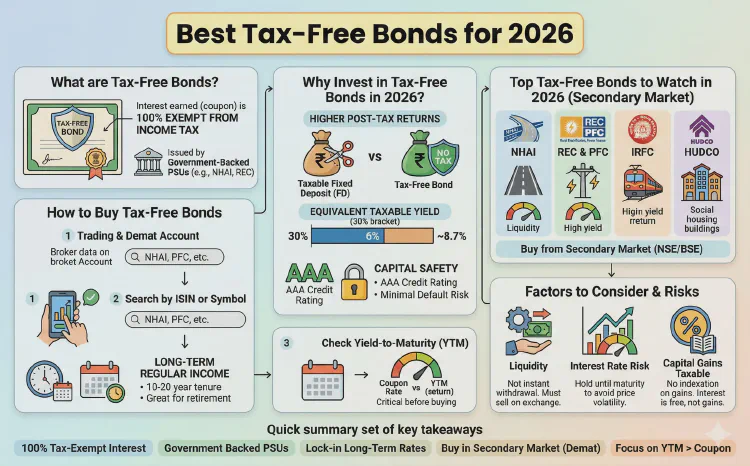
The best tax-free bonds for 2026 in India are AAA-rated public sector undertakings (PSU) issues from NHAI, REC, PFC, and IRFC traded on secondary stock exchanges, offering high-earning investors 100% tax-exempt annual yields between 5.20% and 5.85% (equivalent to a pre-tax bank fixed deposit rate of 7.55% to 8.50% or higher for individuals in the 30% tax slab).
In the Indian fixed-income landscape, capital preservation has traditionally meant relying on bank Fixed Deposits (FDs). However, for taxpayers falling in the 20%, 30%, or highest surcharge tax brackets, FDs present a steep tax drag because interest earned is added directly to annual income and taxed at marginal slab rates. When factoring in standard retail inflation alongside mandatory Tax Deducted at Source (TDS), the real, post-tax return on a standard 7.00% bank deposit often drops below 4.85%. This reality has driven savvy investors to re-evaluate sovereign-backed tax-free bonds, which legally shelter every rupee of coupon interest from income tax under Section 10(15)(iv)(h) of the Income Tax Act.
As of 2026, the Government of India has not permitted fresh primary issuances of tax-free bonds for several fiscal cycles, prioritizing alternative infrastructure financing mechanisms. Consequently, all trading in tax-free bonds takes place on the secondary market via the National Stock Exchange (NSE) and Bombay Stock Exchange (BSE). At NV Trends, analysis of debt markets indicates that purchasing these existing instruments at prevailing market prices allows investors to secure predictable, high-safety cash flows with zero tax liability on annual coupons through their eventual maturities in the 2030s.
Understanding these instruments requires shifting focus away from original face-value coupon rates toward the secondary market’s Yield to Maturity (YTM). Because market dynamics fluctuate with macroeconomic interest rate cycles, evaluating credit risk, trading volume, and holding tenures is essential to constructing an optimal fixed-income portfolio.
Key takeaways
- 100% Tax-Exempt Coupons: All annual interest income received from tax-free bonds is fully exempt from Indian income tax under Section 10(15)(iv)(h), with zero TDS deducted.
- Superior Pre-Tax Equivalent Yields: For taxpayers in the 30% slab (31.2% with cess), a tax-free bond yielding 5.50% generates the same net return as a taxable bank fixed deposit paying roughly 8.00%.
- Sovereign-Grade Safety: Top issuers—such as NHAI, REC, PFC, and IRFC—carry AAA credit ratings from premier Indian rating agencies, backed by quasi-sovereign public sector ownership.
- Secondary Market Execution: Fresh bonds are not issued in the primary market; investors must acquire them through demat accounts on the National Stock Exchange or BSE based on current market yield rather than face value.
- Capital Gains Are Taxable: While regular interest payments are tax-free, selling these bonds at a profit before maturity triggers capital gains tax under standard Indian tax provisions.
What Are Tax-Free Bonds and How Do They Work Under Indian Tax Law?
Tax-free bonds are long-term, fixed-income debt securities issued primarily by government-owned infrastructure entities and Public Sector Undertakings (PSUs). Authorized through specific budget notifications between FY 2011-12 and FY 2015-16, these instruments were deployed to channel domestic retail and institutional savings directly into nation-building sectors such as highways, railways, urban housing, and power grid electrification.
The legal mechanism behind these instruments is rooted in Section 10(15)(iv)(h) of the Income Tax Act, which explicitly states that interest earned on specified bonds issued by public sector corporations is excluded from total gross income. The Income Tax Department enforces this exemption across all taxpayer categories:
- Resident Indian Individuals
- Hindu Undivided Families (HUFs)
- Non-Resident Indians (NRIs) using NRO/NRE accounts
- Senior Citizens and High-Net-Worth Individuals (HNIs)
Unlike bank fixed deposits or regular corporate debentures where banks automatically deduct 10% TDS (or higher if PAN is unlinked) and require you to pay the marginal differential in advance tax, tax-free bonds transfer the gross coupon directly into the investor’s designated bank account once a year. No TDS is withheld, and no income tax declaration is required other than reporting the income under the “Exempt Income” schedule of your annual Income Tax Return (ITR).
Why Invest in Tax Free Bonds India 2026 Over Bank Fixed Deposits?
As interest rates stabilize across Indian financial markets as of 2026, comparing nominal interest rates between bank deposits and tax-free securities often misleads investors. The true performance metric is post-tax cash flow.
Pre-Tax Equivalent Yield = Tax-Free Yield / (1 - Marginal Tax Rate)
To demonstrate how the mathematics benefits higher-income earners, consider an investor in the standard 30% tax bracket. With the mandatory 4% Health and Education Cess, their effective tax rate stands at 31.20%. For ultra-high-net-worth investors subject to surcharges (10%, 15%, or 25%), the effective marginal tax rate can exceed 35% to 39%.
Pre-Tax Equivalent Yield Comparison (as of 2026)
| Tax-Free Bond YTM | Pre-Tax FD Equivalent (20% Slab + Cess: 20.8%) | Pre-Tax FD Equivalent (30% Slab + Cess: 31.2%) | Pre-Tax FD Equivalent (Highest Surcharge: ~39%) |
|---|---|---|---|
| 5.00% | 6.31% | 7.27% | 8.20% |
| 5.25% | 6.63% | 7.63% | 8.61% |
| 5.50% | 6.94% | 8.00% | 9.02% |
| 5.75% | 7.26% | 8.36% | 9.43% |
| 6.00% | 7.58% | 8.72% | 9.84% |
Based on published banking data as of 2026, leading scheduled commercial banks in India offer 3-to-5-year domestic fixed deposits yielding between 6.75% and 7.10% for general citizens. For an individual in the 31.2% tax bracket, an FD yielding 7.00% delivers an actual post-tax return of just 4.816%:
Post-Tax FD Return = 7.00% * (1 - 0.312) = 4.816%
By comparison, purchasing an NHAI or IRFC tax-free bond in the secondary market at a Yield to Maturity of 5.40% provides an immediate, risk-adjusted outperformance of roughly 58 basis points net in your pocket every single year, completely insulated from tax bracket shifts.
Sovereign-Backed Safety and Institutional Credit Ratings
Default risk is the primary concern when purchasing debt instruments. Tax-free bonds in India carry the highest domestic safety profile outside of direct Government of India Datelined Securities (G-Secs). The primary issuers are owned directly or majority-controlled by the Central Government.
Rating agencies like CRISIL, ICRA, and CARE have consistently assigned AAA (Stable) ratings to instruments from NHAI, PFC, REC, and IRFC. These ratings reflect strong operational standing, strategic sovereign importance, and implicit state support.
Long-Term Interest Rate Lock-In for Retirement Portfolios
A major structural weakness of bank fixed deposits is reinvestment risk. FDs generally cap tenure at 10 years, and most banks offer competitive rates only for narrow 1-to-3-year windows. When an FD matures, prevailing economic rates may have dropped, forcing the investor to roll over their capital at lower yields.
Tax-free bonds issued between 2012 and 2016 were launched with 10-, 15-, and 20-year tenures. A substantial portion of these series have maturity dates falling between 2027 and 2035. For retirees and conservative savers seeking guaranteed cash flows, buying these bonds as of 2026 locks in predictable, tax-free annual payouts for up to a decade into the future.
Best Tax-Free Bonds for 2026: Detailed Issuer Breakdown
Because these bonds trade on secondary exchanges, their prices fluctuate above or below face value (typically issued at Rs. 1,000 per unit). Below are the top issuers trading on the NSE and BSE, ranked by market liquidity, institutional backing, and yield reliability.
1. NHAI (National Highways Authority of India) Tax-Free Bonds
NHAI operates under the Ministry of Road Transport and Highways, serving as the central agency tasked with building and monetizing India’s national highway grid.
- Market Profile: NHAI bonds are widely considered the most liquid tax-free securities on the NSE and BSE. High retail awareness and significant institutional holdings mean buy and sell orders have tighter bid-ask spreads compared to smaller municipal or infrastructure issues.
- Key Series: Several large NHAI series mature between 2027 and 2031, with original coupon rates ranging from 7.14% up to 8.30% for original retail subscribers.
- Current Trading Dynamics (as of 2026): Because their original coupon rates were high, these bonds trade at a premium to their Rs. 1,000 par value. However, their calculated Yield to Maturity (YTM) hovers consistently between 5.20% and 5.45%, making them the premier choice for risk-averse investors prioritizing liquidity.
2. REC Limited (Rural Electrification Corporation) Bonds
REC Limited is a Maharatna Public Sector Enterprise under the Ministry of Power, financing power generation, transmission, distribution, and renewable energy infrastructure across India.
- Market Profile: REC bonds typically offer yields that trade 10 to 25 basis points higher than comparable NHAI maturities. Their extensive loan books and central role in India’s green energy transition provide a high degree of financial durability.
- Key Series: Prominent series include maturities extending to 2027, 2028, and 2031.
- Yield Expectation: Reported exchange data indicates secondary market yields generally range from 5.35% to 5.60% YTM, representing an attractive balance of capital safety and yield expansion.
3. PFC (Power Finance Corporation) Bonds
PFC is the parent company of REC and the financial backbone of India’s electrical infrastructure. Operating under the administrative control of the Ministry of Power, PFC is another designated Maharatna PSU.
- Market Profile: PFC bonds mirror the credit safety and yield profiles of REC. They feature substantial trade volumes across retail debt segments on the exchange.
- Key Series: PFC bond series with maturity dates running through 2028, 2030, and 2034 provide attractive long-duration options for locking in yields.
- Yield Expectation: Indicative secondary yields settle between 5.35% and 5.65% YTM as of 2026, offering long-duration cash flow stability.
4. IRFC (Indian Railway Finance Corporation) Bonds
IRFC is the dedicated market borrowing arm of the Indian Railways under the Ministry of Railways. It finances the acquisition of rolling stock and railway infrastructure assets.
- Market Profile: IRFC maintains a distinctive financial model: it leases acquired assets directly back to the Ministry of Railways under guaranteed lease agreements that cover debt servicing. This structure gives IRFC bonds an exceptionally low credit default risk profile.
- Key Series: Major liquid series mature between 2027 and 2032.
- Yield Expectation: Due to strong demand from high-net-worth investors seeking safety, IRFC bonds trade at competitive premiums, with YTMs generally hovering between 5.20% and 5.45%.
5. HUDCO (Housing and Urban Development Corporation) Bonds
HUDCO is a premier techno-financing institution focused on social housing and urban infrastructure development across India, operating under the Ministry of Housing and Urban Affairs.
- Market Profile: While HUDCO’s creditworthiness remains AAA-backed, secondary market liquidity is somewhat lower than that of NHAI or IRFC. Because institutional trading desks trade HUDCO less frequently in massive blocks, retail investors can occasionally find mispriced lots offering higher relative yields.
- Yield Expectation: For patient buyers willing to execute limit orders over several trading sessions, HUDCO bonds often yield between 5.45% and 5.75% YTM as of 2026.
Comparison of Top Tax-Free Bonds in India (as of 2026)
The table below summarizes the key operational characteristics of major tax-free bond issuers available on Indian stock exchanges as of 2026 based on published debt segment metrics:
| Issuer Name | Primary Sector | Credit Rating | Indicative Secondary YTM Range (as of 2026) | Typical Remaining Tenure Horizon | Exchange Liquidity Profile | Ideal Investor Match |
|---|---|---|---|---|---|---|
| NHAI | Road Highways & Infrastructure | AAA (Stable) | 5.20% – 5.45% | Medium to Long (2027–2031) | Highest / Most Active | Investors seeking maximum liquidity and immediate order fills |
| IRFC | Railway Assets & Modernization | AAA (Stable) | 5.20% – 5.45% | Medium to Long (2027–2032) | High / Active | Conservative savers seeking sovereign-style lease security |
| REC Ltd | Power Distribution & Renewables | AAA (Stable) | 5.35% – 5.60% | Medium (2027–2031) | High | Balanced fixed-income investors targeting higher net yield |
| PFC | Power Infrastructure Financing | AAA (Stable) | 5.35% – 5.65% | Medium to Long (2028–2034) | High | Investors seeking extended duration up to 8–10 years |
| HUDCO | Urban Housing & Infrastructure | AAA (Stable) | 5.45% – 5.75% | Medium (2027–2031) | Moderate | Value-oriented investors willing to use limit orders |
Note: Indicative secondary Yield to Maturity (YTM) varies daily based on exchange trade prices, interest rate cycles, and accrued interest.
How to Buy Tax Free Bonds 2026 on the Secondary Market (NSE and BSE)
Because there are no primary IPO issuances for tax-free bonds, investors must navigate the secondary market. The process is straightforward using standard Indian stockbroker platforms (such as Zerodha, Groww, Angel One, ICICI Direct, or HDFC Sky).
[Demat / Trading Account] ---> [Search Bond by Symbol/ISIN] ---> [Analyze YTM & Accrued Interest] ---> [Place Limit Buy Order] ---> [T+1 Settlement]
Step 1: Access Your Brokerage Trading Terminal
Log in to your broker’s application or web portal. Ensure your account is activated for trading in the Cash/Debt or Capital Market segment on the NSE and BSE.
Step 2: Search by Series Symbol or ISIN
Unlike standard equity shares that trade under a single ticker (e.g., “INFY”), tax-free bonds have multiple series based on their issuance year, coupon rate, and maturity date.
On your trading terminal, search for symbols such as:
NHAIorNHAITFBIRFCorIRFCTFBRECLTDorRECTFBPFCorPFCTFB
Each security will display a specific series suffix (e.g., NHAI-N6, IRFC-N2, REC-N8). Alternatively, you can search using the unique 12-character International Securities Identification Number (ISIN) assigned by the depository (NSDL or CDSL).
Step 3: Never Buy Solely Based on the Nominal Coupon Rate
A frequent mistake made by retail investors is sorting bonds by coupon percentage and purchasing the bond with the highest coupon (e.g., an 8.30% NHAI bond).
Because the coupon rate is much higher than prevailing market interest rates, the bond will trade at a substantial premium above its original Rs. 1,000 face value (for example, at Rs. 1,120). When the bond matures, the issuer will redeem it at face value (Rs. 1,000), resulting in capital loss on the premium paid.
Always calculate or check the Yield to Maturity (YTM):
- YTM factors in:
- The annual coupon cash flow you will receive.
- The exact price you pay today (including market premium or discount).
- The capital gain or loss realized at final maturity redemption.
- The exact number of days remaining until maturity.
The Securities and Exchange Board of India (SEBI) mandates that regulated debt trading platforms and broker web portals display the annualized YTM alongside market quotes.
Step 4: Account for Clean Price vs Dirty Price (Accrued Interest)
In secondary bond trading, market quotes typically reflect the clean price. When the transaction settles, the buyer pays the seller the clean price plus accrued interest from the last annual coupon payment date up to the settlement date.
When the issuer pays the next scheduled annual coupon, you receive the full 12 months’ worth of interest, which reimburses the accrued portion you paid upfront.
Step 5: Execute via Limit Orders
Secondary market bond volumes are smaller than equity stock volumes. Never place a market order when buying or selling bonds. Market orders can execute at unfavorable prices if the order book is thin. Always place a Limit Order specifying the exact maximum price you are willing to pay based on your target YTM.
Critical Risks, Trade-offs, and Taxation Rules Every Investor Must Know
While tax-free bonds are safe from a credit default standpoint, they carry market-related nuances that investors must evaluate before committing capital.
1. Capital Gains Tax Nuance (Section 112)
While the interest income is 100% tax-free under Section 10(15)(iv)(h), any capital gains realized from selling the bond on an exchange before maturity are not tax-exempt.
- Short-Term Capital Gains (STCG): If held for 12 months or less before selling, gains are taxed at your applicable income tax slab rate.
- Long-Term Capital Gains (LTCG): If held for more than 12 months, listed bonds sold on recognized stock exchanges are taxed under Section 112 at 12.5% without indexation benefits (following updated capital gains tax regulations).
- If you hold the bond until maturity and redeem it directly from the issuer at par, capital gains tax rules on secondary market transfers do not apply.
For a complete breakdown of holding periods, indexation removal, and tax slabs on secondary asset sales, read our in-depth guide on Understanding Capital Gains Tax in India.
2. Liquidity and Bid-Ask Spreads
Unlike blue-chip stocks where millions of shares trade daily, secondary bond trading can be sporadic. If you invest Rs. 25 lakh in a specific bond series and unexpectedly require immediate cash within 48 hours, you may encounter wide bid-ask spreads. Forcing an urgent sale in a shallow market can erode 1% to 2% of your capital value.
What to do:
- Only allocate funds you do not need until the stated maturity date.
- Focus exclusively on large, high-volume series from NHAI, REC, and IRFC.
- If you must sell, stagger limit orders in smaller lot sizes over several trading days.
3. Interest Rate and Duration Risk
Bond prices have an inverse relationship with systemic interest rates:
- If general interest rates in the economy rise, existing bond prices fall to align their YTM with newer market levels.
- If interest rates fall, existing bond prices rise.
This price volatility only impacts investors who sell prior to maturity. If you hold the instrument until the redemption date, market fluctuations along the way have zero effect on your principal redemption or annual coupon payouts.
Tax-Free Bonds vs Other Tax-Efficient Alternatives in India
Before deploying capital, it is wise to compare tax-free bonds against other popular tax-saving and fixed-income avenues available in India as of 2026.
+------------------------+-------------------+--------------------+----------------------+
| Asset Class            | Risk Level        | Tax Treatment      | Indicative Net Yield |
+------------------------+-------------------+--------------------+----------------------+
| Tax-Free Bonds (PSU)   | Very Low (AAA)    | 100% Tax-Exempt    | 5.20% - 5.75% Net    |
| Bank Fixed Deposits    | Low (DICGC Cover) | Taxed at Slab Rate | 4.60% - 4.90% Net*   |
| Arbitrage Mutual Funds | Low               | 12.5% LTCG / 20%   | 5.80% - 6.40% Net    |
| Sovereign Gold Bonds   | Moderate (Gold)   | Tax-Exempt at Mat. | 2.5% + Capital Gain  |
| ELSS Equity Funds      | High (Equity)     | 12.5% LTCG > 1.25L | Variable (Market)    |
+------------------------+-------------------+--------------------+----------------------+
*Net return assuming 31.2% tax slab on a 7.00% gross FD.
Arbitrage Funds vs Tax-Free Bonds
Arbitrage mutual funds generate returns by exploiting price differentials between the cash and derivatives (futures) segments of Indian equities. Because they hold more than 65% equity exposure, they are taxed under equity capital gains rules (20% STCG, 12.5% LTCG over the basic exemption threshold).
For investors with a short-to-medium investment horizon (6 months to 2 years), arbitrage funds provide greater liquidity. However, for a 5-to-10-year lock-in with zero market direction risk, tax-free bonds offer superior cash flow predictability. If you prefer market-linked strategies or hybrid portfolios, explore our guide on Tax Saving Strategies Through Mutual Funds.
ELSS Mutual Funds vs Tax-Free Bonds
Equity Linked Savings Schemes (ELSS) serve an entirely different portfolio objective. ELSS qualifies for deductions under Section 80C of the Income Tax Act (up to Rs. 1.5 lakh under the Old Tax Regime) and invests directly in domestic equities with a mandatory 3-year lock-in.
Investors seeking equity-linked wealth accumulation under Section 80C often compare bond safety against equity vehicles like those detailed in our analysis of the Top 5 ELSS Funds for Tax Saving in 2026. While ELSS targets higher long-term capital appreciation, it carries equity market volatility and provides no guaranteed annual income.
Who Should Invest in Tax Free Bonds in 2026 (and Who Should Avoid Them)?
Recommended For:
- Investors in the 30%+ Tax Brackets: If your marginal income incurs a 31.2% to 39% tax rate, tax-free bonds deliver unmatched post-tax yields compared to taxable fixed-income instruments.
- Retirees and Pensioners: Individuals needing dependable annual cash distributions to fund living expenses without dealing with annual TDS deductions, advance tax payments, or interest income calculations.
- Conservative Wealth Preservation Portfolios: Family offices, trusts, and HNIs looking to secure portions of their portfolio against equity market drawdowns while preserving capital in AAA-rated quasi-sovereign paper.
- NRIs with Repatriable or Non-Repatriable Funds: NRIs seeking safe fixed income in India can invest in tax-free bonds without worrying about Indian withholding taxes on coupon receipts.
Not Recommended For:
- Taxpayers in the 0% to 10% Brackets: If your total taxable income is below Rs. 7,00,000 to Rs. 10,00,000 (especially under the New Tax Regime where rebates effectively neutralize tax on moderate incomes), bank FDs or senior citizen deposit schemes yielding 7.25% to 8.20% will generate higher cash in hand than a 5.40% tax-free bond.
- Short-Term Speculators: If you require your funds within 1 to 3 years, secondary market transaction costs, bid-ask spreads, and potential capital gains taxation make liquid mutual funds or arbitrage funds more suitable.
- Aggressive Wealth Accumulators: Young professionals with long-term investment runways should prioritize compounding equity assets over low-volatility fixed-income instruments.
FAQ
What are the best tax free bonds 2026 to buy in India?
Based on exchange trading activity as of 2026, the best tax-free bonds are AAA-rated issues from the National Highways Authority of India (NHAI), Indian Railway Finance Corporation (IRFC), Rural Electrification Corporation (REC), and Power Finance Corporation (PFC). These institutions provide the highest liquidity on the NSE and BSE alongside quasi-sovereign credit profiles, with secondary Yield to Maturity (YTM) levels generally ranging between 5.20% and 5.65%.
How does NV Trends evaluate the best tax-free bonds for 2026?
At NV Trends, our editorial team evaluates fixed-income securities by calculating real secondary market Yield to Maturity (YTM) rather than relying on nominal coupon rates. We also analyze average daily trading volumes on the NSE/BSE to gauge exit liquidity, verify underlying PSU balance sheet fundamentals, and benchmark pre-tax equivalent returns against commercial bank fixed deposits.
Where can investors buy tax free bonds india 2026 securities today?
Because the Indian government has not issued fresh tax-free bonds in recent years, investors can only purchase these bonds on the secondary market through a standard Demat and trading account on the NSE or BSE. You can search for specific bond series using their exchange ticker symbols or ISIN codes via any major Indian brokerage terminal and place limit buy orders during normal market trading hours.
Are tax-free bond interest payouts completely free of TDS?
Yes, under Section 10(15)(iv)(h) of the Income Tax Act, interest earned on these designated public sector bonds is 100% exempt from income tax, and issuers do not deduct any Tax Deducted at Source (TDS). You receive the full coupon payment directly into your linked bank account, though you must disclose the amount under the exempt income schedule in your annual ITR.
What happens if I sell my tax-free bonds before maturity?
If you sell your tax-free bonds on the secondary exchange prior to maturity, any capital appreciation above your purchase price is subject to capital gains tax. Under Indian tax rules, listed bonds held for more than 12 months are subject to Long-Term Capital Gains (LTCG) tax at 12.5% without indexation benefits, while bonds held for 12 months or less are taxed at your applicable personal income tax slab rate.
Conclusion
Tax-free bonds represent one of the most effective, low-risk wealth preservation mechanisms available to Indian investors subject to high income tax brackets. As of 2026, the combination of complete tax immunity on annual interest, AAA-rated sovereign-backed credit safety, and the ability to lock in guaranteed returns through the 2030s gives these instruments a clear edge over standard fixed deposits.
To maximize your returns, focus your purchases on active, high-liquidity series from established institutions like NHAI, IRFC, and REC. Always base your investment decisions on calculated Yield to Maturity (YTM) rather than face-value coupon rates, account for accrued interest at the time of purchase, and use limit orders to avoid paying unnecessary liquidity premiums on the secondary market. By holding these bonds to maturity, you can secure a predictable, high-safety income stream that keeps every rupee of interest firmly in your own hands.
- Tags:
- Tax Free Bonds
- Tax Free Bonds 2026
- Fixed Income India
- Nhai Bonds
- Tax Saving
- Indian Debt Market