
Shopify Billing vs Shipping Address Mismatch: Safe Rules
Learn how to safely flag and review Shopify billing and shipping address mismatches without losing legitimate gift and office orders.

- NV Trends
- 16 min read
A mismatch between the billing address and shipping address on a Shopify order is not an automatic indicator of fraudulent activity; in practice, a substantial share of mismatched transactions represents genuine customer orders, including gifts, corporate purchases, and deliveries to workplace addresses. When merchants configure their systems to automatically cancel any order where the billing and shipping details differ, they inadvertently turn away legitimate buyers, destroy repeat customer lifetime value, and depress store revenue.
The core challenge for online merchants—particularly those operating in high-volume, diverse markets like India—is distinguishing between benign customer behavior and deceptive card testing or identity theft. An order shipping to an office complex in Bengaluru paid for with a card registered to a residential address in Pune is standard consumer practice. Conversely, an order placed with a credit card issued in one country but shipping to a freight forwarder in another demands immediate scrutiny.
Successfully handling mismatched addresses requires a structured operational workflow rather than blunt cancellation rules. By setting up automated tagging, distinguishing between domestic discrepancies and cross-border discrepancies, and establishing a clear manual review protocol, Shopify merchants can protect their stores against chargeback losses while preserving a frictionless checkout experience for authentic shoppers.
Key takeaways
- Mismatches are frequently legitimate: Gift purchases, workplace deliveries, corporate GST expenses, and student hostel accommodations regularly produce mismatched billing and delivery data.
- Avoid auto-cancellation rules: Automatically canceling mismatched orders sacrifices valid sales; instead, apply automated risk tags and place fulfillment holds on ambiguous orders.
- Enforce the country mismatch rule: When
billing_address.country_code != shipping_address.country_code, tag the order asREVIEWand hold it for verification rather than canceling on the spot. - Automate screening triggers: Leverage Shopify Flow or dedicated screening apps to tag anomalies, calculate combined risk factors, and notify operations teams instantly.
- Combine data points before deciding: Address mismatches should be evaluated alongside Address Verification System (AVS) responses, CVV match status, IP geolocation, and order value.
Why Billing and Shipping Addresses Frequently Differ on Legitimate Orders
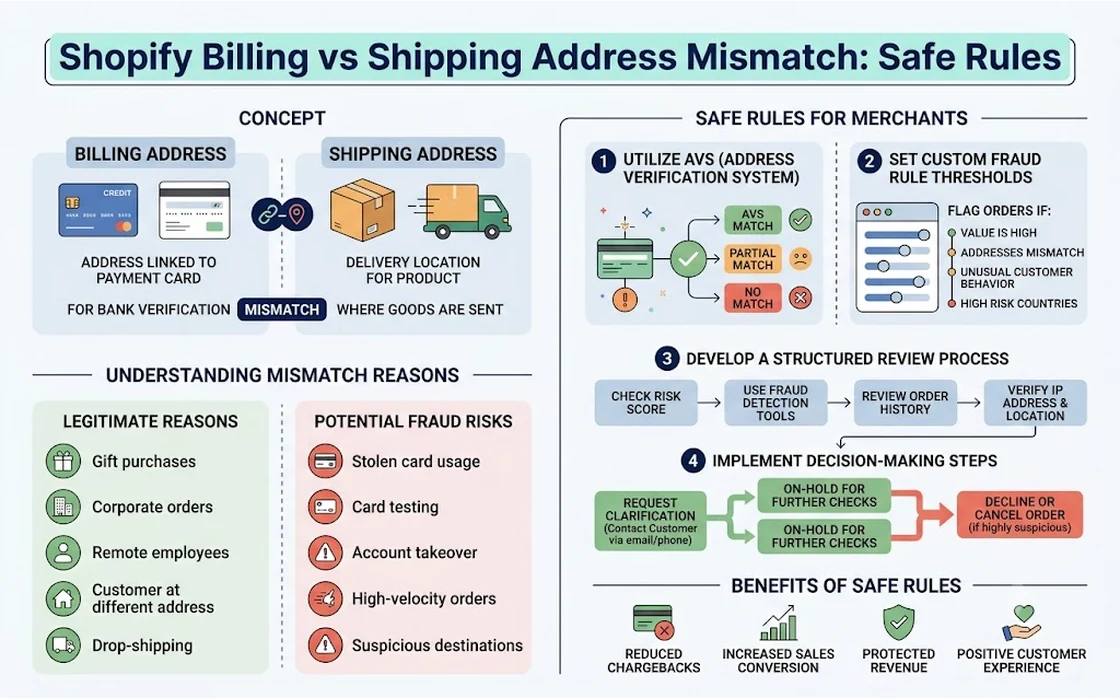
Before treating an address discrepancy as suspicious, fulfillment teams must understand standard consumer buying habits. Modern online shopping involves varied logistics, and forcing billing and delivery addresses to be identical creates unnecessary friction at checkout.
1. Gifting and Festive Occasions
Personal gifting is one of the most common reasons billing and delivery destinations diverge. During festivals like Diwali, Raksha Bandhan, Eid, or Christmas, as well as for birthdays and anniversaries, customers purchase products intended directly for family members or friends.
In these transactions, the customer enters their own residential or office address under billing to match their banking records, but specifies the recipient’s residence under the shipping address. The customer name on the payment method and the recipient name on the shipping label will naturally be different.
2. Workplace and Commercial Deliveries
Many working professionals spend their daytime hours at offices, hospitals, tech parks, or retail businesses. Because courier deliveries in India typically occur between 9:00 AM and 7:00 PM, customers frequently enter their office address for delivery so that reception desks or security teams can sign for the parcel.
However, credit card and debit card billing addresses in India are almost always tied to the cardholder’s permanent residential address or home branch. This results in a routine mismatch where the billing city or neighborhood differs from the commercial delivery hub, despite both belonging to the same individual.
3. Split Households and Students
A growing segment of ecommerce orders comes from university students residing in hostels, young professionals living in rented shared apartments, or individuals on temporary work assignments. These shoppers frequently use cards linked to their family’s permanent address in another state or tier-2/tier-3 city, while their shipping address reflects their temporary local accommodation.
4. Corporate and B2B Purchases
Business owners, startup founders, and procurement staff often purchase hardware, office accessories, or software supplies through ecommerce stores. When claiming business expenses or input tax credit, the billing address must match the company’s registered entity or GST certificate, while the physical goods may be shipped directly to a job site, remote employee, or regional branch office.
5. Recent Relocation
Banks frequently take days or weeks to update address records following a customer relocation. If a customer moves to a new home and immediately places an order, their bank card may still be linked to their old residence. To ensure successful payment authorization, the buyer must enter their old address as the billing address while providing their current residence as the shipping destination.
When Does an Address Mismatch Signal Fraud?
While many mismatched orders are benign, address discrepancies can also accompany unauthorized transactions. Fraudsters who acquire stolen payment card numbers rarely ship merchandise to the victim’s billing address; they route goods to temporary drop locations, vacant houses, or forwarding services.
According to documentation published on the Shopify Help Center on Fraud Analysis, address alignment serves as a key input into Shopify’s machine-learning risk engine. Evaluating an address mismatch requires looking at surrounding risk indicators:
- Stolen Card Redirection: A criminal possessing stolen card details enters the actual cardholder’s address under billing (to pass basic bank authorization checks) but inputs an untraceable drop address under shipping.
- High-Value Resale Targets: Fraudulent mismatches skew heavily toward compact, high-value goods that are easy to liquidate on secondary markets—such as smartphones, designer watches, premium audio gear, and luxury apparel valued above Rs. 10,000.
- Mismatched Postal Codes with High Geolocation Distance: If an order originates from an IP address in one state, specifies a billing card in another state, and requests express delivery to a third state with an unverified phone number, the probability of fraudulent activity rises significantly.
- Repeated Card Attempts: If an order with mismatched addresses was preceded by two or three failed checkout attempts with different card numbers or expiration dates, the transaction is likely part of an automated card-testing attack.
Merchants interested in broader operational screening frameworks can explore Shopify order fraud prevention screening rules to learn how to stack multiple defense layers against organized card rings.
The Core Rule: Billing Country != Shipping Country
Among all variations of address mismatches, cross-border discrepancies carry the highest commercial risk. A transaction where the billing country is completely different from the shipping country requires an established, rigid handling rule:
Core Operating Rule: If
billing_address.country != shipping_address.country, immediately tag the order asREVIEW_CROSS_BORDERand place a fulfillment hold. Do not auto-cancel.
Order Placed
    │
    ▼
Is Billing Country == Shipping Country?
    ├── YES ──► Continue normal fulfillment workflow
    │
    └── NO  ──► Apply tag: "REVIEW_CROSS_BORDER"
                 Place Fulfillment Hold
                 Send notification to operations team
                 Conduct manual verification (DO NOT auto-cancel)
Why You Should Never Auto-Cancel Cross-Border Mismatches
It can be tempting to set up a rule that automatically cancels and refunds any order where the billing country does not match the shipping country. Doing so, however, harms one of the most profitable buyer categories: international expatriates and Non-Resident Indians (NRIs).
During holiday seasons, weddings, and family milestones, thousands of individuals living in the United States, the United Kingdom, Canada, Singapore, or the UAE purchase gifts on Indian Shopify stores for delivery to parents and relatives living in India. An NRI using an overseas American Express or Visa card with a California billing address sending a Rs. 8,000 gift hamper to an address in New Delhi represents a legitimate, high-margin sale.
Auto-canceling this transaction frustrates an honest customer, triggers international payment processing fees that may not be fully refunded, and loses future order potential.
Why You Must Never Blindly Fulfill
Conversely, dispatching a cross-border mismatched order without manual verification exposes the store to severe chargeback liability. If an order ships using domestic courier logistics, and thirty days later an international bank issues a fraudulent card claim, the merchant loses both the inventory and the sale amount, alongside bank chargeback penalties that often exceed Rs. 1,500 to Rs. 2,500 per incident.
Holding the order for review provides the ideal balance: the store secures the funds, pauses inventory dispatch, and validates the buyer’s intent before shipping.
Address Mismatch Scenarios: Risk Assessment and Action Table
The table below outlines common address mismatch scenarios encountered by Shopify merchants, their associated risk levels, and the recommended fulfillment protocol.
| Scenario | Risk Level | Common Operational Indicators | Recommended Action |
|---|---|---|---|
| Domestic Gift Order | Low | Same country; recipient name differs from buyer; residential shipping address; matched CVV. | Apply GIFT_ORDER tag; proceed with standard fulfillment unless overall risk score is High. |
| Workplace Delivery | Low | Same city or state; shipping address contains office/tech park terms; recipient matches buyer name. | Fulfill normally; verify delivery phone number is included for courier dispatch. |
| Split Household / Student | Low to Moderate | Same country, different states; IP location matches shipping state; valid phone and personal email. | Standard fulfillment; send automated dispatch confirmation via SMS or email. |
| Cross-Border NRI Gifting | Moderate | Foreign billing country (US, UK, UAE); domestic shipping; matching surnames or gift note attached. | Tag REVIEW_CROSS_BORDER; place temporary fulfillment hold; verify via email or message. |
| Cross-Border Freight Forwarder | High | Foreign billing country; domestic shipping address resolves to an export hub, warehouse, or locker. | Tag HIGH_RISK_HOLD; request identity verification or cancel and refund order. |
| Domestic Discrepancy + Failed AVS | High | Address lines differ; bank reports AVS mismatch on postal code; multiple failed checkout attempts. | Hold order; contact buyer to confirm cardholder authorization before packing. |
| High-Value Electronics Mismatch | High | High cart value (>Rs. 15,000); mismatched names; express overnight shipping requested on high-theft items. | Tag MANUAL_AUDIT; pause fulfillment; perform telephone confirmation. |
How to Auto-Flag Address Mismatches in Shopify
Relying on warehouse staff to manually inspect every line of billing and shipping text on hundreds of daily orders is slow and prone to human error. Instead, stores can automate detection through native workflows or specialized applications.
Method 1: Building a Rule in Shopify Flow
For stores on the Shopify plan or higher, Shopify Flow provides an accessible method to inspect order properties as soon as a customer checks out. Merchants can learn more about configuring logic through the official documentation on Shopify Flow.
To create a cross-border mismatch flagging workflow:
- Trigger: Select
Order created. - Condition: Add a criteria check comparing the country codes:
order.billingAddress.countryCodedoes not equalorder.shippingAddress.countryCode - Action:
- Add Order Tag:
Review-CountryMismatch - Hold Fulfillment Order: Select reason as
OtherorSuspected Fraud - Send Internal Notification: Route an alert to your fraud or customer service channel.
- Add Order Tag:
Trigger: Order Created
   │
   ▼
Condition: order.billingAddress.countryCode != order.shippingAddress.countryCode
   │
   ├── [True]  ──► Action 1: Add Tag "Review-CountryMismatch"
   │           ──► Action 2: Hold Fulfillment Order
   │           ──► Action 3: Send Slack / Email alert to support team
   │
   └── [False] ──► (No action taken; standard processing continues)
Limitations of Native Flow Rules
While Shopify Flow handles basic equality checks (such as comparing country codes or zip codes), it has notable limitations:
- Fuzzy Logic Absence: Shopify Flow cannot tell whether “MG Road, Flat 4B” and “Mahatma Gandhi Road, Apt 4-B” are the exact same domestic address spelled differently. It treats them as an absolute mismatch, creating excessive false flags.
- No Integrated Address Standardization: Flow does not normalize Indian address conventions, pin codes, or regional spelling variants.
- Limited Workflow Branching: Complex multi-condition evaluations (e.g., comparing risk score, cart value threshold, payment gateway, and address distance simultaneously) can become difficult to maintain across nested Flow trees.
Method 2: Deploying Automated Order Screening Tools
For merchants processing larger order volumes or seeking granular validation, using a dedicated screening system like Order Validation & Automation provides a more robust operational workflow.
Specialized screening applications allow merchants to:
- Automatically cross-reference billing vs. shipping states and countries.
- Exclude known corporate hubs, tech parks, and commercial delivery keywords from false-positive fraud flags.
- Combine address checks with phone number verification and pin code validity before orders reach the fulfillment queue.
- Place and release fulfillment holds automatically based on configurable business rules.
Verification Checklist: What to Check During Manual Review
When an order is tagged with REVIEW_COUNTRY_MISMATCH or HOLD_ADDRESS_MISMATCH, operations teams should follow a standardized 5-step verification process before canceling or releasing the parcel:
Step 1: Examine the Address Verification System (AVS) Response
In markets and gateways where AVS is supported, check whether the numeric street address and postal code matched the bank’s records. A positive AVS match on the billing address indicates that whoever placed the order possesses the actual statement address of the cardholder, reducing the probability of a casual stolen-card attack.
Step 2: Compare IP Geolocation with Billing and Delivery Data
In Shopify’s Fraud Analysis card, review the order’s IP details:
- Did the order originate from an IP address in the billing country?
- Is the user routing their traffic through a known commercial data center VPN or anonymous proxy? If a buyer claims to live in the UK sending a gift to Chennai, but their checkout IP resolves to a known proxy server in Eastern Europe, treat the order with heightened suspicion.
Step 3: Inspect the Product Profile and Shipping Method
Evaluate the physical contents of the package:
- Are the items easily resold commodities (electronics, unopened perfumes, high-demand sneakers)?
- Did the customer select the most expensive express or overnight shipping option without querying shipping costs? Fraudsters often prioritize speed over delivery expense to ensure goods are shipped before the cardholder spots the charge.
Step 4: Validate Customer Contact Details
Legitimate buyers usually supply working contact information. If an order is on hold, contact the customer to confirm the purchase.
Customer support teams can initiate a quick confirmation through automated messaging channels like NV WhatsApp Chat or a direct phone call. Authentic gift-givers or office workers will readily verify the recipient’s name and confirm they authorized the transaction. Fraudsters, on the other hand, rarely respond or provide invalid, disconnected telephone numbers.
Step 5: Adjust Order Details When Necessary
If a customer explains that they mistakenly entered their shipping address into the billing field, or made an error in their street details, support agents can update the order records. Merchants can review best practices in how to edit a Shopify order after it is placed to maintain accurate fulfillment records without creating confusing draft orders.
Address Mismatches in the Indian Market: Prepaid vs. Cash on Delivery (COD)
In Indian ecommerce, the operational meaning of an address mismatch changes dramatically depending on whether the order is Prepaid or Cash on Delivery.
Address Mismatch Detected
       │
       ├── PREPAID ORDER ──────► Primary Concern: Payment Fraud & Chargebacks
       │                         Action: Verify AVS, CVV, Card Origin, IP Location
       │
       └── COD ORDER ──────────► Primary Concern: Non-Delivery & RTO (Courier Costs)
                                 Action: Verify Phone Number, Pin Code, Delivery Confirmation
Prepaid Orders: Card Fraud and Chargeback Protection
For prepaid orders (UPI, credit cards, debit cards, net banking), an address mismatch is primarily a chargeback risk.
Because payment has already cleared the gateway, the merchant’s financial liability lies in the possibility that the rightful account holder will dispute the charge later. Verifying the billing details and ensuring that high-value orders have verifiable buyer intent shields the business from costly bank disputes.
Cash on Delivery (COD) Orders: Return to Origin (RTO) Risk
On Cash on Delivery orders, credit card fraud is not an issue because no card was used. However, address discrepancies on COD orders signal an elevated Return to Origin (RTO) risk.
Unscrupulous or impulse shoppers frequently input incomplete addresses, fabricated office locations, or friend’s addresses without their consent. When the courier attempts delivery, the recipient refuses the parcel, forcing the merchant to absorb two-way logistics fees (forward shipping plus reverse shipping), which typically averages Rs. 120 to Rs. 250 per failed parcel depending on weight and zone.
For COD orders where the shipping address appears vague or differs from the contact’s regional profile:
- Send an automated OTP or WhatsApp confirmation to verify the buyer actually intends to accept and pay for the parcel.
- Verify that the pin code matches the stated city and state to prevent courier misrouting.
- Do not ship COD orders containing address discrepancies until the recipient explicitly confirms readiness to accept delivery.
Operational Best Practices to Reduce Friction
To keep your fulfillment pipeline running smoothly while preventing losses, implement these standard operating procedures:
- Add a “This is a gift” checkbox at checkout: If your store theme supports custom checkout fields, allow buyers to indicate gift orders. Capturing this intent directly at checkout reduces the need for manual support intervention.
- Standardize internal tag naming conventions: Use clear, recognizable tags across your fulfillment dashboard, such as
HOLD_CROSS_BORDER,VERIFIED_GIFT, andFRAUD_BLOCKED. This ensures warehouse packing staff know immediately which orders are cleared for dispatch. - Set clear resolution timeframes: Establish an internal SLA (Service Level Agreement) for held orders. If a flagged customer does not respond to verification emails or messages within 48 to 72 hours, cancel the order, restock the inventory, and issue a full refund to the original payment method.
- Train customer support on friendly verification: When reaching out to customers regarding mismatched addresses, never accuse them of fraud. Frame the communication as a routine security measure designed to protect their purchase: “We noticed your delivery address differs from your billing details, and we want to ensure your package arrives safely at the correct destination.”
FAQ
Does a billing and shipping address mismatch automatically mean fraud on Shopify?
No, an address mismatch does not automatically indicate fraud. Many legitimate transactions—such as holiday gifts, office deliveries, student orders, and corporate purchases—naturally feature different billing and delivery addresses. Merchants should treat mismatches as a reason for review rather than grounds for immediate cancellation.
Why shouldn’t I automatically cancel orders with different billing and shipping countries?
Automatically canceling cross-border mismatches turns away high-value, legitimate customers, such as Non-Resident Indians (NRIs) or overseas relatives purchasing gifts for delivery within India. Instead of canceling, apply a REVIEW tag, place a temporary fulfillment hold, and verify buyer intent via email or messaging before shipping.
Can Shopify Flow automatically hold orders with mismatched addresses?
Yes, Shopify Flow can inspect order properties upon creation and place a fulfillment hold if billingAddress.countryCode does not equal shippingAddress.countryCode. However, native Flow workflows lack fuzzy-matching capabilities and may struggle to distinguish minor domestic spelling variations without generating false flags.
How do I safely verify an order with a mismatched address before shipping?
Review the order’s AVS and CVV status in Shopify’s Fraud Analysis, verify the IP geolocation against the billing country, and contact the customer via phone or WhatsApp. Legitimate buyers will readily confirm the recipient’s details and delivery intent, while fraudulent orders frequently feature disconnected numbers or unverified contact data.
Is an address mismatch on a COD order risky for merchants?
On Cash on Delivery orders, an address mismatch does not represent credit card fraud, but it poses a substantial Return to Origin (RTO) risk. If a customer provides an incomplete or unverified delivery address, courier delivery may fail, leaving the merchant to bear forward and reverse logistics costs.
Conclusion
Managing address discrepancies on Shopify is a balancing act between fraud prevention and customer satisfaction. While stolen payment cards are frequently routed to alternative delivery points, treating every mismatched order as malicious damages merchant profitability, inflates cart abandonment, and alienates honest shoppers purchasing gifts or receiving packages at work.
The most resilient ecommerce stores avoid extreme reactions. Instead of fulfilling orders blindly or relying on blanket cancellations, establish automated screening rules that categorize risk accurately. Enforce the golden rule—tagging cross-border mismatches for manual review while holding fulfillment—and leverage structured verification checklists to validate high-value orders. By automating routine checks and reserving manual audits for genuine anomalies, you protect your store from costly chargebacks while delivering a reliable, welcoming shopping experience.
- Tags:
- Shopify
- Order Validation
- Ecommerce Fraud
- Shopify Flow
- Merchant Operations
- Fraud Prevention