
How to Time Your Mutual Fund Investments
Learn how to time your mutual fund investments in India using SIPs, STPs, and valuation metrics to maximize long-term returns without market stress.

- NV Trends
- 18 min read
- Updated
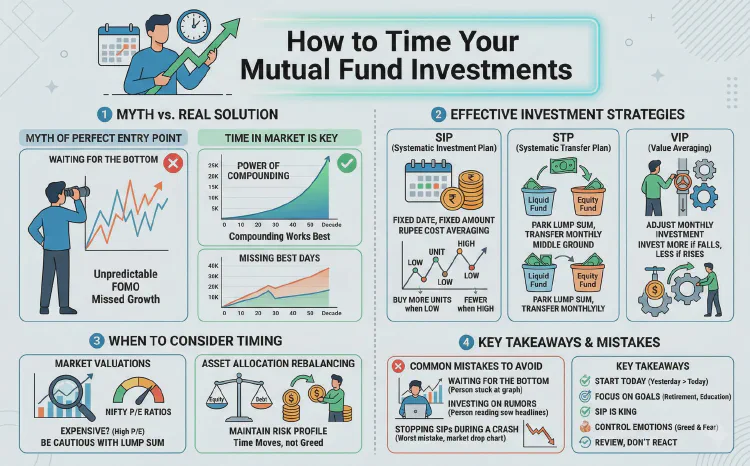
You cannot reliably time mutual fund investments by predicting daily market peaks and troughs; instead, the most effective way to time your entry is by automating consistent contributions through Systematic Investment Plans (SIPs) and using structured deployment mechanisms like Systematic Transfer Plans (STPs) and valuation-based asset rebalancing. For many Indian retail investors, holding cash while waiting for the Nifty 50 or BSE Sensex to suffer a steep correction feels like prudent risk management. However, empirical market studies show that waiting for the “perfect bottom” almost always costs more in lost compounding than entering at an all-time high.
When retail investors attempt to buy only at cyclical market troughs, they face two nearly insurmountable challenges: knowing exactly when the market has hit rock bottom, and finding the emotional courage to invest capital when headlines are overwhelmingly negative. Even institutional fund managers struggle to execute market timing consistently across business cycles. In an expanding economy like India, where corporate earnings and structural economic growth continually lift broad indices over 5-to-10-year horizons, sitting on uninvested cash erodes purchasing power against inflation.
Rather than viewing market timing as a speculative guessing game, disciplined investors achieve far superior risk-adjusted outcomes by shifting from guesswork to systematic risk management. By analyzing valuation benchmarks such as historical Price-to-Earnings (P/E) bands, utilizing rupee cost averaging, and matching deployment methods to capital size—whether a monthly salary surplus or a windfall lump sum—you can build durable long-term wealth without succumbing to market timing anxiety.
Key takeaways:
- Time in the market beats timing the market: Published historical data from Indian equity benchmarks shows that staying consistently invested through market cycles produces significantly higher terminal wealth than attempting to time entry and exit points.
- SIPs automate rupee cost averaging: A Systematic Investment Plan neutralizes entry timing by automatically accumulating more mutual fund units during market pullbacks and fewer during rallies.
- STPs de-risk large lump sums: Deploying a large cash surplus through an STP—parking capital in a liquid debt scheme and transferring fixed tranches into equity over 6 to 12 months—mitigates the impact of sudden market downturns.
- Valuation metrics inform rebalancing, not speculation: Historical valuation indicators like the Nifty 50 P/E ratio serve best as triggers for portfolio rebalancing and asset allocation adjustments, rather than binary “buy everything or sell everything” decisions.
- Missing top days cripples long-term returns: Exiting equity funds to avoid corrections frequently leads to missing the sharpest rebound days, which permanently suppresses long-term compound annual growth rates (CAGR).
Why Timing Mutual Fund Investments Is So Difficult
The Fallacy of the Perfect Market Bottom
Every retail investor dreams of buying at the exact trough of a bear market and selling at the crest of a bull run. In practice, identifying a market bottom in real time is virtually impossible. A market that appears overvalued at Nifty 24,000 can continue rallying to 26,000 before undergoing a modest 5% consolidation back to 24,700. An investor waiting on the sidelines for a 15% crash to Nifty 20,400 ends up permanently sidelined, missing dividends and earnings growth along the way.
Furthermore, consider the psychology of a market crash. During the sharp downturn in March 2020, equity valuations were historically attractive, yet retail panic was at its peak. The investors who had previously pledged to “buy when the market crashes” were often paralyzed by fear, waiting for indices to fall even further. By the time sentiment stabilized and economic confidence returned, the market had already staged a violent recovery. Waiting for clear skies ensures that you buy only after prices have already rebounded.
What Happens When You Miss the Best Market Days?
A primary mathematical reason why market timing fails is the uneven distribution of equity returns. A substantial portion of the total gains generated by Indian equities over any 10-to-15-year holding period occurs during a tiny fraction of total trading sessions.
Published data examining the historical performance of the Nifty 50 Total Returns Index demonstrates that missing just the 10 or 20 best-performing trading days in a decade can cut an investor’s annualized returns by more than half. Crucially, these top-performing days almost always cluster immediately adjacent to the worst days—often occurring in the middle of severe market corrections when panic is widespread. When investors exit equity mutual funds to “wait out the storm,” they routinely miss these sudden, explosive upward revisions, locking in losses and permanently impairing portfolio compounding.
The Hidden Friction of Market Timing
Even if an investor manages to predict a few short-term market swings correctly, the friction associated with frequent buying and selling creates an immense drag on returns. In India, trading in and out of mutual funds triggers several structural costs:
- Taxation: Redeeming equity mutual funds held for less than 12 months incurs Short-Term Capital Gains (STCG) tax at 20% (as of 2026). Units held longer than 12 months attract Long-Term Capital Gains (LTCG) tax at 12.5% on gains exceeding Rs. 1.25 lakh per financial year. Every market-timing exit generates an immediate tax liability that interrupts compounding.
- Exit Loads: Most equity mutual fund schemes levy an exit load (typically 1.00%) if units are redeemed within 365 days of purchase. Frequent churn bleeds capital directly to the fund house.
- Opportunity Cost: While waiting in savings accounts or low-yield instruments for a correction, money earns meager returns that consistently lag inflation after tax deductions.
Systematic Strategies: How to Time Your Mutual Fund Investments Automatically
Because forecasting short-term market movements is an unreliable path to wealth creation, professional financial planners rely on structured allocation frameworks. These strategies harness market volatility to your advantage automatically.
1. Systematic Investment Plan (SIP) and Rupee Cost Averaging
The Systematic Investment Plan (SIP) is the quintessential “anti-timing” mechanism. Rather than attempting to guess whether the market will rise or fall tomorrow, you commit to investing a predetermined sum on a fixed date each month.
This approach enforces the mathematical principle of Rupee Cost Averaging. When the market experiences a downturn and the fund’s Net Asset Value (NAV) declines, your fixed investment buys a larger number of mutual fund units. Conversely, when the market surges to record highs, your installment buys fewer units.
Consider this concrete illustration over a three-month volatile period for an investor committing Rs. 10,000 monthly:
- Month 1: The fund NAV is Rs. 100. The investor purchases 100.00 units.
- Month 2: The market undergoes a correction, and the NAV drops to Rs. 80. The Rs. 10,000 installment purchases 125.00 units.
- Month 3: The market recovers strongly, and the NAV rises to Rs. 125. The Rs. 10,000 installment purchases 80.00 units.
Over these three months, the total capital deployed is Rs. 30,000, and the total units accumulated equal 305.00 units.
The investor’s average cost per unit is calculated as: $$\text{Average Cost per Unit} = \frac{\text{Total Investment}}{\text{Total Units}} = \frac{\text{Rs. 30,000}}{305} \approx \text{Rs. 98.36}$$
Notice that the simple arithmetic mean of the three NAV values is $(100 + 80 + 125) / 3 = \text{Rs. 101.67}$. Because the SIP automatically bought more units when the NAV was low, the investor’s effective acquisition cost (Rs. 98.36) is lower than the average market price. According to monthly industry figures published by the Association of Mutual Funds in India (AMFI), monthly SIP inflows across Indian mutual funds have reached record levels as retail investors recognize the wealth-building power of automated cost averaging.
2. Systematic Transfer Plan (STP) for Lump Sum Deployments
A common dilemma arises when an investor receives a large lump sum—such as an annual performance bonus, maturity proceeds from an insurance policy, or property sale receipts. Investing Rs. 10,00,000 into an equity fund in a single tranche when indices are trading at all-time highs carries psychological and sequence-of-returns risk. If the market drops 10% the following month, the portfolio shows an immediate paper loss of Rs. 1,00,000, which often leads to investor panic.
The recommended practitioner method to time lump-sum deployments is the Systematic Transfer Plan (STP):
- Park Capital Safely: Place the entire lump sum of Rs. 10,00,000 into a low-risk liquid fund or ultra-short duration fund.
- Automate Transfers: Set up an STP mandate to transfer a fixed portion—for example, Rs. 1,00,000 per month over 10 months—into your chosen equity mutual fund.
- Earn While You Wait: The unallocated balance sitting in the liquid fund continues to generate modest, low-volatility returns while the equity allocation is built systematically.
Selecting an appropriate source debt scheme is essential for capital preservation during this period; our detailed guide on Understanding Debt Fund Categories in India explains why liquid, overnight, and money market funds are ideal for short-term parking without exposing your principal to duration risk.
3. Value Averaging Investment Plan (VIP)
For investors seeking a more dynamic approach that adjusts to market swings without abandoning systematic discipline, a Value Averaging Investment Plan (VIP) provides a quantitative alternative.
Instead of investing a fixed rupee amount every month, you set a target growth trajectory for the total value of your investment portfolio—for instance, expecting your portfolio value to expand by Rs. 20,000 each month:
- If a market decline causes your portfolio value to fall short of the cumulative monthly target, you increase your monthly contribution (e.g., investing Rs. 28,000) to compensate for the market drop.
- If a sharp market rally pushes your portfolio value above the target trajectory, you scale back your monthly contribution (e.g., investing only Rs. 12,000) or temporarily pause contributions.
While VIP mathematically forces investors to buy aggressively at lower valuations, it requires substantial discipline, active tracking, and access to liquid surplus cash to fund larger installments during extended bear markets. For most retail investors, a standard SIP remains simpler and easier to execute over multiple years.
Comparing Mutual Fund Investment Strategies
To help you decide how to approach market timing based on your capital profile and risk tolerance, the table below compares the primary entry methods available to Indian mutual fund investors:
| Strategy | Capital Requirement | Market Condition Suitability | Timing Risk | Operational Complexity | Ideal Investor Profile |
|---|---|---|---|---|---|
| Systematic Investment Plan (SIP) | Regular monthly income (from Rs. 500/month) | All market cycles; excels in volatile or sideways markets | Negligible; neutralized by rupee cost averaging | Very Low (fully automated via auto-debit) | Salaried individuals accumulating wealth from ongoing earnings |
| Systematic Transfer Plan (STP) | Lump sum capital (typically Rs. 1,00,000+) | Elevated market valuations or uncertain macro environments | Low; spreads entry point over 6 to 12 months | Low to Moderate (one-time setup across AMC schemes) | Investors with sudden windfalls, bonuses, or real estate proceeds |
| Direct Lump Sum | Discretionary surplus capital | Deep bear markets and historic valuation troughs | High; susceptible to immediate short-term drawdowns | Very Low (single transaction) | Experienced investors deploying capital during broad panic |
| Value Averaging Plan (VIP) | Flexible cash flow with contingency buffer | Highly volatile and cyclical markets | Moderate; mathematically buys more during dips | High (requires manual calculation and variable funding) | Advanced investors seeking active, formulaic cost reduction |
| Asset Allocation Rebalancing | Established multi-asset portfolio | Market extremes (raging bull runs or severe crashes) | Controlled; enforces disciplined profit-taking | Moderate (annual or semi-annual review) | Mature investors with dedicated equity and debt allocations |
When Does Timing Make Sense? Valuation Indicators to Watch
While short-term technical timing is generally counterproductive, tracking broad market valuation metrics over multi-year cycles is legitimate. Rather than dictating day-to-day trades, valuation awareness should determine your broad asset allocation and the pace at which you deploy surplus capital.
Nifty 50 Price-to-Earnings (P/E) and Price-to-Book (P/B) Ratios
Historically, index valuation multiples provide valuable insight into whether broad markets are trading at a discount or carrying an elevated premium. The consolidated index valuation metrics reported on NSE India highlight distinct historical valuation zones:
- Undervalued Zone (P/E below 18–20): Historically, deploying discretionary lump-sum capital when the broad market trades at these depressed valuation levels has delivered superior 5-to-7-year rolling returns. These conditions typically coincide with severe macro pessimism.
- Fair Value Zone (P/E between 20–24): The index is trading in line with long-term historical norms. Investors should continue standard monthly SIPs and run steady 6-to-12-month STPs for any lump sums.
- Elevated Zone (P/E above 25–28): Market prices are running ahead of underlying corporate earnings. While you should never cancel existing SIPs, deploying large, aggressive lump sums directly into equity funds during these phases carries elevated drawdown risk. Utilizing a 12-to-18-month STP is the prudent course of action.
Asset Allocation Rebalancing Over Speculation
True professional timing is not about guessing which direction the market will head next week; it is about maintaining disciplined asset allocation.
Under regulatory frameworks established by the Securities and Exchange Board of India (SEBI), mutual funds are clearly categorized by asset allocation mandates (such as Balanced Advantage Funds and Aggressive Hybrid Funds), highlighting the importance of balancing equity risk with fixed-income stability.
Consider an investor whose financial plan calls for a 70% Equity / 30% Debt asset allocation:
- During an Extended Bull Run: Strong equity performance might lift the equity proportion of the portfolio to 82%, leaving debt at only 18%.
- The Rebalancing Action: Instead of speculating on when the bull market will top out, the investor systematically trims equity by 12% and transfers the proceeds into debt funds. This locks in gains and de-risks the portfolio before a correction occurs.
- During a Severe Bear Market: A sharp 25% crash might pull the equity allocation down to 55%.
- The Buying Action: The investor redeems capital from debt funds and buys equity funds to restore the portfolio to its 70% target.
Through this process, the investor is automatically buying low and selling high based on clear mathematical rules, entirely devoid of emotion.
Goal Horizon Timing: The Glide Path Strategy
Another crucial scenario where timing is non-negotiable is as you approach your financial goal. As your investment horizon shortens, your portfolio’s risk profile must change.
- 10+ Years from Goal: Short-term market crashes are beneficial opportunities to accumulate fund units at cheaper valuations.
- Within 3 Years of Goal: Market timing shifts from entry management to capital preservation. You must not leave your entire corpus in equity up until the day you need the money.
A disciplined glide path involves systematically de-risking your portfolio. For instance, if your child’s college education is three years away, you should redeem 30% to 35% of your equity mutual fund holdings each year and move the proceeds into capital-preserving instruments such as liquid funds, short-term fixed deposits, or banking and PSU debt funds. This ensures that a sudden market crash right before your milestone does not jeopardize your financial objective.
Common Timing Mistakes Indian Investors Must Avoid
Even well-intentioned investors frequently fall into psychological traps that undermine their returns. Avoiding these errors is critical to realizing the full benefits of mutual fund investing.
1. Stopping SIPs During Market Crashes
This is the single most destructive mistake retail investors make. When stock market indices decline 15% to 25%, news channels broadcast alarming headlines, and account statements show red ink, many investors cancel their SIP mandates to “stem the losses.”
Stopping your SIP during a correction completely defeats the purpose of the strategy. A market drawdown is precisely when your fixed monthly installment purchases units at a substantial discount. By pausing your SIP during a downturn, you miss out on accumulating cheap units and forfeit the sharp gains generated when the market inevitably recovers.
2. Attempting to Time Volatile, High-Beta Categories
Retail investors frequently try to trade high-beta categories like mid-cap, small-cap, and sectoral funds based on short-term market momentum. Investors exploring growth-oriented funds, such as selecting from the Top 5 Mid Cap Fund Picks for High Growth in 2026, must understand that mid-cap and small-cap segments carry significantly higher volatility than large-cap indices. Attempting to enter and exit these funds rapidly often leads to buying near the peak of sector hype and selling at the bottom of a cyclical drawdown. High-growth equity categories should always be held with a minimum 7-to-10-year horizon using staggered allocations.
3. Confusing Market Corrections with Fund Underperformance
When an investor’s mutual fund portfolio declines by 8%, many assume the fund manager has made poor investment choices and rush to switch to another fund. However, if the broader benchmark index dropped 10% during the same window, the fund manager actually provided downside protection.
Rather than making emotional switches during market fluctuations, understanding How to Track Your Mutual Fund Performance against relevant benchmark indices (such as the Nifty 500 TRI) on a 3-year and 5-year rolling-return basis helps you evaluate whether an underperforming scheme is experiencing temporary sector headwinds or structural management issues.
4. Following Unverified Social Media “Gurus”
Telegram channels, YouTube tipsters, and social media feeds are filled with self-proclaimed market experts predicting imminent crashes or multibagger rallies. Relying on short-term forecasts to time your mutual fund entries is dangerous. Professional fund investing is designed for long-term wealth creation, not speculative day-trading. Base your decisions on personal financial goals, asset allocation targets, and verified data from official market institutions.
A Practical Step-by-Step Framework for Stress-Free Investing
To eliminate the temptation to time the market while ensuring your capital is deployed intelligently, follow this step-by-step implementation roadmap:
[Monthly Income / Salary]
           │
           ▼
┌─────────────────────────┐
│   Emergency Buffer      │  ───► Park 6-12 months of expenses in Liquid Debt Funds
└─────────────────────────┘
           │
           ▼
┌─────────────────────────┐
│   Asset Allocation      │  ───► Define Target Split (e.g., 70% Equity / 30% Debt)
└─────────────────────────┘
           │
     ┌─────┴────────────────────────┐
     ▼                              ▼
┌───────────────┐            ┌───────────────┐
│ Monthly Cash  │            │  Lump Sum     │
│ Flow (Salary) │            │  Windfall     │
└───────────────┘            └───────────────┘
     │                              │
     ▼                              ▼
Automate Monthly SIPs        Park in Liquid Fund;
into Diversified Schemes     Run 6-12 Month STP into Equity
     │                              │
     └──────────────┬───────────────┘
                    ▼
┌────────────────────────────────────────┐
│ Annual Rebalancing & Goal Glide Path   │
└────────────────────────────────────────┘
- Build Your Emergency Liquidity: Maintain 6 to 12 months’ worth of essential household expenses in liquid funds or sweep-in fixed deposits before investing in equity mutual funds. Having an emergency reserve ensures that unexpected personal expenses never force you to liquidate equity holdings during a market trough.
- Establish Target Asset Allocation: Decide on an equity-to-debt ratio based on your age, risk profile, and investment timeline. A common benchmark for investors with a 10+ year horizon is 70% equity and 30% debt.
- Automate Monthly Inflows via SIP: Schedule your SIP auto-debit dates within 2 to 5 days of your monthly salary credit. This enforces an automated savings habit before discretionary spending occurs.
- Deploy Windfalls via 6-to-12-Month STPs: Whenever you receive a lump-sum bonus, tax refund, or asset sale proceeds, place the amount into a liquid debt fund and execute a weekly or monthly STP into diversified equity schemes.
- Rebalance Annually Using a 5% Tolerance Band: Review your portfolio once every 12 months. If your equity allocation drifts more than 5% away from your target (for example, rising from 70% to 76%), rebalance back to your target allocation.
- Execute a 3-Year Pre-Goal Glide Path: As any major financial goal approaches its final 36 months, begin transferring capital systematically from equity funds into capital-preserving debt instruments to immunize your goal against unexpected market downturns.
FAQ
Is there an optimal day of the month to time your SIP investments?
Based on long-term historical analyses of Indian equity market data, the specific date chosen for your monthly SIP (whether the 1st, 10th, 15th, or 25th) has a negligible impact on 10-year annualized returns. What matters fundamentally is consistency and completing your monthly investment cycle. The ideal SIP date is simply 2 to 5 days after your monthly salary or primary income is credited to your bank account, ensuring that savings are automated before discretionary spending occurs.
Should I pause or stop my mutual fund SIP when the market hits an all-time high?
No, you should not stop your SIP when the market reaches record highs. Equity markets in expanding economies naturally spend substantial periods trading near or at all-time highs as corporate earnings grow over time. Pausing your SIP interrupts the compounding process and prevents you from participating in extended bull rallies. If a correction eventually occurs, your ongoing SIP installments will automatically purchase cheaper units at lower NAV levels.
How should I invest a large lump sum when market valuations appear expensive?
When broad market valuation metrics like the Nifty 50 P/E ratio are elevated, avoid investing an entire lump sum into equity funds in a single transaction. Instead, deposit the lump sum into a low-volatility liquid or ultra-short duration debt mutual fund and establish a Systematic Transfer Plan (STP) to transfer fixed amounts into your target equity mutual funds over a 6-to-12-month period. This strategy protects your principal while ensuring you benefit from rupee cost averaging if the market corrects.
Can actively managed equity mutual fund managers time the market on my behalf?
Most standard actively managed equity mutual funds remain almost fully invested (typically keeping 90% to 98% of their assets in equities) because SEBI regulations mandate minimum equity exposure thresholds for each fund category. Fund managers focus on stock selection and sector allocation rather than holding large cash balances to time market cycles. If you want a fund that actively shifts between equity and debt based on market valuations, consider investing in a Dynamic Asset Allocation or Balanced Advantage Fund.
Conclusion
Attempting to time the mutual fund market is a speculative exercise that consistently frustrates retail investors and professional managers alike. In the fast-growing Indian economy, corporate earnings, demographic expansion, and capital investments continually drive benchmark indices upward across long-term cycles.
The secret to building substantial wealth in mutual funds is not finding the single cheapest day to buy; it is establishing the emotional and operational discipline to stay invested through both market booms and market pullbacks. By automating your contributions through SIPs, deploying lump sums prudently via STPs, and rebalancing your asset allocation systematically, you allow the mathematical power of compounding and rupee cost averaging to work for you. Shift your energy away from predicting where the market will turn next week, and focus on maintaining the consistent investment habits that deliver enduring financial freedom.
- Tags:
- Mutual Funds
- Investing
- Market Timing
- Sip
- Personal Finance
- Stock Market