
The Zen of Digital Chores: Firewood Splitting Simulator
Explore the viral Firewood Splitting Simulator, the rise of vibecoding, and why the tech world is obsessed with virtual physical labor in 2026.

- NV Trends
- 8 min read

In the middle of a high-speed, hyper-automated 2026, the most popular thing on the internet isn’t a new AI video generator or a crypto-renaissance token. It is a piece of virtual wood. Specifically, it is the satisfying, crisp, and almost tactile “thwack” of a virtual axe hitting a digital log. The “Firewood Splitting Simulator,” a browser-based interactive experience that recently went viral on Hacker News and social media, has captured the collective imagination of the tech world.
At first glance, it seems like a joke. Why would anyone, especially in a country like India where we are more likely to be ordering a quick commerce delivery than splitting logs for a winter hearth, spend hours clicking on a screen to chop wood? Yet, the simulator is more than just a “screen toy.” It is a cultural landmark that signals a massive shift in how we build software, how we consume digital art, and how we find peace in an increasingly abstract digital world. For the Indian developer and tech enthusiast, this simulator is a masterclass in the new era of “vibecoding.”
The Allure of the Digital Thwack
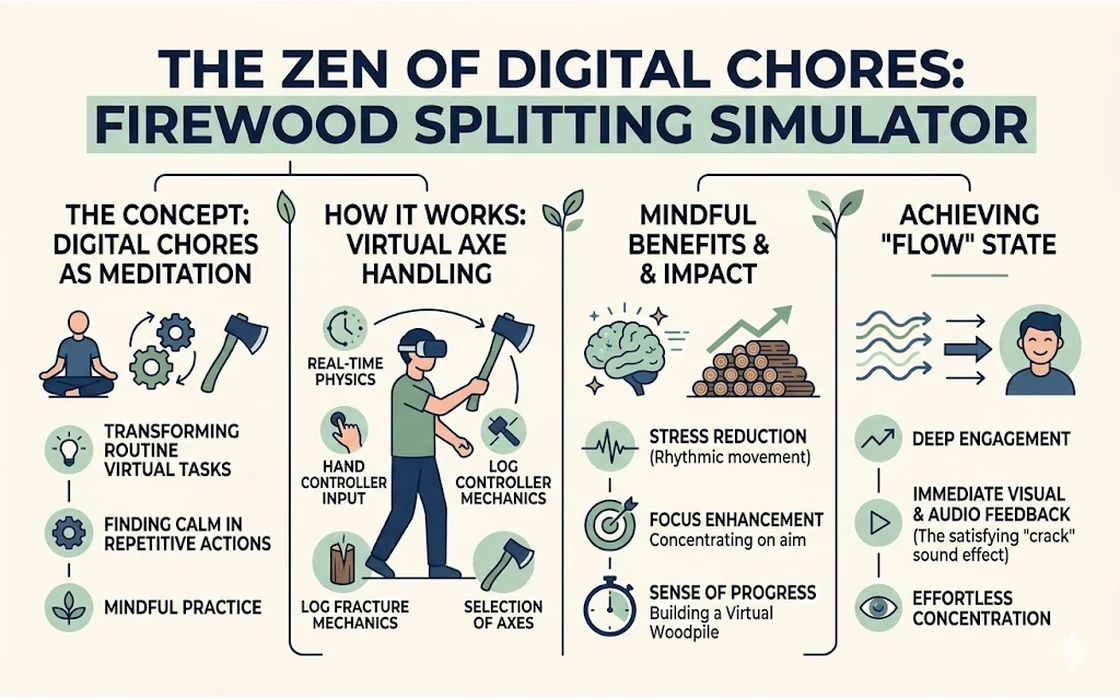
The Firewood Splitting Simulator (found at screen.toys/firewood) is deceptively simple. You are presented with a stump, a log, and an axe. You click to swing. If you hit the log correctly, it splits into two. Do it again, and it splits into four. Once the pieces are small enough, they fly off and stack themselves into a neat, geometric woodpile in the background.
The magic lies in the sensory details. The lighting is golden-hour perfect; the shadows of the trees dance across the stump. The sound design is what gamers call “crunchy”—a deep, resonant impact that feels like it has physical weight. It is the digital equivalent of popping bubble wrap or watching a pressure washer clean a driveway. In a world where most of our “work” involves moving pixels or prompts around, there is a profound, primal satisfaction in seeing a large object become two smaller objects through a direct action.
For the average Indian professional commuting through the noise of Bengaluru or Mumbai, this simulator offers a five-minute “zen break.” You don’t need a Rs. 50,000 VR headset or a high-end gaming PC. It runs in your mobile browser, providing a moment of “analog” peace in a digital format. It is the ultimate manifestation of the “low stakes, high reward” gameplay that has come to define the mid-2020s.
Vibecoding: How “Screen Toys” are Built in 2026
To understand how a single developer like Matt Bull could create something so polished, we have to look at the “vibecoding” revolution that has taken over the industry since Andrej Karpathy popularized the term. In the “old days” of 2023 or 2024, building a 3D physics simulation with custom textures and spatial audio would have required a team of specialists or weeks of manual coding in Three.js and Blender.
In 2026, we are firmly in the era of Software 3.0. Developers no longer struggle with syntax; they “vibecode.” Using agent-first IDEs like Google’s Antigravity, a developer describes the vibe they want. They might say, “I want the wood to split with a splintering effect that follows the grain, and I want the sound to change based on the thickness of the log.” The AI agents handle the complex physics engine integration and the boilerplate code, while the developer acts as a director and curator.
The Firewood Splitting Simulator is the perfect “screen toy” born from this workflow. It represents a move away from “utility-first” apps toward “experience-first” digital artifacts. For the Indian startup ecosystem, this is a massive opportunity. We have always had the technical talent, but the barrier of “polishing” a product—making it look and feel world-class—was often a bottleneck. With vibecoding, an independent developer in a Tier-2 city can produce a visual experience that rivals a AAA game studio’s tech demo, all for the cost of an AI subscription (roughly Rs. 1,600 a month).
The Fiskars X27 and the Art of Photogrammetry
One of the most fascinating aspects of this simulator is its commitment to realism. The creator didn’t just “draw” an axe; he 3D-scanned his own personal Fiskars X27 splitting axe and the actual stump from his backyard. This process, known as photogrammetry, has become incredibly accessible thanks to the high-end sensors on modern smartphones.
By scanning real-world objects, the developer brought “organic grit” into the digital space. The axe has real scratches; the stump has authentic moss and bark textures. This “hyper-local” approach to game design is something we are starting to see in India as well. Imagine a “Coconut Peeling Simulator” or a “Chai Pouring Simulator” built with the same level of reverence for the physical objects involved.
The Fiskars X27 itself has become a bit of a meme in the tech community. It is known as the “gold standard” of splitting axes because of its weight distribution and carbon fiber-reinforced handle. By including such a specific, real-world tool, the developer tapped into a niche community of “outdoor techies” who appreciate high-quality hardware, whether it’s a mechanical keyboard or a high-carbon steel blade.
The “Most Hacker News” Comment Ever
When the simulator was posted to Hacker News, the reaction was a perfect microcosm of the tech world’s personality. While 90% of users praised the “zen” and the technical execution, one highly upvoted comment became a viral sensation in its own right for its sheer pedantry.
The commenter pointed out that in the simulation, the wood stays perfectly upright after being split, whereas in “real life,” the two halves would fly apart due to the wedge shape of the axe. They further noted that the simulation allowed the user to “slice” the wood vertically into impossibly thin pieces, which would be impossible with a real log’s grain structure.
The internet’s response was swift and hilarious, with users calling it the “most Hacker News comment in history.” It sparked a meta-discussion about the “Pedantic Twat Simulator,” where users joked that the real “simulator” wasn’t the wood chopping, but the comment section itself. This highlights a fundamental truth about our industry: we love to over-analyze the things we enjoy. But it also shows that for a digital experience to truly resonate, it has to be “wrong” in just the right ways to remain fun. If the wood pieces flew off-screen every time, the satisfying “stacking” mechanic would be lost.
Why We Crave “Useless” Software
There is a growing movement in the tech world toward “Useless Software.” For decades, the mantra was “solve a pain point” or “increase productivity.” But as AI takes over the “useful” tasks—writing emails, debugging code, scheduling meetings—we are left with a surplus of digital time.
The Firewood Splitting Simulator is “useless” in the best possible way. It doesn’t help you make more money (unless you’re the developer hosting ads, though this project is notably clean). It doesn’t help you “network.” It simply is. It is a digital toy that respects your attention without trying to “hook” you with dark patterns or loot boxes.
In the Indian context, where our digital lives are often dominated by “super-apps” that try to do everything from banking to grocery delivery, there is something revolutionary about an app that does exactly one thing: it lets you split a log. It’s a return to the “small web”—a collection of beautiful, single-purpose sites that exist simply because a human wanted to make them.
The Opportunity for Indian Creative Tech
For the aspiring Indian developer, the success of the Firewood Splitting Simulator should be an inspiration. We are moving past the era where you need a Rs. 10 Lakh budget to create a viral interactive experience.
1. Focus on the “Feel”
The simulator proves that juice (the visual and auditory feedback of an action) is more important than complex gameplay. If you are building an app for an Indian audience—say, a digital ledger for small shopkeepers—think about the “vibes.” Can you make the sound of “marking a debt as paid” feel as satisfying as splitting a log?
2. Leverage Local Textures
We live in one of the most visually and sonically rich countries in the world. Using photogrammetry to bring the textures of an Indian monsoon or the specific “clack” of a carrom board into the digital space can create a unique global appeal.
3. Embrace the Browser
You don’t need the App Store. The Firewood Simulator lives on a URL. It’s shareable, instant, and frictionless. In a market like India, where storage space on budget phones is a constant battle, browser-based “screen toys” are the perfect medium.
Conclusion
The Firewood Splitting Simulator is more than just a fleeting trend; it is a reminder of why we fell in love with technology in the first place. It wasn’t for the spreadsheets or the “synergy”; it was for the magic of seeing our actions reflected in a digital world in ways that feel impossible or perfectly satisfying.
As we move deeper into the age of AI and vibecoding, the tools to create these moments of magic are becoming available to everyone. Whether you’re a developer in Silicon Valley or a student in a dorm room in Vellore, the ability to build a “world in a tab” is now at your fingertips. So, the next time you feel overwhelmed by the complexity of the tech industry, take a five-minute break. Go split some virtual wood. Listen to the “thwack,” watch the pieces stack, and remember that sometimes, the best use of a trillion-dollar global infrastructure is simply to provide a little bit of zen.
In 2026, the “vibes” are the code. And the vibes, quite frankly, have never been better.
- Tags:
- Vibecoding
- Threejs
- Game Development
- Simulation
- Hacker News
- Tech Trends