
U.S. Science is in Chaos: The Impact on India's Tech Future
The 2026 U.S. science crisis and historic funding cuts are driving a global talent shift that could redefine India's technology and research landscape.

- NV Trends
- 11 min read
For decades, the United States has stood as the undisputed titan of global scientific research and technological innovation. From the hallowed halls of MIT to the sprawling, sun-drenched campuses of Silicon Valley, the American ecosystem was built on a reliable foundation of robust federal funding, rigorous peer review, and an open-door immigration policy that welcomed the world’s brightest minds. But in 2026, a seismic shift has occurred. Across developer forums, academic networks, and notably trending on platforms like Hacker News, a grim consensus has emerged: U.S. science is in chaos.
This isn’t merely a sensationalist headline designed for clicks. It is a stark reality born out of sweeping policy changes, unprecedented budget slashing, and a fundamental restructuring of how research is governed. For the Indian reader—whether you are a tech entrepreneur scaling a startup in Bengaluru, a researcher aiming for a post-doctoral fellowship abroad, or an investor tracking global technology trends—this chaos is not just an American problem. It is a global pivot point that will dictate the flow of capital and talent for the next decade.
The U.S. innovation engine, which has historically driven everything from the modern internet infrastructure to life-saving mRNA vaccines, is sputtering. As federal agencies grapple with what insiders are calling a “coordinated destruction” of the research enterprise, the ripple effects are already crashing onto Indian shores. The long-standing, aspirational dream of the U.S. as the ultimate destination for Indian STEM talent is being aggressively challenged by highly restrictive visa policies and a deeply politicized research environment. Understanding the depth and mechanics of this crisis is crucial. It presents immense immediate challenges, but it also creates unprecedented, once-in-a-generation opportunities for India’s own technological and scientific trajectory.
The Collapse of Independent Peer Review
At the very heart of the current crisis is a profound, structural attack on the foundational mechanism of modern science: the independent peer-review system. Historically, funding for U.S. scientific research, distributed through massive juggernauts like the National Institutes of Health (NIH) and the National Science Foundation (NSF), was allocated based on the rigorous, blind evaluation of proposals by panels of expert scientists. This meritocratic system ensured that feasibility, scientific rigor, and potential societal impact drove innovation, rather than political whims.
However, the introduction of the new “Unified Funding Strategy” in early 2026 has violently upended this gold standard. A highly controversial 412-page administrative rule has been implemented, granting senior political appointees the unprecedented power to review research results and directly intervene in funding decisions. This explicitly bypasses the traditional expert panels, injecting partisan ideology directly into the scientific process.
The logistical fallout has been nothing short of catastrophic. Because political review is inherently slower, bureaucratic, and heavily scrutinized through a partisan lens, the machinery of grant distribution has ground to a complete halt. Internal reports indicate that nearly $30 billion (approximately Rs. 2.5 lakh crore) in critical grants from the NIH, NSF, and the Environmental Protection Agency (EPA) have been delayed or outright terminated over the past year alone.
For the global technology sector, this is a glaring red flag. Breakthrough technologies do not happen in a vacuum; they are built on decades of publicly funded basic science. The complex algorithms powering today’s artificial intelligence, the materials science behind advanced semiconductors, and the cryptography securing modern blockchain networks all trace their roots back to government-funded university labs. By politicizing the funding process, the U.S. is effectively throttling the very pipeline of open-source knowledge that sustains its own tech industry. Indian IT services and product companies that rely on incorporating cutting-edge U.S. academic research into their offerings will soon find that well running dry.
Drastic Budget Cuts: Starving the Innovation Engine
Compounding the bureaucratic paralysis are the most severe budget cuts to federal science agencies in modern American history. The fiscal blueprints for 2026 and 2027 signal a dramatic, intentional retreat from the broad, exploratory basic research that has historically given the U.S. its unassailable competitive edge. Key impacts include:
- National Science Foundation (NSF): Facing a staggering 56.9% cut, amounting to $5.16 billion (roughly Rs. 43,000 crore). This brutal reduction is expected to plunge the grant award rate from a highly competitive 24% down to an abysmal 6%.
- NASA: Reportedly canceling over 50 deep-space science missions and abandoning vital Earth observation projects that have been in planning for decades.
- NOAA: Seeing its critical climate research labs and cooperative institutes slated for total elimination in the upcoming FY 2027 budget request.
- Strategic Redirection: Remaining funds are heavily concentrated on Artificial Intelligence (AI) and Quantum Information Science for national security, entirely neglecting the foundational sciences those fields rely upon.
For early-career researchers, a 6% success rate at the NSF means that securing funding is no longer about scientific merit; it is more akin to winning a lottery. Interestingly, while basic exploratory science is starved, the current administration is aggressively redirecting whatever funds remain toward a narrow, highly militarized set of priorities. Framed as essential for “winning the global AI race” against geopolitical rivals, these specific fields are receiving concentrated injections of capital.
However, leading tech executives and academics argue this is a fatally shortsighted strategy. AI and quantum computing do not exist in isolation. They rely heavily on continuous advancements in materials science, theoretical physics, and pure mathematics—the very fields currently being defunded. You cannot build the penthouse of advanced technology while actively demolishing its foundation.
The Great Scientific Brain Drain
Perhaps the most immediate and visible symptom of the chaos—and the one most relevant to India—is the mass exodus of intellectual capital from the United States. For generations, the U.S. has relied heavily on immigrant talent to fuel its tech and research sectors. A significant, undeniable portion of Silicon Valley’s founders, top engineers, and leading academic researchers hail from India, drawn by the promise of world-class facilities, abundant funding, and an open, collaborative society.
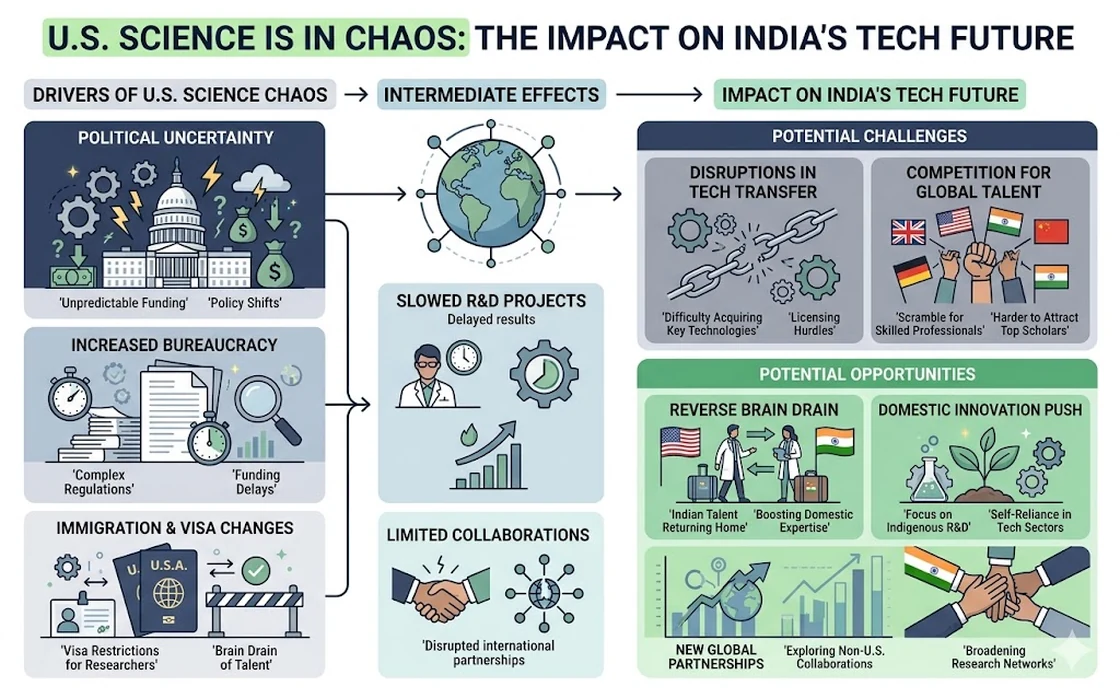
Today, that promise is deeply fractured. A massive “brain drain” is underway, but this time, it is flowing out of America. The environment has simply become too hostile for serious scientific inquiry, driven by several key factors:
- Workforce Exodus: Over 10,000 post-doctoral experts resigned from the federal workforce in 2025 alone, with departures currently outstripping new hires by an astounding ratio of 11 to one.
- Visa Barriers: The administration’s attempt to implement a draconian $100,000 (about Rs. 83 lakh) fee for H-1B visas—though temporarily struck down by a federal judge in June 2026—sent shockwaves of anxiety through the global tech community.
- Student Decline: Mass student visa revocations contributed to a massive 17% drop in new international student enrollment in 2026, the sharpest decline outside of the pandemic era.
For Indian techies already trapped in decades-long green card backlogs, these moves are a clear signal that they are no longer welcome. For Indian students, the calculus has fundamentally changed. The return on investment for an incredibly expensive American STEM degree is no longer guaranteed. The prospect of taking on massive educational debt (often exceeding Rs. 50 lakhs), only to face a hostile visa regime and an underfunded research environment, is forcing India’s brightest minds to radically alter their career trajectories.
The Rise of “Scientific Asylum” and Global Competitors
Nature abhors a vacuum, and the global scientific community is rapidly moving to absorb the premium talent fleeing the United States. Recognizing the historic blunder occurring across the Atlantic, several nations have launched aggressive, heavily funded campaigns to lure disaffected researchers.
Countries like France, Canada, and Belgium have officially introduced “scientific asylum” programs. These initiatives offer fast-tracked permanent residency visas, guaranteed long-term research funding, and state-of-the-art laboratory space for researchers who are willing to relocate their operations from the U.S. European universities are already reporting hundreds of applications from top-tier American-based talent, including many established Indian expats.
For India, this shifting geopolitical landscape presents a once-in-a-generation opportunity. While historically a primary victim of brain drain itself, India is now uniquely positioned to be a major beneficiary of the U.S. exodus. With the Indian government aggressively pushing its “Viksit Bharat” agenda, rolling out Production Linked Incentive (PLI) schemes for semiconductor manufacturing, and investing in space exploration via ISRO, the domestic environment is ripe for a “reverse brain drain.”
Indian venture capital firms are increasingly backing deep-tech startups rather than just consumer apps. Institutions like the IITs, IISc, and newly established research clusters are forging much stronger industry-academia partnerships. If India can effectively streamline its own bureaucratic hurdles, improve the ease of doing research, and increase its gross domestic expenditure on research and development (GERD), it could successfully repatriate its top talent. The goal should no longer be just retaining local talent, but actively attracting foreign researchers looking for stability, economic growth, and scientific freedom.
Research Integrity and the Oversight Collapse
Beyond the tangible issues of funding and talent retention, the very integrity of U.S. science is under intense, unprecedented scrutiny. The institutional infrastructure designed to catch fraud, plagiarism, and data manipulation is failing due to deliberate neglect and defunding.
The Office of Research Integrity (ORI), the federal watchdog responsible for policing scientific misconduct, reported an astonishingly low two misconduct findings in the entirety of 2025. This was the lowest number recorded since 2006. This drop did not occur because scientists suddenly became perfectly honest; it happened because the ORI has been hollowed out by relentless leadership turnover and severe staffing cuts.
Paradoxically, while official federal findings have plummeted, independent “science sleuths” on the internet—often using AI-driven image analysis—are uncovering massive fraud cases at elite U.S. institutions like Stanford and the Dana-Farber Cancer Institute. The situation reached a boiling point in May 2026, when a high-profile physical chemist received a rare 15-year federal funding ban for egregious data falsification. Crucially, this investigation was driven more by relentless public pressure and independent bloggers than by robust federal oversight.
Adding to the systemic chaos, new NSF policies have reportedly handed the responsibility of misconduct investigations entirely back to the universities themselves. This creates a severe structural conflict of interest—a classic case of the fox guarding the henhouse. Universities rely heavily on the prestige, patent royalties, and grant money brought in by star researchers, making them highly reluctant to vigorously investigate allegations of fraud that could damage their brand and bottom line.
For the Indian tech industry, which relies heavily on published academic papers to guide its own R&D investments, this degradation of trust is catastrophic. If an Indian DeepTech company cannot implicitly trust the foundational research coming out of U.S. labs, it forces them to replicate basic experiments internally. This drives up operational costs, wastes valuable time, and significantly slows down the pace of commercial innovation.
Global Health, Climate, and the Ripple Effect on Tech
The dismantling of the U.S. scientific apparatus extends far beyond computer chips, AI algorithms, and quantum bits; it has profound, life-or-death implications for global survival. The 2026 formal withdrawal of the United States from the World Health Organization (WHO) and the complete dissolution of the U.S. Agency for International Development (USAID) mark a devastating, isolationist retreat from global health leadership.
Public health experts are warning that these moves, coupled with massive $1.9 billion cuts to critical programs like the PEPFAR HIV/AIDS initiative, could lead to millions of preventable deaths globally over the next decade.
Similarly, climate science has been practically erased from federal budgets. For a rapidly developing country like India, which is acutely vulnerable to climate change-induced extreme weather events, the lack of U.S. participation in global climate modeling, data sharing, and clean energy research is deeply concerning.
However, this abrupt withdrawal also forces the global tech ecosystem to pivot rapidly. Climate-tech and health-tech are no longer just Silicon Valley buzzwords reserved for specialized VC funds; they are urgent, localized necessities that other nations must now pioneer themselves. Indian startups focusing on sustainable agriculture tech (AgriTech), highly efficient renewable energy grids, electric vehicle infrastructure, and accessible digital healthcare are finding themselves stepping directly into the leadership void left by the Americans. The sheer necessity of solving these massive problems locally, without relying on U.S. innovation trickling down, is drastically accelerating India’s own domestic tech capabilities.
Conclusion
The trending sentiment echoing across Hacker News and global forums is, unfortunately, entirely accurate: U.S. science is indeed in chaos. The toxic confluence of political interference in peer review, catastrophic budget cuts, a massive talent brain drain, and collapsing institutional oversight has severely damaged the most successful innovation engine in human history.
For the global technology landscape, this represents a massive, irreversible tectonic shift. The era of undisputed, unilateral American scientific hegemony is ending before our eyes in 2026. For Indian students plotting their careers, researchers seeking funding, and tech leaders building the next generation of products, it is time to urgently recalibrate. The U.S. can no longer be viewed as the default destination for cutting-edge research or the sole, infallible source of technological truth.
Instead, the future of technology will be increasingly multipolar and decentralized. The opportunity is now firmly in the hands of emerging hubs—be it in Europe, East Asia, or right here in India. By continuing to invest heavily in deep tech, streamlining domestic research funding, and rolling out the red carpet for the immense talent that the U.S. is currently driving away, India has the chance to transition from being the IT back office of the world to one of its premier scientific leaders. The chaos in the West is an undeniable tragedy for global science, but it may just be the exact catalyst India needs to forcefully define the next era of technological evolution.
- Tags:
- Us Science
- Research Funding
- Technology Trends
- Brain Drain
- India Tech
- Innovation