
US Spares DeepSeek from Blacklist: What It Means for AI
The US government avoids blacklisting AI lab DeepSeek while identifying over 100 other Chinese firms as security risks, impacting the global AI landscape.

- NV Trends
- 9 min read
The global artificial intelligence landscape was recently rocked by a series of high-stakes maneuvers in Washington D.C. that could redefine how Indian developers and businesses access cutting-edge technology. In a move that has surprised many industry analysts, the U.S. government has reportedly held off on officially blacklisting DeepSeek—the Chinese AI sensation that has sent shockwaves through Silicon Valley—even as it prepares to label over 100 other Chinese firms as significant security risks.
For the uninitiated, DeepSeek is not just another tech company; it represents a paradigm shift in how AI is built and priced. While American giants like OpenAI and Google have been building increasingly massive and expensive models, DeepSeek released a series of open-weights models that match or even exceed the performance of their Western counterparts at a fraction of the cost. The news that the U.S. Commerce Department is hesitating to add DeepSeek to its infamous “Entity List” suggests a complex geopolitical game of cat-and-mouse where economic utility is clashing with national security concerns.
For the Indian tech ecosystem, which has rapidly adopted DeepSeek’s models for their cost-efficiency and performance, this delay provides a temporary sigh of relief. However, the broader context of 100 other firms being designated as security risks—including major memory chipmakers like CXMT—indicates that the “Tech Cold War” is only intensifying. Understanding the nuances of this decision is crucial for any Indian startup founder, developer, or policy enthusiast who relies on global AI infrastructure.
The DeepSeek Phenomenon: A Disruptor Like No Other
To understand why the U.S. government is struggling with whether to blacklist DeepSeek, one must first look at the company’s meteoric rise. Earlier this year, DeepSeek released its V3 and R1 models, which demonstrated a level of efficiency that many thought impossible. While training a top-tier model in the U.S. can cost hundreds of millions of dollars, DeepSeek managed to achieve comparable results with significantly less compute and a fraction of the budget.
The most tangible impact of this efficiency is the pricing. In the U.S., using a frontier model like GPT-4o or Claude 3.5 Sonnet can cost developers anywhere from $15 to $30 (approximately Rs. 1,250 to Rs. 2,500) per million tokens. In contrast, DeepSeek’s API prices have plummeted to as low as $0.14 to $0.80 (approximately Rs. 12 to Rs. 67) per million tokens. For an Indian SaaS startup processing millions of customer queries daily, this isn’t just a marginal saving—it is the difference between a viable business model and a massive monthly loss.
This “DeepSeek Shock” forced American companies to rethink their entire strategy. It proved that the “brute force” approach of throwing more GPUs and more electricity at the problem wasn’t the only path to intelligence. Naturally, this efficiency has drawn the ire of U.S. incumbents, who have begun lobbying for regulatory interventions, citing national security as the primary driver.
The “Security Risk” Label: Protectionism or Genuine Concern?
The U.S. interagency committee—comprising officials from the Commerce, Defense, and State Departments—has reportedly been debating DeepSeek’s status for months. While they have already moved forward with blacklisting ~100 other firms, the delay regarding DeepSeek is telling. The primary allegations against the firm include:
- Intellectual Property (IP) Extraction: Leading U.S. AI labs, including OpenAI and Anthropic, have alleged that DeepSeek used a technique called “distillation” to “free ride” on their models. In simple terms, distillation involves using a larger, more powerful model (like GPT-4) to generate training data for a smaller model. This allows the smaller model to “learn” the logic of the larger one without the original developer having to spend the billions of dollars required for initial research.
- Military and Intelligence Ties: The U.S. State Department has raised concerns that DeepSeek’s low-cost models are being directly used by the Chinese military to enhance cyber-warfare capabilities and intelligence gathering.
- Export Evasion: There are allegations that DeepSeek has used shell companies in Southeast Asia to bypass U.S. export controls and acquire high-end Nvidia H100 chips, which are technically banned for sale to Chinese entities.
However, many in the developer community—including those on forums like Hacker News—are skeptical. They argue that the “national security” argument is often used as a tool for regulatory capture. By blacklisting a low-cost competitor, the U.S. government effectively protects the high profit margins and market dominance of its domestic “AI Oligopoly.” For Indian users, this creates a dilemma: do we prioritize the security concerns of a foreign superpower, or do we prioritize the economic growth enabled by affordable AI?
Why This Matters for India’s AI Ambitions
India is currently at a crossroads in its AI journey. With the government’s “IndiaAI Mission” and a booming startup scene in Bengaluru, Hyderabad, and Pune, the country is hungry for compute and intelligence. The US-China tech rivalry directly impacts India in several ways.
1. The Cost of Innovation
As mentioned earlier, the price difference is staggering. If an Indian developer is forced to use only U.S.-approved models because Chinese models are blacklisted or restricted, the “AI Tax” on Indian innovation will increase significantly. If a task costs Rs. 2,000 on a U.S. model but only Rs. 50 on a Chinese model, the competitive disadvantage for Indian startups is obvious.
2. The Open-Weights Movement
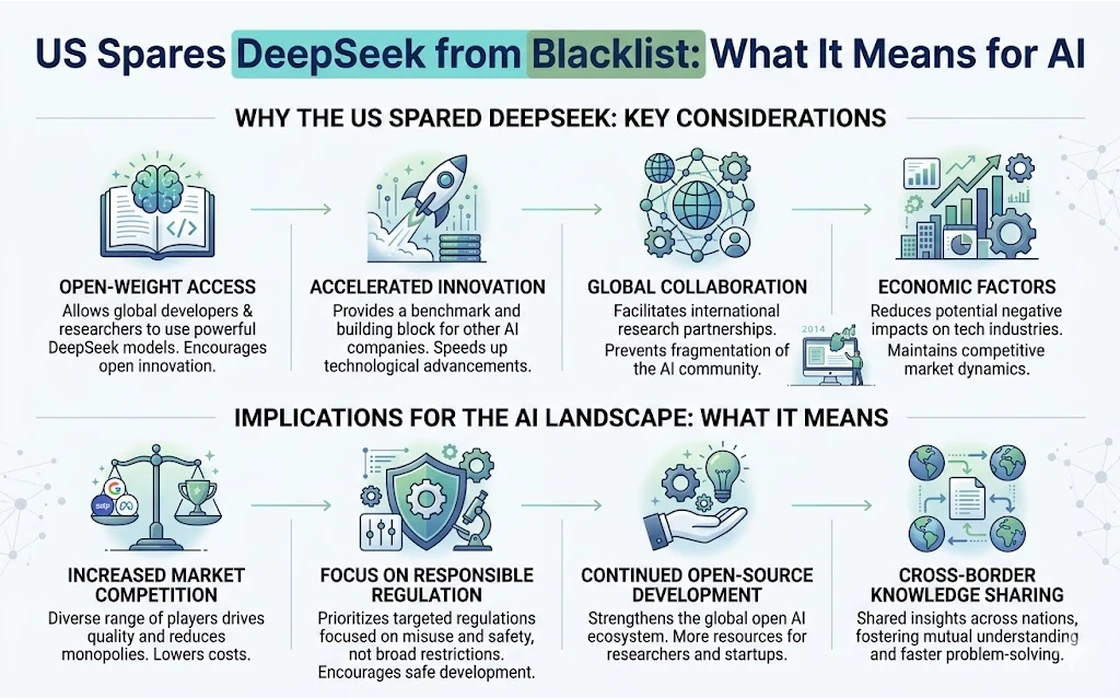
DeepSeek R1 is an “open-weights” model, meaning developers can download the model and run it on their own servers (if they have the hardware). This is vital for data sovereignty. Indian banks, healthcare providers, and government agencies cannot always send sensitive data to servers in the U.S. or China. Being able to run a powerful model like DeepSeek locally in an Indian data center is a massive win for privacy and control. If DeepSeek is blacklisted, it becomes much harder for Indian firms to legally acquire the support or infrastructure needed to run these models effectively.
3. Dependency and Sovereignty
The hesitation to blacklist DeepSeek shows that even the U.S. realizes how integrated these technologies have become. However, if India becomes too dependent on any single foreign entity—whether American or Chinese—it loses its strategic autonomy. The U.S. holds the keys to the hardware (Nvidia chips), while China is currently winning the “efficiency” war. India must navigate this by developing its own “Sovereign AI” while utilizing the best available global tools in the interim.
The Technical Controversy: What is “Model Distillation”?
One of the most heated debates in the tech world right now is whether “distillation” constitutes theft. When DeepSeek (or any other lab) uses ChatGPT to generate 10 million high-quality training examples, are they “stealing” OpenAI’s work?
From a legal standpoint, the answer is murky. U.S. companies argue that their terms of service prohibit using their output to train competing models. However, the open-source community argues that “learning from output” is exactly what humans do. If a student learns math by reading a textbook, they aren’t “stealing” from the author.
In the context of the U.S. blacklist, this technical nuance becomes a political weapon. If the U.S. can successfully brand distillation as “IP extraction,” they can justify blacklisting any firm that matches their performance too quickly. For Indian developers, who are masters of “Jugaad” and efficiency, this debate is particularly relevant. We are a nation that prides itself on doing more with less, and seeing a company get punished for doing exactly that is a worrying precedent.
The Broader Context: 100 Firms and the Silicon Shield
While DeepSeek escaped the immediate axe, 100 other Chinese firms did not. This includes CXMT (ChangXin Memory Technologies), China’s leading manufacturer of DRAM (memory) chips. This is arguably more important than the AI model debate.
Memory chips are the “silicon shield” of the modern economy. Every smartphone, laptop, and server in India uses DRAM. By blacklisting CXMT, the U.S. is signaling that it wants to completely decouple the global electronics supply chain from Chinese technology. This could lead to:
- Supply Chain Disruptions: If Indian manufacturers like Dixon Technologies or Lava cannot source affordable memory chips from China, the cost of “Made in India” electronics could rise.
- A “Two-Internet” World: We are moving toward a world where one half uses U.S.-approved hardware and software (Google, Meta, Nvidia, Apple) and the other half uses Chinese alternatives (Huawei, DeepSeek, CXMT). India, with its massive market, will be pressured by both sides to pick a lane.
Cybersecurity Risks: A Genuine Warning for Indian Users
Despite the economic benefits, we must not ignore the genuine security risks. Using an AI model developed by a firm with close ties to a foreign government comes with inherent dangers:
- Data Exfiltration: If you are using a hosted API (sending your data to a server in China), there is no guarantee that the data isn’t being intercepted or stored for future analysis by foreign intelligence services.
- Biased Output: AI models are trained on specific datasets. A Chinese-trained model may have different “guardrails” or biases regarding geopolitical issues that could influence the users of that AI.
- The “Kill Switch”: If an Indian business builds its entire infrastructure on a foreign API, they are at the mercy of that provider. If the provider decides to cut access (or is forced to by their government), the Indian business could collapse overnight.
For Indian enterprises, the solution is local hosting and multi-model redundancy. Never rely on just one AI provider. Use a mix of U.S. models, open-weights models (like Llama or DeepSeek) running on Indian soil, and eventually, Indian-born models like Sarvam or Krutrim.
Conclusion
The U.S. government’s decision to hold off on blacklisting DeepSeek is a temporary reprieve in an otherwise escalating tech war. It highlights a fascinating reality: DeepSeek has become “too useful to ignore,” even for its rivals. The sheer economic advantage of its high-efficiency AI is forcing even the world’s most powerful regulators to move with caution.
For the Indian reader, the lesson is clear. We are entering an era where technology is the ultimate currency of power. The “Rs. 75 vs Rs. 2,500” price gap in AI tokens is a perfect illustration of how efficiency can disrupt global order. While we must remain vigilant about the cybersecurity risks associated with any foreign-controlled technology, we cannot afford to fall behind in the AI race by ignoring the most efficient tools available.
As a nation, India must continue to advocate for a “multi-polar” tech world. We should leverage the cost-savings of models like DeepSeek to build our own startups, while simultaneously investing in our own compute infrastructure and data privacy laws. The U.S. might be holding off on the blacklist today, but the pressure will only mount. In the world of AI, the only true security is self-reliance.
Future Outlook: What to Watch For
In the coming months, keep an eye on three things:
- The U.S. Commerce Department’s Final Ruling: Will they buckle under pressure from Silicon Valley and finally add DeepSeek to the Entity List?
- Nvidia’s Response: How will the world’s most valuable chipmaker navigate the ban on its Chinese customers, especially as firms like DeepSeek find clever ways to bypass controls?
- India’s “AI Stack”: Will the Indian government provide more incentives for startups to host models locally, reducing our dependency on foreign APIs?
The AI revolution is moving at a speed that traditional policy can barely keep up with. Whether it’s DeepSeek or the next big thing, the tension between economic growth and national security will be the defining story of our decade.
- Tags:
- Deepseek
- Ai
- Cybersecurity
- Us China Trade
- Tech News
- Artificial Intelligence
- Silicon Valley