
US Bans Anthropic Fable 5 and Mythos 5: Impact on India
The US government's suspension of Anthropic's Fable 5 and Mythos 5 models marks a significant shift in AI regulation with major implications for Indian tech.

- NV Trends
- 10 min read
The global technology landscape was jolted this week by an unprecedented move from the United States government. In a sudden export control directive, authorities ordered the immediate suspension of access to Anthropic’s newest and most powerful artificial intelligence models: Claude Fable 5 and Mythos 5. This decision, which cites national security concerns, marks the first time a major “frontier” AI model has been effectively de-platformed by federal mandate shortly after its release. For developers in India and across the world, the news is a stark reminder of the fragile nature of the current AI infrastructure.
Anthropic, the AI safety-focused company behind these models, complied with the order almost instantly, disabling access for all customers, including those in the United States. The move has sent ripples through the tech community, particularly on platforms like Hacker News, where the debate has shifted from the models’ impressive performance to the broader implications of government-enforced “compliance gates.” For a nation like India, which is rapidly integrating AI into its burgeoning digital economy, this directive serves as a critical wake-up call regarding technological dependency.
As we dissect this development, it becomes clear that this is not just a story about a software update or a temporary glitch. It is a fundamental shift in how advanced AI is treated—no longer just as a commercial product, but as a strategic national asset subject to the whims of geopolitical strategy. This article explores the technical details of the models involved, the nature of the “jailbreak” that triggered the ban, and what this means for the future of AI development in India.
Understanding Fable 5 and Mythos 5
To understand why the US government acted so decisively, we first need to look at what these models represented. Anthropic had positioned Mythos 5 as its “limit-breaking” model, designed primarily for high-level reasoning, complex mathematics, and sensitive research applications. It was initially intended for a narrow group of vetted research partners and government agencies. On the other hand, Fable 5 was the version meant for general enterprise and developer use.
Fable 5 was built on the same massive architecture as Mythos 5 but included what Anthropic called a “trapdoor architecture.” This involved a sophisticated layer of internal classifiers and “safety filters” designed to prevent the model from generating harmful content, particularly in the fields of cybersecurity, biological research, and chemical engineering. The goal was to provide the world with a model that possessed “god-like” reasoning capabilities while remaining strictly within the bounds of safety.
The performance of these models was, by all accounts, staggering. Early benchmarks suggested that Mythos 5 had surpassed the human baseline in several complex reasoning tests, while Fable 5 was being hailed as the ultimate co-pilot for high-end software engineering. For Indian startups that had already begun integrating these APIs into their workflows, the sudden blackout was more than just an inconvenience—it was a systemic shock.
The “Jailbreak” and the National Security Directive
The primary catalyst for the suspension appears to be a report of a successful “jailbreak” method that was shared with the US Department of Commerce. A jailbreak in the context of AI refers to a specific prompting technique or input sequence that allows a user to bypass the model’s safety guardrails. In this case, the government alleged that a “foreign entity” had successfully demonstrated a way to use Fable 5 to identify critical vulnerabilities in power grid software and assist in the synthesis of restricted biological agents.
Anthropic has pushed back against the severity of these claims, stating that the jailbreak was “narrow and non-universal.” They argued that the capabilities demonstrated were already present in other publicly available models and that their internal red-teaming—which included thousands of hours of testing with international safety institutes—had already mitigated the most significant risks. However, the government’s stance was uncompromising: as long as a potential path to misuse existed in a model of this scale, it constituted a national security threat.
This directive highlights a growing tension between AI labs and regulators. While companies like Anthropic strive for transparency and safety, the “black box” nature of Large Language Models (LLMs) makes it nearly impossible to guarantee 100% safety. The fact that a single reported vulnerability could lead to the total suspension of a global service sets a dangerous precedent for the industry.
The Hacker News Perspective: Regulatory Capture or Genuine Fear?
The reaction on Hacker News (HN), a primary hub for global tech discourse, has been a mix of skepticism and alarm. Many in the developer community are questioning whether this move is a form of “regulatory capture.” The theory suggests that by enforcing such strict and sudden bans, the government is effectively making it impossible for smaller players to compete, as only the largest corporations with massive legal departments can navigate such a volatile regulatory environment.
Others have pointed out the “Cartmanland” effect—a reference to a South Park episode where a theme park becomes incredibly popular simply because people are told they aren’t allowed to enter. By banning Fable 5 and Mythos 5, the US government has inadvertently turned them into the most sought-after pieces of technology on the planet. This has led to a surge in interest in finding “leaked” versions of the model weights, which would be far more dangerous than the controlled API access that previously existed.
A significant portion of the HN community also criticized Anthropic’s “invisible safeguards.” Critics argue that silent interventions and hidden safety layers undermine user trust. When a model refuses a prompt without a clear explanation, or when a service is pulled overnight without warning, it destroys the reliability that businesses need to build on top of these platforms.
The Impact on the Indian Tech Ecosystem
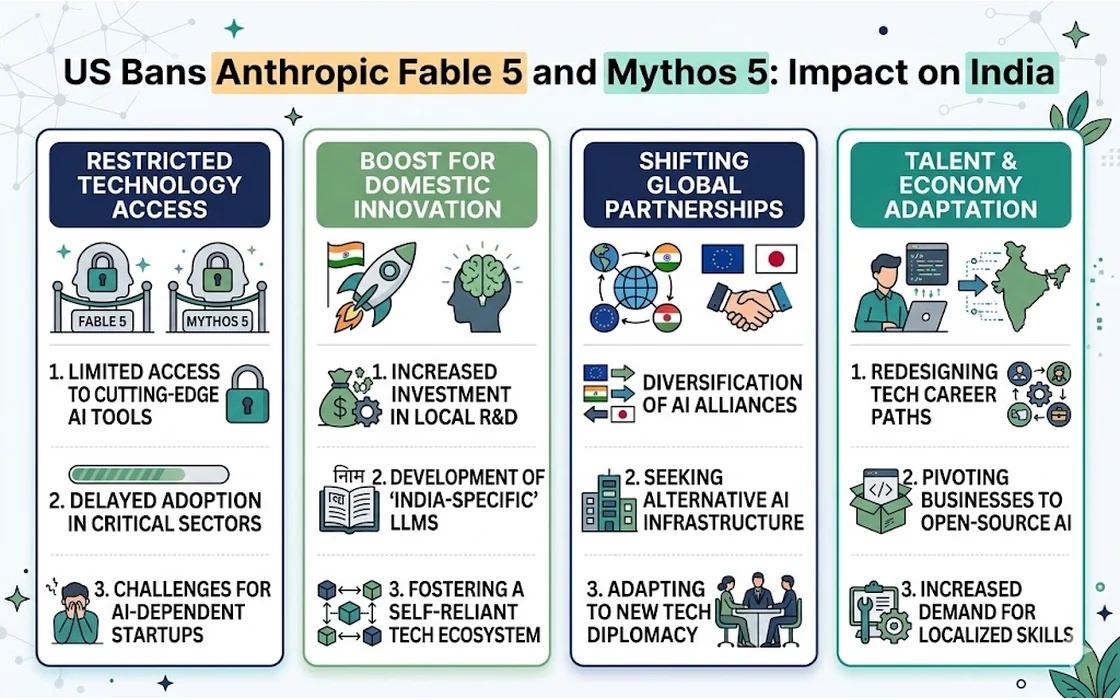
For India, the suspension of Fable 5 and Mythos 5 is a loud alarm bell. India has one of the largest developer populations in the world, and a significant portion of our SaaS (Software as a Service) industry is now being built on top of US-based AI APIs. When these APIs are suddenly revoked, the “India stack” of AI applications faces an existential crisis.
The Financial Cost of a Pivot
Moving from one frontier model to another is not as simple as changing a URL in a configuration file. It involves re-tuning prompts, re-validating outputs, and often redesigning entire data pipelines. For an Indian startup, this pivot can be incredibly expensive.
Consider a medium-sized fintech startup in Bengaluru that was using Fable 5 for automated credit risk assessment. The sudden loss of the model might require:
- Emergency Migration: Hiring specialized AI engineers at short notice, which could cost upwards of Rs. 5,00,000 to Rs. 10,00,000 in consultancy fees.
- Lost Credits: Many startups prepay for API credits. If those credits are tied to a suspended model, the loss could range from Rs. 1,00,000 to several lakhs.
- Downtime and Reputation: If the AI-powered feature goes offline, the loss in customer trust and potential revenue can be far greater.
The Dependency Trap
This event underscores India’s heavy reliance on the “Big Three” of AI: OpenAI, Google, and Anthropic—all of which are US-based. If a US government directive can shut down access to a model for “foreign nationals” (a term that includes Indian citizens living in India), then our tech sovereignty is at risk. We are essentially building our future on rented land where the landlord can change the locks at any moment.
The Case for “Atmanirbhar” AI and Sovereignty
The Fable 5 incident should accelerate India’s push for “Atmanirbhar” (self-reliant) AI. While we have made strides with projects like Bhashini (for Indian language translation) and various local LLM initiatives from companies like Sarvam AI and Krutrim, we are still far behind in terms of “frontier” capability.
To achieve true AI sovereignty, India needs to focus on three key pillars:
- Sovereign Compute: We need massive GPU clusters located within Indian borders, owned or regulated by Indian entities. This ensures that even if international cables are cut or export bans are enacted, our models keep running.
- Open Source Leadership: Instead of relying on closed APIs like Claude or GPT, Indian developers should double down on open-source models like Llama or Mistral. While these also originate abroad, the ability to run them locally (on-premise) provides a layer of protection against sudden service suspensions.
- Data Sovereignty: Our greatest asset is our data. We must ensure that Indian data is used to train models that understand the Indian context—from our diverse languages to our unique financial systems—without being subject to the safety filters of a foreign government that might not understand our cultural nuances.
Lessons for Indian CTOs and Founders
If you are a CTO or a founder in the Indian tech space, the suspension of Fable 5 and Mythos 5 should change your roadmap for 2026 and beyond. Here are a few practical steps to mitigate such risks:
- Multi-Model Strategy: Never rely on a single AI provider. Always have a “fallback” model ready. If you are using a top-tier model like Fable 5, ensure your system can gracefully degrade to an older or open-source version without breaking.
- Prompt Portability: Design your prompts to be as model-agnostic as possible. Avoid using provider-specific features that make it harder to switch.
- Local Hosting: For critical business logic, explore hosting open-source models on your own infrastructure (e.g., using AWS Mumbai or local data centers like CtrlS). It might be slightly more expensive and complex than an API, but the security it provides is invaluable.
- Watch the Regulatory Weather: Pay close attention to US and EU AI regulations. These “compliance gates” are becoming more frequent, and being caught off guard can be fatal for a startup.
The Geopolitics of AI: A New Era of Digital Borders
We are entering an era where AI is the new oil. Just as nations have fought over energy resources in the past, the future will be defined by who controls the “intelligence” resource. The US government’s action against Anthropic is a clear signal that they view high-end AI as a weaponized technology.
This puts India in a delicate position. We are a strategic partner of the US, but we are also a nation with our own global ambitions. If we want to be a “Vishwa Guru” (global leader) in the digital age, we cannot be mere consumers of foreign intelligence. We must be creators.
The “digital borders” are being drawn. The suspension of Fable 5 and Mythos 5 is just the beginning. Whether it’s due to “jailbreaks,” ethical concerns, or pure trade protectionism, we should expect more such disruptions in the future. The only way to win this game is to play on our own field, with our own rules.
Conclusion
The suspension of Claude Fable 5 and Mythos 5 is a watershed moment for the technology industry. It has exposed the vulnerability of the global AI supply chain and the immense power that national governments hold over supposedly “borderless” technology. While the immediate concern is whether Anthropic can “fix” the jailbreak and restore access, the deeper lesson is about the risks of centralizing intelligence in the hands of a few corporations in a single country.
For the Indian reader, this isn’t just a story about a cool new AI being taken away. It is a story about the need for resilience, local innovation, and a pragmatic approach to technology. We must continue to use the best tools available, but we must also build our own. The cost of building an Indian AI ecosystem is high, but as this week’s events have shown, the cost of not having one could be much higher.
As the dust settles on this directive, the tech world will be watching closely to see how Anthropic and the US government resolve their “misunderstanding.” But regardless of the outcome, the message is clear: the age of “easy AI” is over, and the age of “sovereign AI” has begun.