
TinyWind: Pixel Pirate Sailing with Real Wind Physics
Explore TinyWind, the indie pirate game where real wind physics meet pixel art, creating a unique and technical sailing experience for gamers.

- NV Trends
- 9 min read
In the vast ocean of modern gaming, where high-definition graphics and ray-tracing often take center stage, a small indie title called TinyWind has managed to capture the imaginations of thousands. Recently trending on platforms like Hacker News, this pixel-art pirate sailing game has achieved a staggering milestone: over 380,000 kilometers sailed by its community. While the visual aesthetic is rooted in the charming simplicity of 8-bit and 16-bit eras, the engine beneath the surface is anything but simple. It is a testament to how deep technical complexity can be hidden within a minimalist package.
For the average Indian gamer, who is increasingly looking beyond mainstream mobile titles toward unique indie experiences on platforms like Steam and itch.io, TinyWind represents a fascinating intersection of art and science. It isn’t just about pressing a button to move forward; it is about understanding the very air that moves your vessel. By incorporating real wind physics into a pirate-themed adventure, the developers have created a simulation that is as educational as it is entertaining.
The success of TinyWind highlights a growing trend in the global gaming industry: the “cozy” simulation movement. However, unlike many other cozy games that focus on farming or interior design, TinyWind focuses on the mastery of a craft. It asks players to respect the elements, learn the nuances of aerodynamics, and navigate a world where the environment is both your greatest ally and your most persistent obstacle.
The Magic of Real-World Physics in a Pixelated World
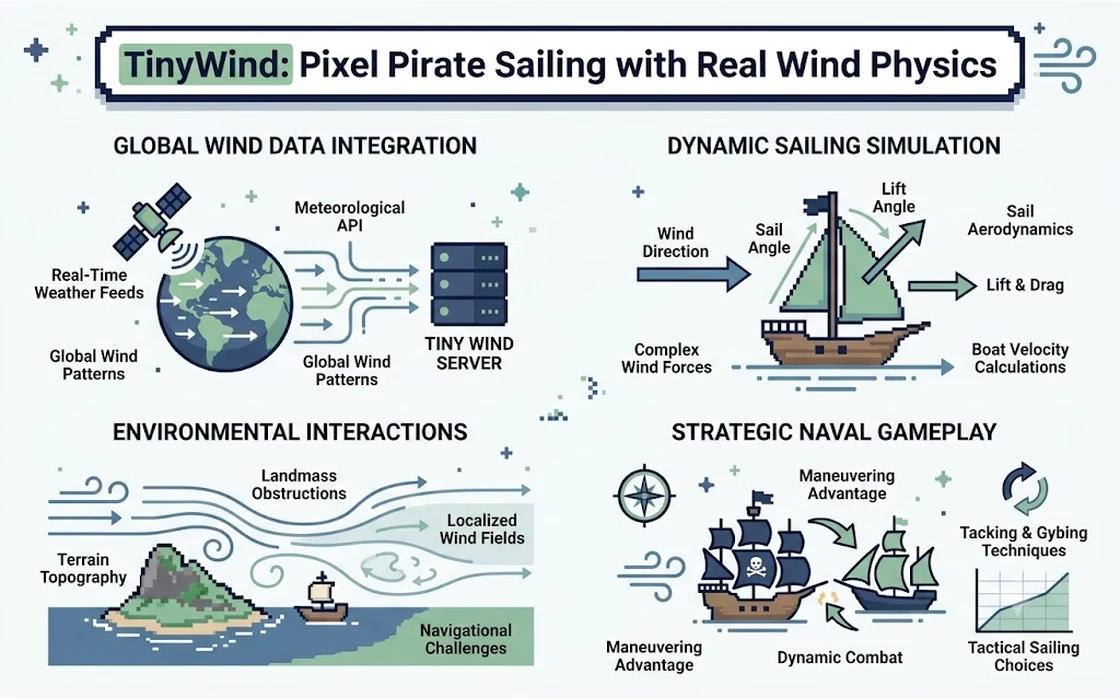
The core hook of TinyWind is its commitment to realistic wind physics. In most sailing games, “wind” is often just a vector that increases or decreases your speed based on the direction your ship is pointing. If you point “upwind,” you slow down; if you point “downwind,” you speed up. TinyWind discards this arcade-style approach in favor of something much more rigorous. It simulates how wind interacts with the surface area of your sails, creating lift and drag in a manner that mimics real-world fluid dynamics.
When you sail in TinyWind, you are not just controlling a sprite on a screen; you are managing a complex system of forces. The game requires you to “trim” your sails—adjusting their angle relative to the wind—to maximize efficiency. This introduces players to the concept of the “points of sail.” Whether you are running with the wind (dead run), sailing across the wind (reaching), or trying to move toward the wind (beating), the physics engine calculates your velocity based on the lift generated by the pressure difference across the sail.
This level of detail is usually reserved for high-end flight simulators or hardcore nautical sims like Sailaway. To see it implemented so flawlessly in a pixel-art pirate game is a breath of fresh air. For Indian tech enthusiasts and budding game developers, it serves as a masterclass in how to use “invisible” technology to enhance gameplay. You don’t see the air, but you feel its impact on your ship’s momentum and heel.
Why 380,000 Kilometers Matter
The announcement that players have collectively sailed over 380,000 kilometers is not just a marketing stat; it is a significant indicator of player retention and community engagement. In the indie world, “stickiness” is the hardest metric to achieve. Most small games are played for an hour or two and then forgotten. TinyWind, however, has managed to create a gameplay loop that keeps people coming back for “just one more voyage.”
To put 380,000 kilometers into perspective, that is roughly the distance from the Earth to the Moon. In the context of a game where your speed is dictated by the elements, this represents hundreds of thousands of hours of collective navigation. This distance speaks to the satisfying nature of the mechanics. There is a meditative quality to finding the perfect sail trim and watching your little pixel ship slice through the waves at its theoretical maximum speed.
This milestone also suggests a robust procedural generation system or a very expansive world map. For a small developer, managing a persistent world where players feel their progress contributes to a global total is a smart way to build a community. In India, where community-driven gaming (like clan systems in mobile games) is massive, the idea of a shared “sailing record” adds a layer of collective pride that resonates well with the local audience.
The Technical Breakdown: Simulating the Invisible
From a software engineering perspective, TinyWind’s wind simulation is a fascinating study. Most modern game engines like Unity or Godot offer physics components, but they are typically optimized for rigid-body collisions or gravity. Simulating wind requires a custom implementation of aerodynamic forces.
Bernoulli’s Principle and Sail Design
In real sailing, a sail acts like a vertical airplane wing. As wind flows over the curved surface of the sail, it travels faster on the outer side than the inner side, creating a low-pressure zone. This pressure difference “pulls” the boat forward. TinyWind’s engine must calculate this force in real-time. For developers, this involves:
- Vector Math: Constantly calculating the angle between the wind vector and the ship’s heading.
- Surface Area Calculations: Determining how much wind is being “caught” based on the sail’s orientation.
- Drag Coefficients: Simulating the resistance of the water against the hull, which prevents the ship from simply being blown sideways.
The Challenge of Optimization
Running these calculations for a single player is manageable, but if the game features multiple ships or complex weather patterns, optimization becomes critical. The beauty of TinyWind is that it keeps the visual load low (pixel art) to save processing power for the physics calculations. This is a brilliant trade-off. It ensures the game can run on a wide variety of hardware—from high-end PCs to older laptops—making it highly accessible to the Indian market where not everyone has a dedicated gaming GPU.
Indie Gaming and the Indian Context
The Indian gaming landscape is currently at a turning point. While mobile gaming (Free Fire, BGMI) still dominates the market share, there is a growing interest in PC gaming and indie titles. Platforms like Steam have introduced regional pricing, making games much more affordable.
The Value Proposition
A game like TinyWind typically retails in the range of Rs. 400 to Rs. 800 on international storefronts. For the price of a single movie ticket and a tub of popcorn in a Mumbai or Bangalore mall, an Indian gamer can get dozens of hours of high-quality, physics-based entertainment. This “value for money” factor is a major driver for the adoption of indie games in India.
The Rise of the “Niche” Gamer
We are seeing a shift away from “only playing what everyone else is playing.” The Indian tech community, particularly those working in IT and software development, is increasingly attracted to games that respect their intelligence. A game that uses real wind physics is naturally appealing to someone who appreciates clean code and elegant systems. TinyWind isn’t just a game; it’s an interactive system that rewards logical thinking and patience.
Sailing Mechanics 101: A Guide for New Pirates
If you are looking to dive into TinyWind, you should be prepared for a learning curve. Unlike your typical “WASD” movement, sailing requires a strategic approach to the environment.
Tacking and Jibing
The most important skill to master is “tacking.” Since you cannot sail directly into the wind, you must move in a zigzag pattern to reach an upwind destination. This involves turning the bow of your ship through the wind. “Jibing” is the opposite—turning the stern of the ship through the wind when sailing downwind. In TinyWind, performing these maneuvers correctly is the difference between a smooth voyage and being “in the irons” (stuck with no momentum).
Reading the Waves
The game also incorporates water physics. Waves can push your hull off course, and understanding the rhythm of the sea is vital. In the Indian context, think of it like navigating a busy street in Delhi or Chennai—you have to anticipate the movements of the elements around you and adjust your “path” constantly to stay efficient.
The Aesthetic Appeal: Why Pixel Art Still Wins
There is a common misconception that pixel art is “easy” or “lazy.” On the contrary, creating evocative pixel art like that seen in TinyWind requires immense skill in color theory and composition. By using a limited palette and restricted resolution, the developers force the player’s imagination to fill in the gaps.
This aesthetic choice also serves a functional purpose. Pixel art is timeless. While a game with “realistic” 2024 graphics will look dated by 2028, TinyWind will look just as charming ten years from now. For a small indie studio, this longevity is crucial. It also makes the game incredibly lightweight, often taking up less than 500MB of storage space—a huge plus for users with limited data plans or smaller SSDs.
The Future of Physics-Based Indie Games
TinyWind is part of a larger movement of games that prioritize “mechanical depth” over “visual fidelity.” We have seen this before with titles like Kerbal Space Program (orbital mechanics) or Oxygen Not Included (thermodynamics). These games succeed because they treat the player like a participant in a simulation rather than just a consumer of content.
As the Indian game development scene grows, we are likely to see more local developers taking inspiration from titles like TinyWind. Imagine an indie game based on the monsoon cycles of the Western Ghats or a simulation of the historical spice trade routes across the Arabian Sea, all powered by real-world weather data and physics. The potential for educational and culturally relevant “sim-lite” games in India is massive.
Conclusion
TinyWind is more than just a “pixel pirate” game; it is a sophisticated simulation that proves you don’t need a multi-million dollar budget to create something technically impressive. By focusing on the core physics of wind and water, the developers have created a world that feels alive and reactive. The milestone of 380,000 kilometers sailed is a testament to the game’s depth and the passion of its community.
For Indian readers, whether you are a developer looking for inspiration or a gamer tired of the same old repetitive mechanics, TinyWind offers a refreshing and intellectually stimulating experience. It reminds us that the best games are often those that teach us something about the world—even if that world is made of pixels. At a price point that is often less than Rs. 700, it is an investment in both entertainment and a deeper understanding of the forces that have shaped human history for centuries. So, trim your sails, watch the wind, and join the thousands of other digital sailors on this remarkable journey.