
SpaceX to Acquire Cursor for $60B: What It Means for Tech
SpaceX's $60B acquisition of Cursor signals a massive shift in AI-driven engineering and the future of aerospace software development.

- NV Trends
- 11 min read
The global technology landscape witnessed a seismic shift this week as SpaceX, the aerospace giant recently valued at a staggering $2 trillion (approximately Rs. 167 lakh crore) following its historic IPO, announced the acquisition of Anysphere. For those unfamiliar with the corporate hierarchy, Anysphere is the parent company behind Cursor, the AI-native code editor that has effectively disrupted the developer tool market. The price tag for this acquisition is a jaw-dropping $60 billion (approximately Rs. 5 lakh crore), making it one of the largest software acquisitions in history.
This move marks a definitive turning point in the “Musk-verse,” signaling a deep integration between hardware engineering and generative AI. While SpaceX is primarily known for its reusable rockets and the Starlink satellite constellation, this acquisition proves that the company views software as the ultimate frontier. By bringing the world’s most advanced AI coding environment under its wing, SpaceX is not just building rockets; it is building the very tools that will write the future of interplanetary civilization.
The deal has sent shockwaves through Silicon Valley and the Indian IT corridors alike. With Cursor already generating a massive $2 billion (Rs. 16,700 crore) in Annual Recurring Revenue (ARR), the acquisition isn’t just a speculative bet on technology—it is a strategic consolidation of a highly profitable, high-growth asset. As we dive into the details of this deal, we see a vision where code is no longer just written by humans but is orchestrated by AI to meet the extreme demands of space exploration and global telecommunications.
What is Cursor? The AI-Native Editor Taking Over the World
To understand why Elon Musk’s SpaceX would shell out Rs. 5 lakh crore for a code editor, one must first understand what makes Cursor special. For decades, Microsoft’s Visual Studio Code (VS Code) has been the undisputed king of development environments. However, Cursor—a fork of VS Code—has done what many thought impossible: it has made VS Code feel obsolete for the modern era of AI.
The AI-First Architecture
Unlike traditional editors that treat AI as a “plugin” or an “extension” (like GitHub Copilot), Cursor is built with AI at its core. It doesn’t just suggest the next line of code; it understands the entire codebase. Whether you are working on a small React app or a massive C++ engine for a rocket’s telemetry system, Cursor can:
- Refactor entire modules based on a single natural language prompt.
- Predict developer intent with unprecedented accuracy through its “Tab” feature.
- Fix bugs autonomously by analyzing error logs and suggesting patches in real-time.
- Generate complex features across multiple files using the “Composer” mode.
Rapid Adoption and Financial Success
The rise of Cursor has been nothing short of meteoric. In an industry where developers are notoriously picky about their tools, Cursor managed to convert millions of users from VS Code within a couple of years. This user growth translated into a financial powerhouse, reaching a $2 billion ARR. For a software company, this level of revenue density is rare, justifying the premium SpaceX paid to secure the technology before a rival like Microsoft or Google could consolidate their lead. Many Indian startups have already mandated Cursor for their engineering teams, citing a 30-50% increase in sprint velocity.
SpaceX’s Strategic Pivot: Why Rockets Need AI Coding
At first glance, a rocket company buying a code editor seems like a mismatch. However, if you look at the complexity of the Starship program, the logic becomes clear. Modern aerospace engineering is increasingly a software problem. From the autonomous landing of Falcon 9 boosters to the complex routing of data in the Starlink mesh network, software is the invisible hand that makes “impossible” things happen.
Accelerating the Path to Mars
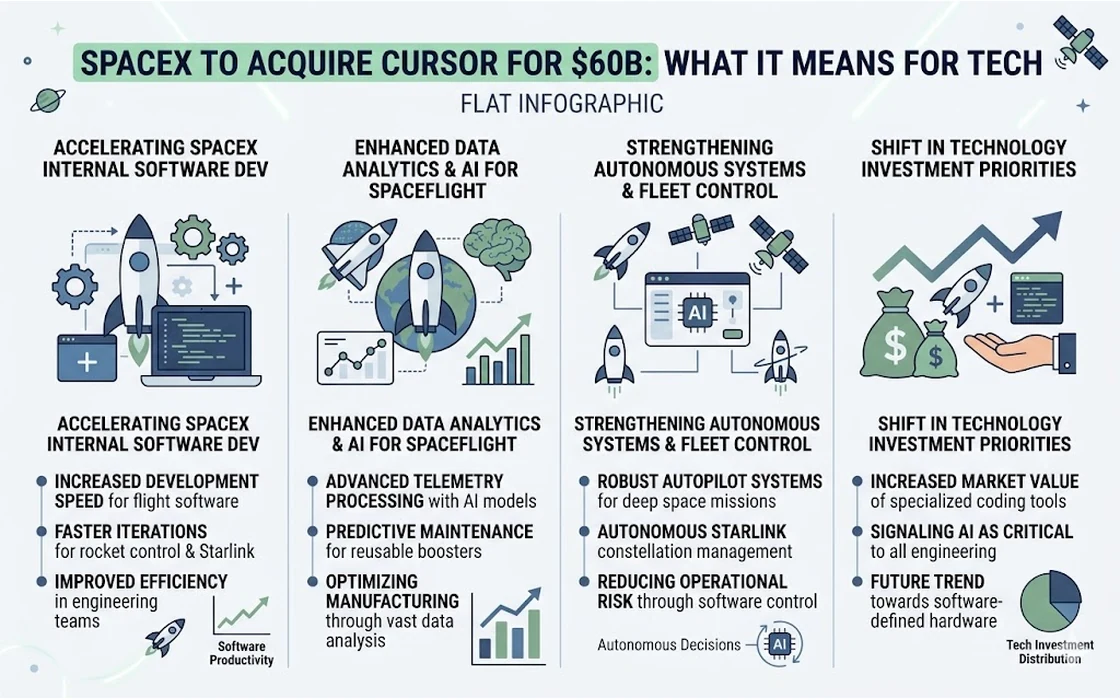
Elon Musk has often stated that the bottleneck to progress is the “rate of iteration.” By acquiring Cursor, SpaceX is effectively verticalizing its development stack. If SpaceX engineers can write, test, and deploy flight software 10x faster using Cursor’s AI capabilities, the timeline for the first human mission to Mars shrinks significantly. In the high-stakes environment of space travel, where a single line of buggy code can lead to a multi-billion dollar failure, having an AI that understands the mission-critical constraints is invaluable.
SpaceX is moving toward a future of “Software-Defined Aerospace.” This means:
- Rapid Prototyping: Writing simulation code for Starship’s heat shield dynamics in minutes rather than weeks.
- Autonomous Systems: Building more robust AI for orbital maneuvers and landing sequences on lunar or Martian surfaces.
- Real-time Optimization: Using AI to constantly rewrite and optimize code for Starlink’s global throughput as millions of new users join the network.
Vertical Integration at Scale
Musk’s companies are famous for vertical integration—building their own chips, their own batteries, and their own engines. Acquiring Cursor allows SpaceX to own the “meta-tool.” They no longer rely on third-party IDEs (Integrated Development Environments) that might not be optimized for the specific, high-concurrency needs of aerospace software. By controlling the editor, SpaceX can build custom “rules” into the AI that enforce aerospace safety standards directly as the code is being typed.
The xAI & Colossus Synergy: A Unified Intelligence
One of the most exciting aspects of this deal is the potential synergy with xAI, Musk’s dedicated artificial intelligence company. xAI recently made headlines with the launch of the Colossus supercomputer, currently one of the most powerful AI training clusters in the world, boasting a massive array of H100 equivalents.
Grok Integration in Cursor
It is almost certain that Cursor will transition from being model-agnostic to being powered primarily by xAI’s Grok. This creates a closed-loop ecosystem where:
- Colossus trains the most advanced coding models using data from SpaceX’s internal proprietary codebases.
- Grok provides the intelligence backend, optimized for “system-level” thinking.
- Cursor serves as the user interface for developers, providing a seamless “thought-to-code” pipeline.
The Power of Specialized Models
While general-purpose LLMs (Large Language Models) are great at writing generic Python scripts, SpaceX needs models that understand real-time operating systems (RTOS), hardware-level constraints, and complex physics simulations. By combining Cursor’s interface with xAI’s compute power, they can create a specialized “Aerospace AI” that knows the intricacies of SpaceX’s proprietary hardware better than any human engineer. This level of specialization is what will separate SpaceX from traditional aerospace competitors who still rely on legacy manual coding processes.
The $60B Price Tag: Analysis of the Valuation
A $60 billion (Rs. 5 lakh crore) valuation is difficult for the average reader to wrap their head around. To put it in perspective, Microsoft bought GitHub for $7.5 billion in 2018. Why is Cursor worth eight times more just a few years later?
The “AI Multiplier”
In the pre-AI era, software tools were valued based on user seats and subscriptions. In the AI era, tools are valued based on productivity gains. If Cursor can make a $200,000-a-year engineer twice as productive, the value of that software is immense. With $2 billion in ARR, the $60 billion price tag represents a 30x revenue multiple. While high, it is consistent with “category-defining” AI companies that have the potential to become the next Microsoft or Adobe.
Comparison to the SpaceX $2T IPO
With SpaceX recently completing a $2 trillion IPO, a $60 billion acquisition represents only 3% of its total valuation. In the context of a company with such massive capital, this is a calculated surgical strike to dominate the developer toolchain. For SpaceX investors, this isn’t a distraction; it’s an insurance policy for the company’s technical superiority. It ensures that the brightest minds in the world continue to use a tool owned and optimized by SpaceX.
Impact on Indian Developers: The Shift to AI Engineering
India is home to the world’s largest developer population, with millions of engineers working in Bengaluru, Hyderabad, Pune, and NCR. The SpaceX-Cursor deal is not just a US-centric event; it has massive implications for the Indian IT sector, which contributes significantly to the national GDP.
From “Coding” to “AI Orchestration”
The acquisition reinforces the reality that the traditional “coder” is being replaced by the "AI Engineer." Indian developers who were once valued for their ability to write syntax are now being judged on their ability to architect systems using AI tools.
- Upskilling: Indian engineers must master Cursor and similar AI-native tools to remain competitive in the global market.
- The Cost Efficiency: An Indian startup that previously needed 10 developers (costing roughly Rs. 2 crore per year) might now achieve the same output with 2 developers using Cursor, drastically reducing the “cost to build” and increasing the survival rate of early-stage ventures.
The Future of IT Services and the “Man-Month” Model
Large Indian IT firms like TCS, Infosys, and Wipro will likely have to pivot their delivery models. If AI can automate 60-70% of code generation, the traditional “man-month” billing model—where companies are paid based on how many people they assign to a project—is under serious threat. The SpaceX acquisition of Cursor serves as a wake-up call: the tools of production are changing, and those who don’t adapt to an “outcome-based” or “AI-first” model will face obsolescence. We may soon see “AI-Certified” engineering teams in Bengaluru commanding higher premiums than traditional teams.
The Competitive Landscape: How Microsoft and Google Might Respond
SpaceX’s entry into the developer tool space creates a new “Third Front” in the AI wars. Previously, it was Microsoft (GitHub Copilot) vs. Google (Gemini/IDX). Now, a hardware-first giant with nearly infinite capital and its own supercomputer has entered the fray.
Microsoft’s Defense Strategy
Microsoft, as the owner of VS Code and GitHub, cannot afford to lose the developer’s “eyeballs.” We can expect Microsoft to accelerate the integration of GPT-5 (or its successors) directly into the VS Code core, moving away from the extension model to mimic Cursor’s “AI-native” feel. The threat for Microsoft is that Cursor is already winning the hearts and minds of the most elite developers—the “power users” who set the trends for the rest of the industry.
Google’s “IDE-less” Vision
Google has been pushing Project IDX, a cloud-based development environment. However, Cursor’s success proves that developers still prefer a high-performance local editor. Google may need to double down on its “Gemini for Google Cloud” integration or perhaps make a move to acquire other emerging AI-native editors like Zed or PearAI to stay relevant in the local development space.
Privacy, Security, and Corporate Control
While the acquisition is a win for SpaceX, it has raised concerns among the open-source community and enterprise legal teams. Cursor was built on the foundations of VS Code, which is open-source, but the AI layers are increasingly proprietary.
Data Sovereignty and the Defense Angle
Many companies are wary of their proprietary code being used to train AI models. With SpaceX—a major US defense contractor—owning Cursor, there are questions about where the code goes. Will a developer in India or Europe feel comfortable using an editor owned by a company so closely tied to the US military and government interests? For Indian firms working on sensitive national projects, this might necessitate the development of “Air-gapped” or “Indigenized” AI coding tools.
The Proprietary Shift and the “Digital Divide”
There is a fear that Cursor might move away from its VS Code roots and become a completely closed, proprietary ecosystem. If the best AI features are locked behind a SpaceX/xAI subscription, it could create a “digital divide” in the developer community. Large enterprises with deep pockets (like those with Rs. 1,000 crore+ IT budgets) will have access to hyper-productive AI, while independent developers and students in Tier-2 Indian cities might be left with legacy tools, widening the inequality in the tech talent market.
The Future of Software-Defined Aerospace
Looking ahead, the integration of Cursor into SpaceX opens up possibilities that were once the domain of science fiction. We are looking at a future where software and hardware are truly one.
- Self-Healing Satellites: If a Starlink satellite experiences a software glitch in orbit, an AI powered by Cursor/Grok could potentially write and deploy a patch autonomously, preventing service outages for millions of users.
- Mars-Base Automation: On a planet where communication lag to Earth is 20 minutes, astronauts will need tools that can generate software solutions locally and instantly. A “Mars-Edition” of Cursor could be the primary tool for survival.
- Universal Engineering: The boundary between “writing code” and “designing hardware” will blur. Cursor could evolve into a tool that not only writes C++ but also designs CAD models for rocket parts or optimizes fuel mixtures through real-time AI simulations.
The $60 billion price tag is a bet on this convergence. It is a bet that the company that controls the AI coding pipeline will ultimately control the pace of human innovation across all physical and digital domains.
Conclusion
The acquisition of Cursor by SpaceX for $60 billion (Rs. 5 lakh crore) is far more than a simple business transaction; it is a manifesto for the future of technology. By combining the financial might of a $2 trillion aerospace titan with the cutting-edge AI capabilities of a $2 billion ARR software disruptor, Elon Musk is building a vertical empire that spans from the silicon chips on Earth to the stainless steel hulls of ships bound for Mars.
For the general reader and the developer alike, the message is clear: the era of manual coding is drawing to a close. We are entering an age where AI-driven engineering is the standard, and the speed of software development will dictate the speed of human progress. As Cursor integrates with the xAI ecosystem and the Colossus supercomputer, we can expect a revolution in how software is conceived, written, and deployed.
Whether this consolidation of power is beneficial for the broader tech ecosystem remains to be seen, but one thing is certain: the "SpaceX-ification" of software development has begun. For the millions of developers in India and across the globe, the challenge now is to master these new tools and find their place in a world where the line between human creativity and machine intelligence continues to fade. The stars are no longer just a destination; they are a codebase, and SpaceX just bought the best editor to write it.
- Tags:
- Spacex
- Cursor
- Ai Coding
- Elon Musk
- Software
- India Tech
- Aerospace