
Renault's Rare-Earth-Free EV Motors: A Tech Revolution
Renault is pioneering electric motors without rare earth metals, offering a sustainable and affordable path for the future of global EV adoption.

- NV Trends
- 9 min read
The global shift toward electric vehicles (EVs) is no longer a distant dream but a rapidly accelerating reality. In India, we see this transformation every day—from the silent hum of electric scooters weaving through Mumbai’s traffic to the growing number of electric SUVs at charging stations in Delhi. However, as we embrace this “green” future, a quiet but significant concern has been brewing in the background: our dependence on rare earth elements. These materials, essential for the powerful magnets in most EV motors, carry a heavy environmental and geopolitical price tag.
Renault, a pioneer in the electric vehicle space, has recently made headlines with a breakthrough that could change the trajectory of the entire industry. By developing high-performance electric motors that completely eliminate the need for rare earth metals, the French automaker is addressing one of the most critical bottlenecks in the EV supply chain. This innovation is not just a technical curiosity; it is a strategic move that aligns perfectly with global sustainability goals and offers profound implications for the Indian market, where cost-efficiency and supply chain security are paramount.
In this deep dive, we will explore the science behind Renault’s magnet-free motors, the hidden costs of rare earth mining, and why this technological shift is a massive win for the Indian consumer and the “Atmanirbhar Bharat” (Self-Reliant India) initiative. As we stand at the crossroads of a transportation revolution, understanding these fundamental changes in how our cars are powered becomes essential for every tech enthusiast and car buyer in India.
The Hidden Crisis: What are Rare Earth Elements?
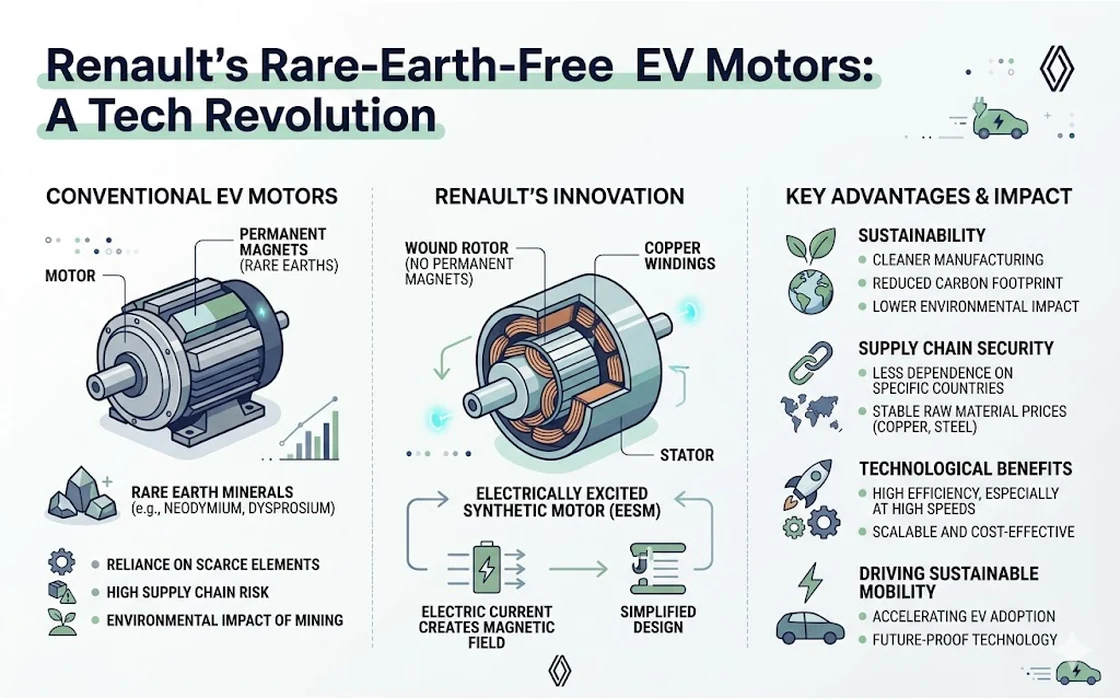
To understand why Renault’s innovation is so significant, we first need to look at what they are leaving behind. Most modern electric vehicles use Permanent Magnet Synchronous Motors (PMSM). These motors rely on incredibly strong magnets made from a specific group of minerals known as rare earth elements (REEs), such as Neodymium, Terbium, and Dysprosium.
Despite their name, rare earth elements are relatively abundant in the earth’s crust. However, they are “rare” because they are seldom found in high concentrations and are extremely difficult and expensive to mine and refine. The extraction process is notoriously “dirty,” involving toxic chemicals and producing radioactive waste as a byproduct. For an industry that prides itself on being “zero-emission,” the reliance on these minerals is a significant ethical and environmental contradiction.
The Geopolitical Monopoly
Beyond the environmental toll, there is a massive geopolitical risk. Currently, China controls over 80% of the world’s rare earth processing capacity. For a country like India, which is aggressively pushing for EV adoption to reduce its oil import bill, swapping oil dependency for rare earth dependency is a risky trade-off. Fluctuations in international relations can lead to supply shocks, causing the prices of EV components to skyrocket. By removing rare earths from the equation, Renault is effectively “de-risking” the electric motor.
Economic Volatility for India
For the Indian manufacturer and consumer, the cost of these magnets is a major component of the vehicle’s final price. When the price of Neodymium spikes in the global market, an EV that was supposed to cost Rs. 15 Lakh might suddenly become unviable for the manufacturer without a price hike. Renault’s move toward a more stable material list—primarily copper and steel—provides a level of price predictability that is essential for the price-sensitive Indian market.
Decoding Renault’s Technology: The Wound-Rotor Motor
Renault isn’t just “removing” magnets; they are replacing them with a more elegant engineering solution. The technology they are championing is known as the Wound-Rotor Synchronous Motor (WRSM). While most EVs use permanent magnets to create a magnetic field in the motor’s rotor, Renault’s design uses electricity to create that field.
How It Works
In a standard PMSM, the rotor (the part that spins) has permanent magnets fixed to it. These magnets interact with the magnetic field created by the stator (the stationary part) to produce torque. In Renault’s WRSM:
- The rotor does not have any magnets.
- Instead, it features copper coils wound around the rotor teeth.
- When an electric current is passed through these coils, they become “electromagnets.”
- By controlling the current sent to the rotor, engineers can precisely manage the strength of the magnetic field.
This design is not entirely new—Renault has been using variations of it in the Zoe and the Megane E-Tech. However, their latest generation, the E7PT motor (developed in partnership with Valeo), takes this to a whole new level of efficiency and power density.
The Power of Precision
One of the greatest technical advantages of a wound-rotor motor is its flexibility. In a permanent magnet motor, the magnets are always “on.” This creates “drag” or energy loss at high speeds (known as back-EMF). In Renault’s design, because the magnetic field is created by electricity, it can be turned down or optimized depending on how you are driving. If you are cruising on a highway, the motor can adjust its internal magnetic strength to maximize efficiency, potentially increasing the vehicle’s range without needing a larger battery.
Why This is a Game Changer for the Indian EV Ecosystem
India is currently in a “sweet spot” for EV growth. With the government’s PLI (Production Linked Incentive) schemes and the push for local manufacturing, the focus is on building a supply chain that doesn’t rely on volatile imports. Renault’s rare-earth-free technology fits this vision like a glove.
Supporting “Make in India”
India has a robust copper and steel industry. By shifting the focus of EV motors from exotic rare earth magnets to copper windings, we move the manufacturing requirements into areas where India already has significant industrial strength. Instead of importing expensive processed magnets from China, Indian manufacturers could potentially source all the raw materials for a WRSM right here at home. This is the definition of Atmanirbhar Bharat.
Cost Savings for the Consumer
The cost of magnets can account for up to 25% to 30% of the total cost of an electric motor. By eliminating them, the manufacturing cost of the motor drops significantly. In the competitive Indian market, where every Rs. 50,000 difference can shift a buyer from one segment to another, this technology could help bring high-performance EVs into the Rs. 10 Lakh to Rs. 12 Lakh price bracket more effectively.
Performance in Indian Conditions
India’s extreme heat is a challenge for EV batteries and motors. Permanent magnets can actually lose their magnetism if they get too hot (a phenomenon known as demagnetization). While modern cooling systems manage this, a wound-rotor motor is inherently more robust in this regard. The ability to control the rotor current gives engineers more tools to manage the thermal profile of the motor, which is a significant plus for cars operating in the 45°C summers of Northern India.
Sustainability: A Truly Green Lifecycle
We often talk about EVs having “zero tailpipe emissions,” but we must also consider the “cradle-to-grave” impact. A vehicle’s environmental footprint includes the energy used to build it and the materials extracted from the earth.
- Recyclability: Permanent magnets are notoriously difficult to recycle. Separating rare earth elements from a used motor is a complex, energy-intensive chemical process. In contrast, copper and steel are two of the most recycled materials on the planet. A Renault motor at the end of its life can be melted down, and nearly 100% of the copper can be reused in a new motor.
- Reduced Carbon Footprint: The carbon footprint of mining copper is significantly lower than that of mining rare earth elements. By switching to WRSM, Renault claims to have reduced the overall environmental impact of their motor production by nearly 30%. For an Indian buyer who is switching to an EV for environmental reasons, this “hidden” sustainability is a powerful selling point.
Addressing the Challenges: Complexity and Size
It would be unfair to say that wound-rotor motors are perfect in every way. If they were, every company would have switched years ago. There are two main hurdles that Renault and their partners have had to overcome:
1. The Complexity of the Rotor
In a permanent magnet motor, the rotor is essentially a solid piece of metal with magnets glued on. In a WRSM, you have to wind copper wire around it and find a way to get electricity into a part that is spinning at 15,000 RPM. Historically, this required “brushes”—small carbon blocks that rub against the spinning shaft. Brushes wear out over time and create “dust,” making them unsuitable for the long life-cycles expected of EVs.
Renault’s solution? Brushless excitation. By using inductive technology (similar to how a wireless phone charger works), they can transfer electricity to the spinning rotor without any physical contact. This eliminates wear and tear, making the motor virtually maintenance-free for the life of the vehicle.
2. Power Density
Magnets are incredibly powerful for their size. To get the same amount of “magnetic push” from a copper coil, you often need a larger, heavier motor. However, Renault’s latest E7PT motor uses an 800V architecture and advanced cooling to achieve a power density that rivals the best magnet-based motors from companies like Tesla or BYD. It produces up to 200 kW (approx 270 bhp) of power while remaining compact enough to fit into a standard passenger car.
The Future of EV Engineering
Is the industry following Renault’s lead? The signs point to a resounding “Yes.” While Tesla originally made the Induction Motor famous (another magnet-free design), they switched to permanent magnets for their “Model 3” to maximize efficiency. However, even Tesla is now researching ways to reduce or eliminate rare earths in their next-generation drive units.
BMW is another major player that has embraced wound-rotor technology for its “i” series of cars (like the i4 and iX). By opting for this path, these European manufacturers are setting a new standard for what a “responsible” EV should look like.
What This Means for Indian Manufacturers
Indian giants like Tata Motors and Mahindra have been watching these developments closely. Currently, most Indian-made EVs use permanent magnet motors sourced from global suppliers. If Renault’s technology proves successful at scale, expect a shift in the R&D labs of Pune and Chennai. The prospect of building an EV that is 100% independent of the Chinese magnet supply chain is too tempting for Indian CEOs to ignore.
Conclusion
Renault’s development of rare-earth-free electric motors is a masterclass in “conscious engineering.” By looking beyond the easy solution of using permanent magnets, they have tackled the three biggest problems facing the EV industry today: environmental degradation, geopolitical instability, and cost volatility.
For us in India, this technology is more than just a win for Renault; it is a blueprint for how we can build a truly sustainable and self-reliant automotive future. As we transition from petrol and diesel to electric, we must ensure that our new “fuel” is as clean and ethical as possible. Renault has shown that with a bit of ingenuity, we can have high-performance, long-range electric vehicles without digging a hole in the planet or our pockets.
The next time you see a Renault EV on the road, remember that its heartbeat is powered not by exotic minerals from a distant mine, but by the simple, elegant force of electromagnetism—proving once again that the best way forward is often found by rethinking the basics of how the world works.