
Pancreatic Cancer Breakthrough: Finding the Master Switch
A new medical breakthrough targeting the KRAS protein could revolutionize pancreatic cancer treatment, offering hope for millions through molecular glues.

- NV Trends
- 10 min read
For decades, a diagnosis of pancreatic cancer has been one of the most feared sentences in modern medicine. Known as a “silent killer,” it often remains undetected until it has reached an advanced stage, leaving doctors with very few tools to combat its aggressive spread. In India, where late-stage diagnosis is the norm due to lack of routine screening and specialized awareness, the survival rates have historically been dishearteningly low. However, a major scientific breakthrough, recently highlighted across global technology and medical forums, suggests that we may have finally identified and learned how to toggle cancer’s “master switch.”
At the heart of this discovery is a protein known as KRAS. For over forty years, scientists have known that KRAS acts as a central control for cell growth, but they also knew that when it mutates, it becomes an unstoppable engine for tumour development. This mutation is present in nearly 90% of pancreatic cancers, making it the primary target for any potential cure. Until now, KRAS was considered “undruggable”—a fortress that no medicine could penetrate. But the emergence of a new class of drugs, led by a compound called daraxonrasib, is changing that narrative, effectively “gluing” the rogue switch into an off position.
This development isn’t just a win for the scientific community; it is a beacon of hope for thousands of Indian families currently battling this disease. As we stand on the cusp of a new era in oncology, understanding how this technology works, the clinical success behind it, and what it means for the future of healthcare in India is essential. This is not just about a new pill; it is about a fundamental shift in how we understand the very mechanics of human life and the errors that lead to cancer.
Understanding the KRAS Protein: The Master Switch of Life and Death
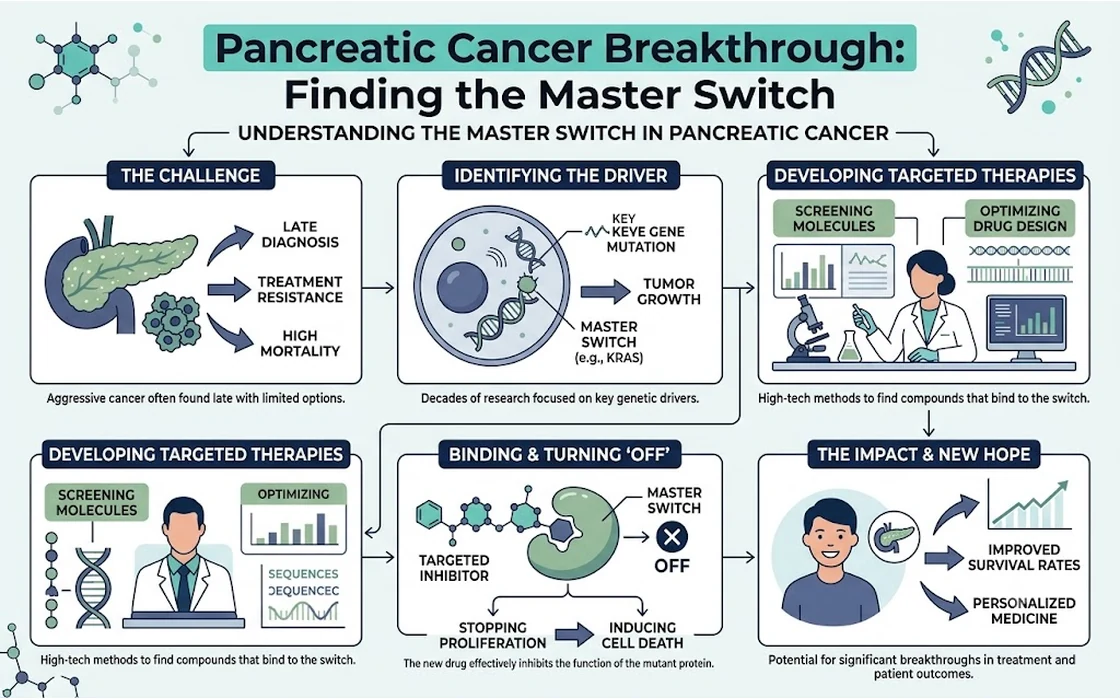
To understand why this breakthrough is so significant, one must first understand the role of the KRAS protein. In a healthy body, KRAS acts like a sophisticated light switch. When the body needs to grow new cells—perhaps to heal a wound or replace old tissue—the KRAS protein flips to the “on” position, sending signals that tell cells to divide. Once the job is done, it flips back “off.” It is a perfectly balanced system that regulates the growth of every organ in our bodies.
However, in many forms of cancer, a tiny genetic mutation causes this switch to get stuck in the “on” position. The signals to grow and divide never stop. The result is an uncontrolled explosion of cell growth that forms a tumour. In pancreatic cancer, this KRAS mutation is almost universal. Because the pancreas is deep within the abdomen, these growing tumours often go unnoticed until they interfere with digestion or cause jaundice, by which time the “on” switch has already driven the cancer to spread to other organs.
For years, researchers tried to design drugs that could turn this switch off. They searched for “pockets” on the surface of the KRAS protein where a drug molecule could latch on, similar to how a key fits into a lock. But they discovered that the surface of the KRAS protein is remarkably smooth—often described by scientists as a “greased cannonball.” There was nowhere for a traditional drug to grab. This led to the depressing consensus that KRAS was “undruggable,” and pancreatic cancer remained one of the most difficult challenges in medicine.
The Science of “Molecular Glues”: How Daraxonrasib Works
The breakthrough that has captured the attention of the technology world is the shift from “locks and keys” to “molecular glues.” Instead of trying to find a hole in the KRAS protein, researchers developed a way to make it stick to something else. This is the core technology behind daraxonrasib.
Daraxonrasib is part of a revolutionary class of medications known as molecular glues. Instead of trying to block the KRAS protein directly, the drug acts as an adhesive. It binds to the mutated KRAS protein and then forces it to stick to another common, harmless protein already present in our cells, known as Cyclophilin A (CypA). When KRAS is “glued” to CypA, its shape is distorted, and its ability to send growth signals is physically blocked.
This is a massive leap in biotechnology. It is the equivalent of moving from a physical barrier to a chemical redirection. By using the cell’s own proteins to neutralize the cancer-driving switch, daraxonrasib can target the “undruggable” KRAS with surgical precision, leaving healthy cells largely unaffected. This high level of specificity is what makes the drug so promising, as it potentially reduces the devastating side effects often associated with traditional chemotherapy.
Clinical Success: Doubling the Survival Odds
The excitement surrounding this “master switch” discovery is not merely theoretical. Recent clinical trials have yielded results that oncologists are calling “unprecedented.” For patients with advanced, metastatic pancreatic cancer—who typically have a median survival rate of about six to seven months—the introduction of these KRAS-targeting drugs has nearly doubled that timeline in early studies.
In the most recent trials, patients treated with daraxonrasib showed a median survival of over 13 months. While 13 months may still seem short to a healthy person, in the world of pancreatic oncology, it represents a monumental achievement. It means more time with family, more opportunities for other treatments to work, and a higher quality of life. Furthermore, some patients in the trial showed “partial responses,” where their tumours actually shrank significantly, something rarely seen in late-stage pancreatic cancer patients.
Beyond the numbers, the clinical success proves that the KRAS barrier has finally been breached. If we can target one version of the KRAS mutation, we can theoretically target them all. This opens the door for a wave of new treatments not just for the pancreas, but for lung and colorectal cancers as well, where KRAS mutations are also prevalent.
The Indian Landscape: Challenges in Diagnosis and Treatment
In India, the burden of pancreatic cancer is particularly heavy. While the incidence is lower than in some Western countries, the mortality rate is disproportionately high. According to the Indian Council of Medical Research (ICMR), cancer cases in India are projected to increase by 12.8% by 2025. Pancreatic cancer, though accounting for a smaller percentage of total cases, is rising in urban populations due to changing lifestyles, sedentary habits, and rising rates of diabetes.
The primary challenge in India is late diagnosis. Most patients arrive at major hospitals like AIIMS in Delhi or Tata Memorial in Mumbai only when the cancer is at Stage III or IV. Symptoms like vague abdominal pain or weight loss are often dismissed or misdiagnosed as digestive issues. By the time jaundice or severe pain appears, the KRAS “master switch” has already caused extensive damage.
Furthermore, access to specialized oncology care is concentrated in Tier-1 cities. For a patient in a rural part of Bihar or Rajasthan, getting a biopsy and a genetic test to identify a KRAS mutation is a Herculean task. Without identifying the specific mutation, these new “master switch” drugs cannot be used effectively. Therefore, the technological breakthrough in the lab must be matched by a technological breakthrough in Indian diagnostic infrastructure.
Affordability and Access: Can India Lead the Way?
Whenever a new “miracle drug” is announced, the first question in the Indian context is always: “How much will it cost?”
Currently, targeted therapies and immunotherapies in India can cost anywhere from Rs. 2 lakhs to Rs. 8 lakhs per month. For the average Indian family, this is an impossible sum. Even with insurance, these costs often lead to “financial toxicity,” where the cost of treatment destroys the family’s financial stability.
However, India has a unique advantage: our robust pharmaceutical industry. We are often called the “Pharmacy of the World” for our ability to produce high-quality generic versions of expensive drugs. While daraxonrasib is currently under patent and will likely be very expensive upon its initial launch, there are several paths to making it affordable for Indians:
- Clinical Trials in India: By participating in global clinical trials, Indian patients can get early access to these drugs for free, while also providing data on how the drug works specifically within the Indian genetic pool.
- Compulsory Licensing: In cases of extreme public health need, the Indian government has the power to allow local companies to produce a drug even if it is under patent, though this is a complex legal route.
- Local Innovation: Several Indian biotech startups are already working on their own versions of “molecular glues.” If an Indian company can develop a similar mechanism, the price could drop by 80-90%.
For a breakthrough to be truly revolutionary, it must be accessible. The hope is that as the “master switch” technology matures, the cost of manufacturing will decrease, and tiered pricing models will allow Indian patients to access life-saving treatment at a fraction of the Western cost.
The Ripple Effect: Targeting Other KRAS-Driven Cancers
While the news focuses on pancreatic tumours, the implications of finding the “master switch” extend far wider. KRAS mutations are responsible for:
- 30% of Lung Cancers: Particularly non-small cell lung cancer (NSCLC), which is a major health concern in India due to high pollution levels and smoking rates.
- 40% of Colorectal Cancers: A cancer that is seeing a steady rise among younger Indians due to diets high in processed foods.
- Various other tumours: Including those in the biliary tract and some types of leukemia.
By proving that we can “glue” KRAS into an inactive state, we have essentially created a blueprint for treating a huge segment of all human cancers. This is why the Hacker News community and the broader tech world are so energized. This isn’t just one drug for one cancer; it’s a new “platform” for drug discovery.
In the future, a patient in India might go for a routine check-up, have a simple blood test (known as a “liquid biopsy”), and if a KRAS mutation is detected early, they could be prescribed a specific “molecular glue” to flip that switch off before a tumour even has the chance to grow. This is the dream of precision medicine.
Artificial Intelligence and Cancer Detection in India
The “master switch” discovery is being bolstered by another technological giant: Artificial Intelligence. In India, AI is already being used to assist radiologists in identifying early signs of pancreatic tumours on CT scans that the human eye might miss.
Companies and research institutes in Bengaluru and Hyderabad are developing AI models trained on thousands of Indian patient records. These models can predict which patients are at a higher risk of having a KRAS mutation based on their medical history and minor symptoms. When you combine early AI-based detection with a “master switch” drug like daraxonrasib, the survival rates could jump from “doubling” to “curing.”
For the tech-savvy Indian, this is the most exciting intersection of biology and data science. We are no longer just guessing; we are using code and chemistry to debug the human body.
Conclusion
The discovery of cancer’s “master switch” in pancreatic tumours marks a historic turning point in our battle against the disease. For decades, we were fighting an invisible enemy with blunt tools. Today, we have a map of the enemy’s control room and a way to sabotage the primary switch.
While the journey from a laboratory breakthrough to a tablet available at your local pharmacy in Delhi or Chennai is still ongoing, the hard part—the “undruggable” part—is over. We now know that KRAS can be beaten. We know that “molecular glues” work. And we know that for the first time in history, pancreatic cancer is no longer a hopeless fight.
As an Indian audience, our focus must now shift toward improving early diagnosis and ensuring that when these treatments become available, they are affordable for all, not just the wealthy. The “master switch” has been found; now we must ensure everyone has the power to turn it off. The future of oncology is bright, and it is built on a foundation of technology, persistence, and the refusal to accept “undruggable” as an answer.