
OpenAI is Burning Billions: Should India Worry?
Leaked documents reveal OpenAI's staggering $38 billion loss in 2025. Explore what this means for the AI industry and the impact on the Indian tech landscape.

- NV Trends
- 7 min read
The world of Artificial Intelligence was recently rocked by a series of leaked financial documents that have pulled back the curtain on the fiscal reality of OpenAI. While the creators of ChatGPT have become a household name globally, including in millions of homes across India, the numbers behind the scenes tell a story of astronomical growth shadowed by even more staggering losses. In 2025 alone, OpenAI reportedly posted a net loss of over $38 billion, a figure that has sent shockwaves through the technology and finance sectors alike.
For the average Indian professional or student who uses ChatGPT daily for coding, writing, or learning, these numbers might seem like abstract Silicon Valley math. However, the financial health of the world’s leading AI lab has direct implications for the tools we use, the startups being built in Bengaluru and Hyderabad, and the broader digital economy. This isn’t just about a company losing money; it’s about the sustainability of the “AI revolution” that promised to change everything.
As we dive into these leaked documents, it becomes clear that OpenAI is playing a high-stakes game of “winner-takes-all.” The company is spending money at a rate rarely seen in corporate history, betting that the eventual creation of Artificial General Intelligence (AGI) will be so valuable that today’s tens of billions in losses will look like pocket change. But as the burn rate intensifies, the question remains: is this a visionary leap forward or a looming financial bubble?
The Staggering Scale of the Burn
To understand the gravity of the situation, we have to look at the sheer leap in spending. In 2024, OpenAI was already losing significant capital, but 2025 saw those figures explode. The company’s revenue actually grew by a massive 253%, jumping from $3.7 billion to over $13 billion. In any other industry, a company tripling its revenue would be cause for celebration. Yet, at OpenAI, the expenses grew even faster.
The total expenses for 2025 reached a mind-boggling $34 billion. While a significant portion of the $38 billion net loss includes a one-time accounting charge related to their transition from a non-profit to a for-profit entity, the actual “cash burn”—the real money leaving their bank accounts—was still around $8 billion for the year. To put that in perspective for an Indian reader, $8 billion is approximately Rs. 67,000 crores. That is more than the annual budget of several Indian states, spent by a single company in just twelve months.
Why is OpenAI Losing So Much Money?
It’s natural to wonder how a software company can manage to lose such a vast fortune. Unlike a manufacturing firm that has to buy raw materials or a logistics company that needs a fleet of trucks, OpenAI’s “raw materials” are data and computing power.
1. The Compute Tax: The Microsoft Connection
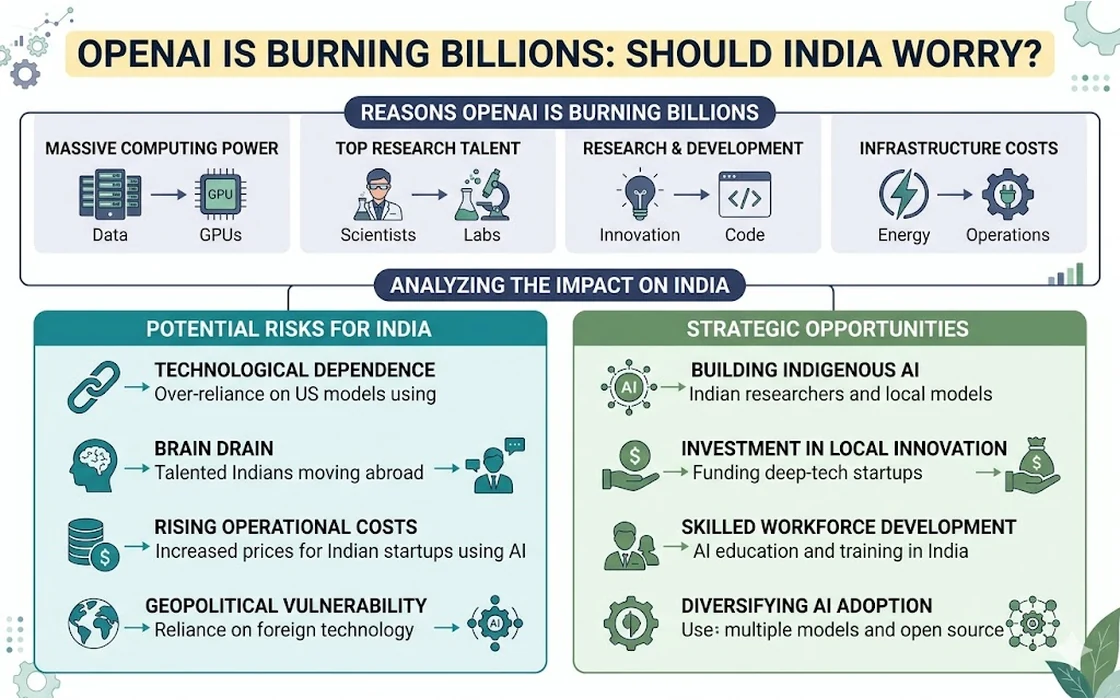
The single biggest drain on OpenAI’s resources is “compute.” Training a model like GPT-5 or the rumored “Sora” video generator requires thousands of high-end NVIDIA GPUs running for months. According to the leaks, OpenAI paid Microsoft—their primary partner and cloud provider—a staggering $17.2 billion in 2025 for cloud services and R&D support.
This creates a fascinating, if somewhat lopsided, relationship. While Microsoft has invested billions into OpenAI, a huge chunk of that investment goes right back to Microsoft in the form of Azure cloud fees. It’s a virtuous cycle for Microsoft’s stock price, but a punishing reality for OpenAI’s balance sheet.
2. The Talent War
In the world of AI, the smartest minds are the most expensive assets. OpenAI is in a fierce “war for talent” against Google, Meta, and well-funded startups like Anthropic. To keep the engineers who are capable of pushing the boundaries of neural networks, OpenAI has to pay Silicon Valley salaries that often reach $1 million (approx. Rs. 8.4 crores) per year or more, plus equity. The leaked documents show that R&D spending, which includes these salaries, hit $19.18 billion in 2025.
3. Customer Acquisition at Scale
As competition heats up, OpenAI is no longer just a research lab; it’s a massive consumer business. Spending on sales and marketing quintupled in 2025 to over $5.7 billion. They are fighting to ensure that ChatGPT remains the “default” AI for enterprises and individuals, even as Google integrates Gemini into every Android phone and Apple brings “Apple Intelligence” to the iPhone.
The Indian Perspective: Why This Matters to Us
India has the second-largest user base for ChatGPT in the world. From developers in Pune to small business owners in Chennai, the “AI-first” mindset has taken deep root. However, the financial instability of the industry leader introduces several risks and opportunities for the Indian ecosystem.
The Cost of “Free” AI: Currently, many of us enjoy a very capable free version of ChatGPT. But if OpenAI is losing Rs. 67,000 crores a year, the “free” era might not last forever. We have already seen the introduction of “ChatGPT Plus” and enterprise tiers. If the financial pressure continues, we could see more aggressive monetization, which might make these essential tools less accessible to Indian students and researchers.
The Opportunity for Indian Startups: The massive losses at OpenAI highlight a “moat” problem. If it takes $20 billion a year just to stay in the race, can an Indian startup ever compete? The answer might lie in Frugal Innovation. Instead of building massive “frontier” models, Indian AI startups are increasingly focusing on “Small Language Models” (SLMs) that are optimized for specific tasks or Indian languages like Hindi, Tamil, and Bengali. These models are much cheaper to train and run, potentially offering a more sustainable path than the “burn-at-all-costs” model of Silicon Valley.
Is an IPO the Only Way Out?
With such massive losses, OpenAI needs constant infusions of cash. The leaked reports suggest that OpenAI has already filed a confidential “S-1” with the US Securities and Exchange Commission (SEC), signaling an intent to go public through an Initial Public Offering (IPO).
An IPO would allow the company to raise tens of billions of dollars from public market investors. Some analysts predict the company could be valued at $1 trillion (about Rs. 84 lakh crores). For context, that would make OpenAI more valuable than almost every company in India combined, save for a few giants like Reliance Industries and TCS.
However, a public listing brings scrutiny. Shareholders expect a path to profitability. If OpenAI goes public, the pressure to “show the money” will be intense. This could lead to a shift away from “Open” research and towards proprietary, high-cost products that prioritize margins over the “benefit of humanity” mission the company was founded on.
The Road to 2030: Profitability or Bust?
Internal projections cited in the leaks suggest that OpenAI doesn’t expect to turn a profit until 2030. Between now and then, they plan to commit over $600 billion (approx. Rs. 50 lakh crores) to data centers and infrastructure.
This is a bet of unprecedented scale. The logic is that once the AI is “smart enough,” it will be able to perform tasks that are currently done by humans—coding, legal analysis, medical diagnostics, etc.—at a fraction of the cost. If OpenAI owns the “brain” that powers the global economy, $38 billion in annual losses will seem like a bargain.
But there are risks. Regulation is tightening globally. In India, the government is already looking at how AI uses data and its impact on jobs. If regulators limit how AI can be used, or if “AI fatigue” sets in among consumers, OpenAI’s path to $1 trillion in value could turn into a path to a $1 trillion collapse.
Conclusion
The leaked financial documents of OpenAI serve as a stark reminder that the “magic” of AI is built on a foundation of cold, hard cash. While we marvel at ChatGPT’s ability to write poems or debug code, we must realize that every prompt we enter costs the company money in compute and electricity.
For the Indian tech community, this is a wake-up call. We cannot simply rely on the largesse of Silicon Valley giants forever. The massive burn rate at OpenAI shows that the current path of “bigger is better” in AI might be hitting a financial ceiling.
As we move forward, the focus may shift from Artificial General Intelligence to Artificial Sustainable Intelligence. Whether OpenAI can survive its own success and reach that 2030 profitability goal is the biggest question in tech today. For now, the “world’s most important startup” is also the world’s most expensive one.
- Tags:
- Openai
- Artificial Intelligence
- Sam Altman
- Chatgpt
- Tech Finance
- Silicon Valley
- Future of Ai