
MiMo Code: The Open-Source AI Agent Trending Today
Xiaomi's MiMo Code is an open-source AI coding assistant. Discover its powerful features, technical architecture, and how it empowers Indian developers.

- NV Trends
- 12 min read
Just when the developer community thought the landscape of artificial intelligence coding assistants was settling into a predictable rhythm of pricey, closed-source subscriptions, the paradigm shifted overnight. On June 10, 2026, Xiaomi’s highly secretive MiMo AI team officially released MiMo Code as an open-source project. Within hours of the repository going public under the permissive MIT license, the tool skyrocketed to the top of Hacker News, igniting passionate discussions and garnering thousands of stars on GitHub in record time.
For the uninitiated, the sudden hype around a new AI tool might seem like just another blip in the relentless, fast-paced tech news cycle. However, MiMo Code represents a fundamental shift in how developers interact with large language models (LLMs). Rather than forcing software engineers into a rigid, browser-based chat window or a heavily monetised IDE extension, MiMo Code is a high-performance, terminal-native agent designed to sit right where the actual development work happens. It is a powerful “harness” that can read your codebase, write files, execute complex shell commands, and seamlessly manage Git workflows without ever asking you to leave your command line interface.
In India’s rapidly expanding tech ecosystem—home to millions of freelance developers, ambitious cutting-edge startups, and massive global enterprise hubs—the release of a high-calibre, open-source AI agent is nothing short of revolutionary. We are witnessing a clear transition where the underlying AI models are becoming powerful commodities, and the tools used to interact with them are finally being democratised. Let’s dive deep into what makes MiMo Code the most exciting software release of 2026, how its underlying architecture works, and why it is uniquely positioned to become the default assistant for Indian developers worldwide.
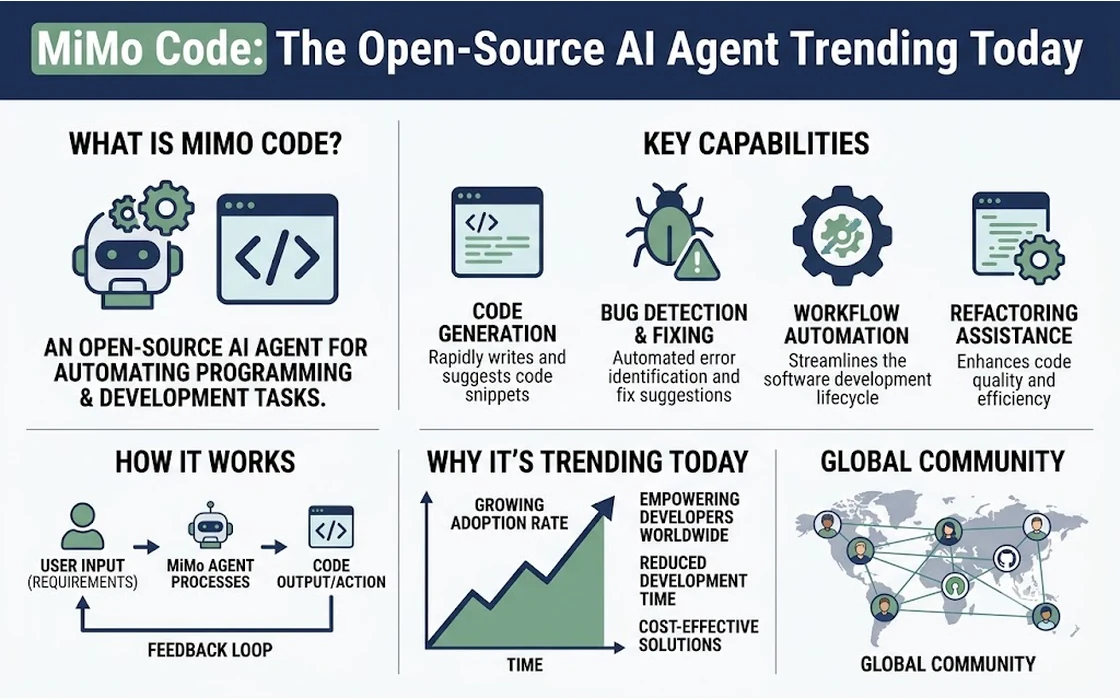
What is MiMo Code? A Terminal-Native Powerhouse
To truly understand the appeal of MiMo Code, one must first look at the daily frustrations plaguing modern developers. Traditional AI coding assistants like GitHub Copilot or Anthropic’s Claude Code have undoubtedly boosted overall productivity across the industry. However, they almost universally suffer from what engineers call the “copy-paste bottleneck.” You ask a complex question in a chat window, the AI generates a block of code, and you must manually integrate it, run tests, observe the inevitable failures, copy the error logs, and paste them back into the chat. It is a disjointed, frustrating loop that breaks a developer’s deep state of flow.
MiMo Code eliminates this friction entirely. As a terminal-native tool built conceptually as a highly advanced fork of the earlier OpenCode agent, it operates with direct, secure access to your local development environment. It doesn’t just suggest code; it executes it autonomously. If you instruct MiMo Code to “refactor the authentication module, upgrade the cryptography libraries, and fix any failing test suites,” the agent will autonomously navigate your directory structure, apply the precise edits, run the tests, and—if a compilation error occurs—read the stack trace and iterate on its own solution until the tests pass perfectly.
What truly sets this 2026 release apart is its intense focus on “long-horizon” tasks. While many legacy AI tools excel at writing a single isolated function or generating a boilerplate React component, they quickly lose contextual awareness when asked to perform a complex refactoring job that spans dozens of interrelated files and requires hundreds of sequential logical steps. MiMo Code’s specialised, state-driven architecture is built explicitly to handle these deep, multi-layered engineering challenges without getting confused or hallucinating module dependencies that do not exist in your project.
The Philosophy of the “Open Harness”
The intense enthusiasm on Hacker News following the June 2026 release wasn’t solely about the tool’s execution speed; it was largely driven by its core engineering philosophy. A popular argument that dominated the prominent forum threads is the concept of the “open harness.”
In the AI coding space, the “harness” refers to the CLI wrapper or IDE plugin that actively manages the flow of information between your local computer and the LLM API endpoint. Corporate tech giants have historically used proprietary harnesses to lock developers into their specific, paid ecosystems. For instance, you cannot easily configure Copilot to use a different backend LLM, nor can you comprehensively inspect exactly how Claude Code is packaging, formatting, and sending your proprietary codebase to Anthropic’s servers.
By releasing MiMo Code under the permissive MIT License, Xiaomi’s team is making a bold statement: the harness should be a transparent, community-driven commodity. Developers should have the absolute right to see exactly what repository context is being gathered, how the system prompts are being constructed, and where their sensitive data is travelling. This transparency is absolutely crucial for Indian IT service companies and local fintech startups handling highly sensitive client data. With MiMo Code, internal security teams can thoroughly audit the open-source code, ensure no intellectual property is leaking, and easily modify the tool to point strictly to self-hosted, air-gapped, or enterprise-approved LLMs.
Key Technical Features: Under the Hood
A deep dive into the GitHub repository for MiMo Code reveals a sophisticated piece of modern software engineering. It is far more than a thin wrapper around a chat API; it is a full-fledged autonomous agent equipped with several groundbreaking architectural features.
Persistent Cross-Session Memory
One of the most universally frustrating aspects of typical AI assistants is their digital amnesia. Every time you start a new chat session, you must manually remind the AI about your project’s architectural quirks, your preferred testing framework, or specific organisational styling guidelines. MiMo Code solves this elegantly with a persistent cross-session memory system powered by a highly optimised SQLite FTS5 (Full-Text Search) backend.
As you work alongside it, MiMo Code maintains and silently updates a dynamic MEMORY.md file and an underlying indexed database. It actually learns your engineering preferences over time. If you tell it once, “We strictly use explicit composition over inheritance in this specific repository,” it commits that architectural rule to memory and proactively applies it to all future coding sessions, saving countless hours of repetitive prompting.
Max Mode: Parallel Planning and Judging
For immensely complex algorithmic challenges, MiMo Code introduces a revolutionary feature called “Max Mode.” Instead of generating a single viable solution and hoping it compiles, Max Mode instructs the underlying LLM to draft up to five completely distinct implementation plans in parallel. The agent then acts as a rigorous “judge,” systematically evaluating the pros and cons of each approach based on your project’s specific context, expected performance requirements, and established security standards before explicitly selecting the optimal path. Xiaomi claims this parallel evaluation process increases the successful execution rate on rigorous coding benchmarks by a staggering 10% to 20%.
Dream & Distill: The Self-Improvement Loop
Perhaps the most futuristic and discussed feature is the “Dream & Distill” background process. When your terminal is idle, MiMo Code can optionally review its past coding sessions. It independently identifies repetitive workflows, common compilation errors you frequently encounter, and the specific sequential steps it took to fix them. It then automatically “distills” these actionable insights into reusable custom skills or automated macros. Essentially, the tool becomes measurably smarter and more perfectly attuned to your specific codebase the longer you use it.
Multimodal Vision Support
Modern software development isn’t exclusively about text. Often, a bug is purely visual—a misaligned navigation button, a broken responsive layout on mobile, or a colour contrast failure. MiMo Code natively embraces multimodal capabilities, allowing developers to pass screenshots, wireframes, or design mockups directly into the terminal context. You can simply command the agent to “fix the CSS flexbox layout so the login form matches this attached image exactly,” and it will intelligently interpret the visual data alongside the underlying source code to produce pixel-perfect results.
The Financial Impact for Indian Developers
While the technical features are undeniably impressive, the financial implications of MiMo Code are equally—if not more—compelling, especially in the context of the highly competitive Indian IT market. Over the past few years, independent developers and agencies alike have suffered from acute, compounding “subscription fatigue.”
Consider the baseline economics: A premium monthly subscription for a top-tier closed-source coding assistant currently costs around $20 to $25 per individual user. When converted to Indian currency, that translates to approximately Rs. 1,600 to Rs. 2,100 monthly. For a solo freelancer, this is a very noticeable recurring operational expense. However, for a small to mid-sized Indian tech agency employing just 50 developers, outfitting the entire engineering team with these proprietary tools costs well over Rs. 1,00,000 per month—a massive, unavoidable overhead that cuts directly into company profit margins.
MiMo Code completely shatters this restrictive pricing model. Because the tool itself is completely free and genuinely open-source, developers operate exclusively on a “Bring Your Own Key” (BYOK) basis. You simply plug in your private API key for whichever AI model you prefer (be it OpenAI, Anthropic, Google, or even powerful locally hosted models like Llama 3 via Ollama). You pay strictly for the exact API tokens you consume. For many efficient developers, heavily optimised API usage costs only a tiny fraction of a flat monthly subscription, potentially bringing the monthly expenditure down to a highly manageable Rs. 300 to Rs. 500 per user.
Furthermore, alongside the historic open-source release, Xiaomi announced a generous limited-time free tier for their proprietary MiMo-V2.5 base model, which boasts a staggering 1-million-token context window. For early adopters and bootstrapped startups in India, this presents an unprecedented opportunity to leverage massive, enterprise-grade AI capabilities at virtually zero financial cost.
MiMo Code vs. The Competition
How does MiMo Code actually stack up against the established heavyweights in the arena? On Hacker News and Reddit, the technical comparisons were immediate, brutal, and highly analytical.
When directly compared to Anthropic’s highly regarded Claude Code, users consistently noted that MiMo Code feels significantly “snappier” and more responsive in the terminal. Closed-source tools often invisibly inject massive amounts of hidden “prompt cruft”—invisible system instructions designed by corporate lawyers to heavily govern the AI’s behaviour. These hidden prompts heavily bloat the context window and artificially slow down response times. Because MiMo Code is completely open-source, the community has aggressively stripped and optimised the base prompts, resulting in demonstrably faster execution speeds and significantly lower token usage per request.
Against other notable open-source agents like Aider or OpenDevin, MiMo Code firmly distinguishes itself through its polished user experience and robust state management. While Aider remains excellent for quick, surgical, single-file edits, it entirely lacks the deep, SQLite-backed relational memory architecture that makes MiMo Code so powerful for large projects. OpenDevin, conversely, operates within a much heavier, resource-intensive Dockerized environment and relies on a web UI, which can feel sluggish and bloated compared to MiMo Code’s blazing-fast, direct terminal execution. Furthermore, developers who were actively mourning the recent deprecation of the open-source Gemini CLI have quickly gravitated towards MiMo Code, anointing it as the definitive, spiritual successor in the CLI space.
Real-World Application: Building for the Indian Market
To fully grasp the practical, everyday utility of MiMo Code, imagine a fast-growing Indian startup tasked with building a complex new fintech application. The engineering team urgently needs to integrate highly specific local systems, such as a secure Unified Payments Interface (UPI) SDK, while simultaneously implementing intricate, dynamically changing business logic for Goods and Services Tax (GST) calculations.
These highly localised tasks are notoriously difficult for generic, western-trained AI assistants because the necessary documentation is highly specific to the Indian banking sector and changes with every union budget. With MiMo Code, the lead architect can effortlessly feed the latest RBI regulations and UPI API documentation directly into the agent’s context window. They can then permanently update the MEMORY.md file with strict, unbending rules: “Always accurately round currency calculations to the nearest Rupee using standard banking algorithms, and ensure absolutely all GST data models separate CGST and SGST explicitly in the database schema.”
Because of its persistent memory engine, MiMo Code will rigidly enforce these critical local business rules across every single file it touches for the entire duration of the project. When a newly hired junior developer uses the agent to quickly scaffold a new automated invoice generation module, MiMo Code will automatically apply the legally correct GST structure without ever needing to be manually reminded. It beautifully bridges the gap between raw, generic coding ability and highly specialised, localised domain knowledge.
Moreover, regulatory compliance in the Indian financial market requires rigorous, transparent auditing. A completely open-source tool allows the senior engineering team to review the exact logic and prompts generated by the AI before it ever goes into production, significantly reducing the catastrophic risk of regulatory penalties.
How to Install and Get Started
Getting started with MiMo Code is remarkably straightforward. The Xiaomi developers have clearly prioritised a frictionless, zero-configuration onboarding experience for engineers. Assuming you have Node.js installed on your machine, you can install the CLI globally in seconds via a simple npm command:
npm install -g @mimo-ai/cli
Alternatively, for developers on macOS and Linux systems who prefer shell scripts, the official installation script can be safely run directly from the terminal:
curl -fsSL https://mimo.xiaomi.com/install | bash
Once cleanly installed, simply type mimo init inside your target project directory. The interactive setup tool will gently guide you through safely connecting your preferred API keys, scanning your codebase to build its initial FTS5 search index, and generating the foundational MEMORY.md configuration file. From there, you can immediately begin issuing natural language commands, such as mimo "find all instances of deprecated moment.js functions across the entire src folder and replace them with date-fns, ensuring all unit tests still pass successfully."
Conclusion
The release of MiMo Code on June 10, 2026, will likely be remembered as a crucial watershed moment in the rapid evolution of developer tools. By boldly open-sourcing a highly advanced, terminal-native agent, the MiMo AI team has directly challenged the suffocating dominance of proprietary coding harnesses and decisively handed control back to the developers who build the internet.
For the vibrant, rapidly scaling Indian tech industry, this release represents significantly more than just a convenient new command-line utility. It is a genuine opportunity to drastically reduce monthly overhead costs, consistently improve code quality through persistent memory and parallel planning, and absolutely maintain critical data sovereignty by auditing the open-source codebase. As artificial intelligence continues to deeply integrate into every single facet of modern software engineering, powerful tools like MiMo Code ensure that the future of software development remains open, transparent, fiercely competitive, and fundamentally accessible to absolutely everyone with a terminal. The transformative era of the open harness is officially here, and for Indian developers, it is time to start building the future.