
The Mechanical Watch Revival: Engineering a Timeless Trend
Discover why the 2022 mechanical watch explainer took the tech world by storm, and learn how to start your own horology journey in India.

- NV Trends
- 11 min read
We live in an era dominated by silicon, lithium-ion batteries, and touchscreens. Every device we own is connected, continuously pinging servers across the globe, and engineered to be replaced in a few short years. The smartwatch on your wrist can monitor your heart rate, predict the weather, and pay for your groceries. It is a triumph of modern electronics. Yet, amidst this relentless push towards digital omniscience, something remarkable happened in 2022. The highly technical, developer-centric forum Hacker News—a place usually reserved for debates on artificial intelligence, programming languages, and startup valuations—was taken over by an interactive essay about a technology that is over three centuries old: the mechanical watch.
Created by computer graphics engineer Bartosz Ciechanowski, this viral explainer broke down the inner workings of a mechanical timepiece using hundreds of hand-coded, 3D interactive web graphics. Millions of software developers and tech enthusiasts spent hours rotating virtual gears, zooming in on mainsprings, and studying the escapement mechanism. It was a massive “nerd-snipe,” capturing the collective imagination of the tech world. But why? Why did a purely analog, spring-powered machine captivate the architects of our digital future?
The answer lies in the sheer, undeniable brilliance of micro-engineering. A mechanical watch is not just a tool for telling time; it is a microscopic engine, a physical computer whose logic gates are carved from brass, steel, and synthetic ruby. For tech enthusiasts and professionals in India—a country that is rapidly becoming a global technology hub—there is a growing appreciation for this tangible, deterministic technology. This article dives deep into the engineering marvel of mechanical watches, why they went viral among developers, and how you can navigate the fascinating world of horology right here in India.
The 2022 Hacker News Phenomenon: When Code Met Craftsmanship
To understand the sudden surge of interest in mechanical watches within the tech community, one must look at how the information was presented. The 2022 interactive essay was a masterpiece of educational technology. Instead of relying on dry, two-dimensional diagrams or jargon-heavy textbooks, the creator built an immersive web experience from scratch. Utilizing custom WebGL code, the article allowed readers to virtually disassemble an entire mechanical watch movement—specifically, a model resembling the legendary ETA 2824-2, a workhorse of the Swiss watch industry.
For software engineers, this presentation was a revelation. In software development, systems are often abstract. You cannot hold a cloud server in your hand, nor can you visually see a function executing in memory. A mechanical watch, however, offers complete transparency. Every single action has an equal, observable, and physical reaction. When the crown is turned, a specific gear meshes with another, tightening a coiled spring. There is no hidden state, no unpredictable network latency, and no software bugs. It is a system of absolute determinism.
Furthermore, the tech community deeply appreciates optimization. A mechanical watch movement fits over a hundred microscopic components into a space no larger than a coin, all working harmoniously to measure the passage of time with a margin of error of just a few seconds per day. This level of optimization, achieved purely through mechanical geometry and metallurgy, resonated profoundly with developers who spend their days trying to optimize code for speed and efficiency. The virality of the post was not just about watches; it was a celebration of human engineering.
Anatomy of a Micro-Machine: How It Actually Works
If we view a mechanical watch through the lens of technology, we can break it down into functional modules, much like the architecture of a computer system. While a smartwatch uses a battery, a printed circuit board, a quartz crystal, and an LCD screen, a mechanical watch achieves the same end goal through tension, friction, and kinetic energy.
The Power Source: The Mainspring
Every system needs a power source. In a mechanical watch, this is the mainspring—a long, flat ribbon of specialized alloy coiled tightly inside a cylindrical barrel. When you wind the watch manually, or when the rotor of an automatic watch spins with the movement of your wrist, you are adding kinetic energy to this spring.
Unlike a lithium-ion battery that delivers a relatively constant voltage until it dies, a wound spring wants to uncoil immediately and violently. If left unchecked, the watch would release all its stored energy in seconds, spinning the hands in a rapid blur. The genius of the watch is how it controls the release of this power. The mainspring can store enough energy to run the watch for anywhere from 38 to over 80 hours, depending on the engineering.
The Transmission: The Gear Train
The energy from the mainspring barrel needs to be transferred to the hands of the watch. This is the job of the gear train, which acts much like the transmission in an automobile. The gear train consists of a series of specifically calculated wheels and pinions.
This transmission system serves two purposes. First, it steps up the speed of rotation so that the slow uncoiling of the mainspring translates into the appropriately paced movements of the hour, minute, and second hands. Second, it steps down the raw power of the mainspring, delivering a delicate, precise amount of force to the most critical part of the watch: the escapement.
The Heartbeat: The Escapement
If the mainspring is the battery and the gear train is the transmission, the escapement is the micro-controller. It is the mechanism that prevents the mainspring from unwinding all at once. The escapement consists of the escape wheel (which has specially shaped, club-like teeth) and the pallet fork (a lever with two synthetic ruby jewels).
The escapement functions as a physical logic gate. It allows the gear train to advance by exactly one tooth at a time, locking and unlocking in a rapid, continuous cycle. Every time the pallet fork locks and unlocks the escape wheel, it produces the characteristic “tick-tock” sound of a mechanical watch. This sound is literally the sound of energy being measured and dispensed in microscopic, discrete packets.
The Regulator: The Balance Wheel
The escapement alone cannot keep accurate time; it needs a steady rhythm. This rhythm is provided by the balance wheel and the hairspring. The balance wheel acts as a pendulum, but instead of swinging back and forth under gravity like a grandfather clock, it oscillates rotationally.
The hairspring—a spring so fine it resembles a human hair—breathes in and out, causing the balance wheel to swing back and forth, usually at a rate of 21,600 to 28,800 vibrations per hour (vph) in modern watches. This steady oscillation dictates the speed at which the escapement unlocks, thereby regulating the entire system. It is the analog equivalent of a quartz crystal oscillator or a computer’s CPU clock. Achieving accuracy here is a monumental engineering challenge, as the balance wheel must maintain its rhythm regardless of temperature changes, physical shocks, or the position of the wearer’s wrist.
The Psychological Appeal: Analog Sanity in a Digital World
In today’s hyper-connected environment, the appeal of mechanical watches goes beyond mere engineering. There is a profound psychological comfort in owning an object that exists entirely offline. For many professionals in the Indian IT sector, staring at screens for ten hours a day leads to intense digital fatigue. A mechanical watch offers a sanctuary of analog sanity on your wrist.
Key reasons tech enthusiasts are shifting to analog:
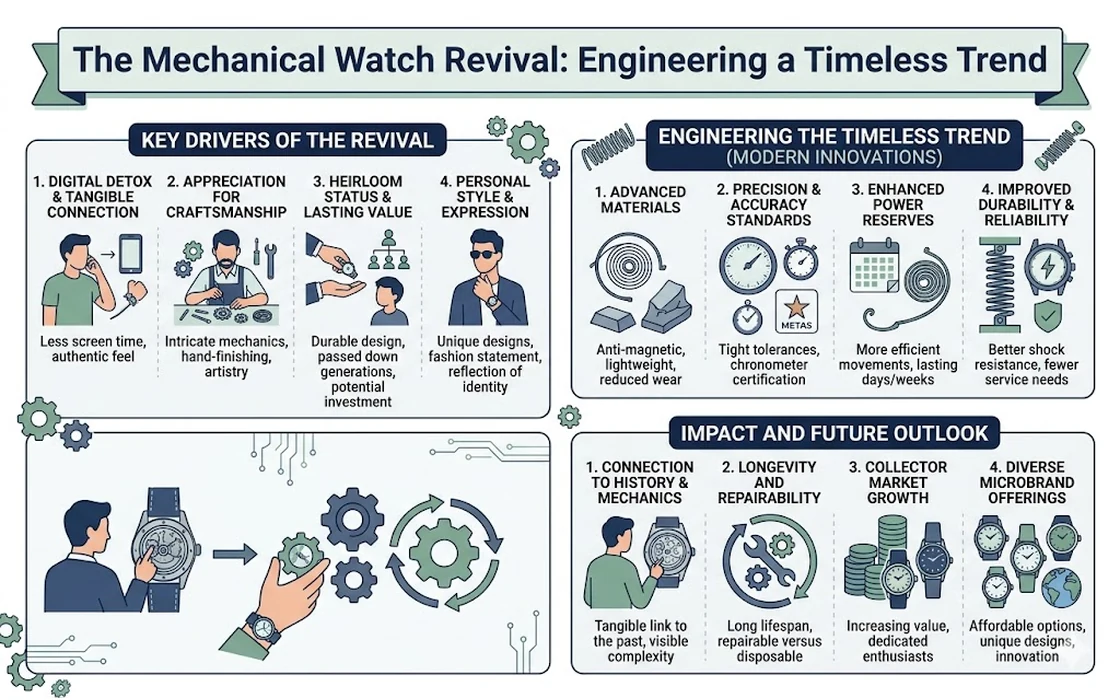
- Permanence and Longevity: The tech industry is built on planned obsolescence. A flagship smartphone or smartwatch bought today for Rs. 80,000 will be obsolete, its battery degraded, and its software unsupported in three to five years. In contrast, a well-maintained mechanical watch can last for generations. It is one of the few pieces of technology you can actually pass down to your children.
- Tactile Engagement: Winding a mechanical watch, feeling the click of the bezel, or simply watching the sweeping second hand glide smoothly across the dial offers a tactile, grounding experience that tapping a piece of glass cannot replicate.
- Unplugged Utility: A mechanical watch never needs a software update, it never asks for your WiFi password, and it will not track your location. It does exactly one thing—tell time—and it does it with quiet dignity.
The Resurgence of Mechanical Watches in India
Historically, India had a rich relationship with mechanical watches. For decades, the public sector giant HMT (Hindustan Machine Tools) was the timekeeper of the nation. Millions of Indians wore hand-wound HMT Janata, Pilot, and Kohinoor models. However, the global “Quartz Crisis” of the 1970s and 80s—which introduced cheap, highly accurate battery-powered watches—decimated the mechanical watch industry worldwide, and India was no exception. Brands like Titan revolutionized the Indian market with reliable quartz technology, pushing mechanical watches into obscurity.
Today, however, the pendulum is swinging back. As disposable income rises among Indian millennials and Gen Z professionals, watches are no longer viewed merely as utilitarian tools for telling time; your smartphone does that perfectly. Instead, watches have become statements of personal style, appreciation for craftsmanship, and in some cases, alternative investments.
The Indian market is witnessing a massive resurgence of interest in mechanical and automatic watches. Online communities, WhatsApp groups, and dedicated watch boutiques in metro cities like Bengaluru, Mumbai, and Delhi are thriving. Furthermore, the nostalgic value of vintage HMT watches has skyrocketed, with restored models becoming highly sought-after collectibles among young enthusiasts.
Building a Mechanical Watch Collection in India
If the 2022 viral explainer piqued your interest and you are looking to buy your first mechanical watch in India, the market has never been more accommodating. However, navigating the world of horology can be daunting. Here is a practical guide for Indian buyers, categorized by budget.
The Entry-Level Enthusiast (Rs. 10,000 to Rs. 30,000)
You do not need to spend a fortune to get a high-quality mechanical watch. The entry-level segment is dominated by robust, reliable Japanese engineering.
- Seiko 5 Series: The undisputed king of entry-level automatics. Seiko offers in-house movements, incredible durability, and a wide variety of styles (from sports to dress watches). A standard Seiko 5 Sports model in India typically retails between Rs. 20,000 and Rs. 28,000.
- Orient: Another Japanese powerhouse, Orient offers fantastic value for money, particularly with their ‘Bambino’ line of dress watches and ‘Kamasu’ dive watches. They are widely available online for around Rs. 15,000 to Rs. 25,000.
- Alba: A sub-brand of Seiko, Alba offers automatic watches using older Seiko movements at an even more accessible price point, often starting around Rs. 10,000.
The Mid-Range Investment (Rs. 50,000 to Rs. 1,50,000)
This tier introduces Swiss-made watches, higher levels of finishing, and superior materials like sapphire crystals and improved power reserves.
- Tissot: The Tissot PRX Powermatic 80 has taken the global and Indian markets by storm. Featuring an integrated bracelet design straight out of the 1970s and a massive 80-hour power reserve, it is a formidable piece of engineering priced around Rs. 60,000 to Rs. 70,000.
- Seiko Presage: Known as the “Cocktail Time” series, these watches offer dials with intricate textures and finishing that punch far above their weight class, generally priced between Rs. 40,000 and Rs. 80,000.
- Hamilton & Victorinox: Brands offering rugged, military-inspired mechanical watches that are built to withstand extreme conditions, perfect for those who appreciate robust tool watches.
The High-End Luxury Tier (Rs. 3,00,000 and above)
At this tier, you are paying for heritage, meticulous hand-finishing, and prestigious brand names. Brands like Omega, Rolex, and Grand Seiko dominate this space. While these are significant financial commitments, certain models in this tier, particularly steel sports watches, have shown an ability to retain or even increase their value over time, making them appealing to finance-minded buyers in India.
The Hidden Costs: Maintenance and Ownership
Before diving into mechanical horology, it is crucial to understand the reality of ownership. Because a mechanical watch is an engine with moving metal parts, it requires lubrication. Over time, the synthetic oils inside the watch dry up or degrade.
Just like a car, a mechanical watch requires periodic servicing—typically every 5 to 7 years. Servicing involves completely disassembling the movement, cleaning every individual component in specialized solutions, reassembling the watch, applying microscopic drops of fresh oil, and regulating the timing.
In India, finding a qualified, independent watchmaker can be challenging, though authorized service centers for major brands are available in large cities. You should budget for maintenance: servicing an entry-level Seiko might cost around Rs. 2,000 to Rs. 4,000, while servicing a mid-tier Swiss watch like a Tissot or Longines can cost anywhere from Rs. 8,000 to Rs. 15,000. Luxury watches command even higher servicing fees.
Conclusion
The viral Hacker News thread of 2022 proved something profound: in an age where technology is increasingly invisible, hidden in the cloud or buried inside sealed aluminum chassis, we still possess a deep-seated fascination with machines we can see, understand, and touch.
A mechanical watch is a defiant celebration of human ingenuity. It is an intricate puzzle of gears, springs, and jewels that works tirelessly on your wrist, drawing its very life force from your daily movements. For the Indian technology enthusiast, stepping into the world of horology is not just about adopting a new fashion accessory; it is about acknowledging and wearing a piece of engineering history. Whether it is a humble vintage HMT Janata or a meticulously crafted Swiss automatic, a mechanical watch serves as a daily reminder that true technical brilliance does not always require a battery.
- Tags:
- Mechanical Watches
- Engineering
- Horology
- Indian Watch Market
- Tech Gadgets