
Retro Graphics: How to Create Visuals Like it's 1993
Discover why the low-fidelity aesthetics of 1993 are returning to modern design and how you can recreate this iconic retro look for your projects today.

- NV Trends
- 9 min read
The year 1993 was a watershed moment for digital visuals. If you were a computer enthusiast in India back then, you likely remember the hum of a CRT monitor and the distinct “crunchy” look of images that seemed to glow with a limited but vibrant palette. It was the year that Doom redefined our expectations of 3D spaces and when VGA (Video Graphics Array) became the standard for anyone serious about computing. Today, that aesthetic is seeing a massive resurgence, not just as a nostalgic trip, but as a deliberate design choice in a world saturated with hyper-realistic, high-definition imagery.
Making graphics like it is 1993 is an exercise in creativity through constraint. In an era where a single smartphone photo can be 20 megabytes, it is hard to imagine that some of the most iconic visual experiences of the early nineties were squeezed into less than a megabyte of total storage. Designers didn’t have millions of colors or billions of polygons; they had 256 colors and a handful of pixels. This forced a level of artistic ingenuity that modern “clean” design often lacks. For the modern Indian developer or designer, revisiting these techniques offers a way to stand out in a crowded digital marketplace.
In this deep dive, we will explore the technical foundations of 1993 graphics, the clever tricks used to bypass hardware limitations, and how you can apply these “lo-fi” principles to your modern projects. Whether you are an indie game developer in Bengaluru or a graphic designer in Mumbai looking for a fresh brand identity, understanding the “Mode 13h” era of graphics is a powerful tool for your creative arsenal.
The Technical Backbone: Understanding VGA and Mode 13h
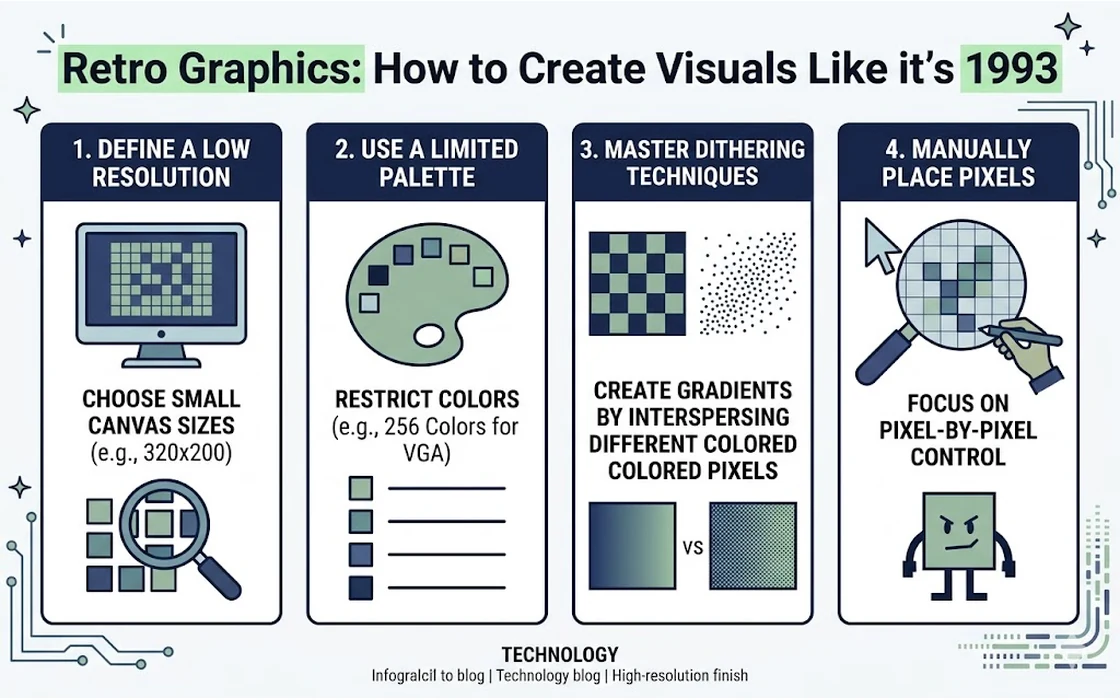
To recreate the look of 1993, we must first understand the hardware that dictated it. The most significant technical standard of that time was VGA, specifically a display mode known as Mode 13h. For those who coded in C or Assembly during that period, Mode 13h was legendary. It provided a resolution of 320x200 pixels and a palette of 256 colors.
By today’s standards, 320x200 sounds laughable—most modern icons are larger than that. However, the beauty of this resolution was its simplicity. Each pixel was represented by exactly one byte in memory. If you wanted to change the color of a pixel, you simply wrote a value to a specific memory address. This allowed for incredibly fast manipulation of the screen, which was essential for the “fast-paced” action games that began to dominate the market.
The 256-Color Palette Constraint
The most defining characteristic of the 1993 aesthetic is the limited color depth. While we now use “True Color” (16.7 million colors), 1993 was the era of the Indexed Palette. You didn’t just pick any color; you had a list of 256 specific colors available at any one time. If you needed a shade of navy blue that wasn’t in your palette, you were out of luck—unless you used dithering.
This constraint meant that artists had to be very strategic. Many games and applications used custom palettes tailored to specific environments. A jungle-themed game would sacrifice blues and reds to have 50 different shades of green. This gave 1990s graphics a “mood” that felt cohesive. When you look at a screenshot from that era, the color harmony isn’t an accident; it was a technical necessity.
The Art of Dithering: Making 256 Colors Look Like Millions
One of the most recognizable “retro” effects is dithering. Because artists were stuck with a limited palette, they couldn’t always create smooth gradients. If you wanted to fade from a bright red to a dark red, you might only have three intermediate shades. On their own, these would look like ugly “bands” of color.
Dithering solved this by interleaving pixels of two different colors in a checkerboard or stippled pattern. From a distance, the human eye “mixes” these colors, creating the illusion of a third color that isn’t actually in the palette.
Why Dithering is Back
In modern design, we see dithering used in everything from high-end fashion branding to “webcore” aesthetics. It adds a tactile, grainy texture that feels more “human” than the perfect gradients produced by modern software. For an Indian brand looking to evoke a sense of heritage or “retro-cool,” using dithered gradients in social media graphics can create a distinct look that separates them from the flat, minimalist style used by every other tech startup.
There are several types of dithering you can experiment with today:
- Ordered Dithering: Uses a predefined threshold map to create a repetitive, grid-like pattern. This is the most “digital” looking style.
- Error Diffusion (Floyd-Steinberg): A more organic-looking dithering that pushes the “error” of a pixel’s color to its neighbors. This looks more like film grain or newsprint.
2.5D and the Raycasting Revolution
1993 was also the year that “3D” became a household term, but it wasn’t the 3D we know today. Computers were not powerful enough to calculate true 3D geometry with lighting and textures in real-time. Instead, developers used Raycasting.
This was the engine behind Doom and Wolfenstein 3D. The game world was essentially a 2D map, but the engine “cast rays” from the player’s position to see how far away the walls were. It then drew vertical lines on the screen, scaling them based on distance. It was a brilliant hack that allowed 3D-like navigation on hardware that should have been incapable of it.
Recreating the “Billboarding” Effect
In these early 3D worlds, the environment was 3D, but the objects (enemies, power-ups, trees) were 2D images called sprites. These sprites always faced the player, a technique called “billboarding.”
Modern developers can recreate this in engines like Unity or Godot to achieve a “HD-2D” look. By combining low-resolution pixel art sprites with a 3D environment that uses low-fidelity textures and no anti-aliasing, you can capture that 1993 “fake 3D” charm. This style is not just for games; it is increasingly used in interactive web experiences to provide a sense of depth without the high performance cost of complex 3D models.
The Economic Case for 1993 Graphics in Modern India
Beyond aesthetics, there is a very practical reason to consider “Making Graphics Like it’s 1993” for your next project: Cost and Efficiency.
Developing high-fidelity, “AAA” style graphics is incredibly expensive. In India, a small indie studio or a solo developer might face a steep climb to produce art that competes with global giants.
- High-Fidelity Assets: Creating a single high-poly, photorealistic character can cost anywhere from Rs. 1,00,000 to Rs. 5,00,000 when you account for modeling, rigging, and high-res texturing.
- Retro Assets: A skilled pixel artist can create a complete set of retro-style characters and environments for a fraction of that cost. The turnaround time is faster, and the hardware requirements for the end-user are much lower.
For a startup or an independent creator, choosing a 1993-inspired aesthetic allows you to focus your budget on gameplay, storytelling, and user experience rather than chasing a level of realism that will be outdated in three years. Retro graphics are “time-proof”—a well-drawn pixel art game looks as good today as it did 30 years ago.
Tools of the Trade: How to Start Today
You don’t need an old 486 PC to make graphics like it’s 1993. Modern software has made it easier than ever to emulate these constraints.
1. Aseprite
Aseprite is the gold standard for modern pixel art. It includes features specifically designed for the retro workflow, such as palette management and “indexed color” modes. It even has tools to automatically create dithering patterns. For a few thousand rupees, it’s an investment that pays for itself almost immediately.
2. Blender (with a Twist)
You can use the most powerful 3D software in the world to make 1993-style graphics. By using a “pixelate” node in Blender’s compositor, you can render 3D scenes at a low resolution and then “crush” the colors down to a 256-color palette. This allows you to have the benefits of 3D (easy animation and lighting) with the aesthetic of 1993.
3. PICO-8
If you want to go “full retro,” PICO-8 is a “fantasy console.” It deliberately limits you to a 128x128 resolution and a 16-color palette. It is a fantastic way to learn the discipline of working within constraints. Many Indian developers use PICO-8 for “game jams” to prototype ideas quickly.
Integrating Retro Aesthetics into Modern Web Design
You don’t have to be a game developer to use these ideas. Modern web design is currently moving away from the “Clean and Flat” era toward something more expressive. This is often called “Neo-Brutalism” or “Retro-Futurism.”
Custom Cursors and UI Elements
In 1993, user interfaces weren’t afraid to look like software. Beveled edges, heavy shadows, and custom cursors were everywhere. You can bring this back by:
- Using system fonts or “pixel fonts” for headings.
- Implementing window-style containers with thick borders.
- Adding a CRT shader or scanline overlay to images to give them that warm, analog glow.
While these should be used sparingly to maintain usability, they can make a landing page feel nostalgic and memorable. Imagine a FinTech app that uses a “1993 Terminal” aesthetic for its advanced trading view—it would immediately signal “expert power user” in a way that a minimalist white interface cannot.
The Cultural Impact: Why 1993 Resonates in India
For many of us in India, the early 90s represented the beginning of the “Computer Boom.” It was the era of the first IT parks, the rise of NIIT and Aptech, and the arrival of the home PC. The graphics of 1993 aren’t just technical artifacts; they are symbols of a time when the digital future felt limitless and exciting.
By using these graphics today, creators are tapping into a shared cultural memory. It’s a way to bridge the gap between the generation that grew up with “snakes” on a Nokia and the Gen Z crowd that finds “Y2K” and 90s aesthetics “aesthetic” and trendy. It is a visual language that speaks to both groups.
Conclusion
Making graphics like it’s 1993 is more than just a gimmick. It is a return to a philosophy where every pixel mattered and every color was a choice. By embracing the constraints of Mode 13h, the logic of dithering, and the ingenuity of raycasting, modern creators can produce work that is visually striking, cost-effective, and culturally resonant.
In an age where we are constantly told that “more is better”—more pixels, more frames per second, more realism—there is a profound power in saying “less is enough.” Whether you are building a brand, a game, or a website, don’t be afraid to look back to 1993. Sometimes, to move forward and innovate, you first need to understand how we did so much with so little. Start small, pick your 256 colors, and see where the constraints take you.
- Tags:
- Retro Graphics
- 1993 Tech
- Pixel Art
- Game Development
- Vga
- Dithering
- Design Trends