
Lore: The Open Source VCS Revolutionizing Scalability
Discover Lore, the new open-source version control system from Epic Games designed to solve scalability challenges that Git and Perforce struggle to handle.

- NV Trends
- 10 min read

For nearly two decades, Git has been the undisputed king of version control. Whether you are a solo developer working on a hobby project in Bengaluru or a software engineer at a global tech giant, Git is likely the tool you use to manage your code. It revolutionized the way we think about branching, merging, and collaboration. However, as software projects have grown in complexity—merging massive codebases with gigabytes of binary assets—the cracks in Git’s foundation have started to show. Developers working on massive game engines, machine learning models, or enterprise-scale monorepos often find themselves fighting against the very tool meant to help them.
Enter Lore. Recently announced by Epic Games, Lore is an open-source version control system built from the ground up to address the specific scalability limitations that have plagued the industry for years. While Git was designed for the decentralized, text-heavy world of the Linux kernel, Lore is designed for the modern era of “everything-scale.” It aims to provide the administrative control and performance of centralized systems like Perforce while maintaining the flexibility and open-source ethos that developers have come to love. This isn’t just another incremental improvement; it is a fundamental shift in how we manage the lifecycle of digital assets.
For the Indian developer community, which is increasingly contributing to high-end game development, sophisticated AI projects, and massive fintech platforms, Lore represents a significant milestone. It offers a path away from expensive, proprietary licensing and toward a future where “scalability” isn’t a bottleneck. In this article, we will dive deep into what makes Lore different, how it handles data that would bring Git to its knees, and why it might just be the most important piece of infrastructure software released this decade.
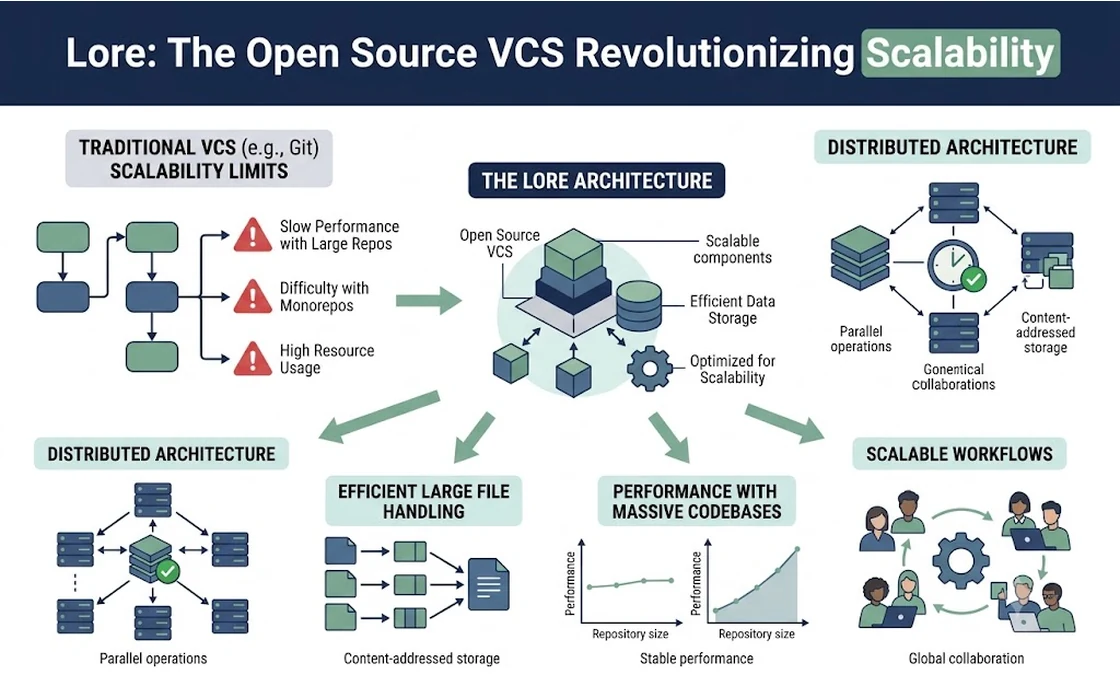
The Scalability Wall: Why Git Isn’t Always Enough
To understand why Lore is necessary, we must first look at where Git fails. Git is a distributed version control system (DVCS). When you run git clone, you are typically downloading the entire history of the project. For a project like a simple web application or a Python library, this is brilliant. However, imagine a modern AAA game project or a large-scale enterprise application. These projects often exceed hundreds of gigabytes, containing not just code but high-resolution textures, 3D models, and massive binary libraries.
When a project reaches this scale, Git starts to struggle. Clones take hours, git status commands become sluggish, and the .git folder consumes massive amounts of disk space. While tools like Git LFS (Large File Storage) were created to patch these issues, they often feel like “bolted-on” solutions that add complexity and break the seamless nature of the Git workflow. For many large teams, the only alternative has been Perforce (Helix Core), a proprietary system that can cost a company thousands of dollars (often upwards of Rs. 60,000 per user per year in enterprise settings) and requires specialized administrators.
The “Scalability Wall” isn’t just about file size; it’s about the number of files and the complexity of the history. In a monorepo—where a single repository houses hundreds of different services—Git’s performance degrades as the number of tracked files reaches the millions. For Indian startups that are scaling rapidly and moving toward monorepo architectures to simplify dependency management, these performance hits translate directly into lost developer productivity and increased frustration.
Enter Lore: A New Paradigm in Version Control
Lore was born out of the necessity at Epic Games to manage the astronomical growth of the Unreal Engine and its associated projects. Epic realized that the industry needed a version control system that didn’t treat binary assets as second-class citizens and didn’t force developers to choose between the speed of Git and the scalability of Perforce.
The core philosophy of Lore is “scalability along every axis.” This means it is designed to handle:
- File Count: Scaling to millions of files without performance degradation.
- Data Volume: Handling petabytes of data across the entire repository.
- User Count: Supporting thousands of developers and artists working concurrently.
- History Depth: Managing decades of revisions without slowing down modern operations.
By making Lore open-source, Epic Games has effectively commoditized the version control layer of high-end development. This is a bold move that mirrors the impact of the Unreal Engine itself—giving small and medium-sized teams access to tools that were previously the exclusive domain of companies with massive budgets.
How Lore Achieves Massive Scale: The Technical Core
Lore’s architecture is fundamentally different from Git’s. Instead of a monolithic design, Lore separates its concerns into two distinct but integrated subsystems: the Storage Subsystem and the Version Control Subsystem.
The Binary-First Storage Subsystem
Unlike Git, which was optimized for text-based source code, Lore is a “binary-first” system. It treats every file as an opaque stream of bytes. To manage massive files efficiently, Lore uses a technique called content-addressed chunking. Instead of storing a file as a single entity, Lore breaks it down into smaller “chunks.” If you change only a small part of a 2GB texture file, Lore only stores the new chunks, deduplicating the rest across the entire system.
This approach is highly efficient. It means that if ten different projects in your organization use the same large library, Lore only stores it once. In an Indian enterprise environment where storage costs (even on cloud platforms like AWS or Azure) can run into lakhs of rupees per month, this deduplication can lead to significant cost savings.
Partition-Based Immutability
Lore organizes its data into “partitions.” Each partition is an immutable store of content. This design allows Lore to scale horizontally across multiple servers. While Git repositories are difficult to split or distribute across physical hardware without losing the “source of truth,” Lore’s partition-based design makes it naturally suited for distributed cloud environments.
Sparse and Partial Working Copies
One of the most frustrating aspects of Git for large projects is that you often have to download everything to change anything. Lore introduces a robust sparse checkout mechanism. A developer can choose to “check out” only the specific folders or sub-projects they are working on. The rest of the repository remains on the server, only being downloaded if and when it is needed.
For a developer in an office with limited bandwidth—a reality for some smaller studios or remote workers in India—this is a game-changer. You no longer need to wait for a 100GB clone to finish before you can fix a single line of code. You download the 50MB of code you need, and you’re ready to work.
Lore vs. Git and Perforce: The Battle for the Repository
To truly appreciate Lore, we must see how it stacks up against its primary competitors.
| Feature | Git | Perforce (Helix Core) | Lore |
|---|---|---|---|
| Model | Distributed | Centralized | Hybrid (Centralized + Offline) |
| Binary Support | Poor (Needs LFS) | Excellent | Excellent (Native) |
| Scalability | Limited by local disk/RAM | High (but expensive) | Very High (Architected for it) |
| Licensing | Open Source (GPL) | Proprietary (Expensive) | Open Source |
| Branching | Lightweight & Powerful | Complex | Lightweight & High-Scale |
| Learning Curve | Steep | Moderate | Designed for Modern Devs |
The “Perforce Killer” Narrative
On forums like Hacker News, Lore is being hailed as the “Perforce Killer.” Perforce has long held a monopoly on game development because it handles large binary files and provides “exclusive locking” (ensuring two people don’t edit the same binary file at once). Lore provides these same features but in an open-source package.
For an Indian game studio, moving from Perforce to Lore could save them millions of rupees in licensing fees over the life of a project. That capital can instead be diverted toward hiring more talent or improving game quality. Moreover, Lore brings the “vibe” of modern software engineering—CLI-first, scriptable, and community-driven—to a space that has felt stagnant and “corporate” for too long.
The Open Source Advantage: Why Epic’s Move Matters
Epic Games’ decision to open-source Lore is not just a gift to the community; it’s a strategic move to define the next era of development infrastructure. By making the source code available, they ensure that Lore can be audited, extended, and integrated into every possible workflow.
In India, we have seen how open-source technologies like Flutter, Kubernetes, and React have created massive ecosystems of jobs and innovation. Lore has the potential to do the same for the “unseen” part of the stack—the version control layer. We can expect to see Indian DevOps consultants specializing in Lore migrations, and local hosting providers offering “Managed Lore” services, similar to how GitHub and GitLab provide managed Git.
Furthermore, an open-source VCS means no vendor lock-in. If a company decides to move their Lore server from an on-premise data center in Mumbai to a cloud region in Singapore, they can do so without asking for permission or paying “migration fees.”
Relevance for the Indian Tech Ecosystem
India is currently witnessing a massive surge in three key areas where Lore excels:
1. The Rise of Indian Game Development
From mobile gaming giants to ambitious indie studios, the Indian game dev scene is exploding. These studios are moving away from simple 2D games toward complex 3D experiences built on the Unreal Engine. Lore provides these studios with the “industrial-strength” infrastructure they need to compete on a global stage without the “industrial-strength” price tag of proprietary tools.
2. Large-Scale Fintech and SaaS Monorepos
As Indian fintech companies grow, their codebases become behemoths. Managing hundreds of microservices in separate repositories often leads to “dependency hell.” The move toward monorepos is a natural progression for many, but Git’s performance issues often hold them back. Lore offers a viable path to a massive, high-performance monorepo that can serve thousands of engineers without breaking.
3. AI and Machine Learning Pipelines
AI models involve massive datasets and weight files that are frequently updated. Traditional version control systems are terrible at handling these. Lore’s binary-first, chunking-based storage is perfectly suited for versioning ML models and the data used to train them. This makes it an attractive tool for the growing number of AI startups in Bengaluru and Hyderabad.
Getting Started and the Future Outlook
While Lore is relatively new, the momentum behind it is significant. Being backed by Epic Games gives it a level of credibility that most new open-source projects lack. However, transitioning a team’s version control system is no small feat. It requires a change in mindset and a carefully planned migration.
The community is already building bridges. We are seeing the development of “Git-to-Lore” import tools and plugins for popular IDEs like VS Code and IntelliJ. For individual developers, the best way to get started is to explore the Lore CLI and understand the concepts of partitions and sparse checkouts.
In the coming years, we can expect Lore to evolve rapidly. As more companies adopt it, the ecosystem of tools around it will grow. We might see “LoreHub” or “LoreLab” emerging as social coding platforms designed for the massive-scale projects that Lore enables.
Conclusion
The release of Lore marks the beginning of the end for the “one-size-fits-all” era of version control. While Git will remain the standard for the vast majority of software projects, Lore provides a necessary alternative for the frontiers of technology where scale is the primary challenge. It solves the “binary problem,” eliminates the “cloning bottleneck,” and brings the power of enterprise-grade version control to the open-source community.
For the Indian tech industry, Lore is more than just a new tool; it’s an opportunity. It’s an opportunity to build larger, more complex systems without being hampered by infrastructure limitations. It’s an opportunity to save significantly on licensing costs and reinvest that money into innovation. As we look toward the future of software development, it’s clear that our tools must evolve alongside our ambitions. Lore is that evolution—a scalable, open-source foundation for the next generation of digital creation. Whether you are building the next hit game or a nation-scale financial platform, Lore is a name you need to know.
- Tags:
- Lore
- Version Control
- Git
- Open Source
- Scalability
- Software Development
- Epic Games