
The LinkedIn Job Offer Trap: New Backdoor Targets Devs
A sophisticated new malware campaign is targeting developers on LinkedIn through fake job offers and backdoored coding tests. Learn how to stay safe.

- NV Trends
- 10 min read
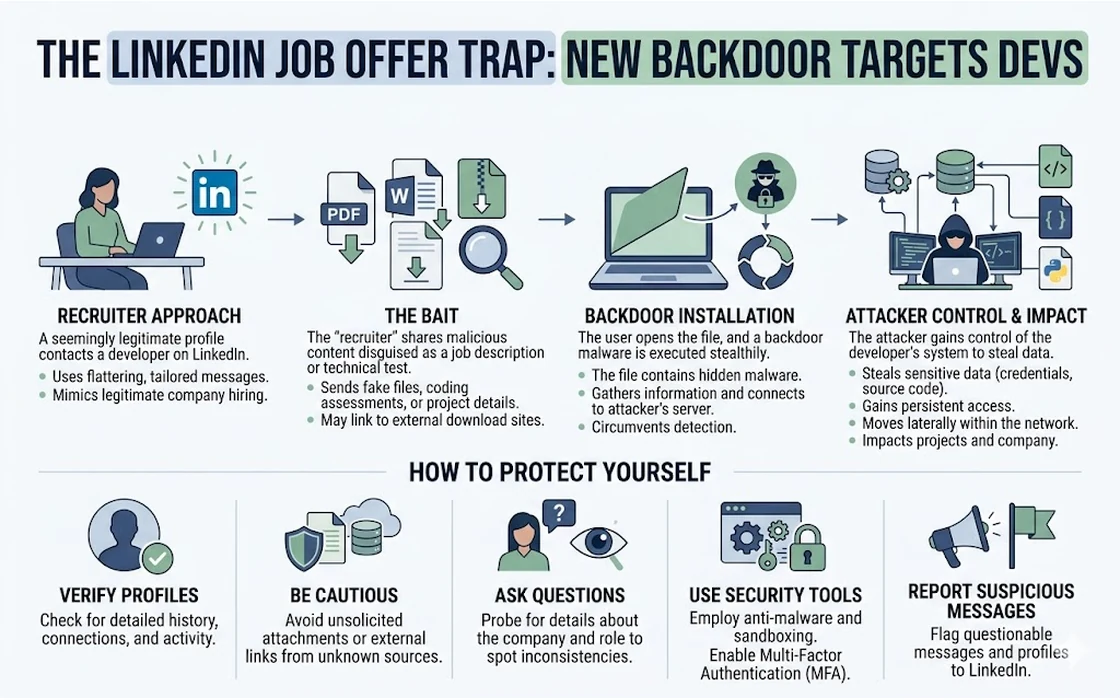
Imagine opening your LinkedIn messages on a standard Tuesday afternoon to find an incredible proposition. A recruiter from an exciting, well-funded Web3 startup—or perhaps a recognizable tech unicorn—is reaching out directly to you. They have bypassed the usual corporate red tape, having seen your impressive GitHub repositories and recent project updates. The role they are offering is fully remote, the equity options are highly competitive, and the proposed salary is comfortably sitting around Rs. 45 Lakhs to Rs. 60 Lakhs per annum. For any ambitious software developer, this is the exact message you have been waiting to receive.
You reply with enthusiasm, and the conversation moves quickly. The “recruiter” is highly professional, knowledgeable about the specific tech stack you use, and eager to move forward. The next step is standard industry practice: a technical coding assessment. They send over a link to a GitHub repository containing a simple React or Node.js application and ask you to implement a specific feature or fix a deliberately broken component within 48 hours. Eager to prove your worth, you clone the repository, open your terminal, and run the standard commands to get started.
But the moment you hit Enter, you haven’t just initialized a test project. You have unwittingly unlocked the front door to your machine, handing over complete control, sensitive browser data, and potential access to your current employer’s internal networks to a highly organized syndicate of state-sponsored cybercriminals. This is not a hypothetical scenario from a cyberpunk novel; it is a very real, rapidly escalating cyberattack campaign taking the global developer community by storm, and Indian tech professionals are squarely in the crosshairs.
The Anatomy of the Perfect Trap
The cyber threat landscape has shifted dramatically over the past few years. While traditional phishing emails targeting non-technical employees remain common, advanced threat actors have realized that targeting developers yields a far greater return on investment. Developers possess the “keys to the kingdom”: access to production databases, source code, cloud infrastructure credentials, and administrative privileges.
This specific campaign, often dubbed the “Contagious Interview” or the “Dream Job” attack, represents a masterclass in social engineering. The attackers—frequently linked by cybersecurity researchers to North Korean state-sponsored groups like the Lazarus Group or its affiliates (such as UNC1549 or TA455)—do not rely on brute force. Instead, they exploit the natural ambitions, professional workflows, and inherent trust mechanisms of the software engineering community.
They spend weeks building highly credible fake personas on LinkedIn. These profiles boast hundreds of connections, endorsements from other seemingly legitimate accounts, and detailed work histories at prominent technology companies. When they reach out, the messaging is highly tailored. They don’t send generic blasts; they reference specific libraries you have used, recent comments you have made on technical forums, or particular skills listed on your profile. This meticulous personalization disarms the victim’s natural skepticism. Once trust is established, the payload is delivered under the guise of an entirely normal professional requirement: the take-home coding challenge.
How the “Contagious Interview” Works
The brilliance of this attack lies in its use of standard, everyday developer tools against the developer. The malicious payload is rarely an obvious executable file like a .exe or a .zip attachment, which modern antivirus software or corporate Endpoint Detection and Response (EDR) systems would easily flag. Instead, the malware is hidden in plain sight within the code itself.
The Trojan Horse: The NPM Install Trap
The most common vector in this campaign exploits the Node Package Manager (NPM) ecosystem, a foundational tool used by almost every modern web developer. When a developer clones the “coding test” repository, they are instructed to run npm install to download the necessary dependencies to build and run the application.
This command reads the package.json file, which lists the libraries the project needs. However, the package.json file has a built-in feature that allows developers to define custom scripts, such as a prepare or preinstall script, which automatically executes before or after the installation process. The attackers hide their malicious commands within these lifecycle scripts.
When the unsuspecting developer types npm install, the package manager obediently executes the hidden script in the background. This script silently reaches out to a remote Command and Control (C2) server and downloads the primary malware payload, all while the developer watches the familiar, mundane terminal output of packages being fetched and installed. By the time the prompt returns control to the user, the system is already compromised.
Unseen Dangers: BeaverTail and InvisibleFerret
The technical payloads delivered in these recent campaigns are incredibly sophisticated. Cybersecurity researchers have identified two primary pieces of malware deployed in these attacks: BeaverTail and InvisibleFerret.
- BeaverTail: This is typically the initial stage of the infection. BeaverTail acts as a downloader and information stealer. In recent iterations, it has been observed written in cross-platform frameworks like Qt or Node.js, allowing it to infect both Windows and macOS machines. Its primary goal is to quietly gather basic system information and establish a stable connection to the attacker’s server, paving the way for the second stage.
- InvisibleFerret: This is the heavy artillery. InvisibleFerret is a powerful backdoor that provides the attackers with persistent, remote control over the infected machine. Once installed, it allows the hackers to browse the file system, upload or download files at will, execute arbitrary shell commands, and even install additional ransomware or keyloggers. Furthermore, it is explicitly designed to scrape browsers for saved passwords, session cookies, and critically, cryptocurrency wallet extensions.
Why Indian Tech Professionals Are Prime Targets
The global nature of the internet means anyone can be a target, but the specific dynamics of the Indian IT sector make it a particularly lucrative hunting ground for these state-sponsored actors.
The Allure of Remote Work
India boasts one of the largest and most skilled pools of software engineering talent in the world. Since the pandemic, the desire for permanent remote work—specifically for companies based in the US, Europe, or the Middle East—has skyrocketed. These roles offer unparalleled flexibility and exposure to global product development. Attackers are well aware of this aspiration. By posing as recruiters from international firms offering fully remote “work-from-anywhere” positions, they present an irresistible proposition to an Indian developer looking to level up their career.
The Salary Bait
The financial disparity between domestic IT salaries and remote offshore roles is a significant vulnerability. While a mid-level developer in a domestic IT services firm might earn between Rs. 10 Lakhs and Rs. 15 Lakhs per annum, a remote role for a US-based startup can easily offer Rs. 40 Lakhs to Rs. 80 Lakhs, or even more for specialized skills in Web3, AI, or cybersecurity.
When a fake recruiter approaches an Indian developer with an offer that essentially triples their current salary, the emotional excitement often overrides rational security protocols. The prospect of financial freedom and a massive career jump creates a sense of urgency. The victim is eager to prove themselves and less likely to critically analyze the coding test or question the recruiter’s somewhat unusual requests, making them highly susceptible to the trap.
The Fallout: What Happens When the Backdoor Opens?
The consequences of falling for this scam extend far beyond a damaged ego or a bruised hard drive. For the individual developer, the immediate threat is identity theft and financial loss. The malware actively hunts for cryptocurrency wallets; if a developer has personal crypto assets stored or managed on their work machine, those funds can be drained in minutes. Session cookies stolen from the browser can allow attackers to bypass two-factor authentication (2FA) and hijack personal email, social media, and banking accounts.
However, the bigger prize for these sophisticated threat actors is often the developer’s employer. By compromising a developer’s machine, the attackers gain a trusted foothold inside the corporate perimeter. From this vantage point, they can pivot laterally across the network, escalating privileges and hunting for valuable corporate intellectual property, customer databases, or financial records.
A single compromised developer’s laptop can lead to a massive corporate data breach, resulting in severe financial penalties, devastating reputational damage for the company, and significant legal and professional repercussions for the developer involved.
Recognizing the Red Flags of a Fake Recruiter
While the attacks are sophisticated, they are not flawless. By maintaining a critical eye and knowing what to look for, developers can spot the inconsistencies and protect themselves before the payload is ever downloaded. Here are the critical red flags to watch for:
- Too Good to Be True Offers: If a recruiter is offering a salary that is vastly above market rate (e.g., offering Rs. 80 Lakhs for a junior React role) with minimal interview stages, proceed with extreme caution. Scammers use astronomical numbers to blind you to the risks.
- Aggressive Timelines: Legitimate hiring processes take time. If the recruiter is applying immense pressure, demanding that you complete a complex coding test within an unreasonably short window (like 12 hours over a weekend), they are trying to rush you into making a mistake.
- Refusal to Verify Identity: If the recruiter dodges requests for a video call or refuses to communicate via an official company email address (e.g., using a generic Gmail address instead of
name@company.com), it is a massive red flag. Always cross-reference the recruiter’s profile with the company’s official LinkedIn page. - Suspicious Test Environments: Be extremely wary if the recruiter insists that you run the test code on your primary local machine, or if they provide a custom “interview application” that you must install, rather than using standard web-based platforms like HackerRank or LeetCode.
- Obfuscated Code or Bizarre Dependencies: Before running anything, inspect the repository. If the
package.jsoncontains unusually complexprepareorpreinstallscripts, or if it lists obscure, heavily obfuscated dependencies that seem unnecessary for a simple test, stop immediately.
How to Protect Your Code and Your Career
Awareness is the first line of defense, but technical safeguards are equally crucial. Developers must adopt a “zero-trust” approach to unsolicited code, even if it appears to come from a legitimate professional source.
1. Isolate Your Work Environment: Never run untested, untrusted code directly on your primary host operating system, especially if it is the same machine you use to access sensitive corporate networks or personal financial data. Always use isolated environments.
- Virtual Machines (VMs): Set up a dedicated VM using tools like VirtualBox or VMware specifically for testing external code. If the VM gets infected, you can simply delete it and spin up a fresh one without risking your host machine.
- Containers: Utilize Docker containers to sandbox the execution of the application. Containers restrict the application’s access to the host’s file system and network resources.
- Cloud Workspaces: Consider using browser-based, disposable development environments like GitHub Codespaces or Gitpod for reviewing take-home tests.
2. Audit Before You Execute: Make it a habit to thoroughly review the configuration files of any repository before running installation commands.
- Scrutinize the
package.json(for Node.js),requirements.txt(for Python), orCargo.toml(for Rust). - Look explicitly for lifecycle scripts (
preinstall,postinstall,prepare). If a simple React to-do list app has a complex bash script hidden in its preinstall phase, it is almost certainly malicious.
3. Use Security Tooling: Employ tools that scan for known vulnerabilities and suspicious behavior in your dependencies. Tools like npm audit are a start, but dedicated security scanners can identify anomalous scripts or known malicious packages before they execute.
4. Verify the Source: Treat every unsolicited inbound message with professional skepticism. If approached on LinkedIn, verify the recruiter’s identity. Look for their profile on the company’s official website or team page. If in doubt, reach out to the company’s official HR department directly through their main website to confirm the recruiter’s legitimacy and the open role.
Conclusion
The “LinkedIn Job Offer” backdoor is a stark reminder that the tools we rely on daily to build the digital world can easily be turned against us. For software developers, particularly in high-demand markets like India, the lure of a life-changing remote opportunity can be a powerful blindfold.
As cybercriminals continue to refine their social engineering tactics and develop increasingly stealthy malware like BeaverTail and InvisibleFerret, technical proficiency alone is no longer enough. Developers must cultivate a security-first mindset, treating every unsolicited repository and unexpected job offer not just as an opportunity, but as a potential threat vector. By utilizing virtual machines, rigorously auditing code dependencies, and maintaining a healthy dose of professional skepticism, you can ensure that your pursuit of a dream job doesn’t end in a cybersecurity nightmare. Stay vigilant, verify everything, and never let the promise of a massive salary compromise your primary machine.