
How JPL Keeps the 13-Year-Old Curiosity Rover Doing Science
Explore the incredible engineering and software innovations that allow NASA's Curiosity rover to continue its Mars mission after 13 years of exploration.

- NV Trends
- 8 min read

In the cold, radiation-blasted desert of Gale Crater on Mars, a machine roughly the size of a small car is doing something it was never supposed to do for this long. It has been thirteen years since NASA’s Curiosity rover touched down on the Red Planet, and despite the harsh environment and the inevitable decay of its components, it continues to churn out groundbreaking science. For those of us following from Earth—and particularly for the space-enthusiastic audience in India that celebrated the longevity of our own Mangalyaan—the story of Curiosity is a masterclass in resilient engineering and the power of remote software updates.
When Curiosity landed in August 2012, its primary mission was slated to last just two Earth years. The goal was simple yet profound: to determine if Mars ever had the right environmental conditions to support small life forms called microbes. It achieved that goal within its first year, finding evidence of ancient lakebeds that could have once been habitable. But instead of retiring, Curiosity has entered its “teenage” years, climbing mountains, dodging sharp rocks, and surviving technical glitches that would have ended any other mission. The secret to its longevity isn’t just a rugged build; it’s a brilliant strategy of “hardware-hacking” and software ingenuity orchestrated by the engineers at the Jet Propulsion Laboratory (JPL).
The Power Struggle: Managing a Decaying Heart
At the core of Curiosity’s endurance is its power source, the Multi-Mission Radioisotope Thermoelectric Generator (MMRTG). Unlike many previous Mars missions that relied on solar panels (which can be rendered useless by dust storms), Curiosity is nuclear-powered. It carries about 4.8 kilograms of plutonium-238, which naturally decays and releases heat. This heat is converted into electricity by thermocouples, providing a steady stream of power day and night, regardless of the season or dust levels.
However, physics is a relentless master. As the plutonium decays, the amount of heat it produces decreases. Today, Curiosity’s “heart” produces significantly less power than it did on launch day. To keep the science going, JPL engineers have had to rethink how the rover spends its daily energy budget. In the early years, the rover was operated like a cautious student, performing tasks one at a time. It would drive, then stop, then take a photo, then use its robotic arm. Each transition required powering up different instruments and keeping heaters running to protect sensitive electronics from the Martian night.
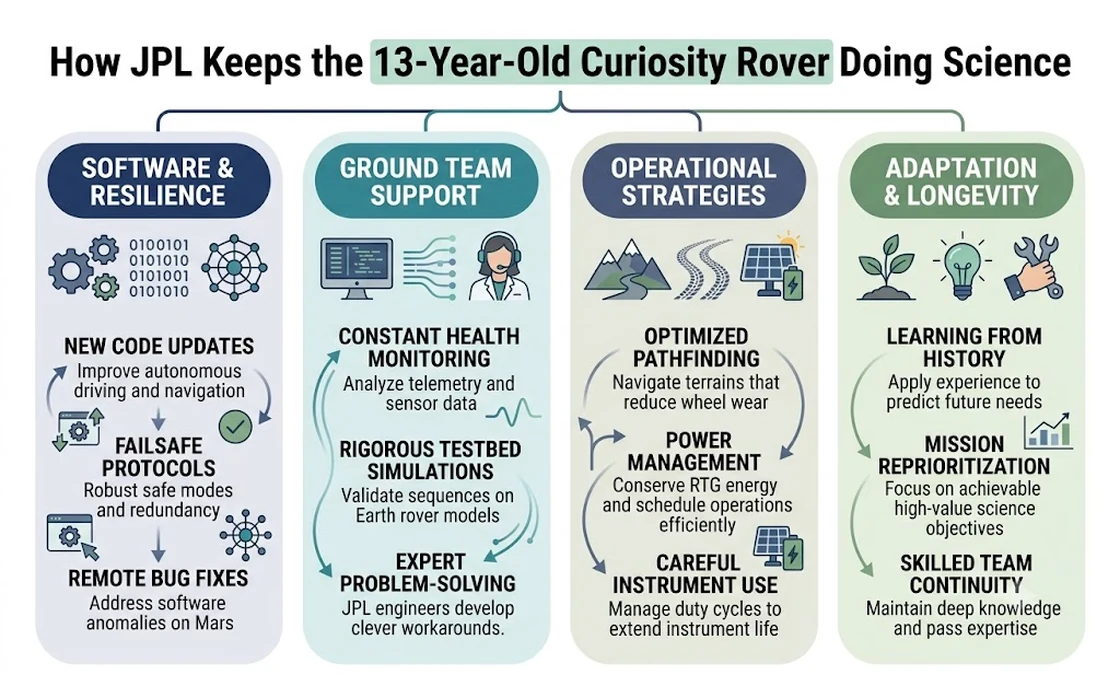
To combat the power decline, JPL recently rolled out a major software update that allows for multitasking. This is essentially a brain transplant for the rover. Curiosity can now drive while simultaneously relaying data or moving its robotic arm while snapping high-resolution images. By overlapping these activities, the rover finishes its daily checklist faster. This efficiency allows the team to shut down high-power heaters 20 to 30 minutes earlier every day, saving precious watt-hours that can be used for more drilling and analysis. For a mission costing billions of dollars (over Rs. 20,000 crores), every extra minute of operation is a massive return on investment.
Software as a Surgeon: Fixing Hardware from 200 Million Kilometres Away
One of the most remarkable aspects of the Curiosity mission is how the team fixes physical failures using only code. Mars is a hostile environment where repair missions are impossible. When something breaks, it stays broken—unless you can find a way to use it differently.
The Great Wheel Crisis
A few years into the mission, engineers noticed alarming holes and tears in Curiosity’s aluminum wheels. The Martian terrain turned out to be much sharper and more “ventifacted” (wind-sculpted) than anticipated. Without a fix, the wheels would eventually shred, leaving the rover stranded. Instead of giving up, JPL developed a traction control algorithm. This software monitors the terrain and adjusts the speed of each wheel individually to reduce pressure and “slipping” against sharp rocks. It’s similar to the electronic stability control in modern Indian SUVs, but adapted for a six-wheeled robot on a different planet. This update has successfully slowed the wear and tear, allowing Curiosity to keep rolling toward the heights of Mount Sharp.
The Drill Resurrection
In 2016, the rover’s drill—its most vital tool for sampling Martian history—suffered a major mechanical failure. A motor responsible for extending the drill bit stopped working. For a year, the team couldn’t drill. Most would have declared the mission’s primary science over. But JPL engineers spent months in a testbed on Earth, figuring out a technique called Feed Extended Drilling (FED). They realized they could use the rover’s massive robotic arm itself to push the drill bit into the ground, bypassing the failed internal motor. They wrote entirely new control logic, uploaded it to Mars, and Curiosity started drilling again. It was the equivalent of performing open-heart surgery using a remote-controlled prosthetic arm while blindfolded.
Autonomous Navigation: Giving Curiosity “Eyes” to Lead
As the rover gets older, its commute gets longer. It is currently exploring the base of Mount Sharp, a 5-kilometer-high mountain in the center of Gale Crater. To reach the most interesting geological layers, Curiosity needs to travel across treacherous terrain. Traditionally, engineers on Earth would map out a path, send the commands, and wait for the rover to execute them. This process is slow because of the 20-minute signal delay between Earth and Mars.
To speed things up, JPL has given Curiosity a “brain boost” in navigation. The rover now uses advanced autonomous navigation software (AutoNav) to map the terrain in front of it in 3D. It can identify obstacles, plan a safe path, and execute the drive without waiting for a “go-ahead” from Earth. This has increased the distance the rover can travel in a single day, ensuring that even as its hardware ages, its productivity increases. For the Indian reader, think of this as the difference between a car with a manual gearbox and an autonomous vehicle that can navigate the unpredictable traffic of Bengaluru—except the “traffic” on Mars consists of razor-sharp rocks and deep sand traps.
A Legacy of Discovery: Why the Effort Matters
You might wonder why we go to such lengths to keep a 13-year-old robot alive. The answer lies in the rocks Curiosity is currently touching. The rover is currently exploring a region of Mount Sharp that contains “boxwork” formations—intricate mineral lattices that look like spiderwebs. Scientists believe these were formed by groundwater flowing through cracks in the rock billions of years ago.
By analyzing these minerals, Curiosity is helping us understand the transition of Mars from a wet, warm planet to the frozen desert it is today. This isn’t just about curiosity; it’s about the history of our solar system. If Mars once had water and organic molecules (which Curiosity has found in abundance), did it once have life? And if it did, what happened to it? These are questions that resonate with the scientific community in India, where our own space agency, ISRO, is planning future Mars and Venus missions. The lessons learned from Curiosity’s longevity will undoubtedly influence how we build our next generation of space probes.
Key Milestones of the 13-Year Journey:
- 2012: The “Seven Minutes of Terror” landing using a revolutionary sky-crane.
- 2013: Discovery of an ancient freshwater lakebed at Yellowknife Bay.
- 2014: Reaching the base of Mount Sharp.
- 2018: Discovery of complex organic molecules in 3.5-billion-year-old rocks.
- 2021: Confirmation of ancient “megafloods” in Gale Crater.
- 2023-2024: Exploring the “sulfate-bearing unit,” which marks a major climatic shift in Martian history.
Lessons in Frugality and Resilience
There is a certain “Indian-ness” to the way Curiosity is being managed today. In India, we have a concept called Jugaad—the art of finding innovative, low-cost solutions to complex problems. While the Curiosity mission was certainly not low-cost at its inception, its current management is a masterclass in making the most of what you have.
JPL engineers aren’t just scientists; they are stewards of a rare resource. They treat the rover’s remaining plutonium and its thinning wheels with the same care a middle-class Indian household might treat a vintage Bajaj Chetak that still runs perfectly. They don’t replace; they repair. They don’t give up; they innovate. This philosophy of “extreme engineering” is exactly what is needed for the future of space exploration, where resources are limited and the stakes are high.
Conclusion
The story of the Curiosity rover is a testament to human persistence. It reminds us that even when our hardware fails—whether it’s a motor on Mars or a challenge in our daily lives—we can often find a way forward through creativity and better “software” in our thinking. Curiosity has survived longer than anyone dared to hope, not because it was indestructible, but because it was adaptable.
As it continues to climb the slopes of Mount Sharp, Curiosity stands as a lonely but triumphant sentinel on the Red Planet. It proves that with the right combination of engineering excellence and remote ingenuity, we can keep the flame of discovery alive for decades. For the millions of students and engineers in India looking toward the stars, Curiosity is more than just a robot; it is a promise that no matter how far we go, our ability to solve problems will always be our most powerful engine.
- Tags:
- Nasa
- Jpl
- Mars
- Curiosity Rover
- Space Technology
- Robotics
- Engineering