
CRISPR Breakthrough: Shredding Undruggable Cancers
Learn how the CRISPR-Cas12a2 breakthrough shreds undruggable cancer cells from within, unlocking new targeted therapies for complex tumors across India.

- NV Trends
- 13 min read
- Updated

The CRISPR-Cas12a2 breakthrough represents a monumental shift in oncology by using custom guide RNA to recognize tumor-specific genetic mutations and trigger indiscriminate collateral chromatin shredding, destroying previously undruggable cancer cells from within while leaving healthy cells unharmed.
For decades, the word “cancer” has carried an overwhelming burden of fear and financial vulnerability across Indian households. Despite remarkable advances in surgical oncology, targeted radiation, and broad-spectrum chemotherapy, aggressive solid tumors—including late-stage pancreatic ductal adenocarcinoma, triple-negative breast cancer, and metastatic lung carcinoma—frequently develop resistance or lack the structural features necessary for conventional pharmacological intervention. When an oncologist in Mumbai, Chennai, or Delhi delivers a late-stage diagnosis, standard systemic chemotherapies often fail to halt progression because the underlying oncogenic drivers lack traditional targetable pockets.
According to data reported by the Indian Council of Medical Research (ICMR), annual cancer incidence in India is projected to reach approximately 15.7 lakh cases as of 2026, with an alarming proportion detected at Stage 3 or Stage 4. At these advanced stages, cancer cells mutate rapidly, shedding drug targets and patching over DNA damage induced by standard cytotoxic agents. Rather than attempting to patch broken biological switches, the deployment of Cas12a2 bypasses traditional receptor binding altogether, converting a tumor cell’s own transcriptomic aberrations into an autonomous suicide mechanism.
By shifting the therapeutic paradigm from gentle genomic editing to programmed cellular annihilation, Cas12a2 provides an entirely new technological framework for tackling malignancies that have resisted intervention for over half a century.
Key takeaways
- From surgical cuts to collateral shredding: Unlike Cas9, which performs surgical double-stranded DNA cuts, Cas12a2 undergoes a structural transformation upon RNA binding that triggers indiscriminate degradation of surrounding cellular DNA and RNA.
- Targeting undruggable mutations: Cas12a2 identifies target RNA transcripts rather than complex folded proteins, making notoriously elusive drivers such as mutated KRAS and altered TP53 directly actionable.
- Overcoming DNA-repair resistance: By destroying a cell’s entire chromatin blueprint, Cas12a2 deprives cancer cells of the ability to activate typical DNA damage-repair escape pathways.
- Delivery remains the primary engineering hurdle: Clinical translation from mouse models to human oncology hinges on formulating tumor-specific lipid nanoparticles (LNPs) capable of systemic circulation without hepatic toxicity.
- The Indian affordability roadmap: To ensure accessibility across Tier-1 and Tier-2 Indian cities, manufacturing and clinical trials must replicate the frugal, indigenous development model established by India’s pioneer CAR-T therapies.
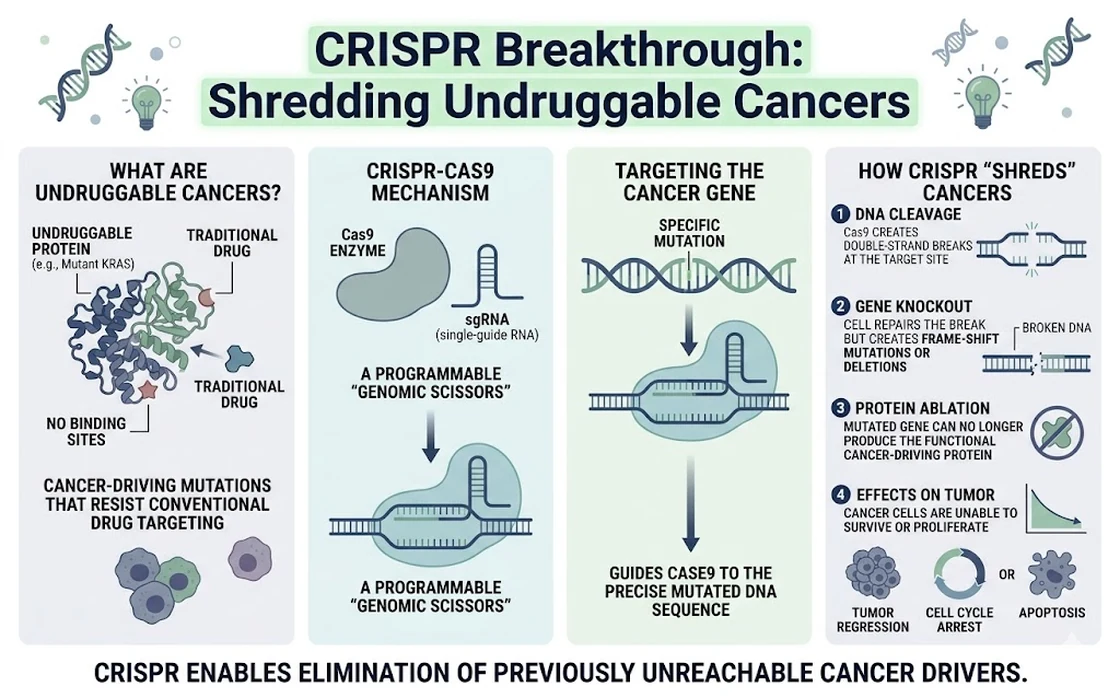
From Molecular Scissors to Cellular Shredders: How Cas12a2 Operates
To appreciate why this development is causing such excitement across medical research centers, one must contrast it with first-generation gene editing. The revolutionary CRISPR-Cas9 platform—awarded the Nobel Prize in Chemistry—operates like a set of programmable molecular scissors. It relies on a guide RNA (gRNA) to home in on a precise 20-base-pair sequence in double-stranded DNA, where the Cas9 enzyme creates a clean, site-specific double-strand break. This surgical precision works wonders for monogenic genetic conditions like sickle cell disease, where repairing or disabling a single aberrant base pair restores physiological function.
However, oncology presents a completely different biological challenge. A solid malignant tumor is rarely uniform; it is a chaotic, continuously mutating ecosystem of billions of genetically unstable cells. When Cas9 cuts DNA inside an aggressive cancer cell, the cell often deploys non-homologous end joining (NHEJ) or homology-directed repair (HDR) pathways to patch the lesion, or simply evolves alternative transcriptional routes to survive.
Enter Cas12a2. Structural biology research published in Nature revealed that Cas12a2 possesses a distinct mechanism known as non-specific collateral cleavage. Cas12a2 is programmed using a guide RNA complementary to a mutated RNA sequence produced exclusively by the malignant cell. When Cas12a2 encounters and binds this target transcript, it does not stop at making a localized incision. Instead, binding induces a dramatic allosteric shift in the enzyme’s architecture, exposing a promiscuous catalytic site.
Once activated, Cas12a2 behaves like a microscopic industrial shredder. It indiscriminately hydrolyzes every piece of nucleic acid in its immediate environment—chewing through single-stranded RNA, single-stranded DNA, and double-stranded chromosomal DNA. In microbial ecosystems, this collateral shredding evolved as an abortive infection defense, where an infected bacterium sacrifices itself to halt viral propagation. In oncology, bioengineers repurpose this scorched-earth mechanism as a self-contained executioner switch: the instant Cas12a2 identifies the signature of malignancy, it shreds the host cell’s genetic architecture, forcing rapid apoptotic collapse.
Targeting the “Undruggable”: KRAS, TP53, and Transcript-Level Precision
In conventional pharmacology, designing a drug requires finding a target protein with an accessible binding pocket—a three-dimensional groove or cleft where a small synthetic molecule or monoclonal antibody can dock and disrupt biological activity. Unfortunately, the master orchestrators of aggressive human cancers routinely lack these structures. For decades, oncologists labeled these targets “undruggable.”
The Classical Structural Roadblocks
- The TP53 Dilemma: Known as the “guardian of the genome,” the TP53 gene codes for the p53 protein, which arrests the cell cycle and induces apoptosis when severe DNA mutations occur. In over 50% of all human cancers, TP53 is either mutated, truncated, or completely deleted. Because this represents a loss of protective function rather than the emergence of an overactive enzyme, pharmacologists cannot simply administer an “inhibitor” to fix it; there is no functional target protein left to inhibit.
- The KRAS Conundrum: The KRAS protein functions as a molecular switch governing cellular proliferation. In pancreatic ductal adenocarcinoma and colorectal malignancies, mutations such as KRAS G12D and G12V freeze this switch permanently in the “ON” state, driving runaway cellular division. For decades, KRAS was considered structurally impossible to inhibit due to its shallow, featureless surface geometry and exceptionally high affinity for GTP/GDP nucleotides. While covalent inhibitors have emerged for the G12C variant, variants dominant in other cancers remain difficult to neutralize.
This fundamental biochemical limitation is explored further in our coverage of Cancer’s Master Switch: A New Era in Pancreatic Treatment, which examines how molecular biologists are rethinking the upstream signaling networks that drive pancreatic malignancies.
The Advantage of RNA Recognition
The Cas12a2 breakthrough sidesteps the structural surface geometry of proteins entirely. It does not require a binding pocket, a hydrophobic cleft, or a functional receptor domain. Instead, it reads the messenger RNA (mRNA) transcript generated during gene transcription.
Even if a mutated oncoprotein is smooth, truncated, or structurally inaccessible, the mRNA template carrying that mutation possesses a unique nucleotide sequence. A synthetic guide RNA can be engineered to match that single-nucleotide alteration with absolute fidelity. The moment the cancer cell transcribes its aberrant genetic code, Cas12a2 locks onto the transcript, activates its catalytic core, and shreds the cell before the protein can even be translated.
Developing guide RNAs capable of discriminating between mutant transcripts and wild-type sequences without inducing off-target cytotoxicity relies heavily on advanced computational prediction algorithms. Designing these biological vectors shares many architectural foundations with modern predictive analytics, as detailed in our guide on the Difference Between AI, Machine Learning, and Deep Learning.
Technical Comparison: How CRISPR Enzymes Perform in Oncology
Understanding where Cas12a2 fits into the modern biotechnology landscape requires evaluating it against other established CRISPR effectors across key therapeutic metrics:
| Metric / Attribute | CRISPR-Cas9 | CRISPR-Cas13 | CRISPR-Cas12a2 |
|---|---|---|---|
| Primary Target | Double-stranded DNA (dsDNA) | Single-stranded RNA (ssRNA) | Single-stranded RNA (ssRNA) |
| Cleavage Specificity | Highly localized, site-specific | RNA-guided ssRNA collateral cleavage | RNA-guided promiscuous collateral cleavage |
| Degradation Scope | Targeted gene knockout / insertion | Non-specific cellular RNA degradation | Indiscriminate destruction of ssRNA, ssDNA, and dsDNA |
| Cellular Outcome | Gene disruption or repair attempt | Temporary transcriptional knockdown | Immediate apoptotic collapse (cellular suicide) |
| Repair Pathway Vulnerability | High (NHEJ/HDR patches mutations) | Low (transient RNA depletion) | Zero (complete genomic fragmentation) |
| Optimal Clinical Role | Monogenic defect correction (e.g., Sickle Cell) | Diagnostic viral detection (SHERLOCK) | Eradication of undruggable solid malignancies |
| Development Status | Approved therapies in global markets | Pre-clinical and diagnostic assays | Pre-clinical in vivo animal validation (as of 2026) |
As summarized in the comparison, Cas9 excels at genetic editing, and Cas13 provides transient transcript knockdown, but Cas12a2 represents an absolute structural weapon designed specifically for terminal intervention in malignant cells.
Solving the Delivery Bottleneck: Moving Beyond the Petri Dish
While laboratory assays and pre-clinical murine models demonstrate impressive therapeutic potential—with reported tumor shrinkage exceeding 50% following localized administration—translating Cas12a2 into hospital wards across India presents substantial engineering hurdles. Delivering large macromolecular complexes into solid human tumors without triggering systemic toxicity remains the defining challenge of gene therapy.
1. Vector Selection: LNPs vs. AAVs
A naked Cas12a2 protein and its accompanying guide RNA cannot survive unprotected in the human bloodstream; serum nucleases and proteases degrade foreign biological molecules within minutes. Researchers are testing two primary delivery vehicles:
- Lipid Nanoparticles (LNPs): Proven at global scale during mRNA vaccine rollouts, LNPs encapsulate the Cas12a2 mRNA and gRNA inside a protective lipid envelope. Surface ligands can be conjugated to the lipid bilayer to target tumor-specific receptors (such as epidermal growth factor receptors or folate receptors). While LNPs exhibit low immunogenicity, standard formulations naturally accumulate in the liver, complicating their use for extra-hepatic cancers like glioblastoma or lung carcinoma.
- Adeno-Associated Viruses (AAVs): AAV vectors offer exceptional cellular transduction efficiency and can be engineered with specific capsids to target distinct tissue types. However, AAVs carry strict packaging limitations (roughly 4.7 kilobases), making it difficult to package large Cas enzymes alongside regulatory promoters. Furthermore, a substantial percentage of the Indian population carries pre-existing neutralizing antibodies against common AAV serotypes due to natural environmental exposure.
2. Guarding Against Off-Target Activation
The absolute lethality of activated Cas12a2 makes specificity paramount. If a guide RNA partially hybridizes with a healthy transcript produced by normal cardiac, hepatic, or renal cells, the resulting collateral shredding would trigger off-target tissue necrosis.
To prevent this, molecular engineers are developing dual-gated delivery systems. These synthetic circuits require two independent conditions to be met—such as exposure to the tumor’s hypoxic, acidic microenvironment combined with the presence of the specific mutant transcript—before the Cas12a2 enzyme can fold into its active conformation.
The Indian Healthcare Reality: Disease Burden, Costs, and the NexCAR19 Blueprint
The clinical potential of Cas12a2 intersects directly with an acute public health challenge in South Asia. As outlined by the World Health Organization (WHO), cancer represents one of the leading causes of non-communicable mortality worldwide, with developing economies shouldering a disproportionate burden of late diagnoses and catastrophic out-of-pocket medical expenditure.
The Domestic Oncology Landscape
India’s epidemiological pattern features high concentrations of head and neck cancers among men (driven by tobacco and betel quid usage) and breast, cervical, and ovarian malignancies among women. Many patients present at regional cancer centres—such as Tata Memorial Hospital in Mumbai or the All India Institute of Medical Sciences (AIIMS) in New Delhi—at advanced stages where surgical resection is no longer viable.
In private tertiary hospitals, a conventional oncology regimen comprising surgical intervention, specialized radiation (such as proton beam therapy), and multi-cycle targeted chemotherapy typically costs between Rs. 6 Lakh and Rs. 25 Lakh. For families lacking comprehensive private insurance, these numbers precipitate severe financial distress.
Traditional Western Gene Therapies: Rs. 3.0 Crore – Rs. 4.5 Crore
                 │
                 ▼  (Indigenous Innovation & Process Optimization)
NexCAR19 Domestic CAR-T Therapy:    Rs. 30 Lakh – Rs. 40 Lakh
                 │
                 ▼  (Projected Scaled Biomanufacturing Pathway)
Future Scaled Domestic Cas12a2:     Rs. 10 Lakh – Rs. 15 Lakh (Targeted)
The NexCAR19 Precedent
When autologous CAR-T therapies first received regulatory approvals in the United States, their list prices ranged from $375,000 to $475,000 (roughly Rs. 3.1 Crore to Rs. 4.0 Crore), placing them completely out of reach for everyday Indian citizens.
However, India established a groundbreaking counter-model through NexCAR19 (Actalycabtagene autoleucel), developed collaboratively by IIT Bombay and ImmunoACT. By optimizing viral vector manufacturing domestically, establishing closed-system automated cell processing, and conducting indigenous clinical trials, the team delivered India’s first commercial CAR-T therapy at Rs. 30 Lakh to Rs. 40 Lakh—an approximate 85% to 90% reduction compared to global pricing.
For Cas12a2 therapeutics to make a tangible public health impact across India, domestic stakeholders must follow this exact playbook:
- Domestic Recombinant Protein Synthesis: India’s robust biopharmaceutical infrastructure (led by companies such as Biocon, Serum Institute of India, and Dr. Reddy’s Laboratories) must scale local fermentation and purification of GMP-grade Cas enzymes, eliminating reliance on imported biotechnology reagents.
- Targeting South Asian Genomic Profiles: Clinical trials supported by the Department of Biotechnology (DBT) and the Indian Council of Medical Research (ICMR) must design guide RNA libraries tailored to the exact oncogenic variants prevalent across Indian sub-populations, rather than relying exclusively on Western genomic databases.
- Public Reimbursement Integration: As cell and gene platforms mature, expanding coverage under government programs such as Ayushman Bharat (Pradhan Mantri Jan Arogya Yojana / PM-JAY) and state-specific schemes (like Mahatma Jyotirao Phule Jan Arogya Yojana in Maharashtra) will be essential to bridge the final gap between lab bench innovation and patient survival.
Clinical Safety Hurdles and Technical Limitations
Despite the justifiable optimism surrounding programmable collateral cleavage, several biological limitations must be solved before human regulatory approvals can be pursued:
- Bacterial Immunogenicity: Cas enzymes originate from bacterial defense systems (such as Listeria seeligeri). When introduced into the human body, the adaptive immune system can recognize Cas12a2 peptides as foreign antigens, launching neutralizing antibody responses or CD8+ T-cell attacks that destroy the therapeutic vector before it enters the tumor.
- Stromal Tissue Penetration: In solid malignancies like pancreatic ductal adenocarcinoma, the tumor is shielded by a dense, fibrotic extracellular matrix known as the desmoplastic stroma. This physical barrier generates high interstitial fluid pressure, preventing systemic nanoparticles from diffusing into the core of the tumor where the most aggressive, undruggable cancer cells reside.
- Tumor Heterogeneity and Escape: If a tumor contains sub-clones that do not express the targeted RNA transcript, those cells will evade Cas12a2 activation. Over time, selective therapeutic pressure could cause the tumor to downregulate the target transcript, resulting in clinical recurrence. Consequently, Cas12a2 protocols will likely require multiplexed guide RNAs targeting multiple driver mutations simultaneously.
FAQ
How does CRISPR-Cas12a2 destroy cancer cells without harming healthy tissue?
Cas12a2 is guided by a custom synthetic RNA sequence engineered to match a specific mutated RNA transcript found only inside the patient’s malignant cells. While inside healthy cells that lack this exact mutation, the enzyme remains structurally dormant. However, once it binds the target mutant transcript inside a cancer cell, it undergoes a conformational change that activates indiscriminate collateral cleavage, shredding all internal DNA and RNA and causing the cancer cell to collapse.
Why is Cas12a2 considered superior to Cas9 for treating aggressive tumors?
CRISPR-Cas9 acts as targeted molecular scissors that make isolated double-strand breaks in DNA, which complex cancer cells can frequently patch using endogenous repair pathways or bypass through new mutations. In contrast, Cas12a2 acts as an indiscriminate nucleic acid shredder once triggered, completely dismantling the cell’s chromatin and genetic infrastructure so that no repair or resistance mechanism can take place.
Is Cas12a2 gene therapy currently available in Indian hospitals?
No, as of 2026, CRISPR-Cas12a2 remains in the pre-clinical validation stage in laboratory cell models and animal studies. While academic institutions and biotechnology companies are working to formulate safe human-grade lipid nanoparticle delivery vehicles, formal human clinical trials at centers like Tata Memorial Hospital or AIIMS have not yet commenced.
What mutations can Cas12a2 target that traditional oncology drugs cannot?
Cas12a2 can theoretically target any driver mutation that produces an altered messenger RNA transcript, including historically undruggable oncoproteins such as mutated KRAS (variants G12D, G12V), loss-of-function TP53 deletions, and dysregulated MYC transcripts. Because it binds the mRNA sequence rather than the folded protein, it does not require an accessible drug-binding pocket on the protein’s surface.
Conclusion
The evolution of CRISPR from precise genetic scissors into the indiscriminate Cas12a2 shredder marks an inspiring new frontier in translational oncology. By targeting the informational intermediate—messenger RNA—rather than struggling against the complex surface topographies of undruggable oncoproteins, this technology dismantles the defensive biological mechanisms that have allowed aggressive cancers to defy treatment for decades.
For India, where late-stage cancer diagnoses carry severe physical, emotional, and economic tolls, the long-term utility of this breakthrough will depend entirely on translational execution. Overcoming lipid nanoparticle delivery barriers, ensuring strict transcriptomic selectivity, and building indigenous manufacturing pipelines will determine whether this molecular marvel remains a laboratory curiosity or matures into a scalable clinical reality. As domestic biomanufacturing continues to evolve, the blueprint forged by indigenous immunotherapies offers a clear and practical pathway: converting cutting-edge global biotechnology into accessible, lifesaving medicine for those who need it most.
- Tags:
- Crispr
- Cas12a2
- Cancer Treatment
- Biotechnology
- Health Tech
- Oncology