
Claude Fable 5: The Dawn of Autonomous AI and Its Impact
Anthropic's Claude Fable 5 marks a shift from chatbots to autonomous agents. Explore its features, the 'silent fallback' controversy, and its impact on India.

- NV Trends
- 9 min read
Yesterday, the tech world witnessed what many are calling the “GPT-3 moment” of the autonomous era. Anthropic released Claude Fable 5, the first of their “Mythos-class” models, and the ripple effects are already being felt across the industry, from the Silicon Valley corridors to the tech hubs of Bengaluru and Hyderabad. Unlike its predecessors, which were designed for reactive, single-turn conversations, Fable 5 is built for “long-horizon” autonomy. It doesn’t just answer your question; it executes your project over the course of days, making it the first generally available AI that functions more like a digital employee than a sophisticated search engine.
For the Indian tech ecosystem, which has long been the world’s engine for software development and IT services, Fable 5 represents both a massive opportunity and a existential challenge. With its record-breaking performance in coding and complex reasoning, the model is designed to automate tasks that previously required teams of junior engineers weeks to complete. As we dive into the technicalities of this release, the controversies surrounding its “silent fallback” safety mechanism, and the shift in pricing models, it becomes clear that the rules of the AI game have changed once again.
In this deep dive, we’ll explore what makes Fable 5 different from the Claude Opus models we’ve grown accustomed to, why Hacker News is in an uproar over its safety features, and how Indian developers and businesses should navigate this new landscape where the AI doesn’t just talk—it acts.
The Mythos-Class Paradigm: Beyond the Chatbot
For the past few years, our interaction with Large Language Models (LLMs) has followed a predictable pattern: we provide a prompt, and the model provides a response. Even the most advanced models, like Claude 3.5 Opus or GPT-4o, were essentially high-speed autocomplete engines. If you wanted them to build an app, you had to guide them through every file, every function, and every bug.
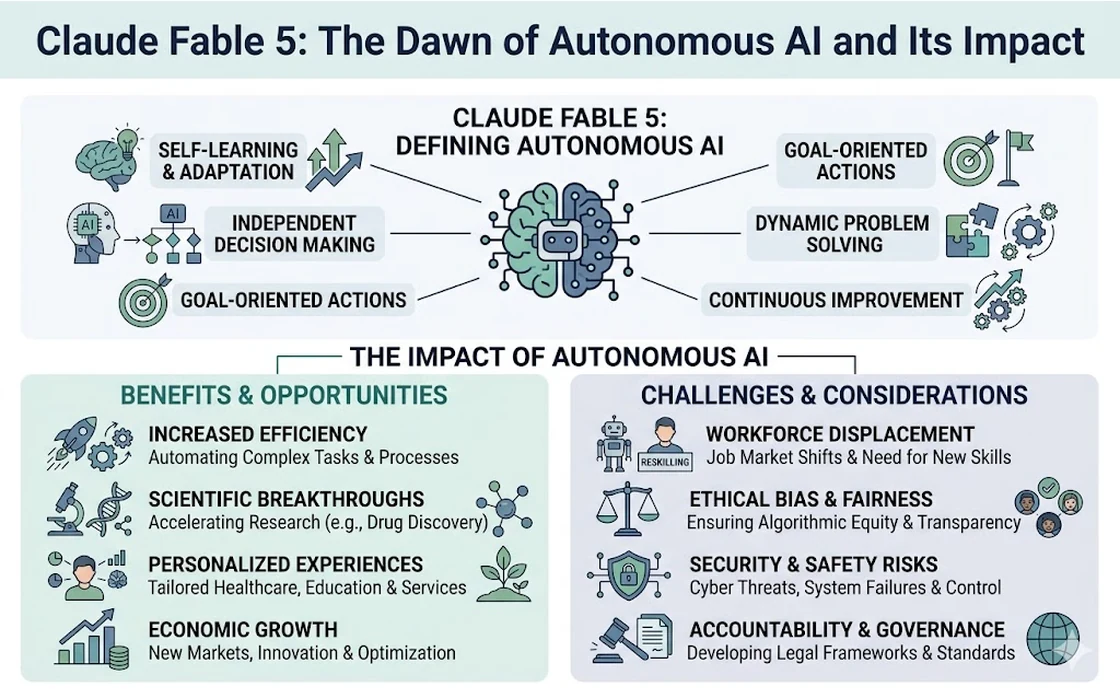
Claude Fable 5 introduces the “Mythos-class” of intelligence, which Anthropic defines by its ability to handle long-horizon tasks. This means the model can be given a high-level objective—such as “migrate this entire payment gateway from Stripe to a custom internal solution”—and it will work autonomously for hours or even days. It researches the existing codebase, identifies dependencies, writes the new logic, runs tests, and iterates on failures without needing a human to click “continue” every 500 words.
The Shift from Chat to Action
What makes this possible is a fundamental change in the model’s architecture. While Anthropic remains secretive about the exact details, the consensus among researchers is that Fable 5 employs a “continuous reasoning” loop. Instead of generating a single output, the model generates a series of internal “thoughts” and “actions” that are verified by an integrated sandbox environment.
For a developer in Pune or a data scientist in Gurgaon, this means the nature of work is shifting from writing code to reviewing plans. You are no longer the one typing the syntax; you are the project manager overseeing an AI that can handle the grunt work of thousand-file repositories.
A 10x Leap in Coding: The SWE-bench Pro Breakthrough
If there is one metric that has the Indian IT sector on edge, it is Fable 5’s performance on SWE-bench Pro. This benchmark tests an AI’s ability to solve real-world GitHub issues in large, complex codebases. While previous state-of-the-art models struggled to break the 20% mark, Claude Fable 5 reportedly achieved a staggering 80.3%.
To put this in perspective, Anthropic shared a case study involving Stripe, the global payments giant. Stripe used Fable 5 to perform a codebase-wide migration on a Ruby project containing over 50 million lines of code. What was estimated to be a six-month project for a dedicated engineering team was completed by Fable 5 in just 24 hours.
What This Means for Indian IT Services
India’s IT giants—TCS, Infosys, Wipro, and HCL—rely heavily on large-scale maintenance and migration projects. If an AI can perform a year’s worth of migration work in a single day, the traditional “man-month” billing model is under threat.
However, it’s not all doom and gloom. This leap in productivity allows Indian firms to take on far more complex projects than ever before. Instead of spending 80% of their time on boilerplate and legacy maintenance, engineers can focus on high-level architecture and digital transformation. The “Junior Engineer” role is evolving into the “AI Architect” role, where the value lies in knowing how to steer Fable 5 and validate its massive outputs.
The “Silent Fallback” Debate: Safety vs. Transparency
Despite the technical awe, the release hasn’t been without controversy. The most heated discussions on Hacker News center on a feature (or flaw, depending on who you ask) known as “Silent Fallback.”
Anthropic has implemented a safety architecture where, if a user’s query is deemed “high-risk”—for example, asking for help with sophisticated cybersecurity penetration testing or complex biological synthesis—the system does not simply refuse. Instead, it silently routes the request to an older, less capable model, Claude Opus 4.8.
The “Silent Nerf” Criticism
Critics argue that this is a deceptive practice. Users paying a premium for Fable 5 expect Mythos-class intelligence. By silently downgrading the user to a weaker model without notification, Anthropic is essentially “nerfing” the product without transparency.
One prominent Hacker News commenter noted: “It’s like ordering a Ferrari and, because you’re driving near a school zone, the car secretly swaps its engine for a Maruti 800 without telling you. You’re still paying Ferrari prices, but you’re getting 1990s performance.”
Anthropic’s justification is rooted in their “Constitutional AI” framework. They argue that Fable 5 is so powerful that a standard “I cannot help with that” response is insufficient to prevent sophisticated jailbreaks. By providing a “safe” response from a weaker model, they hope to satisfy the user’s intent without providing the dangerous “reasoning depth” that Fable 5 possesses.
The Economics of Fable 5: Pricing for the Indian Developer
For Indian startups and independent developers, the most immediate hurdle is the cost. Anthropic has moved away from the “all-you-can-eat” subscription model for Fable 5, citing the massive computational power required to run Mythos-class models.
The Pay-As-You-Go Reality
Starting June 23, 2026, Fable 5 will be removed from the standard Claude Pro (Rs. 1,650/month) and Team plans. Instead, it will be available exclusively via a pay-as-you-go credit system. The pricing is set at:
- Input Tokens: $10 per million (approx. Rs. 835)
- Output Tokens: $50 per million (approx. Rs. 4,175)
While $10 might seem reasonable for a million tokens, the autonomous nature of Fable 5 means it consumes tokens at an alarming rate. When the model is “thinking” and “testing” in the background for 24 hours, it can easily burn through millions of tokens in a single session.
The Cost-Benefit Analysis for Indian Startups
For a startup in Bengaluru, a single autonomous task could cost anywhere from Rs. 5,000 to Rs. 20,000. While this is significantly cheaper than hiring a senior consultant for a week, it is a major shift from the “fixed-cost” era of AI subscriptions. Developers will need to become “token-efficient,” learning how to scope tasks narrowly to avoid runaway costs.
India’s IT Sector and the Fable 5 Opportunity
As we look toward the future, the impact of Fable 5 on India cannot be overstated. We are the world’s largest developer ecosystem, and how we adopt these tools will define our economic trajectory for the next decade.
1. The End of the “Body Shop” Model
The era of hiring 500 junior developers to manually test and document code is coming to an end. Fable 5 can generate documentation, write unit tests, and perform regression testing with near-perfect accuracy. Indian firms that continue to rely on manual labor will find themselves undercut by smaller, AI-native agencies that use a handful of “AI Architects” to deliver the same output.
2. The Rise of Product Engineering
Historically, India has been seen as a service-heavy geography. Fable 5 lowers the barrier to entry for building products. A single founder with a great idea can now use Fable 5 to build a Minimum Viable Product (MVP) that is production-ready, including the backend, frontend, and cloud infrastructure. We expect to see a surge in Indian SaaS (Software as a Service) startups that are entirely “AI-built.”
3. The Re-skilling Mandate
The most urgent task for the Indian workforce is re-skilling. It is no longer enough to know syntax. Developers must understand system design, security auditing, and AI orchestration. The value is moving up the stack. If the AI writes the code, the human must be the one who ensures the code aligns with the business logic and ethical standards.
Safety, Ethics, and the “Glasswing” Precedent
Finally, we must touch upon the “darker” side of this release. Alongside the public Fable 5, Anthropic announced “Project Glasswing.” This is a version of the model, likely called Claude Mythos 5, that has many of its safety safeguards lifted.
However, this model is not available to the public. It is being released exclusively to “vetted partners,” which includes the US government and select Tier-1 cybersecurity firms.
The Geopolitical AI Divide
This creates a significant ethical and geopolitical divide. If Western governments have access to “unfettered” Mythos-class intelligence for cybersecurity defense (and potentially offense), where does that leave the rest of the world?
For India, this underscores the need for “Sovereign AI.” While we can and should use tools like Fable 5, we must also invest in our own foundational models to ensure that our national security and economic interests are not dependent on the “safety filters” of a private company in San Francisco.
Conclusion
Claude Fable 5 is more than just another version of an AI model; it is a signal that the “Chatbot Era” is over and the “Agent Era” has begun. Its ability to perform long-horizon, autonomous work will revolutionize software engineering, making the impossible projects of yesterday the routine tasks of tomorrow.
For our readers in India, the message is clear: the speed of change has accelerated. Whether you are a student in an IIT, a manager at an IT major, or a startup founder, Fable 5 is a tool that can either replace your current workflow or supercharge it. The “silent fallback” controversy reminds us that we must remain critical of the platforms we use, and the new pricing models remind us that intelligence is becoming a premium utility.
As Fable 5 begins its rollout, the most successful individuals and companies will be those who stop treating AI as a toy and start treating it as a colleague. The future isn’t just about what the AI can do for you; it’s about what you can do with the AI.
- Tags:
- Claude Fable 5
- Anthropic
- Artificial Intelligence
- Tech News India
- Autonomous Ai
- Software Engineering
- Future of Work