
Petition to Withdraw Canada's Bill C-22: Privacy at Risk?
The petition to withdraw Canada's Bill C-22 highlights global concerns over encryption backdoors and digital privacy that could affect users everywhere.

- NV Trends
- 10 min read
The digital world is currently fixated on a piece of Canadian legislation that many believe could change the nature of the internet forever. Bill C-22, officially titled the Lawful Access Act 2026, has moved from a legislative debate in Ottawa to a global talking point, dominating tech forums and sparking a massive public backlash. For readers in India, who have seen their own share of debates surrounding digital privacy and platform accountability, the developments in Canada offer a crucial look at the global struggle between national security and personal liberty.
At its core, Bill C-22 is framed by the Canadian government as a necessary tool for modernizing law enforcement in an age of end-to-end encryption and sophisticated cybercrime. However, the technical community, led by voices on platforms like Hacker News, sees it as a “surveillance nightmare.” The controversy has reached a boiling point with a nationwide petition calling for the bill’s immediate withdrawal, gathering tens of thousands of signatures from citizens and experts alike who fear that the legislation will dismantle the foundations of digital security.
Why does a Canadian bill matter to an Indian reader? In our increasingly interconnected tech ecosystem, legislation in one “Five Eyes” nation often serves as a blueprint or a warning for others. As India continues to refine its own Digital Personal Data Protection (DPDP) framework and navigates the complexities of the IT Rules, the fate of Bill C-22 represents a pivotal moment for the global tech industry. It is a story of how a single piece of legislation can threaten the security of billions of users, the integrity of open-source software, and the trust we place in our digital financial systems.
Understanding Bill C-22: The Lawful Access Act 2026
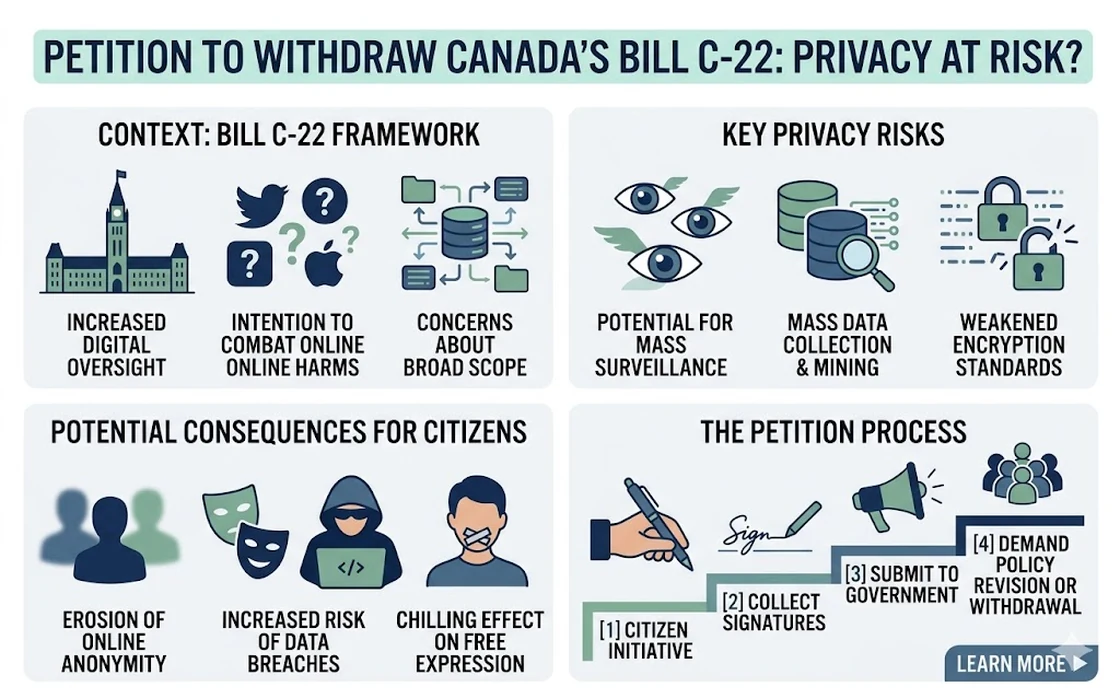
Bill C-22 was introduced with the stated intent of giving agencies like the Royal Canadian Mounted Police (RCMP) and the Canadian Security Intelligence Service (CSIS) the “technical capabilities” required to investigate serious crimes, including terrorism and organized crime. The government argues that as more communication moves to encrypted platforms, “dark spots” are created where law enforcement cannot reach, even with a valid warrant.
Unlike previous attempts at surveillance legislation, Bill C-22 goes significantly further by targeting the very infrastructure of the internet. It doesn’t just ask for data; it mandates that “electronic service providers” ensure they have the technical ability to intercept and provide access to communications when ordered. This broad definition of service providers includes not just telecom companies, but any entity providing digital services—ranging from messaging apps and social media platforms to online banks and small e-commerce startups.
The primary point of contention is the ambiguity of these “technical capabilities.” While the bill’s proponents claim it is “encryption neutral”—meaning it doesn’t explicitly ban encryption—cryptographers and security experts argue that there is no way to provide “lawful access” to encrypted data without creating a vulnerability. This is the “backdoor” problem that has haunted the tech industry for decades, and Bill C-22 is the most aggressive attempt yet to make it a legal requirement.
The Encryption Dilemma: Privacy vs. Security
For most of us, encryption is the invisible shield that protects our private chats, our bank passwords, and our medical records. When you send a message on a platform like WhatsApp or Signal, it is scrambled so that only the recipient can read it. Even the service provider cannot see the content. This is known as end-to-end encryption (E2EE), and it is the gold standard for digital privacy.
Bill C-22’s requirement for “technical capability” effectively demands that companies find a way to unscramble these messages for the government. In the world of cybersecurity, there is a fundamental truth: a backdoor created for a “good guy” is eventually found and exploited by “bad guys.” Whether it’s a rogue state actor, a sophisticated hacking collective, or a disgruntled insider, a built-in vulnerability is a permanent risk.
For an Indian professional working in the tech sector, this isn’t just a theoretical concern. Many Indian IT firms manage data for global clients, including those in Canada. If Bill C-22 mandates these vulnerabilities, the security of that data—and the reputation of the firms handling it—is compromised. The cost of a major data breach for a mid-sized Indian firm can easily exceed Rs. 15-20 crores, not counting the long-term loss of trust and legal liabilities.
The “Signal” Warning: Why Tech Giants are Concerned
The backlash from the technology sector has been unprecedented. Signal, the non-profit messaging app known for its strict privacy stance, has already threatened to withdraw from the Canadian market entirely if the bill passes. Their argument is simple: they cannot and will not build a backdoor that compromises the security of their global user base to satisfy a single government’s mandate.
Apple, Meta, and Google have also voiced strong objections. These companies have spent billions of dollars (equivalent to thousands of crores of rupees) building secure ecosystems. They understand that compromising encryption in one jurisdiction creates a “poison pill” for their entire global infrastructure. If Canada can force a backdoor, what’s to stop other nations from demanding the same? The result would be a fragmented, insecure internet where privacy depends entirely on where you happen to be logged in.
Mandatory Data Retention: Your Digital Footprint
Beyond the encryption debate, Bill C-22 introduces strict mandatory data retention requirements. Under the proposed law, service providers would be compelled to store subscriber metadata for up to one year. While the government emphasizes that this is “just metadata” and not the content of the messages, privacy advocates point out that metadata is often more revealing than the content itself.
Metadata includes who you called, when you called them, how long you spoke, your physical location at the time, and your IP address. It is a detailed map of your life. For a general reader, imagine someone knowing every person you’ve ever contacted, every financial service you’ve accessed, and every website you’ve visited over the last twelve months. It allows for the construction of a deeply personal profile that can be used for profiling, targeted surveillance, or even blackmail if the data falls into the wrong hands.
The risk of a data leak is not a matter of “if,” but “when.” Storing massive amounts of metadata for a year creates a “honeypot” for hackers. In India, where we have seen significant data leaks from both government and private databases, the dangers of centralized data retention are well-understood. Forcing Canadian companies (and by extension, any global company with Canadian users) to hold this data is a massive security liability.
The Economic Impact: A Threat to the Tech Ecosystem
The economic ramifications of Bill C-22 are equally concerning. Shopify CEO Tobi Lütke has publicly described the bill as a “huge mistake,” arguing that it threatens Canada’s international competitiveness as a tech hub. For a company like Shopify, which powers millions of businesses worldwide (including many in India), trust is the primary currency. If international clients fear that their business data is subject to secret government access in Canada, they will look elsewhere.
Cybersecurity companies, particularly VPN providers like Windscribe and NordVPN, have also raised the alarm. Some have already signaled their intent to relocate their headquarters or servers out of Canada if the Lawful Access Act becomes law. This “brain drain” and capital flight could cost the Canadian economy billions of dollars.
For the Indian tech community, this presents both a challenge and a cautionary tale. India is a global leader in software services and is rapidly becoming a hub for SaaS (Software as a Service) startups. Our ability to compete globally depends on our adherence to international security standards. If the global standard shifts toward mandated surveillance, it complicates the landscape for Indian developers who must now navigate conflicting laws in every market they serve.
Why Hacker News is Sounding the Alarm
Hacker News (HN), the influential community of developers, engineers, and founders, has been a primary hub for organizing opposition to Bill C-22. The community’s concern is not just about corporate profits, but about the integrity of the technology itself. One of the most significant points raised is the impact on open-source projects.
OpenBSD, one of the world’s most secure and respected operating systems, is based in Canada. Open-source projects rely on transparency and community trust. If the Canadian government can issue “secret orders” to developers to insert malicious code or vulnerabilities into their software, the entire open-source model is threatened. Developers on HN have pointed out that you cannot “patch” a government-mandated vulnerability without breaking the law, but you cannot leave it in without betraying your users.
This creates an impossible situation for the thousands of Indian developers who contribute to global open-source projects. If the tools we use to build the internet are fundamentally compromised at the source, the security of the entire digital world is at stake. The “HN crowd” understands that Bill C-22 is not just a Canadian law; it’s a technical assault on the principles of the open web.
The Petition to Withdraw: Public Power in Action
In response to these threats, the Justice Centre for Constitutional Freedoms (JCCF) and other advocacy groups have organized a massive petition calling for the withdrawal of Bill C-22. The petition has garnered over 42,000 signatures in a matter of weeks, reflecting a broad-based opposition that spans the political spectrum.
The petition argues that the bill violates the Canadian Charter of Rights and Freedoms by authorizing “unreasonable search and seizure.” It highlights that the “secret orders” provision allows the government to bypass judicial oversight, effectively creating a parallel legal system that operates in the shadows. The public outcry has forced the bill into a heated committee stage, where lawmakers are being grilled by technical experts and civil liberties advocates.
The success of this petition serves as a reminder of the power of collective action. In India, we have seen how public consultation and active participation can influence tech policy, such as the massive response to the TRAI’s consultation on net neutrality years ago. The Canadian petition is a clear signal that the public is no longer willing to accept “security” as a catch-all excuse for the erosion of privacy.
Lessons for India: A Mirror to Our Own Digital Debates
As we watch the events in Canada unfold, the parallels to the Indian digital landscape are striking. India’s IT Rules 2021 introduced the concept of “traceability,” requiring messaging apps to identify the “first originator” of a message. Like Bill C-22, this was criticized by platforms like WhatsApp as a threat to end-to-end encryption.
The debate in Canada is essentially the same debate we are having in India: how do we balance the legitimate needs of law enforcement with the fundamental right to privacy? The Canadian experience shows that even in established democracies with strong legal protections, the urge for government overreach in the digital sphere is ever-present.
For the Indian reader, the takeaway is clear: digital rights are not local; they are global. A win for privacy in Canada is a win for the global standards that protect us all. Conversely, if Bill C-22 passes, it provides a dangerous precedent that other governments—including our own—might be tempted to follow. We must remain vigilant and participate in the shaping of our digital laws, ensuring that they reflect the values of a free and secure society.
Conclusion
The petition to withdraw Canada’s Bill C-22 is more than just a domestic political move; it is a defense of the technical and ethical foundations of the modern internet. By demanding encryption backdoors and extensive data retention, the Lawful Access Act 2026 threatens to turn the tools of empowerment into tools of surveillance. The overwhelming opposition from the tech community, the financial sector, and the general public highlights a growing consensus: privacy is not a luxury, but a prerequisite for a functioning digital economy and a free society.
As this legislative battle continues, the world is watching. For those of us in India, the lesson is to appreciate the fragility of our digital freedoms and the importance of holding our institutions accountable. Whether you are a developer in Bengaluru or a digital consumer in Mumbai, the fate of Bill C-22 will eventually touch your digital life. Supporting the principles of strong encryption and transparent governance is the only way to ensure that the internet remains a safe, secure, and open space for everyone.