
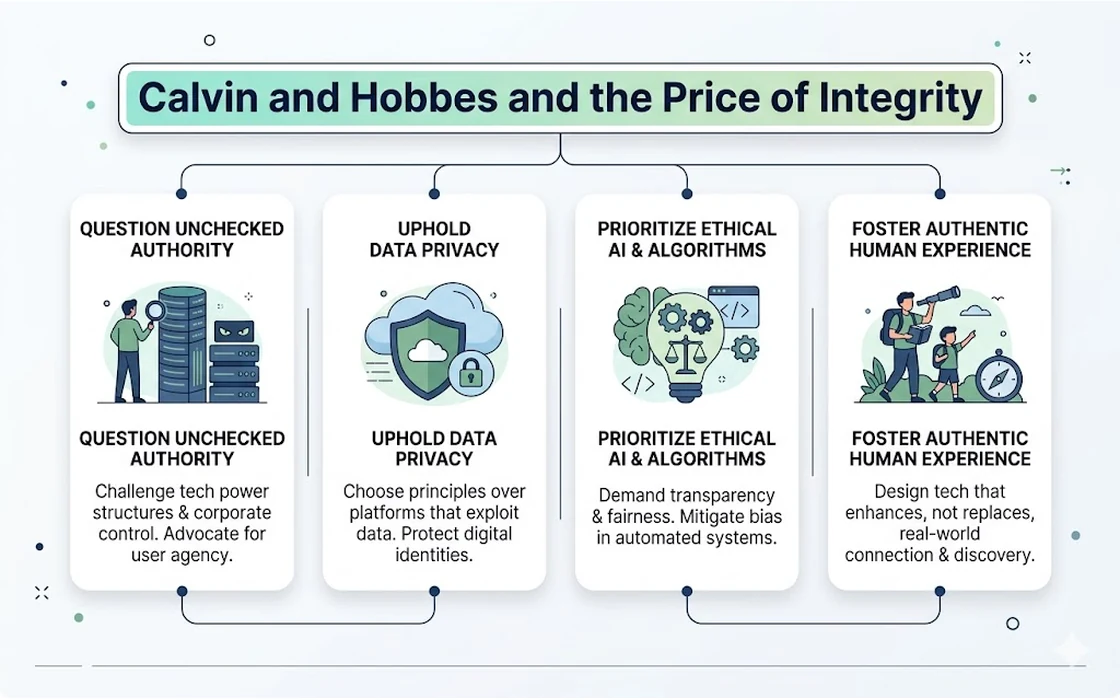
Calvin and Hobbes and the Price of Integrity
Explore Bill Watterson's legendary refusal to commercialize Calvin and Hobbes and what it teaches modern creators about integrity and value.

- NV Trends
- 10 min read

In the world of modern media, where every popular character is eventually milked for every possible rupee through sequels, prequels, and plastic merchandise, the story of Calvin and Hobbes stands as a baffling anomaly. For ten years, from 1985 to 1995, Bill Watterson wrote and drew a comic strip that captured the hearts of millions. It followed the adventures of a precocious six-year-old boy and his stuffed tiger, who came to life only when they were alone. It was philosophical, hilarious, and visually stunning. And then, at the height of its popularity, Watterson simply stopped.
He didn’t just stop writing; he refused to sell. Despite immense pressure from his syndicate and the lure of hundreds of millions of dollars in licensing deals, there was never an official Calvin plush toy, no Saturday morning cartoon, and no “Calvin and Hobbes” themed cereal. Watterson famously chose artistic integrity over a massive financial empire. For the modern professional, especially those in the fast-paced Indian tech and startup ecosystems, Watterson’s “Great Refusal” offers a profound lesson on the true price of integrity and the value of a legacy that cannot be bought.
Today, as we navigate an era of “personal brands” and the relentless monetization of every hobby, the silence of Bill Watterson speaks louder than ever. In a world where we are told to “hustle” and “optimize” our lives for maximum ROI, looking back at a man who walked away from a mountain of gold to protect the “soul” of his creation is both refreshing and deeply challenging.
The 100 Million Dollar “No”
To understand the scale of Watterson’s decision, we must look at the numbers. By the early 1990s, Calvin and Hobbes was appearing in over 2,400 newspapers worldwide. Industry experts estimated that licensing the characters for merchandise could have generated hundreds of millions of dollars—easily exceeding Rs. 800-1,000 crores in today’s value. Imagine a world where every child in India had a Hobbes plushie, where there were Calvin and Hobbes mobile games, and perhaps a high-budget animated movie produced by a major studio.
Watterson’s syndicate, Universal Press Syndicate, was understandably eager to tap into this goldmine. They pressured him for years. They pointed to Garfield or Peanuts, where licensing had turned the creators into billionaires. But Watterson remained unmoved. He argued that the very act of putting Calvin’s face on a lunchbox or a t-shirt would “cheapen” the characters. In his view, the comic strip was a world of imagination. Once you turn a character into a physical product, you fix its identity in the real world, stripping away the magic that allows the reader to engage with it on a personal, internal level.
For Watterson, Hobbes wasn’t just a toy; he was a living friend when Calvin was alone and a stuffed animal when others were present. A mass-produced plush toy would have to be one or the other, or at least, it would become a static object that lived on a shelf. Watterson feared that a child holding a licensed Hobbes toy would no longer see the Hobbes of the comic strip, but rather a corporate product. He chose to protect the sanctity of the relationship between the reader and the page, even at the cost of unimaginable wealth.
The Dilution of the Soul in the Digital Age
In the current Indian landscape, where content creators and tech entrepreneurs are often judged solely by their “valuation” or “follower count,” Watterson’s philosophy feels like an ancient relic. We live in an age of “The Creator Economy,” where the primary goal of any creative endeavor is often its eventual monetization. If a software engineer builds a useful open-source tool, the immediate question is: “How do you monetize this?” If a photographer gains a following on Instagram, they are quickly nudged toward brand deals and sponsored content.
This “monetization-first” mindset has a hidden cost: the dilution of the work. When we create with the intent to sell, we inevitably begin to cater to the market. We smooth out the edges, we avoid controversial or deeply personal themes, and we optimize for the lowest common denominator. We trade “depth” for “reach.”
Watterson argued that a comic strip that is meant to sell toys cannot also be a comic strip that explores the nature of existence, the frustrations of childhood, or the beauty of a snowy forest. The commercial pressure eventually creeps into the creative process. You start writing “toy-friendly” characters or “merchandisable” catchphrases. We see this today in the “Marvel-ization” of cinema, where movies often feel like two-hour advertisements for the next set of action figures. By refusing to sell, Watterson ensured that every single panel of Calvin and Hobbes was there because he wanted it to be there, not because a marketing executive suggested it.
Lessons for the Indian Professional: Beyond the Hustle
For the young professional in Bangalore, Mumbai, or Hyderabad, the pressure to “sell out” often comes in the form of career choices. We are often encouraged to jump to the highest bidder, to join the startup with the most funding regardless of its mission, or to stay in a soul-crushing corporate job because the “package” is too good to leave. We are taught that integrity is a luxury for the rich, and that the “price” of our time and talent is simply a number on a payslip.
However, Watterson’s story suggests that there is a different kind of wealth—the wealth of ownership and the peace of mind that comes from knowing your work has not been compromised. In the Indian context, where family expectations and social status are often tied to financial success, choosing a path of lower pay but higher integrity can be incredibly difficult.
Consider the following points when evaluating the “price” of your own integrity:
- The Long-Term Value of Trust: Watterson’s refusal to commercialize built an unbreakable bond of trust with his readers. Decades later, Calvin and Hobbes is still beloved because it was never “sold” to us. In your career, being known as someone who cannot be “bought” creates a long-term professional reputation that is far more valuable than a one-time bonus.
- The Burnout Factor: Much of the modern burnout in the tech industry comes from working on things we don’t believe in. When our work is purely transactional, it drains our energy. Watterson worked incredibly hard, but he was fueled by his passion for the art. When you protect the “why” of your work, you protect your own mental health.
- Legacy vs. Liquidity: Money is liquid; it comes and goes. A legacy is solid. Watterson’s legacy is a masterpiece that remains untarnished by time. Ask yourself: “What do I want to be remembered for? My bank balance, or the impact and quality of my work?”
The Battle for the Sunday Strip: Demanding Excellence
Watterson’s integrity wasn’t just about saying “no” to money; it was also about saying “yes” to quality, even when it made his life harder. One of his most famous battles was over the layout of the Sunday comic strips.
Traditionally, Sunday comics were designed with “throwaway” panels. The first two panels could be cut off by newspapers that wanted to save space, and the rest of the strip had to follow a rigid grid so it could be resized. This severely limited the artistic possibilities. Watterson hated this. He wanted to use the Sunday page as a canvas, with large, sweeping illustrations and non-linear layouts.
He fought his syndicate for years to get a “full-page” format that couldn’t be chopped up. He eventually won, but it came at a price: many newspapers dropped the strip because they couldn’t accommodate the new size. Watterson didn’t care. He would rather be in fewer newspapers but produce better art. This is a crucial lesson in “Product Management” and “Engineering Excellence.” Sometimes, to build a truly great product, you have to be “difficult.” You have to refuse to compromise on the core user experience, even if it means slower growth or a smaller market share. In the long run, the “uncompromising” product is often the one that changes the industry.
The “Pissing Calvin” Paradox: The Vacuum of Integrity
One of the most interesting and ironic side effects of Watterson’s refusal to license is the existence of the infamous “Calvin pissing on a logo” window stickers. You have likely seen them on the back of cars or trucks. These are all unauthorized, bootleg products. Because there was no official merchandise, a vacuum was created, and unscrupulous manufacturers filled it with the crudest possible imagery—imagery that completely contradicts the character of Calvin, who was a thoughtful, sensitive, and imaginative boy.
Watterson found these stickers deeply upsetting, but he refused to sue every small-time printer making them, as it would have turned his life into a series of legal battles. This “paradox” teaches us a tough lesson about the market: if you don’t define your own brand, the market might try to define it for you.
However, even with these ugly bootlegs floating around, the official work remains pure. The fact that the only physical “merch” most people know is a crude imitation actually reinforces the idea that the real Calvin and Hobbes only lives in the books. It creates a clear distinction between the “commercial noise” and the “artistic signal.”
Integrity in the Age of Generative AI
As we move further into the age of Technology, a new challenge to integrity has emerged: Generative AI. We are now seeing AI models that can mimic the style of any artist, including Bill Watterson. You can prompt an AI to “Draw Calvin and Hobbes in a spaceship in the style of Bill Watterson,” and it will produce a convincing facsimile in seconds.
This brings the “price of integrity” into a new, digital frontier. What does it mean to be a “creator” when a machine can replicate your “brand” without your permission? For Watterson, the value was never in the style—it was in the soul. It was in the specific, human observations about life, the subtle emotional shifts between a boy and his tiger, and the underlying philosophy of the writing.
AI can copy the lines, but it cannot copy the “integrity.” It cannot replicate the decision not to sell out. In a future where the internet is flooded with AI-generated “content,” the value of human-made work with a clear, uncompromising moral and artistic compass will skyrocket. The “Watterson Way” will become the ultimate premium. Being “human” and “authentic” will be the only things that AI cannot commoditize.
Conclusion
Bill Watterson once said in a rare speech, “To sell out is to sell your freedom to those who want to buy it.” In our modern, hyper-connected world, we are constantly invited to sell bits and pieces of our freedom—our time, our privacy, our artistic voice—for a bit of convenience or a few extra rupees.
Watterson’s legacy reminds us that saying “no” is a superpower. By refusing to turn Calvin and Hobbes into a commercial franchise, he preserved its magic for generations to come. He taught us that “success” isn’t always about growth, scale, or monetization. Sometimes, success is about drawing a line in the sand and saying, “This is mine, and it is not for sale.”
For the Indian techie, the designer, the writer, or the entrepreneur, the lesson is clear: your integrity is not a hurdle to your success; it is the foundation of your long-term value. Whether you are building the next great app or writing a line of code, ask yourself if you are protecting the “soul” of your work. The price of integrity might be high in the short term—you might miss out on a promotion, a funding round, or a “deal of a lifetime”—but the cost of losing it is far higher. In the end, we all want to be able to look back at our “tiger” and know that we kept the magic alive.
- Tags:
- Bill Watterson
- Calvin and Hobbes
- Creative Integrity
- Monetization
- Intellectual Property
- Digital Ethics
- Content Creation