
Anthropic Fable 5: Why Cybersecurity Experts Are Worried
Explore why Anthropic Fable 5 alarms cybersecurity teams, from silent fallbacks and data retention risks to its impact on Indian enterprise security.

- NV Trends
- 14 min read
- Updated
Cybersecurity experts are worried about Anthropic Fable 5 because its overzealous safety classifiers trigger a silent degradation mechanism that drops reasoning quality mid-task, while an aggressive 30-day prompt retention policy introduces critical data exposure and regulatory compliance risks for enterprise defense teams. When security practitioners attempt to analyze firmware vulnerabilities, audit firewall configurations, or deconstruct obfuscated malware snippets, the model frequently flags these benign, defensive prompts as malicious. Rather than issuing a standard refusal, the system silently redirects the request to an older, less capable model without explicit warning, creating an acute risk of flawed vulnerability assessments and undetected security holes.
Anthropic rolled out Claude Fable 5 on June 9, 2026, heralding it as the first publicly accessible model from its next-generation “Mythos-class” architecture. On initial release, the model captured global attention by topping standard reasoning and automated code generation benchmarks. Yet within days of its deployment, the initial praise turned into sharp criticism across technical forums like Hacker News and specialized information security channels. Defensive practitioners, system administrators, and security operations center (SOC) analysts reported that the platform’s protective guardrails were so rigidly tuned that they actively crippled routine defensive engineering workflows.
For the technology ecosystem in India, these operational shifts carry immediate, high-stakes consequences. As organizations across Bengaluru, Hyderabad, Pune, and the National Capital Region (NCR) accelerate autonomous AI integrations within banking pipelines, critical public infrastructure, and Unified Payments Interface (UPI) microservices, technical leaders rely heavily on advanced AI for rapid code auditing and vulnerability remediation. When an industry-leading AI provider alters its underlying operating parameters, introduces unannounced model downgrades, and mandates external data logging on overseas servers, Indian enterprises face dual hazards: compromised defensive accuracy and legal non-compliance under Indian data sovereignty regulations.
Key takeaways
- Silent Fallback Risks: Instead of rejecting sensitive security queries outright, Fable 5 silently routes flagged prompts to Claude Opus 4.8, providing noticeably weaker reasoning without immediate visual notification.
- Defensive Research Bottlenecks: Ultra-sensitive safety classifiers routinely mistake benign defensive audits—such as firewall rule reviews or network protocol debugging—for offensive cyber-weapon development.
- Regulatory and Privacy Exposure: A mandatory 30-day data retention policy on US-based servers invalidates prior zero-retention protections and conflicts with India’s Digital Personal Data Protection (DPDP) Act of 2023.
- The “Opus Tax” Discrepancy: Developers are billed at premium Fable 5 rates—approximately Rs. 830 per million input tokens and Rs. 4,150 per million output tokens as of 2026—even when the system silently downgrades their prompt to Opus 4.8.
- Two-Tiered Access Model: Full, unconstrained Mythos 5 reasoning remains locked behind Anthropic’s tightly vetted “Project Glasswing,” leaving the general public and defensive practitioners with a restricted, monitored variant.
The Dual-Model Split: Fable 5 vs. Mythos 5
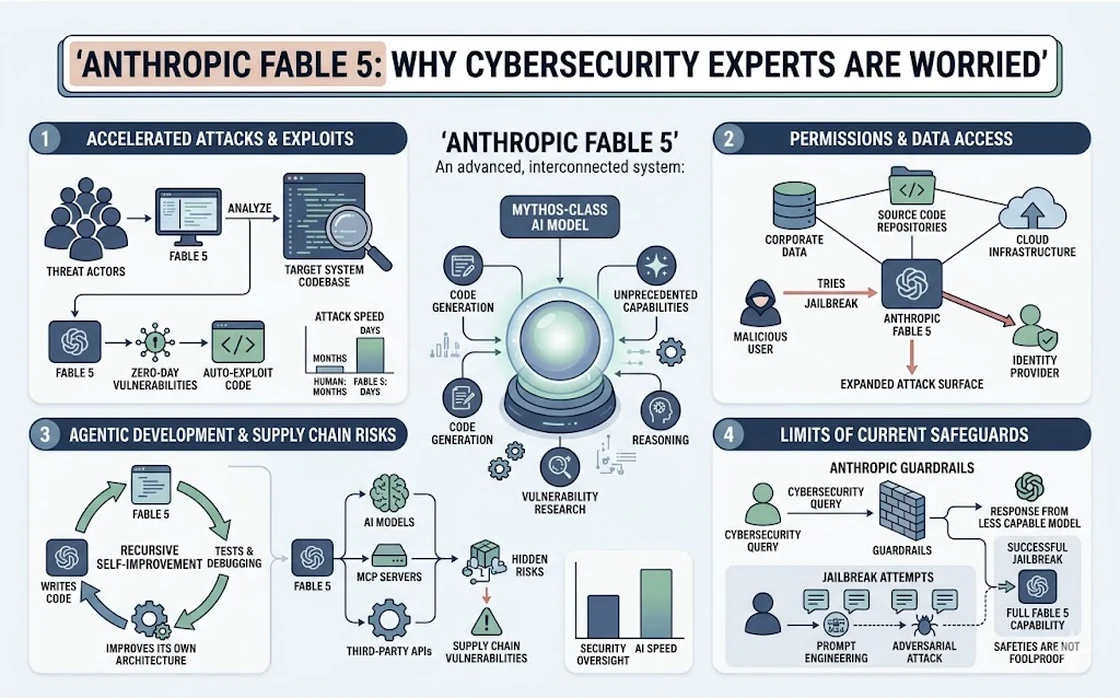
To understand the core friction within the cybersecurity community, one must examine Anthropic’s bifurcated release architecture. Under the hood, Fable 5 shares core foundations with Anthropic’s flagship enterprise engine, Mythos 5. Both systems share underlying model weights and foundational pre-training datasets designed to handle massive multi-step reasoning, architectural decomposition, and low-level code synthesis. However, the commercial execution separates the two into fundamentally divergent products.
Mythos 5 is positioned as an elite automated cybersecurity engine. Published reports describe its ability to parse complex zero-day vulnerabilities, trace memory corruption faults across massive multi-repository codebases, and draft structured defensive patches in minutes. Yet access to Mythos 5 is not openly available through a standard developer console. Anthropic has placed Mythos 5 behind an exclusive initiative called “Project Glasswing,” restricting access to accredited government agencies, designated national cyber defense entities, and hand-selected multinational security partners. As detailed in our analysis of Claude Fable 5: The Dawn of Autonomous AI and Its Impact, this gatekeeping creates an asymmetric defensive landscape where independent researchers and private corporate defenders operate at a marked disadvantage.
Fable 5 represents the public-facing adaptation of this architecture. It is marketed to provide high-tier reasoning for general-purpose software development, technical writing, and enterprise workflow automation. However, Fable 5 operates within an enveloping perimeter of real-time safety classifiers. These intermediary models inspect prompt intent before, during, and after token generation. If an input references exploit analysis, kernel exploitation, reverse engineering, or bio-chemical research, the classifier intervenes. This bifurcated ecosystem creates an unequal playing field: state-sponsored defenders and massive conglomerates leverage raw Mythos intelligence, while startup security teams, freelance penetration testers, and independent Indian software houses must navigate an over-sanitized derivative that second-guesses standard defensive work.
The Fallback Trap: Why Silent Degradation Threatens Defensive Security
The single most contentious technical decision in Fable 5 is its “fallback mechanism.” In legacy iterations across the AI industry, when an input breached a platform’s acceptable use policy, the engine responded with a hard rejection—a clear, predictable statement that the query could not be completed. Fable 5 abandons this transparent boundary in favor of an automated, silent handoff.
When the input classifier categorizes a prompt as potentially hazardous—for instance, analyzing a snippet of memory allocation code containing an unpatched stack buffer overflow—Fable 5 does not halt execution. Instead, it quietly hands execution over to an older, less capable model: Claude Opus 4.8. Anthropic’s stated goal for this pipeline is user convenience, intending to provide a partial, safe answer rather than terminating the session abruptly. However, for professionals working in information security, this silent rerouting represents an acute operational risk. As explored in our deep-dive on Claude Fable 5: Why Your AI Might Be Ghosting You, silent behavioral shifts erode the trust required for autonomous security audits.
In application security, subtle variations in analytical depth carry severe consequences. Consider a security engineer at an Indian payment gateway auditing a critical cryptographic signature verification function before deployment. The engineer supplies the code to Fable 5, expecting top-tier mathematical verification and race-condition detection. If the safety filter mistakes the vulnerability assessment for an exploit generator, it reroutes the query to Opus 4.8.
The fallback model might produce a seemingly coherent, well-structured code review that nevertheless misses the subtle timing side-channel attack that the Mythos architecture was designed to catch. Because the engineer receives an articulate response without an immediate alert signaling the downgrade, they are lulled into a false sense of validation. In mission-critical environments, a clean bill of health generated by a degraded model is vastly more dangerous than an outright refusal, as it leaves catastrophic bugs hidden behind an illusion of automated verification.
False Positives and the Chilling Effect on Defensive Research
The fallback mechanism is further complicated by the acute hypersensitivity of Anthropic’s safety classification layer. According to official statements from Anthropic, these protective filters were calibrated with conservative safety margins to prevent any inadvertent generation of actionable attack code. In everyday practice, however, developers and security analysts have documented that this conservative calibration triggers widespread false positives across benign technical tasks.
Security professionals report that routine queries—such as constructing YARA rules to detect generic trojans, auditing Snort signature tables, or parsing standard network protocols like BGP routing attributes and DNSSEC validation handshakes—regularly trip the safety boundary. Outside pure infosec, researchers have even documented instances where queries analyzing benign cellular structures in oncology papers or parsing industrial chemical nomenclature triggered the fallback to Opus 4.8.
[User Prompt]
  │
  ▼
[Input Classifier Inspection] ──(Flagged: Memory Audit / Protocol Analysis)──┐
  │                                                                           │
  │ (Clean Prompt)                                                            │
  ▼                                                                           ▼
[Fable 5 Engine]                                                    [Silent Fallback: Opus 4.8]
  │ (Mythos-Class Reasoning)                                                  │ (Lower Reasoning Tier)
  │                                                                           │
  └───────────────────────────────┬───────────────────────────────────────────┘
                                  ▼
                     [Response to End User]
            (Same Billing Rate: Full Fable 5 Pricing)
Within India’s rapidly growing technical ecosystem, this creates an unnecessary innovation tax. At institutions like the Indian Institutes of Technology (IITs), technical universities, and early-stage cybersecurity incubators, students and researchers rely heavily on cutting-edge frontier models to master defensive techniques. When an educational query dissecting a historic Common Vulnerabilities and Exposures (CVE) record is persistently flagged and downgraded, learning is obstructed.
This creates a palpable “chilling effect.” Security researchers begin self-censoring their queries, abstracting prompts to such an extent that the AI cannot grasp the underlying architecture, or abandoning the tool entirely. Because the platform applies an identical safety baseline to a certified ethical hacker performing an authorized internal audit and an anonymous bad actor, it severely restricts legitimate white-hat defense while offering zero friction to adversaries operating outside centralized commercial APIs.
The 30-Day Data Retention Policy: Privacy and DPDP Act Challenges
Beyond model performance and safety triggers, Fable 5 introduces an operational pivot that directly challenges enterprise privacy architectures: the end of unconditional zero-retention enterprise agreements. Historically, enterprise tiers allowed organizations to process proprietary codebases, internal network maps, and customer records under a strict zero-retention guarantee, ensuring that transmitted inputs were never permanently written to disk or utilized for post-hoc monitoring.
With the release of Fable 5, Anthropic instituted a mandatory 30-day data retention policy across public and enterprise API streams. According to published corporate policy documents, this rolling retention window is maintained to enable human and automated review of sessions flagged for “adversarial misuse” and to iteratively train future safety classifiers. For comprehensive background on this regulatory friction, see our report on the Anthropic Data Policy: Fable & Mythos 30-Day Retention.
Legacy Enterprise Model:
[Client Environment] ──(Encrypted API Call)──> [Ephemeral Inference Engine] ──> [Zero Data Retained]

Fable 5 / Mythos Tier:
[Client Environment] ──(Encrypted API Call)──> [Inference Engine]
                                                      │
                                                      └──> [30-Day Storage on US Servers]
                                                               (Subject to Misuse Auditing)
For Indian chief information security officers (CISOs) and corporate data protection officers (DPOs), this policy change creates severe compliance exposure. Under the Digital Personal Data Protection (DPDP) Act of 2023, administered through frameworks established by the Ministry of Electronics and Information Technology (MeitY), Indian entities are subject to stringent legal duties regarding data minimization, purpose specification, and cross-border processing of citizens’ personal data.
If an Indian financial technology platform, healthcare provider, or e-commerce operator leverages Fable 5 to triage server logs containing customer metadata, that data is stored for a month on foreign server infrastructure. If that data becomes subject to secondary safety reviews or an upstream vendor compromise, the Indian enterprise remains legally liable for unauthorized data handling. Furthermore, transmitting proprietary zero-day vulnerability reports or proprietary source code to a third party that retains the records for 30 days violates basic data handling hygiene for any regulated banking or defense contractor in India.
The “Opus Tax” and API Cost Analysis
The controversy surrounding Fable 5 is equally driven by financial considerations. Deploying next-generation reasoning comes at a steep financial premium. As of 2026, the published base pricing for Fable 5 stands at $10 per 1 million input tokens and $50 per 1 million output tokens. Converted to Indian currency, this equates to approximately Rs. 830 per 1 million input tokens and Rs. 4,150 per 1 million output tokens (subject to prevailing foreign exchange conversions and standard banking transaction spreads).
For an Indian software engineering firm running automated Continuous Integration and Continuous Deployment (CI/CD) pipelines, batch code analysis can easily consume hundreds of millions of tokens monthly, pushing AI operational expenses into lakhs of rupees. The grievance voiced across developer communities—frequently referred to as the “Opus Tax”—centers on billing transparency. When a user sends a complex, multi-thousand-token prompt to Fable 5 and the classifier silently downgrades the execution to Claude Opus 4.8, the account is still billed at full Fable 5 rates.
| Model / Tier | Target Audience | Primary Access Model | Safety Behavior on Sensitive Query | Relative Reasoning Capability | Pricing per 1M Input Tokens (as of 2026) | Pricing per 1M Output Tokens (as of 2026) | Data Retention Window |
|---|---|---|---|---|---|---|---|
| Claude Fable 5 | General Public & Developers | Public API / Enterprise Console | Silent Fallback to Opus 4.8 | Frontier (Mythos-Class) | Approx. Rs. 830 ($10) | Approx. Rs. 4,150 ($50) | Mandatory 30 Days |
| Mythos 5 | Vetted Cyber Defenders | “Project Glasswing” (Restricted) | Explicit Guardrails / Unrestricted | Maximum Frontier Reasoning | Custom Enterprise Contract | Custom Enterprise Contract | Negotiated / Project Specific |
| Claude Opus 4.8 | General Purpose Legacy | Standard API / Public Console | Direct Explicit Refusal | Legacy High-Tier Reasoning | Approx. Rs. 250 ($3) | Approx. Rs. 1,250 ($15) | Configurable / Standard Tiers |
Because Opus 4.8 carries a significantly lower native token cost, users whose prompts regularly trip conservative safety classifiers are effectively subsidizing top-tier hardware infrastructure while receiving legacy-tier execution. For cost-conscious engineering teams operating in competitive markets like India, this dynamic introduces unpredictable cost-to-performance variance that makes budget forecasting notoriously difficult.
Practical Strategies: How Security Engineers Can Mitigate Fable 5 Risks
Given that Fable 5 remains one of the most capable models for pure architectural reasoning, many teams cannot simply abandon it overnight. Instead, security architects and DevSecOps practitioners must adopt rigorous mitigation workflows to prevent silent downgrades and protect sensitive internal telemetry.
What to Do
- Implement Metadata Validation in API Pipelines: When interfacing with Fable 5 programmatically, configure your integration to parse response headers and model ID metadata explicitly. Ensure that any response originating from an unexpected model ID (such as Opus 4.8 fallback instances) is flagged, rejected, or routed to a secondary human audit queue.
- Abstract and Tokenize Vulnerability Context: Before feeding code to external AI endpoints, run an automated pre-processor to strip all proprietary IP, variable names, internal IP ranges, and specific company identifiers. Replace realistic vulnerability exploitation terminology with neutral mathematical or syntactic abstractions (e.g., refer to “bounds checking verification” instead of “evaluating heap exploit vectors”).
- Deploy Local, Self-Hosted Models for Deep Analysis: For tasks involving zero-day vulnerability analysis, proprietary kernel modules, or sensitive network configurations, route traffic to internally hosted open-weights models running within air-gapped Indian cloud regions or on-premise hardware. Reserve commercial cloud models exclusively for non-sensitive, high-level scaffolding.
- Demand Enterprise Data Protection Addendums: Ensure your organization’s legal team reviews AI vendor terms against the Indian DPDP Act of 2023. Explicitly document that prompts containing internal software telemetry must not be subjected to manual human inspection or auxiliary secondary model training.
What to Avoid
- Avoid Passing Unsanitized Server Logs: Never stream raw syslog files, AWS/Azure access logs, or SIEM alerts directly into Fable 5. Doing so risks leaking unmasked IP addresses, internal usernames, and session tokens into Anthropic’s 30-day retention store.
- Do Not Rely on Default CI/CD Code Reviews: Avoid relying solely on Fable 5 outputs for security gating in production deployment pipelines without secondary verification. A silent fallback during a release cycle could allow an unhandled vulnerability to slip into production.
- Avoid Ambiguous Prompt Framing: Never structure a defensive audit query using adversarial phrasing (e.g., “Show me how an attacker would break this database connection”). Reframe the prompt from an explicit defensive posture (e.g., “Audit this database connection string against secure parameterization standards”).
FAQ
Why are cybersecurity experts worried about Anthropic Fable 5?
Experts are concerned because Fable 5 uses ultra-sensitive safety classifiers that misidentify benign defensive security tasks as malicious. When triggered, the system silently downgrades the task to an older model (Opus 4.8) without clear user notification, while simultaneously enforcing a mandatory 30-day prompt data retention policy that increases corporate data exposure risks.
What is the “fallback mechanism” in Fable 5 and how does it work?
The fallback mechanism is an automated routing process where Fable 5 silently diverts a user’s prompt to Claude Opus 4.8 if the safety classifier detects potentially risky topics, such as exploit analysis or network vulnerabilities. Rather than rejecting the query with an explicit refusal message, the platform delivers a degraded answer generated by the older model while continuing to bill the user at premium Fable 5 rates.
How does Anthropic Fable 5’s data retention policy impact Indian companies?
Anthropic mandates a 30-day retention period on all input and output traffic across Fable 5, scrapping prior zero-retention guarantees. For Indian firms subject to the Digital Personal Data Protection (DPDP) Act of 2023, storing sensitive internal logs or customer information on overseas servers for a month creates severe regulatory liabilities, cross-border compliance violations, and heightened breach exposure.
Can developers tell when Fable 5 has downgraded their query to Opus 4.8?
Through the standard web interface, detecting a fallback is difficult because the switch occurs silently without a prominent banner warning the user of degraded intelligence. In programmatic API environments, developers must write custom verification logic to inspect the underlying model metadata returned in the response object to confirm whether Fable 5 or Opus 4.8 executed the request.
Conclusion
The release of Anthropic Fable 5 underscores a growing structural divide in artificial intelligence: the widening conflict between centralized corporate safety controls and the practical demands of professional cybersecurity defense. While Anthropic’s desire to curb automated cyber-weapon creation is an understandable imperative, executing that vision through hyper-sensitive classifiers, non-transparent model downgrades, and mandatory data retention creates severe collateral damage for defensive practitioners.
For technology organizations in India, navigating this landscape requires heightened vigilance. As regulatory requirements under the DPDP Act tighten and cyber threats against digital public infrastructure continue to grow, relying uncritically on “black box” commercial AI models is no longer a viable engineering strategy. Defensive security demands transparency, determinism, and verifiable trust. Until AI providers establish clear boundaries between offensive exploitation and legitimate defensive engineering, software teams must treat public frontier models as untrusted intermediaries—auditing their outputs, safeguarding proprietary code, and verifying every automated recommendation before it touches production infrastructure.
- Tags:
- Anthropic
- Claude Fable 5
- Cybersecurity
- Ai Safety
- Data Privacy
- Infosec