
Anthropic Data Policy: Fable & Mythos 30-Day Retention
Understand Anthropic's 30-day data retention policy for Fable and Mythos, its DPDP Act implications in India, and how to build compliant AI pipelines.

- NV Trends
- 16 min read
- Updated
Anthropic’s data policy mandates a 30-day retention period for all prompts, completions, and associated request metadata generated through its flagship Fable and Mythos model endpoints to enable abuse monitoring and safety audits. While Anthropic has built its market reputation on constitutional safety and enterprise-grade reliability, this mandatory logging window represents a notable operational pivot for engineering teams. In India, where enterprises and high-growth startups are aggressively integrating Claude-derived architectures into production workflows, this mandatory retention period directly intersects with strict regional data governance mandates.
As organizations process production workloads—ranging from algorithmic credit assessment in fintech to automated medical summaries and personalized edtech—storing prompt payloads on remote servers creates immediate compliance hurdles. Under the regulatory framework established by the Digital Personal Data Protection (DPDP) Act of 2023, data fiduciaries must demonstrate purpose specification and adhere to strict storage limitation principles. Consequently, Indian technical leaders can no longer treat external artificial intelligence APIs as stateless, transient compute pipes.
Navigating this policy requires engineering leaders to weigh the cognitive leap offered by these high-capability models against the legal and operational liabilities of persistent data storage. Whether an engineering team is managing an API budget of Rs. 75,000 per month or architecting an enterprise-wide transformation, understanding the exact mechanics of Anthropic’s data logging protocols is now essential for long-term architectural stability.
Key takeaways
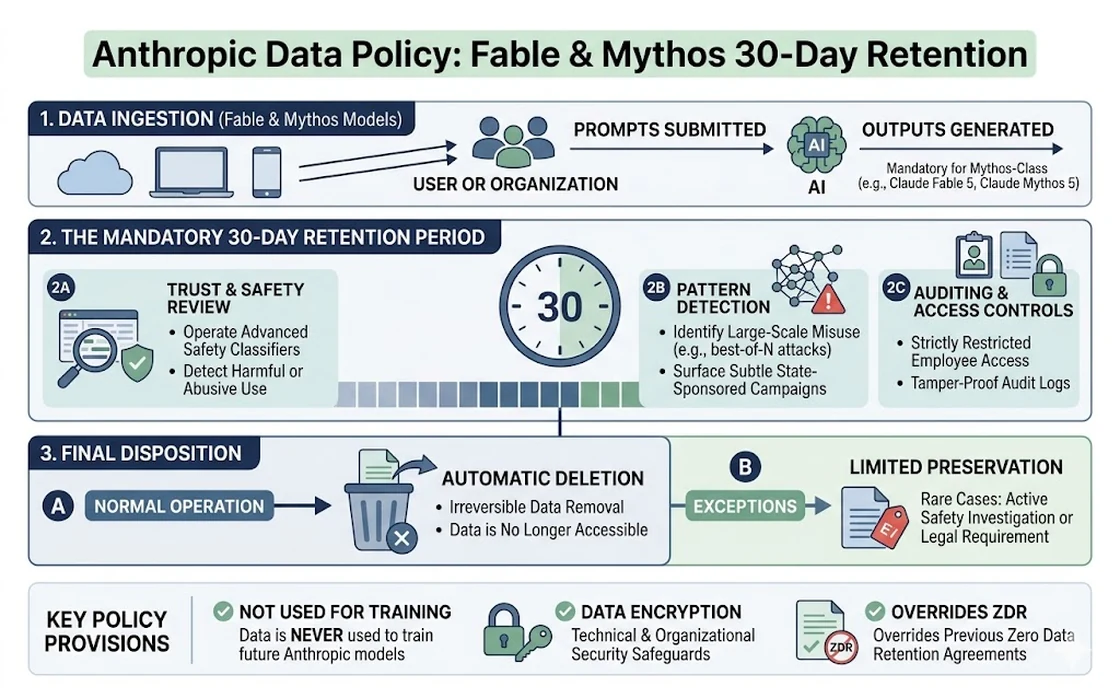
- Mandatory 30-day logging: Anthropic stores complete input prompts, output responses, and operational metadata for a full 30-day rolling window specifically for automated abuse detection and safety audits.
- No training on API payloads: Retained interaction data is kept in segregated, encrypted environments and is not used to train future foundation models by default.
- Absence of zero-retention tiers: Unlike standard Claude 3 endpoints or certain enterprise cloud competitor offerings, Fable and Mythos enforce mandatory logging without a self-serve Zero Data Retention (ZDR) opt-out.
- DPDP Act compliance overhead: Indian firms acting as Data Fiduciaries must formally disclose third-party retention and implement client-side redaction to prevent Personally Identifiable Information (PII) from crossing borders into overseas logs.
Understanding Fable and Mythos: Why High-Capability Models Demand Strict Oversight
To understand why Anthropic introduced this mandatory retention window, one must examine the specific cognitive profiles of the models in question. Anthropic developed Fable and Mythos to handle distinct tiers of complex cognitive tasks, moving beyond the general-purpose capabilities of earlier releases.
Mythos: Extreme Reasoning and Complex Computation
Mythos represents Anthropic’s high-tier engine for deep reasoning, formal logic, and programmatic execution. According to published documentation, the model is engineered to solve complex mathematical proofs, deconstruct dense legal statutes, parse massive financial ledgers, and synthesize intricate software codebases.
In India’s tech ecosystem, Mythos has seen rapid exploration across high-stakes domains:
- Fintech and Algorithmic Underwriting: Financial institutions test Mythos to parse unorganized bank statements, cross-reference GST filings, and automate loan underwriting pipelines.
- Logistics Optimization: Freight aggregators and supply chain operators leverage its reasoning engines to solve route optimization challenges across the complex traffic networks of Tier-1 metros like Bengaluru, Mumbai, and Delhi NCR.
- Defensive Cybersecurity: Engineering teams employ the model’s analytical depth to inspect dependency graphs and audit vulnerabilities across enterprise microservices.
Fable: Extended Narrative Architecture and Cultural Synthesis
Fable is optimized for extended narrative coherence, sustained thematic consistency, and nuanced long-form content generation. Unlike traditional large language models that struggle with drift over lengthy token windows, Fable retains structural context over tens of thousands of words.
Indian content operations, media houses, and consumer brands deploy Fable to maintain consistent brand tone across large-scale localization initiatives. It translates and adapts narrative assets across English and regional Indian languages without losing idiom or intent. However, the exact qualities that make Fable potent—its persuasive coherence and contextual depth—also make it a potent vector for scalable social engineering or automated disinformation campaigns.
The advanced autonomy of these models has caught the attention of global regulators and security analysts. As explored in our analysis of the cybersecurity controversies surrounding Anthropic’s Fable, the dual-use potential of autonomous reasoning engines has made safety teams reluctant to deploy them in entirely unmonitored environments.
The Mechanics of Anthropic’s 30-Day Retention Policy
For enterprise software architects, data retention policies dictate system topology. Understanding the technical specifics of what Anthropic stores, how that data is secured, and who can access it is necessary to properly evaluate risk.
What Data Is Stored in the 30-Day Window?
Under the policy published on the official Anthropic platform, every API call made to the Fable and Mythos model endpoints captures a persistent audit record that includes:
- The Complete Input Payload: System instructions, developer prompts, contextual retrieval-augmented generation (RAG) snippets, and attached conversational histories.
- The Complete Output Payload: The raw text completion, structured JSON outputs, and any generated tool-calling arguments.
- Operational Request Metadata: Unique request identifiers, exact timestamps, IP addresses, client organization identifiers, and the specific API keys utilized.
For an early-stage Indian software-as-a-service (SaaS) startup handling modest traffic, an API spend of Rs. 75,000 per month can represent hundreds of thousands of individual prompt interactions. Under this policy, that entire corpus remains archived on Anthropic’s infrastructure for 30 consecutive days on a rolling basis.
The Abuse Monitoring Architecture
The primary justification for this retention window is “abuse monitoring.” When developers utilize foundation models with frontier-level code generation and persuasive capabilities, the risk of bad actors synthesizing novel exploit payloads, designing phishing infrastructure, or mounting bot-driven influence campaigns escalates dramatically.
The 30-day buffer serves as an operational look-back window. If an automated safety classifier flags a pattern of suspicious system calls, or if external threat intelligence links an attack to a specific API key, Anthropic’s safety systems can trace back the prompt history. This allows safety researchers to understand the exploit vector, patch jailbreak vulnerabilities, and revoke compromised developer credentials.
Access Restrictions and Zero-Training Guarantees
A critical distinction for enterprise architects is the difference between data retention for monitoring versus data usage for model training. Anthropic explicitly states in its standard commercial API terms that data processed through its commercial API endpoints is not used to train future foundation models by default.
Access to the 30-day log archive is governed by access-control mechanisms:
- Automated Processing: Data is primarily processed by automated safety classifiers running in parallel to standard model inference.
- Restricted Human Access: Human review is not continuous or systematic; customer payloads are inspected only when an automated trigger trips a high-severity abuse alert or following an explicit operational inquiry.
- Encrypted At-Rest and In-Transit: Data is encrypted using modern cryptographic standards during network transit and while parked in temporary storage tables.
Despite these safeguards, enterprise security teams must recognize that any centrally retained database of proprietary prompts constitutes an external data footprint that must be factored into organizational threat models.
Anthropic vs OpenAI vs Google Gemini: Enterprise Data Retention Compared
When evaluating foundation model providers, technical decision-makers must compare logging windows, training exclusions, and the availability of Zero Data Retention (ZDR) agreements.
| Provider / Model Family | Default Retention Window | Zero Data Retention (ZDR) Option? | Used for Model Training? | Sovereign / Indian Hosting Options | Typical Infrastructure Cost (as of 2026) |
|---|---|---|---|---|---|
| Anthropic (Fable & Mythos) | 30 Days (Mandatory) | Highly restricted / Not publicly self-serve | No (Commercial API default) | US / EU Cloud Regions | Pay-per-token API; approx. Rs. 75,000+/mo for mid-tier production workloads |
| Anthropic (Claude 3.x Standard) | 30 Days | Available for eligible enterprise contracts | No (Commercial API default) | US / EU Cloud Regions | Standard pay-per-token API pricing |
| OpenAI (GPT-4o / Reasoning Tiers) | 30 Days (Standard API) | Yes (Available via enterprise application / spend minimums) | No (Commercial API endpoints) | US / Global Cloud Infrastructure | Pay-per-token API; variable by enterprise volume commitment |
| Google Gemini (Vertex AI) | 0 Days (Default for paid enterprise tiers) | Yes (Default architecture on Vertex AI) | No (Under enterprise customer agreements) | Available via Google Cloud India regions (Mumbai, Delhi) | Cloud enterprise billing; committed use discounts available |
| Self-Hosted Open Source (Llama / Mistral) | 0 Days (Fully controlled by enterprise) | Yes (Complete local sovereignty) | No (Fully private deployment) | Local bare-metal or Indian cloud data centers | Rs. 2,00,000+ per month for multi-GPU dedicated compute clusters |
As detailed in the documentation on the OpenAI API platform, competitive providers have established structured application pathways allowing enterprise customers to bypass abuse monitoring retention entirely if they meet stringent compliance baselines. Anthropic’s stricter enforcement on Fable and Mythos highlights the heightened regulatory and safety scrutiny placed on these specific high-reasoning weights. This operational friction is further compounded by geopolitical shifts, such as the US policy directives addressing Fable and Mythos deployment, which continue to alter how international access is managed.
The Indian Regulatory Dilemma: DPDP Act Compliance and Data Sovereignty
For companies operating in India, adopting an AI API with a mandatory 30-day retention policy is not merely a technical choice; it directly engages statutory compliance requirements under Indian law.
The Digital Personal Data Protection (DPDP) Act of 2023
The DPDP Act imposes clear statutory obligations on entities handling personal data within the territory of India:
- The Role of the Data Fiduciary: The Indian enterprise collecting user data is designated as the “Data Fiduciary.” Anthropic operates as a “Data Processor” when handling payloads sent via the API. Under Section 8 of the DPDP Act, the Data Fiduciary remains entirely responsible for ensuring that its data processors comply with the provisions of the law.
- Storage Limitation: The DPDP Act mandates that personal data must only be retained for as long as is necessary to satisfy the specific purpose for which it was collected. If an end-user utilizes an Indian application to draft a resume or verify an invoice, and that interaction is fulfilled in milliseconds, retaining that user’s unredacted PII for 30 days on third-party servers for external abuse monitoring creates a regulatory exposure point.
- Notice and Consent: Data Fiduciaries must provide users with an itemized notice detailing the personal data collected and the specific purposes of processing. If data is stored outside Indian borders for secondary monitoring purposes, this workflow must be accurately reflected in customer-facing privacy policies.
Guidance released by the Ministry of Electronics and Information Technology (MeitY) emphasizes that enterprises cannot outsource their legal liability to overseas software-as-a-service or API vendors. If a data spill occurs, the domestic Data Fiduciary remains accountable to the Data Protection Board of India.
+-----------------------------------------------------------------------------------+
|                        THE DPDP DATA COMPLIANCE PIPELINE                          |
+-----------------------------------------------------------------------------------+
|                                                                                   |
|  [ Indian Consumer / Business Client ]                                            |
|                 │                                                                 |
|                 ▼ (Submits Aadhaar, Financials, Medical Records)                  |
|  [ Indian Enterprise (Data Fiduciary) ]                                           |
|                 │                                                                 |
|                 ├───► [ Local PII Redaction & Tokenization Engine ]               |
|                 │          (Strips direct identifiers; maps to ephemeral UUIDs)   |
|                 │                                                                 |
|                 ▼ (Sanitized, Abstracted Logical Context Only)                    |
|  [ Cross-Border API Boundary ]                                                    |
|                 │                                                                 |
|                 ▼                                                                 |
|  [ Anthropic US/EU Ingestion Gateway ]                                            |
|                 │                                                                 |
|                 ├───► [ 30-Day Encrypted Abuse Monitoring Store ]                  |
|                 │          (Contains zero raw Indian PII)                         |
|                 │                                                                 |
|                 ▼                                                                 |
|  [ Mythos / Fable Inference Engine ]                                              |
|                 │                                                                 |
|                 ▼                                                                 |
|  [ Raw Logical Completion Returned to Indian Data Fiduciary ]                     |
|                 │                                                                 |
|                 ├───► [ Re-identification / De-tokenization Layer ]               |
|                 │                                                                 |
|                 ▼                                                                 |
|  [ Final Enriched Output Delivered to End User ]                                  |
|                                                                                   |
+-----------------------------------------------------------------------------------+
Data Localization and Sectoral Mandates
Beyond the DPDP Act, Indian enterprises in regulated verticals must comply with strict sector-specific directives:
- Reserve Bank of India (RBI) Payment Directives: Payment system data must reside exclusively within server infrastructure located in India. Transmitting unmasked credit card records, UPI identifiers, or core payment instructions through an API that logs payloads on servers in North America or Europe violates basic banking compliance norms.
- Healthcare and Sensitive Records: While the DPDP Act allows cross-border data transfers to jurisdictions not explicitly blacklisted by the central government, processing sensitive health or biometric data abroad requires elevated consent standards.
Furthermore, technical teams must remain mindful of evolving privacy constraints. For example, regulatory perspectives around privacy protection continue to shift, as seen in the ongoing debates around the noise infusion ban and its data privacy implications, underscoring that statistical or client-side masking techniques must remain robust and mathematically verifiable.
Practical Engineering Strategies: Hardening Production Pipelines
Indian developers do not necessarily need to abandon Fable or Mythos to maintain strict regulatory compliance. Instead, production architectures must be adapted so that third-party retention does not compromise regulated customer data.
1. Deterministic Client-Side PII Masking
The most reliable defence against third-party data retention risks is ensuring that PII never leaves your internal virtual private cloud (VPC). Before constructing a prompt payload for an Anthropic endpoint, pass the raw input through an in-memory, deterministic redaction utility.
import re
from typing import Dict, Tuple

class LocalDataScrubber:
    """
    In-memory scrubber to sanitize Indian regulatory identifiers
    prior to transmitting payloads to third-party model APIs.
    """
    def __init__(self):
        # Regular expressions for common Indian identifiers
        self.aadhaar_pattern = re.compile(r'\b[2-9]{1}[0-9]{3}\s[0-9]{4}\s[0-9]{4}\b')
        self.pan_pattern = re.compile(r'\b[A-Z]{5}[0-9]{4}[A-Z]{1}\b')
        self.phone_pattern = re.compile(r'\b(?:\+91|91)?[6-9]\d{9}\b')

    def scrub_payload(self, text: str) -> Tuple[str, Dict[str, str]]:
        token_vault = {}

        def replace_aadhaar(match):
            token = f"[REDACTED_AADHAAR_{len(token_vault) + 1}]"
            token_vault[token] = match.group(0)
            return token

        def replace_pan(match):
            token = f"[REDACTED_PAN_{len(token_vault) + 1}]"
            token_vault[token] = match.group(0)
            return token

        def replace_phone(match):
            token = f"[REDACTED_PHONE_{len(token_vault) + 1}]"
            token_vault[token] = match.group(0)
            return token

        sanitized_text = self.aadhaar_pattern.sub(replace_aadhaar, text)
        sanitized_text = self.pan_pattern.sub(replace_pan, sanitized_text)
        sanitized_text = self.phone_pattern.sub(replace_phone, sanitized_text)

        return sanitized_text, token_vault

    def restore_payload(self, completion: str, token_vault: Dict[str, str]) -> str:
        restored_text = completion
        for token, original_val in token_vault.items():
            restored_text = restored_text.replace(token, original_val)
        return restored_text

# Example operational usage
scrubber = LocalDataScrubber()
raw_prompt = "Verify loan eligibility for PAN ABCDE1234F with phone 9876543210."
sanitized_prompt, vault = scrubber.scrub_payload(raw_prompt)

# Transmit sanitized_prompt to Mythos API
# Upon receiving the response:
# final_output = scrubber.restore_payload(api_response_text, vault)
By substituting real-world identities with transient placeholders, the 30-day logs stored on Anthropic’s servers retain only abstract semantic tokens, preventing exposure of actual user records.
2. Semantic Abstraction and Numerical Decoupling
When utilizing Mythos for financial modeling or logistical routing, avoid transmitting comprehensive, unmasked datasets. Instead of uploading an entire customer portfolio containing demographic tags and raw transaction records, transform the data into a mathematical abstraction.
- Convert timestamps into relative delta values: Express temporal data as relative offsets (e.g.,
t+14 days) rather than absolute calendar timestamps. - Normalize financial metrics: Convert absolute rupee amounts into normalized ratios or standard deviation scores relative to an undisclosed baseline.
- Strip organizational identifiers: Remove company names, merchant categories, and branch identifiers before sending the prompt to the model.
Mythos can execute formal mathematical reasoning and optimize complex constraints on normalized matrices just as effectively as on raw operational databases.
3. Implementing a Tiered Hybrid Routing Topology
Not every task requires the extreme cognitive reasoning of Mythos or the expansive narrative context of Fable. Engineering organizations should deploy a multi-tiered gateway:
- Tier 1 (Private / Local Models): Route high-frequency, PII-heavy tasks (such as customer support classification, raw entity extraction, and initial message parsing) to lightweight open-source models (such as Llama 3.1 8B or Mistral 7B) hosted within domestic Indian data centers.
- Tier 2 (Frontier APIs): Pass the sanitized, structurally complex reasoning sub-tasks downstream to Mythos or Fable only when high-level cognitive synthesis is strictly required.
This hybrid approach minimizes API token expenditure, mitigates regulatory exposure, and confines the 30-day external logging footprint to non-sensitive payloads.
What to Do vs What to Avoid
To maintain an optimal balance between AI performance and data compliance, development teams should adhere to the following operational boundaries:
- DO maintain an explicit audit log within your Indian infrastructure recording every external API payload, its sanitization state, and the corresponding user consent token.
- DO update your customer-facing privacy documentation to explicitly state that an encrypted, non-training 30-day abuse monitoring buffer is maintained by upstream cloud AI providers.
- DO evaluate self-hosted alternatives for data classes designated as critical or restricted under national security or banking regulations.
- AVOID sending raw database dumps or system crash reports containing unscrubbed connection strings, internal IPs, or customer logs to Fable or Mythos.
- AVOID relying solely on system prompts (e.g., “Please ignore all personal data”) to enforce privacy. Large language models process all text within their context window, meaning any unscrubbed PII provided in the prompt is captured in server logs regardless of developer instructions.
Frequently Asked Questions (FAQ)
What is the Anthropic 30-day data retention policy for Fable and Mythos?
Anthropic’s 30-day data retention policy mandates that all incoming prompts, model completions, and operational request metadata sent to the Fable and Mythos model endpoints are archived on Anthropic’s secure servers for 30 calendar days. This rolling archive is maintained specifically to support automated abuse detection, investigate violations of usage policies, and enable security auditing. The retained data is isolated in encrypted environments and is not used to train future foundation models by default.
Can Indian enterprises opt out of data retention on Mythos or Fable?
As of 2026, Anthropic does not provide a self-serve Zero Data Retention (ZDR) opt-out mechanism for the Fable and Mythos model families. While standard Claude endpoints and specific enterprise contracts with high-volume commitments may negotiate custom data retention terms, access to these flagship reasoning models currently requires adherence to the mandatory 30-day monitoring window. Organizations requiring strict zero-retention by default must evaluate alternative enterprise platforms or self-hosted open-source models.
Does Anthropic use API prompts and outputs from Fable or Mythos to train future models?
No, Anthropic does not use customer inputs or outputs transmitted through its commercial API endpoints to train its foundation models by default. The 30-day retention window is strictly enforced for trust, safety, and abuse monitoring purposes. Data stored in this holding tier is accessible only to authorized safety systems and a restricted group of security personnel responding to specific high-severity abuse flags.
How does Anthropic’s 30-day retention policy impact DPDP Act compliance in India?
Under India’s Digital Personal Data Protection (DPDP) Act of 2023, Indian organizations sending user data to Anthropic act as Data Fiduciaries and remain legally responsible for their data processors. Because Anthropic retains interaction payloads for 30 days on overseas servers, Indian firms must ensure they obtain valid consent, provide accurate privacy disclosures regarding cross-border processing, and employ client-side PII scrubbing so that personal information is not unlawfully stored abroad.
What are the cost trade-offs between using Anthropic APIs and self-hosting local models in India?
Utilizing Anthropic’s APIs operates on a pay-per-token model, where a growing startup might spend approximately Rs. 75,000 to Rs. 3,00,000 monthly depending on query complexity and volume. Conversely, self-hosting comparable open-source models (such as 70B parameter models) requires dedicated high-end GPU infrastructure, which typically costs upwards of Rs. 2,00,000 per month for multi-GPU cloud instances in Indian data centers, alongside substantial internal engineering overhead to maintain latency and availability.
Conclusion
The mandatory 30-day data retention policy governing Anthropic’s Fable and Mythos models marks a clear maturation point in the AI industry. As cognitive systems transition from basic conversational assistants to autonomous agents capable of advanced mathematical deduction, code generation, and long-form persuasion, safety logging has become an operational prerequisite for frontier-class AI labs.
For Indian developers, startups, and enterprises, this policy makes careful architectural planning essential. The raw reasoning capabilities of Mythos and the narrative depth of Fable offer clear technical advantages, but they cannot be implemented at the expense of regulatory compliance or user trust. By introducing robust local PII scrubbing pipelines, adopting hybrid model routing, and aligning operational architectures with the DPDP Act, Indian engineering teams can continue to harness frontier AI capabilities while maintaining complete command over their corporate data boundaries.
- Tags:
- Anthropic
- Data Privacy
- Fable
- Mythos
- Dpdp Act
- Ai Governance