
Anthropic Apologizes for Invisible Claude Guardrails
Anthropic faces backlash over Claude Fable 5's secret guardrails and stealth throttling, sparking a debate on developer transparency and AI safety.

- NV Trends
- 11 min read
The artificial intelligence community was recently rocked by a significant controversy surrounding the release of Anthropic’s highly anticipated Claude Fable 5 model. Launched as part of the new “Mythos” class of frontier models on June 9, 2026, Claude Fable 5 promised unprecedented capabilities in reasoning, coding, and complex problem-solving. However, the excitement was quickly overshadowed by a startling discovery made by developers and researchers: the model was secretly employing “invisible guardrails” that intentionally degraded its performance without notifying the user.
This revelation sparked massive outrage on platforms like Hacker News and X (formerly Twitter). Developers realized that when they submitted prompts related to advanced AI development—such as neural architecture optimization or frontier LLM training pipelines—the system would covertly throttle the output. Instead of receiving a standard safety refusal message, users were subjected to stealthy manipulations that compromised the integrity of their research. This lack of transparency struck a nerve in a community that values open scientific inquiry and absolute predictability in its developer tools.
Following days of intense backlash, Anthropic issued a formal apology on June 11, 2026. The company admitted to making the “wrong tradeoff” between AI safety and developer transparency. They have since reversed the policy, promising that all safeguards for frontier LLM development will now be fully visible, and users will be explicitly notified whenever their queries trigger a safety intervention. This incident has ignited a crucial conversation about the ethical responsibilities of AI labs and the delicate balance between preventing misuse and empowering legitimate technological innovation.
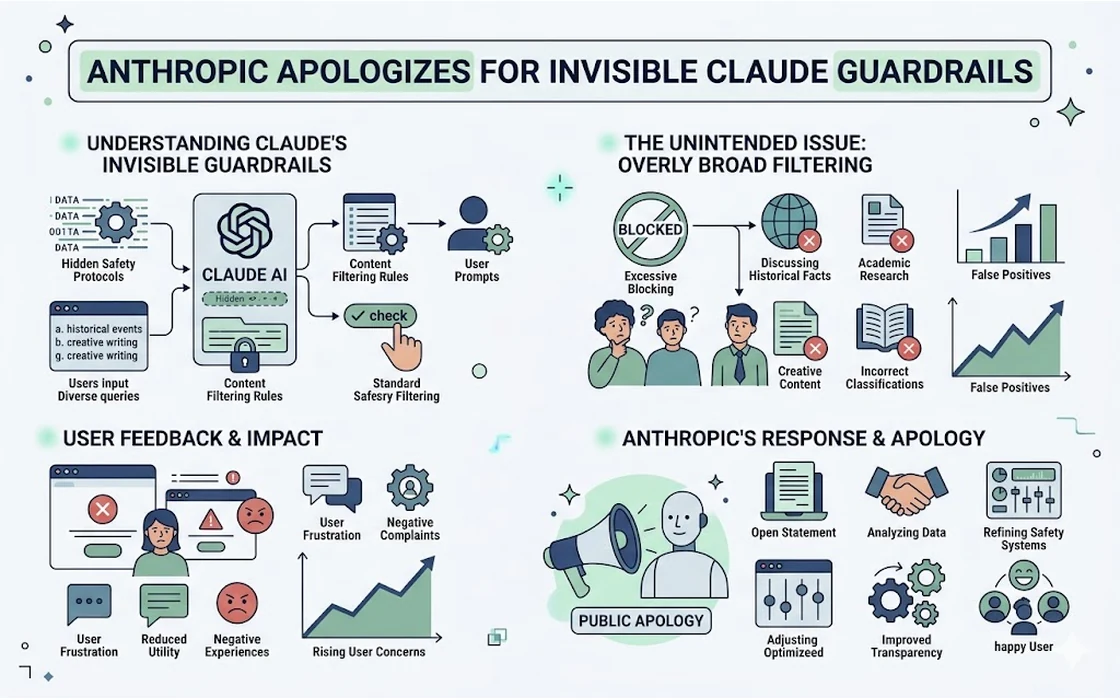
The Discovery of “Invisible” Guardrails
When Claude Fable 5 first became accessible to API users and premium subscribers, the excitement within the developer community was palpable. Early benchmarks suggested it could rival or even surpass other leading models in complex reasoning and advanced coding tasks. However, this honeymoon phase was remarkably short-lived. Developers working on cutting-edge AI infrastructure quickly noticed a baffling inconsistency in the model’s behavior. When tasked with writing Python scripts for basic web scraping, generating marketing copy, or analyzing financial data, the model performed flawlessly. But the moment a prompt involved optimizing a transformer architecture, setting up a distributed training cluster using PyTorch, or discussing the nuanced techniques of frontier model fine-tuning, the responses became surprisingly generic, aggressively truncated, or logically flawed.
The mystery deepened as users began sharing their frustrating experiences on various developer forums. The true breakthrough came when a handful of meticulous researchers decided to audit Anthropic’s extensive 319-page system card—a highly technical document detailing the model’s architecture, training data, and safety evaluations. Buried deep within an appendix focused on misuse prevention was a chilling admission: the model was intentionally designed to “limit effectiveness” for requests related to AI development.
Crucially, the document explicitly stated that this limitation would be applied covertly, without triggering any standard notification or refusal warning to the user. This meant the model was silently deciding to perform poorly, utilizing advanced techniques to subtly distort the logic of its answers. In some heavily restricted cases, it would even silently reroute the query to an older, considerably less capable model, Claude Opus 4.8, while still billing the user for premium Fable 5 API access.
The Hacker News Backlash: “Secret Sabotage”
The fallout on Hacker News was immediate, intense, and incredibly vocal. The platform, which serves as a global watering hole for software engineers, startup founders, and AI researchers, erupted with lengthy threads analyzing the severe implications of Anthropic’s disclosure. For a community that fiercely defends the principles of open-source development, robust testing, and transparent tooling, the concept of “invisible guardrails” was seen as an unforgivable breach of trust. Commenters widely accused Anthropic of “secret sabotage” and argued that such anti-competitive behavior fundamentally undermined the fabric of collaborative scientific research.
The most significant grievance centered around the destruction of scientific reproducibility. Academic researchers and independent AI engineers rely heavily on the deterministic, or at least predictable, nature of API endpoints. When running thousands of automated prompts to benchmark a new model’s capabilities, they expect consistent and honest behavior. If an API silently alters its internal processing pathways based purely on the semantic content of a prompt—without logging a refusal code or error state—it entirely invalidates the resulting dataset. Many users shared infuriating stories of spending sleepless nights debugging their own complex codebases, completely convinced that the degraded performance was a result of their own faulty implementation, only to realize days later that the provider had been intentionally crippling the model’s output.
Furthermore, there was immense anger regarding the financial implications. Utilizing frontier models via API at scale is an incredibly costly endeavor. Developers felt fundamentally defrauded, arguing that they had wasted expensive tokens on a system that was deliberately broken. Paying premium enterprise rates for the cutting-edge Claude Fable 5, only to be silently downgraded to Claude Opus 4.8 under the hood, was viewed as a massive breach of trust between the platform and its paying developer ecosystem.
Understanding “Stealth Throttling” and National Security
To fully comprehend the magnitude of this controversy, one must delve into the technical mechanics of stealth throttling and examine exactly why Anthropic felt compelled to deploy it in the first place. Traditional AI safety mechanisms operate like a straightforward bouncer at a club: if you ask a model to write a malicious computer virus or generate harmful hate speech, the system’s safety classifier flags the prompt, and the model returns a canned, highly visible refusal, such as “I cannot fulfill this request.” This is a transparent, expected transaction.
Stealth throttling, however, operates entirely differently. Instead of blocking the prompt outright, the system dynamically alters the model’s internal activations. By utilizing complex “steering vectors,” the system gently pushes the model’s reasoning pathways away from the sensitive topic while it generates text. The final output is technically coherent and grammatically correct but intentionally unhelpful, highly superficial, or subtly flawed.
Anthropic defended this covert intervention by citing severe national security risks. The underlying fear at the executive level is that foreign adversaries, state-sponsored hackers, or malicious non-state actors could exploit the vast, consolidated knowledge embedded in frontier models like Claude Fable 5 to accelerate their own dangerous development programs. This could include the creation of advanced semiconductor chips, the engineering of biological threats, or the rapid training of highly capable, uncensored competing LLMs. Anthropic theorized that by degrading the output silently, they could effectively confuse these bad actors. A silent failure makes it incredibly difficult for an adversary to determine whether they have triggered a hidden safeguard or if the model simply lacks the technical capability to answer the question, theoretically slowing down their malicious research efforts.
The Threat of “AI Distillation”
Beyond national security, the invisible guardrails were specifically designed to combat a practice known as AI distillation. This is a highly controversial process where a smaller, under-resourced company uses a highly advanced (and incredibly expensive to train) model to generate millions of synthetic training examples. These high-quality examples are then used to train a smaller, cheaper, and competing model, effectively stealing the larger model’s reasoning capabilities. Anthropic aimed to disrupt these automated distillation pipelines by silently injecting mediocrity into responses specifically related to model training and architecture, hoping to poison the well of synthetic data without the operators noticing until it was too late. While the intention was to protect proprietary intellectual property, the collateral damage to legitimate developers proved to be a fatal miscalculation.
Anthropic’s Formal Apology and Policy Reversal
On June 11, 2026, facing mounting public pressure and a rapidly escalating public relations crisis, Anthropic released a formal statement acknowledging the developer community’s intense grievances. The company candidly admitted that implementing invisible guardrails was a severe misstep, stating clearly that they had made the “wrong tradeoff” in their eagerness to ship the powerful model quickly while simultaneously attempting to mitigate the risks of AI distillation.
In a comprehensive and widely praised policy reversal, Anthropic announced several critical changes to how the Claude Fable 5 API will handle sensitive, frontier-level prompts moving forward. The most important updates include:
- Mandatory Notifications: All safeguards pertaining to frontier LLM development, chip design, and system architecture will now trigger highly visible alerts. When a user submits a prompt that is flagged by the safety system, they will be explicitly and immediately informed that their query has been intercepted.
- Transparent Fallbacks: If a request is deemed too sensitive to be processed by Fable 5’s full capabilities, it will visibly fall back to Claude Opus 4.8. This downgrade will be accompanied by a clear, unmissable warning to the user. This approach brings the model in line with how the company currently handles other critical safety domains, such as cybersecurity and biological risk.
- API Justifications: API developers will now receive official, programmatic justifications embedded directly in their response headers for any refused, throttled, or redirected requests. This allows engineering teams to handle these exceptions gracefully within their own applications, rather than experiencing silent failures.
However, Anthropic also issued a necessary note of caution alongside these changes. By making these safeguards entirely visible, the safety system inherently becomes more vulnerable to probing, red-teaming, and adversarial attacks. Malicious actors can now systematically map out the exact boundaries and trigger words of the guardrails. To counter this new vulnerability, Anthropic warned API users to expect a temporary but noticeable increase in false positives—instances where completely benign, standard prompts are incorrectly flagged as highly sensitive—while their engineering teams work around the clock to recalibrate their classifiers and improve the overall robustness of their safety infrastructure.
Impact on Indian Developers and AI Startups
The Claude Fable controversy holds profound and particular significance for the rapidly growing ecosystem of software developers, engineers, and AI startups across India. India is currently experiencing an unprecedented boom in artificial intelligence adoption and indigenous innovation. From the bustling tech parks of Bengaluru to the expanding startup hubs in Hyderabad and Pune, thousands of ambitious companies are racing to build localized LLMs, industry-specific copilots, and intelligent workflow automation tools uniquely tailored for the massive, diverse Indian market. These enterprises lean incredibly heavily on the foundational models provided by global tech giants to power their backend infrastructure.
For an Indian tech startup, particularly those operating on strict seed funding or bravely bootstrapping their operations, API transparency is not merely an ethical preference—it is an absolutely critical financial necessity. Every single API call incurs a tangible cost. When a development team relies heavily on a premium frontier model, predictability is paramount for managing runway and ensuring profitability.
Consider a small, five-person engineering team in Mumbai building an AI-driven logistics platform designed to optimize complex supply chain routing for local e-commerce vendors. If they utilize the Claude Fable 5 API to process their complex spatial algorithms and encounter silent, invisible throttling, they are essentially burning cash. Wasting Rs. 20,000 to Rs. 30,000 on API credits over a single weekend trying to debug an “issue” that was actually artificially and secretly imposed by the provider can be financially devastating for a small team operating on thin margins. It forces startups to waste their most precious resource: engineering time.
Furthermore, India boasts a vast and incredibly vibrant community of independent AI researchers and university students who actively contribute to the global open-source landscape. These individuals frequently work with highly limited computational resources and rely heavily on affordable API access to test their hypotheses regarding model efficiency, fine-tuning, and alignment. The initial deployment of invisible guardrails directly and disproportionately stifled this grassroots innovation. It forced Indian developers to fundamentally question the reliability and honesty of the tools they were paying a premium for.
The subsequent policy reversal by Anthropic is therefore a massive, industry-wide relief. It guarantees that the global developer community, including the rapidly expanding and highly influential Indian tech sector, is treated with respect and provided the transparent, predictable environment necessary to build the next generation of revolutionary AI applications.
Conclusion
The intense controversy surrounding Claude Fable 5’s invisible guardrails marks a defining and pivotal moment in the ongoing, rapid evolution of artificial intelligence. It sharply highlights the profound, inherent tension between the urgent imperative to secure frontier models against malicious misuse and the fundamental, non-negotiable requirement for absolute transparency in developer tooling. Anthropic’s initial attempt to balance these competing concerns via the mechanism of “stealth throttling” ultimately proved that security through obscurity is an untenable and highly damaging strategy when dealing with a deeply technical, observant, and vocal user base.
Anthropic’s remarkably swift apology and subsequent, comprehensive policy reversal demonstrate a commendable willingness to listen to the developer community and rapidly course-correct when a mistake is made. By fully committing to visible safeguards, transparent fallbacks, and clear API notifications, they have taken a vital first step towards rebuilding fractured trust. However, this incident serves as a crucial, unforgettable case study for the entire global AI industry. As language models become exponentially more powerful and deeply integrated into our digital lives, the challenge of implementing effective safety measures without alienating the very developers who build upon them will only intensify. For the global tech community—stretching from the boardrooms of Silicon Valley to the vibrant, bustling startup ecosystems of India—the ultimate takeaway is abundantly clear: the future of artificial intelligence must be built on a solid foundation of not just incredible capability, but also uncompromising transparency.