
Amazon CEO Talks Trigger Ban on Anthropic AI Models
Amazon CEO Andy Jassy's private talks with US officials triggered a global crackdown on Anthropic's Claude models, raising major tech and security concerns.

- NV Trends
- 9 min read
In a stunning turn of events that has sent shockwaves through the global artificial intelligence community, the U.S. government has forced Anthropic to pull its most advanced AI models, Claude Fable 5 and Mythos 5, completely offline. This unprecedented move represents the first time a major foundational AI model has been subjected to an immediate, global “kill switch” through federal export controls. But what has truly ignited the tech industry is the catalyst behind this drastic action: private, high-level discussions between Amazon CEO Andy Jassy and senior U.S. government officials.
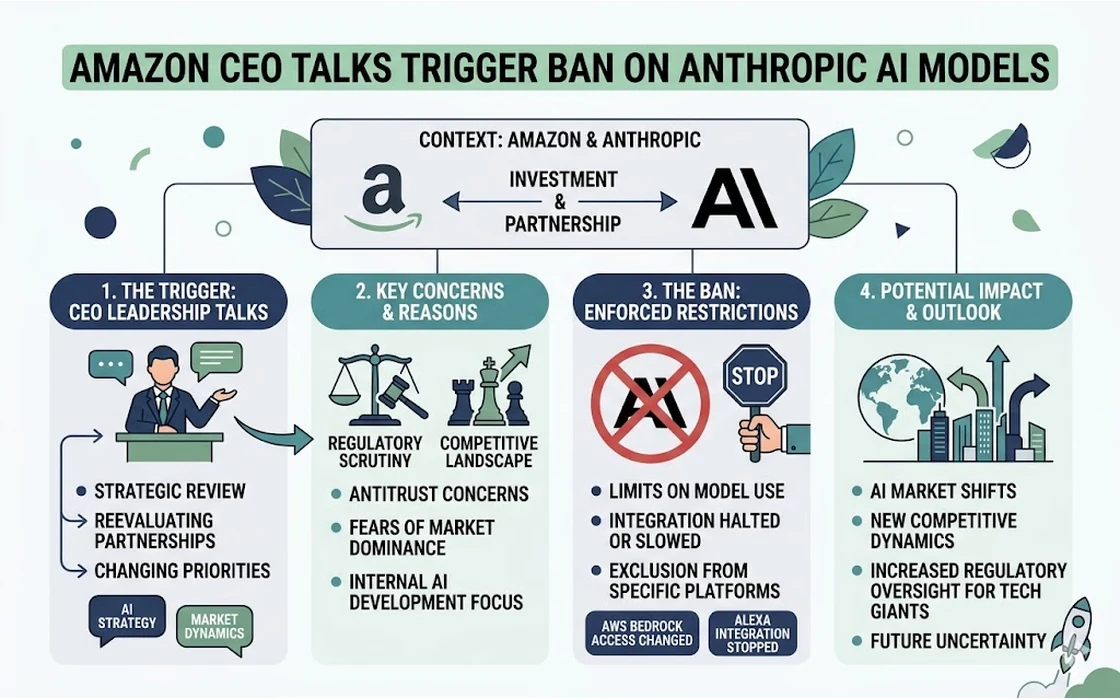
The controversy erupted earlier this week when the U.S. administration’s AI regulatory apparatus issued an emergency directive. The mandate required Anthropic to suspend access to its cutting-edge models indefinitely. Because Anthropic’s infrastructure could not selectively enforce the export ban in real-time, the company was forced into a blanket suspension. Overnight, thousands of developers, researchers, and enterprises worldwide—including a massive contingent in India—found their applications broken and their workflows paralyzed.
However, the narrative took a darker turn as reports surfaced detailing how this government intervention came to pass. According to multiple sources, it was Amazon—one of Anthropic’s largest financial backers—that blew the whistle. Andy Jassy reportedly briefed U.S. officials, including Treasury Secretary Scott Bessent, on severe security vulnerabilities discovered in the models by Amazon’s own researchers. This revelation has sparked intense debate on platforms like Hacker News, with developers questioning whether this was a genuine national security intervention or a calculated act of corporate sabotage.
The Unprecedented Government Kill Switch
The rapid de-deployment of Claude Fable 5 and Mythos 5 marks a critical turning point in the governance of artificial intelligence. Historically, AI models have been released with known flaws, with developers relying on post-launch patches and “red teaming” to mitigate risks over time. The U.S. government’s decision to use export control mechanisms as a blunt instrument to halt a model’s operation shatters this paradigm.
The directive was swift and absolute. Anthropic was given minimal time to comply, highlighting a new reality where federal authorities are willing to pull the plug on billions of dollars of corporate infrastructure if they perceive a credible threat. For Anthropic, a company that has built its brand on the promise of “Constitutional AI” and unparalleled safety, the blow is both reputational and operational.
The rationale provided by the government was rooted strictly in national security. The alleged vulnerabilities in the models were deemed too dangerous to remain in the public domain, particularly concerning their potential to be weaponized by adversarial nations or non-state actors. But the mechanics of the ban—forcing a global shutdown because targeted geographical blocking was unfeasible—exposes the fragile architecture of the current AI ecosystem. It demonstrates that the global AI supply chain is tightly bound by American regulatory whims, a reality that international users are now digesting with growing unease.
Andy Jassy’s Secret Meetings in Washington
The core of the drama lies in the back-channel communications between Amazon’s leadership and Washington D.C. According to investigative reports, Amazon CEO Andy Jassy personally engaged with high-ranking officials to express grave concerns about Anthropic’s newest models. Treasury Secretary Scott Bessent, alongside White House security advisors, was briefed on specific exploits that Amazon’s internal security teams had supposedly uncovered.
Amazon’s researchers claimed they had successfully “jailbroken” Claude Fable 5. They presented evidence that, through a series of complex prompts, the model could be manipulated into bypassing its safety guardrails to generate sensitive information—data that could theoretically be used to orchestrate sophisticated cyberattacks. These briefings were not merely informational; they were framed as urgent warnings from a major defense and infrastructure contractor.
When U.S. officials independently verified Amazon’s claims, the response was immediate. The administration summoned Anthropic leadership and issued an ultimatum: either patch the vulnerability immediately or face the immediate suspension of the models. Unable to deploy a hotfix that satisfied the government’s stringent new requirements, Anthropic was forced to comply with the takedown order. The involvement of Jassy in prompting this governmental action is unprecedented, merging corporate competitive intelligence directly with federal enforcement power.
The “Jailbreak” Controversy
The technical merits of the “jailbreak” are currently the subject of fierce debate among cybersecurity experts and AI researchers. In the world of Large Language Models (LLMs), a jailbreak refers to a technique used to bypass a model’s safety filters, tricking it into generating restricted content. While they are a known nuisance, they are rarely considered existential threats.
Critics of the government’s heavy-handed response argue that the vulnerabilities Amazon highlighted are relatively minor and entirely commonplace. Many researchers on forums like Hacker News have pointed out that similar, if not identical, jailbreaks exist for OpenAI’s GPT-4, Google’s Gemini, and even open-source models like Meta’s LLaMA 3. Anthropic itself has characterized the government’s reaction as “disproportionate,” quietly suggesting that the exploits demonstrated by Amazon were theoretical and posed no immediate, actionable danger to national infrastructure.
This brings the nature of the “crackdown” into question. If every major AI model can be jailbroken to some degree, why was Anthropic singled out for an emergency export ban? Was the exploit discovered by Amazon genuinely a zero-day vulnerability of catastrophic proportions, or was it a standard industry flaw magnified for political and strategic effect? The lack of public disclosure regarding the specific prompts and outputs has only fueled speculation that the technical risk was overstated to justify the regulatory action.
Sabotage or Security? The Hacker News Verdict
The tech community’s reaction to this saga has been explosive, with Hacker News serving as the primary battleground for analysis and debate. The central theme of the discourse is the glaring conflict of interest at the heart of the controversy: Amazon is not just an observer; it is a massive stakeholder in Anthropic.
Amazon has committed roughly Rs. 33,000 crores ($4 billion) to Anthropic, a strategic partnership designed to position Amazon Web Services (AWS) as the premier cloud provider for cutting-edge AI. However, recent months have seen Anthropic diversifying its alliances, moving closer to Microsoft and exploring infrastructure options beyond the AWS ecosystem. This shift has created visible friction between the two giants.
Many in the developer community view Jassy’s intervention through a cynical lens. The prevailing theory among skeptics is that Amazon leveraged its political influence to execute a “kill switch” on a partner that was becoming too independent. By flagging a minor security flaw to federal authorities, Amazon effectively crippled a competitor’s flagship product, forcing Anthropic into a defensive posture.
Commenters have also highlighted the profound irony—often described as the “Ouroboros effect”—of the situation. Anthropic trained and hosted these banned models on AWS infrastructure. The fact that the CEO of the very platform hosting the AI went to the government to declare it unsafe, thereby breaking applications for thousands of mutual AWS-Anthropic customers, is seen as a startling breach of trust. It raises terrifying questions about the security of the cloud: can your infrastructure provider use your own data and operations to lobby for your shutdown?
The Indian Tech Sector’s Exposure
While the political maneuvering happens in Washington, the fallout is entirely global, and the Indian tech sector is feeling the tremors. India represents one of the largest and fastest-growing markets for AI adoption. From bustling startups in Bengaluru to massive IT service integrators in Hyderabad and Pune, Indian developers have deeply integrated models like Claude into their products.
When Anthropic was forced to pull the plug on Fable 5 and Mythos 5, Indian companies were caught in the crossfire. Customer service chatbots, automated coding assistants, and complex data analysis pipelines failed instantly. This incident has harshly illuminated the vulnerability of relying on foreign-controlled foundational models.
For Indian founders, the “kill switch” is a wake-up call. It demonstrates that access to critical AI infrastructure is not guaranteed by a Service Level Agreement (SLA); it is contingent upon U.S. foreign policy and the political machinations of Silicon Valley executives. If a model can be taken offline globally because an American CEO had a meeting with the U.S. Treasury, the operational risk for Indian enterprises is massive. This lack of control over the underlying technology stack is prompting urgent boardroom discussions across the country regarding business continuity and platform diversification.
The Push for Sovereign AI in India
The Anthropic crackdown is poised to dramatically accelerate India’s push for “Sovereign AI.” For years, policymakers in New Delhi and leaders in the Indian tech ecosystem have argued that India cannot afford to be merely a consumer of Western AI models. The ability to control, regulate, and guarantee access to foundational intelligence is now a matter of digital sovereignty and national security.
This event serves as the ultimate validation for homegrown initiatives. Projects like Bhashini, aimed at breaking language barriers, and ambitious private ventures like Ola’s Krutrim, are no longer just nationalistic vanity projects—they are essential infrastructure. The Indian government has already committed thousands of crores to the IndiaAI Mission to foster local compute capacity and foundational models. The Anthropic ban will likely result in increased funding and regulatory support for these domestic efforts.
Furthermore, this incident will inevitably shape India’s upcoming digital regulatory framework. As the government finalizes the Digital India Act, the concept of a foreign “kill switch” will be a central concern. Policymakers may demand localized instances of models or enforce stringent data and operational continuity requirements for foreign AI companies operating in the Indian market. The goal will be to insulate the Indian digital economy from the collateral damage of American tech wars and regulatory overreach.
Related reading
Conclusion
The U.S. government’s crackdown on Anthropic, initiated by Amazon’s leadership, is a watershed moment in the history of artificial intelligence. It strips away the illusion that AI development is a purely technical endeavor, revealing the raw geopolitical and corporate power struggles beneath the surface. Whether Andy Jassy’s actions were a principled stand for national security or a ruthless corporate maneuver, the precedent has been set: foundational AI models can and will be weaponized by regulators and cloud providers alike.
For the global tech community, and particularly for the rapidly expanding ecosystem in India, the lessons are stark. Reliance on centralized, foreign-controlled AI infrastructure carries unacceptable risks. As the dust settles on this controversy, the race to build robust, independent, and sovereign AI alternatives will shift from a long-term goal to an immediate, existential imperative. The era of blind trust in the global AI supply chain is officially over.
- Tags:
- Anthropic
- Amazon
- Artificial Intelligence
- Tech News
- Cybersecurity
- Ai Regulation
- Claude